How to Choose a UV Printing Machine in UAE: Flatbed, Cylindrical, Wall & Conveyor Printers
Published · PRO TECHnology Digital Printing
The choice is decided by the product in front of you. A rigid panel, a perfume bottle, a finished wall and a 2.5 metre roll of wallcovering are four different printing problems, and each belongs to a different class of machine, not a larger version of the same one. This guide answers the question an equipment buyer needs settled first — what type of UV printer the business actually needs — then works through print area, production volume, materials, ink configuration, pre-treatment and the support that follows installation.
Key takeaways
- The shape of the object picks the machine first. Flat and rigid work goes on a Direct Color Systems flatbed: 44 × 61 cm on the UV21, up to 250 × 130 cm on the UV84.
- Bottles, cans and jars need a machine built for cylindrical and tapered products. The LSINC PeriOne is rated at 282 pieces per hour, the PeriQ360 at 1,146 across four print tunnels. Both are rated maximums.
- Walls and oversized panels are families of their own. The German-built wallPen prints up to 4 metres high, 6 with the longer extension; the Swiss-built IQDEMY EVO 2500 runs 2.5 metres wide with unlimited print length.
- Surface preparation decides durability, not the printer. UV ink wets properly above roughly 38 dyn/cm, while polypropylene and polyethylene sit around 29 to 31 dyn/cm and need MODICO pre-treatment or a Marabu primer.
- Every machine PRO TECHnology sells runs daily at Sun Studio in Al Quoz, so you can watch your own bottle, panel or part printed and adhesion-tested before committing. Installation, training and service are handled from Dubai.
What type of UV printer do I actually need?
Start with the object, not the brochure. Which brand, which bed size and which budget all come later. The first question is simpler: what shape is the thing you print on, and how many of them do you produce in a week? A flat acrylic panel, a perfume bottle, a corridor wall and a 2.5 metre glass panel are four different engineering problems, and no single machine is the honest answer to all four.
That is why the industrial UV market divides into machine families rather than into models. The PRO TECHnology Digital Printing division represents six machine manufacturers from the USA, Germany, Switzerland and Poland, covering flatbed, cylindrical, direct-to-wall, continuous belt, confectionery and pre-treatment, alongside Marabu UV inks and consumables. Four of those families answer the question above.
- UV flatbed printer: flat and rigid products in acrylic, wood, glass, metal, plastics and leather, on print areas running from 44 x 61 cm up to 250 x 130 cm.
- Cylindrical UV printer: bottles, cans, cups and tapered containers, decorated through the full circumference so there is no seam or gap where a label would start and finish.
- Direct-to-wall printer: printing onto the wall itself, up to 4 metres high, with no limit on width.
- Continuous-belt (conveyor) printer: oversized and long-format work up to 2.5 metres wide, where print length is limited by the roll or the panel rather than by a fixed bed.
The fifth family is IMAGO, which prints edible inkjet on chocolates, cakes and macarons. That is a separate discipline with its own ink rules, so the rest of this guide stays with the four industrial families. Pre-treatment, the sixth category, is not a printer at all: it raises the surface energy of the material first, so the ink wets and bonds into it instead of beading up and pulling away later. Each section below takes one family in turn: what it is built for, what it will not do, and the question that tells you whether it is the one you need.
If you print flat products: a UV flatbed printer
If the object lies flat and rigid and can be laid on a bed, the machine is an industrial UV flatbed. One flatbed prints directly onto all of the following:
- Glass and acrylic panels
- Metal sheet and anodised aluminium, where adhesion is decided by the surface, not the artwork
- Wood and décor sheet
- Signage, including ADA compliant Braille signage, accessible signage and government signage
- Awards and plaques
- Industrial parts and rigid panels
- Promotional items, gifts and leather goods
PRO TECHnology supplies four Direct Color Systems flatbeds, built on the same core technology with the same capabilities at four bed sizes, so the decision is the size and weight of what you print, and how much of it. The UV21 prints 44 × 61 cm and takes 8 kg, the UV32 60 × 90 cm and 32 kg, the UV44 130 × 130 cm and 111.4 kg, and the UV84 250 × 130 cm and 193 kg. That weight capacity and bed size make the UV84 the range choice for oversized work.
Object depth matters as much as footprint. Maximum print height is 18 cm on the UV21, 32 cm on the UV32 and 30.5 cm on the UV44; no print height is published for the UV84, so confirm it against your own object before specifying that machine. Rated production runs from 4.5 m² per hour on the UV21 to 10 m² per hour on the UV84, or 36 to 80 m² over an eight-hour shift. Real output depends on artwork, ink coverage, number of layers, texture height, loading and changeover, and textured and ADA work runs slower than flat colour work because more ink is laid down.
Every machine in the range prints CMYK plus white plus clear. White ink lays an opaque base, so artwork holds on dark and transparent surfaces. Clear is what makes TEXTUR3D possible: colour, white and clear print together in a single pass and the tonal value of the artwork controls the height, so the relief is real and you can run a hand across it rather than a printed shadow standing in for it. The second patented capability is accessibility work. DCS pioneered printing ADA and Braille signage with UV LED inkjet, with raised characters and Braille domes produced in the same job as the artwork, no separate raster beads, no engraving and no tooling. Our guide to Braille and tactile signage printing in the UAE covers that work in detail. At the small end, the UV21 suits personalisation and boutique production, with no plates or screens, so single pieces and short runs are practical with no setup charge between designs.
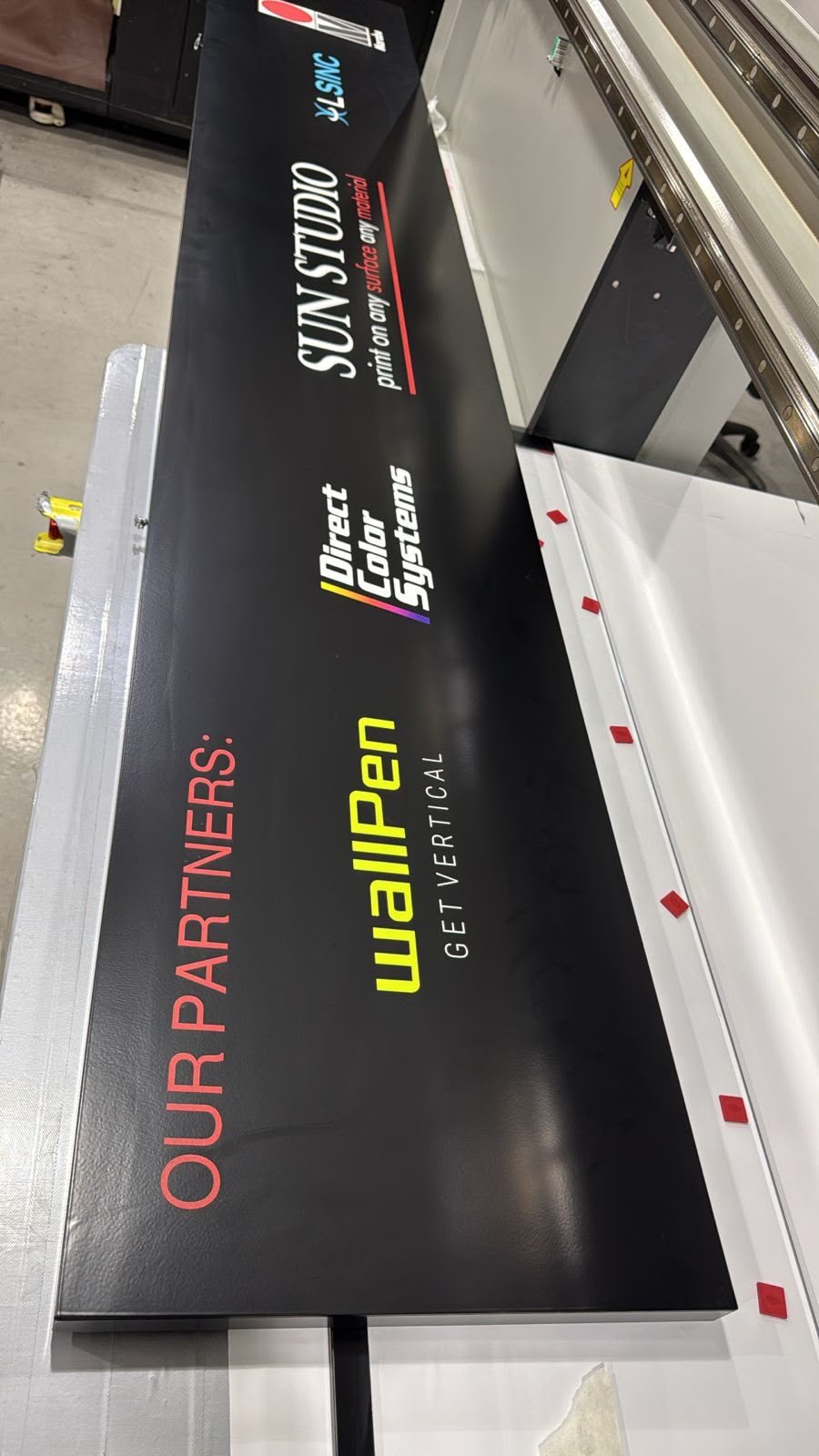
DCS machines are engineered and manufactured in Connecticut, USA. Sun Studio in Al Quoz, Dubai runs a large-format UV84 Gen 2 in daily production, so a buyer can watch it print before committing. For print houses already running these machines as a service, see our comparison of the best UV printing companies in the UAE.
If you print bottles: a cylindrical UV printing machine
Curved containers need a machine built around rotation. A bottle, can, jar or cup is loaded, turned under a UV inkjet head, and the ink cures as it lands, so the decoration belongs to the container rather than being applied to it afterwards. PRO TECHnology supplies the LSINC Peri Series, built by LSINC Corporation of Huntsville, Alabama, specifically for cylindrical and tapered products. Three models are offered commercially in the region by PRO TECHnology, and the choice between them comes down to volume and container shape.
- PeriOne: rated at 282 pieces per hour, manual feed, one object at a time, for low to mid volume, sampling, customisation and boutique production runs. Extended diameter and height dimensions, up to 15.24 cm diameter by 45.72 cm high, take growlers, vases and large wine bottles.
- PeriQ360: rated at 1,146 pieces per hour on semi-automatic feed, with four print tunnels handling four objects at a time and up to four different designs together. Built for high volume, multi-shift production, run by one to two operators, on containers up to 11.43 cm diameter by 40.64 cm high.
- Perivallo360m: rated at 174 pieces per hour, manual feed on servo-driven mandrels, with printheads that adapt to contours so it handles shapes the other models cannot. Built for contoured and luxury work, and the only model in the range that prints up the neck of a bottle, provided the angle does not exceed 30 degrees, on containers up to 13.97 cm diameter by 40.64 cm high.
Products decorated on Peri Series machines:
- Perfume bottles, in full wrap colour and raised white relief
- Aluminium body spray and deodorant aerosol cans, decorated across a whole fragrance range
- Glass water bottles for beverage brands, including Eid and UAE National Day seasonal designs
- Qahwa cups in production quantities, including personalised two cup designs
- Wine and spirits bottles, printed base to neck, including prefilled bottles
- Stainless steel and bamboo tumblers, ceramic mugs and glass drinkware
- Candle jars, cosmetic jars, plastic containers and plastic spray bottles
- PET bottles for cosmetics, haircare and food, plus industrial steel cans and plastic tubes
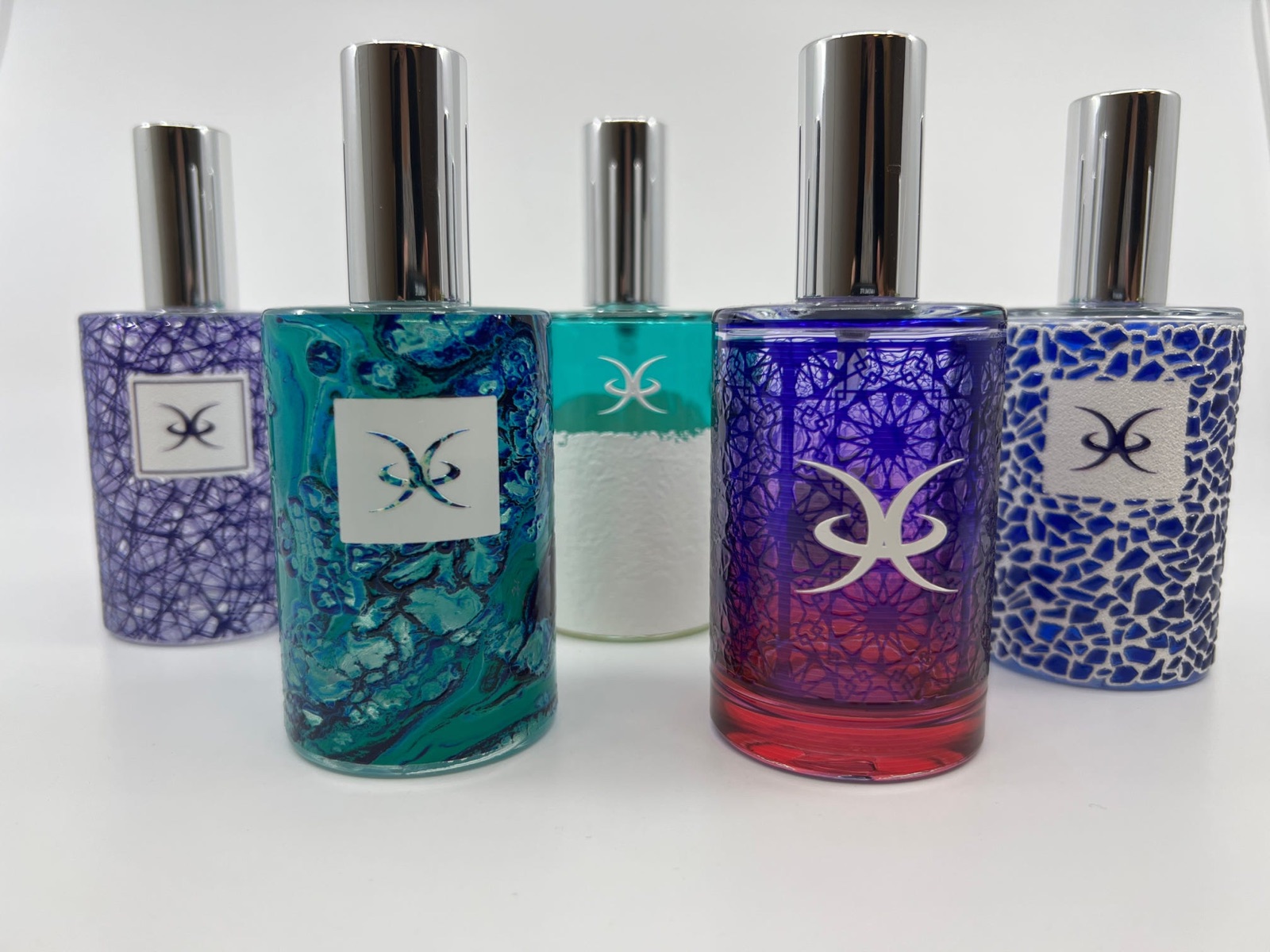
A dedicated cylindrical machine is not the same as a small rotary attachment on a flatbed. See our full guide to LSINC cylindrical UV and bottle printing machines for the model-by-model specifications. Once production volume and full 360-degree coverage matter, the difference is mechanical. The Peri Series is engineered around the container: high-precision industrial printers built specifically for cylindrical and tapered products, by a team trusted in aerospace, defence and commercial industries. The tunnel counts, mandrels and feed systems above are what that focus produces, and it shows in the finished piece. All-over printing covers the full circumference with no start and no finish, and no seam or gap where a label would begin and end. Height is not the constraint either, because every model in the range prints a wine bottle from base to neck, taller than the maximum print area of many cylindrical printers. Clear glass is the hard case, since UV light travels through the bottle and can cure ink on the far wall, yet the Peri Series prints it with no barrier and no manual intervention, so nothing has to be packed inside the container to block the light. Our cylindrical UV printing guide covers the application range, and the body spray can capacity guide separates rated speed from what a production floor achieves.
If you print directly onto walls: a direct-to-wall printer
A direct-to-wall printer goes to the site, so the wall never travels to a workshop. The wallPen climbs the wall on its own rail and prints artwork straight onto the surface, with no wallpaper, no vinyl and no seams. It reaches 4 metres high, and print width is not limited, so a full corridor or facade runs as one continuous piece. Setup takes around 30 minutes and one person can do it alone.
- Hotels, restaurants and leisure interiors: feature walls and decorative artwork.
- Retail units and showrooms: full-height brand walls and product imagery.
- Offices and reception areas: reception branding, wayfinding and feature walls printed on site.
- Interior feature walls and branded walls: single-piece graphics straight onto plaster, concrete or brick.
- Glass partitions: privacy, branding and decoration printed onto the glass itself.
- Murals: anywhere a wall would otherwise take wallpaper, vinyl or hand painting.
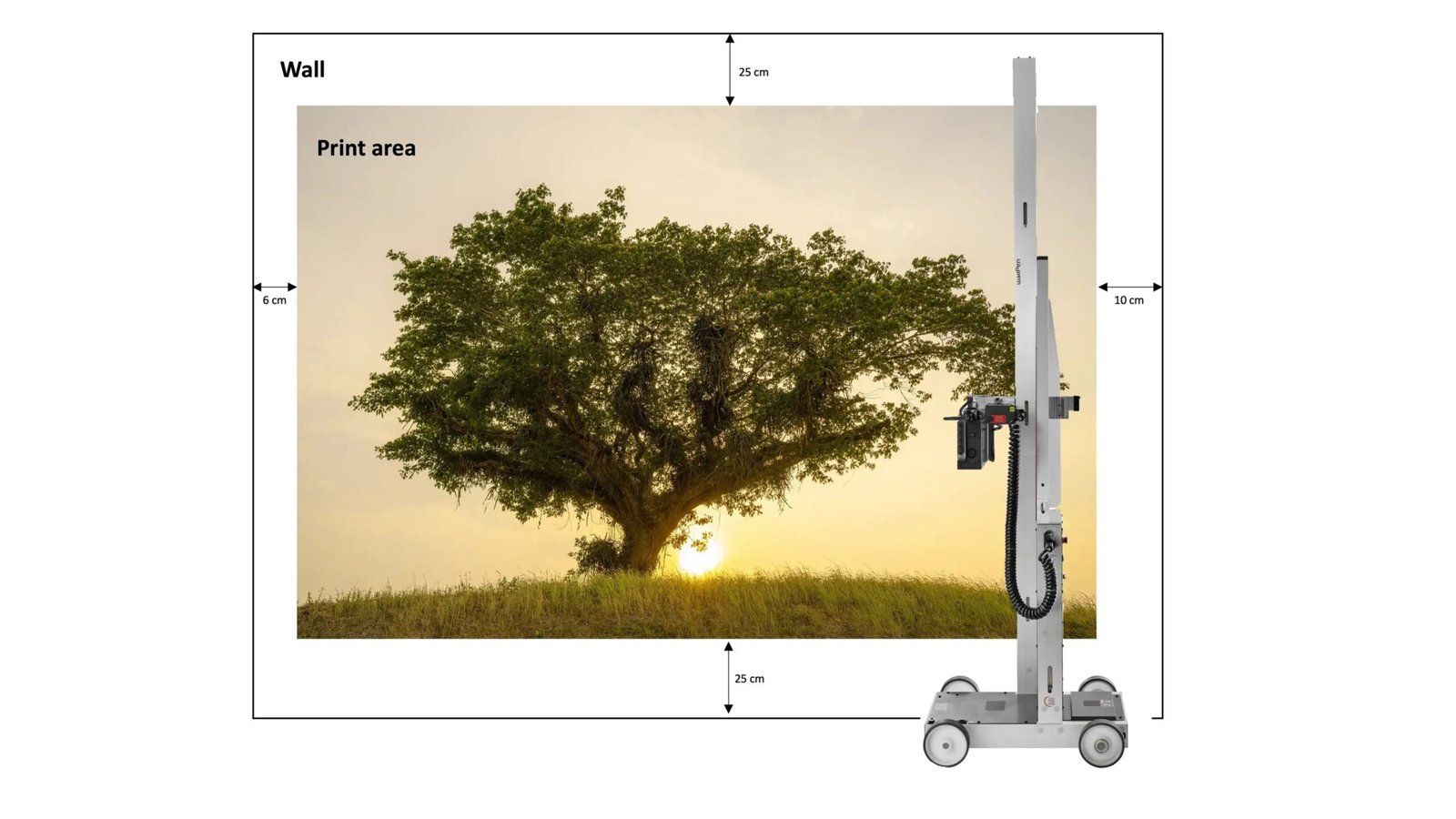
Almost any wall surface prints: plaster, concrete, brick, wood, glass and metal, rough as well as smooth, because the printhead carries a laser system that sets its own distance from the wall. Colour is CMYK plus white with ICC profiles, so artwork holds up on dark and coloured walls. Indoor prints stay durable for at least 12 years where the surface has been prepared correctly, and the cured ink is scratch, water and solvent resistant. Outdoors, UV resistance is typically around 2 years depending on the material, and is often extended beyond 5 years with a transparent UV protective coating.
Print speed runs from 2 to 16 square metres per hour, depending on the wall surface, the number of passes, the resolution and the artwork size. It is built by wallPen GmbH in Wissen, Germany, and runs from a standard single phase socket with a 12 metre cable, so most sites need no special electrical work. Specifications are on the wallPen brand page, applications in our UV wall printing guide for the UAE, and the numbers in our wall printing business ROI study.
If you print oversized or continuous panels: a conveyor UV printer
A flatbed stops where its bed stops. Once a panel is longer than the bed, the work has to be split into tiles and the seams lined up on site. A continuous-belt machine removes that limit: the media travels through on the belt rather than sitting on a fixed table, so print length is set by the roll or the panel, not by the machine. Typical work for a belt printer:
- Large glass panels and flat ceramic, printed at the full architectural panel width in a single pass.
- Rolled metal, rigid board and laminate decor surfaces for furniture and fit-out.
- Long decorative panels and embossed wall coverings, colour-stable for 10 to 15 years.
- Architectural surfaces for malls and retail, airports and transport, hospitality and high-end residential fit-outs, where the print has to survive daylight and cleaning for years.
- Roll work no fixed bed can take in one piece: wallpaper, textile, leather, PVC banner and film, and soft signage.
The machine PRO TECHnology supplies for this work is the IQDEMY EVO 2500, a 2.5 m roll-fed hybrid UV-LED production system engineered in Sierre, Switzerland. It takes media up to 2.5 metres wide with no limit on print length, sheet up to 200 mm thick, and material weighing up to 100 kg. A hybrid belt-plus-table feed with expandable side tables lets it run rigid sheet work without a separate flatbed. Output runs 32 to 62 square metres per hour at 508 × 1200 dpi, and 15 to 30 at 508 × 2400 dpi, spanning the three-head and six-head configurations. Where floor space is the constraint, a 1.6 m version, the EVO 1600, is available.
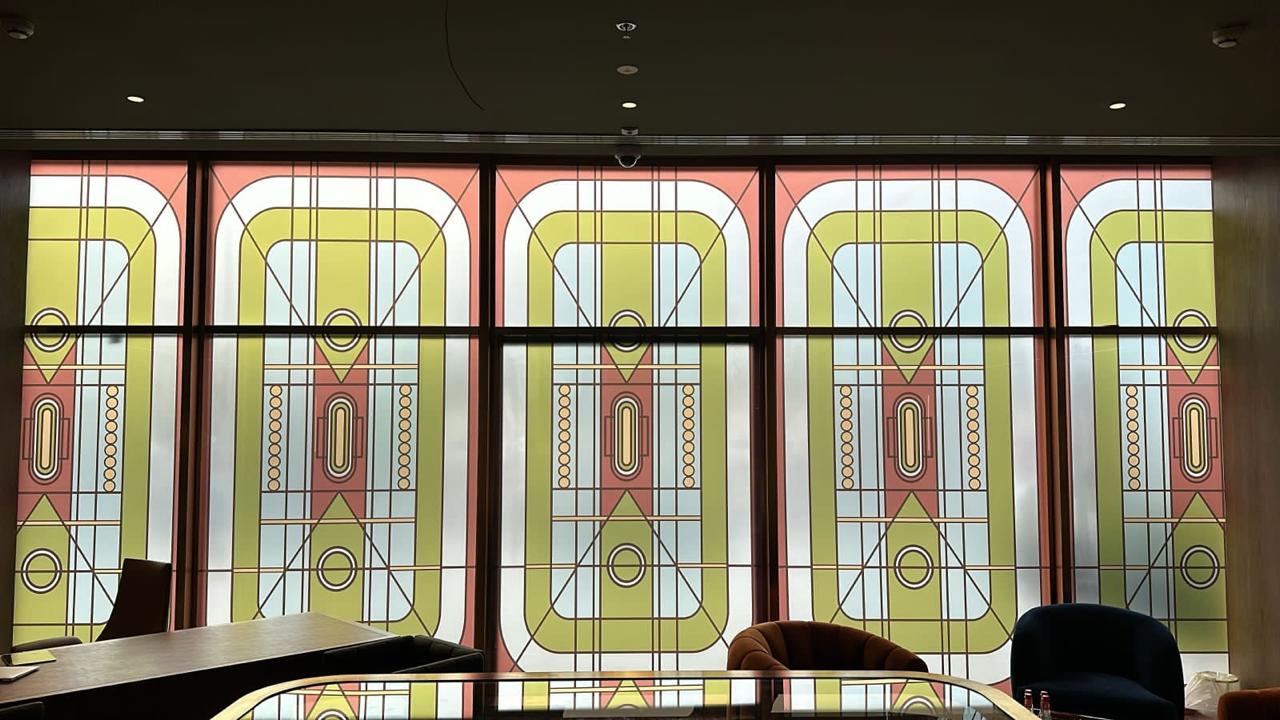
Glass runs in three stages: MODICO ModiTreat pre-treatment, UV-LED printing, then Marabu coatings for UV and scratch resistance, confirmed by cross-hatch testing on the actual glass. Acoustic panels are porous by design, so variable dot printing from 3.5 to 21 pL controls ink laydown without filling the structure that absorbs the sound. Our article on large-format glass and acoustic panel printing covers both.
Which UV printer for which product?
Most buying decisions settle at the level of the product rather than the specification sheet. The table below maps six common jobs to the equipment built for them: Direct Color Systems flatbeds, LSINC cylindrical printers, wallPen for walls and IQDEMY continuous-belt systems. The last row is the exception, because the answer there is not a machine on its own: surfaces that resist ink, such as glass and low energy plastics, are prepared with MODICO surface pre-treatment before whichever printer suits the product.
| What are you printing? | Machine type |
|---|---|
| Glass, acrylic, metal, wood | UV flatbed |
| Perfume, beverage and cosmetic bottles | Cylindrical UV printer |
| Walls and murals | Direct-to-wall printer |
| Very long glass or panels | Conveyor UV printer |
| Braille and tactile signage | Specialist UV flatbed |
| Difficult glass and plastic surfaces | Pre-treatment plus the correct UV printer |
Do not choose a UV printer by price alone
Two quotations can look comparable and describe very different machines. A quotation prices hardware; it does not say whether the machine takes your largest product, carries your busiest day’s volume, or can be serviced when a printhead needs attention. Specify the job first, and let the machine follow.
Start with what you will actually print:
- What the products are. Rigid sheet and panels, bottles and cans, finished walls, or long rolls and oversized panels. These are separate machine families rather than settings on one machine: the LSINC Peri Series is built specifically for cylindrical and tapered products; a Direct Color Systems flatbed is built around flat and rigid material.
- Maximum object size, height and weight. Specify from your largest piece rather than your average one, and read the maximum print height as carefully as the bed size, because a tall object rules out a machine whose bed is wide enough. Check which figure a specification quotes as well: on the DCS range the print area and the maximum substrate size are given as separate numbers, and they differ.
- Daily volume at real speed. Rated speed is a manufacturer maximum. Net output depends on artwork, ink coverage, number of layers, texture height, loading and changeover, and textured or ADA work runs slower than flat colour work because more ink is laid down. Take the rated figures set out for each model earlier in this guide, discount them to a realistic efficiency, then have the result confirmed on your own product.
- Colour configuration and finish. White ink is what puts colour on dark, clear and bare metal surfaces; clear or varnish is what gives gloss, matte and raised effects. Confirm it model by model rather than assuming. Every machine in the DCS flatbed range prints CMYK plus white plus clear, and patented TEXTUR3D lays all three down in a single pass; in the LSINC range, 360 degree CMYK plus white and varnish is stated for the Perivallo360m.
Then the running costs a quotation does not show:
- Pre-treatment. Acrylic, most ABS, PC and PET and many coated boards usually print well after a good clean, while glass, ceramics, bare metal and coated bottles need pre-treatment, a primer, or both. MODICO ModiTreat pre-treatment is a separate machine ahead of the printer, not an option on it, and surface activation decays after treatment, so it has to sit close to printing in the workflow. Our UV printing adhesion guide covers the tests that settle which of these your material needs.
- Ink, primers and cleaners. There is no brochure figure for ink cost per m²; it follows your artwork, coverage and number of layers, which is why a demonstration returns an ink consumption figure on your own material. Marabu inks, primers, adhesion promoters and cleaners are stocked in Dubai with local technical support, and on LSINC machines only approved consumables from the manufacturer or an authorised distributor are warranted.
- Operators and loading. Feeding varies more between models than printing does. The PeriQ360 uses semi-automatic feed, takes four objects at a time and runs with one to two operators; the PeriOne is fed manually, one object at a time; a wallPen is set up in about 30 minutes by one person.
- Maintenance and printheads. Routine DCS maintenance is printhead cleaning and basic system checks. LSINC expects daily operator maintenance after installation: purging and cleaning the printheads, checking pressures, and clearing spills and broken media. Printheads and fan filters are consumables and are not replaced under LSINC’s limited warranty, so plan for them as a running cost rather than a warranty item.
- Parts, engineers, installation and training. UV inks, primers, cleaners and spare parts are held in Dubai, machines are installed by PRO TECHnology’s own engineers, operator training is included with installation, and remote diagnostics and support are possible depending on the fault.
Only once those are known does a return calculation mean anything. The DCS and wallPen pages each carry a calculator that takes your shift pattern, a realistic working speed rather than the rated one, your own selling price per m² and your own ink cost per m², and returns gross margin per day and per month and the months needed to cover the investment; our wall printing business case works that model through for a wallPen. Read the output for what it is: gross margin only, with labour, maintenance, rent and finance cost all sitting outside it. A full ROI study on your own figures can be requested instead.
Most disappointing purchases come down to one of two things: a machine that cannot do the job it was bought for, because the specification was written around a price, or a machine nobody in the country can service. Neither appears on a quotation, and both appear in the first month. Define the work, then book a demonstration and watch your own material go through the machine before price enters the conversation.
Why test your product before buying a UV printer?
Specifications describe a machine under ideal conditions; your product decides what actually happens on the floor. Bring the real item to Dubai before you commit to one: the perfume bottle with its factory coating, the acrylic or anodised metal panel, the glass sheet, the promotional piece, or a sample of the wall surface you intend to print. Sun Studio in Al Quoz is PRO TECHnology’s own production and demo centre, running since 2011, and every machine the company sells runs there daily.
Adhesion is the first thing tested, because no datasheet can answer it. Acrylic, most ABS, PC and PET, wood and many coated boards usually print well after a good clean, while glass, ceramics, bare metal and coated bottles usually need MODICO surface pre-treatment, a primer, or both. The part is printed untreated first and left 24 hours before testing, because cross-linking continues after the print leaves the bed, and pre-treatments are added one at a time rather than stacked together.
Four checks follow, run in order on the cured print and set out in full in our adhesion testing guide:
- Cross-hatch cut: roughly six cuts are made one way and six across, a couple of millimetres apart, through the ink and down to the surface, following ISO 2409 or ASTM D3359.
- Tape test: strong clear tape is pressed over that grid and removed in one fast, smooth pull. Tiny flakes at the cut lines pass; whole squares on the tape fail.
- Isopropanol rub: an isopropanol-soaked pad is worked back and forth over the print and the cycles are counted until colour transfers or the print visibly wears, and that count is judged against the exposure the job will really meet.
- Soak test: drinkware and outdoor items also get a 24-hour water soak, followed by a repeat of the tape test.
Print quality is judged on the sample rather than on a specification sheet. White ink is what lets colour hold on a dark or transparent surface, and every DCS flatbed prints CMYK plus white plus clear, so a demonstration shows how the white base reads under your artwork on your own material. Finishing belongs in the same test, because clear and varnish are what produce gloss, matte or raised results: DCS TEXTUR3D prints raised logos, patterns and lettering along with embossed and debossed effects, while an LSINC cylindrical printer uses varnish for gloss, matte and raised or embossed finishes on a bottle. Where a part needs protection over the ink, Sun Studio runs MODICO pre-treatment, UV printing and Marabu post-treatment coatings under one roof, so a coated sample can come back alongside the bare one.
The commercial questions are settled the same way. Rated speed is a manufacturer maximum, and net output depends on artwork, ink coverage, curing, loading, changeover and operator skill, so a realistic net speed is confirmed on your own product during the demonstration. You leave with the printed samples, a net speed figure, an ink consumption figure and the adhesion results on your material. If you cannot travel, post the bottle, panel or part and it is treated, printed and tested before any machine conversation starts. Book a demonstration and bring the product with you.
Buying a UV printing machine in the UAE, Saudi Arabia or the GCC
Where a machine is supported from matters as much as where it is built. PRO TECHnology supplies and supports industrial UV printing systems from Dubai, across the UAE, Saudi Arabia, Qatar, Kuwait, Bahrain, Oman and the wider Middle East, and has worked in digital printing since 2011. It holds formal agreements as the authorised distributor and partner in the Middle East for every brand in its Digital Printing division: LSINC, wallPen, IMAGO, Direct Color Systems, MODICO, IQDEMY and Marabu.
Support is worth defining in concrete terms, because it is what the machine depends on for the rest of its working life. Installation and commissioning are carried out by PRO TECHnology’s own engineers, and operator training is included with the installation. UV inks, primers, cleaners and spare parts are held in Dubai, so a reorder is a local supply question rather than an import one. That has a warranty consequence as well: on LSINC machines, only consumables approved and bought from LSINC or an authorised distributor are warranted for use in them. Depending on the fault, remote diagnostics and support are possible before anyone travels, and every machine in the range is demonstrated at Sun Studio in Al Quoz, the group’s own production and demo centre.
If you are specifying a UV printer for a business anywhere in the region, the useful next step is a conversation about the application before the hardware. Call +971 4 343 5501, email sales@protech.ae, or use the contact page to tell us what you print, on what material and in what volume.
Frequently asked questions
What UV printer is best for printing on glass?
It depends on the shape and size of the glass rather than the material. Flat rigid sheet goes on a UV flatbed such as a Direct Color Systems machine, with print areas from 44 x 61 cm up to 250 x 130 cm. Panels longer than any bed run on a continuous-belt printer, where the IQDEMY EVO 2500 prints 2.5 metres wide with unlimited length. Glass bottles and jars need a cylindrical machine instead.
What machine prints directly on perfume bottles?
A dedicated cylindrical UV printer. LSINC machines are built specifically for cylindrical and tapered products, and print 360 degrees so the decoration covers the full circumference with no seam where a label would start and finish. LSINC cylindrical printers lay down CMYK with white and varnish, and the Perivallo360m is the only model that prints up the neck of a bottle, provided the angle does not exceed 30 degrees. Adhesion on a coated perfume bottle is settled by testing your own bottle and fragrance, not promised in advance.
Can one UV printer print flat and cylindrical objects?
Partly. With the appropriate attachments or setups, a Direct Color Systems flatbed can handle a variety of shapes including cylindrical items, which covers occasional work alongside a flat production programme. Volume and true 360 degree quality are a different job: a dedicated machine such as the LSINC PeriQ360 takes four objects at a time across four print tunnels, and the Perivallo360m runs servo-driven mandrels with printheads that adapt to contours. Our guide to cylindrical UV printing explains where the line falls.
What printer is best for 360-degree bottle printing?
The LSINC Peri Series, chosen by volume and container shape. The PeriOne is rated at 282 pieces per hour with manual feed and takes the largest containers, up to 15.24 cm diameter by 45.72 cm high. The PeriQ360 is rated at 1,146 pieces per hour with semi-automatic feed and four print tunnels. The Perivallo360m, at 174 pieces per hour, handles contoured and irregular containers. All three print a wine bottle from base to neck.
What machine can print on glass bottles?
A cylindrical UV printer. The LSINC Peri Series prints directly onto clear glass with no barrier and no manual intervention, so nothing has to be packed inside the bottle to block the UV light, and white ink gives colour a base to sit on over clear or dark glass. Glass bottles often carry an invisible factory cold-end coating that kills adhesion, so Pyrosil flame treatment is usually part of the process.
What printer can print directly on walls?
A direct-to-wall printer. The wallPen prints up to 4 metres high, and print width is not limited, because the machine moves along the wall on its own rail and prints the artwork as one continuous piece with no seams. It runs from a standard single phase socket, sets up in around 30 minutes with one person, and prints plaster, concrete, brick, wood, glass and metal.
Can a UV printer print on aluminium?
Yes. Direct Color Systems UV flatbeds print directly onto metal, including aluminium, alongside acrylic, wood, glass and plastics, and white ink allows printing on dark or bare surfaces with good opacity. Whether the ink holds is a surface question rather than a printer question: cleaning, any lacquer or coating, and the anodising itself all matter, which is why adhesion on anodised aluminium is worth testing on your own material first.
Do I need pretreatment before UV printing?
It depends on the material. Acrylic, most ABS, PC and PET, wood and many coated boards usually print well after a good clean. Glass, ceramics, bare metal and coated bottles usually need pre-treatment, a primer, or both. Polypropylene and polyethylene sit at around 29 to 31 dyn/cm where UV ink needs roughly 38, so they will never hold ink untreated. MODICO ModiTreat systems cover that step, and treated parts must be printed within their working window.
How much does a UV printing machine cost in the UAE?
There is no single figure, because the price follows the configuration. Print area or bed size, the ink set including white, clear and varnish channels, the level of automation, and rated throughput all move it, and a small flatbed for personalised gifts and a four-tunnel cylindrical machine are different classes of equipment. Define the application, the substrate and the monthly volume first, and the quotation follows from that.
What should I check before buying a UV printer?
Start with the object: its size, weight and shape decide the machine family before anything else. Then check the print area against your largest part, the ink configuration, and realistic net output rather than rated speed, because artwork, ink coverage, layers, texture height, loading and changeover all reduce it. Add the surrounding requirements: pre-treatment, ink and consumables, operator numbers, routine maintenance such as printhead cleaning, installation, training, and whether spare parts and engineers are held locally.
Is local technical support important when buying a UV printer?
Yes, and it is often what separates a productive machine from an idle one. PRO TECHnology installs and commissions with its own engineers, includes operator training with installation, and holds UV inks, primers, cleaners and spare parts in Dubai, with remote diagnostics possible depending on the fault. It also matters for warranty terms: with LSINC, only consumables approved and bought from LSINC or an authorised distributor are warranted for use in the machines.
Can I test my product before buying the machine?
Yes, and it is the step we recommend most. Send a bottle, panel or part, and it is pre-treated, printed and adhesion-tested on your own material before any machine conversation starts. You get the printed samples back along with a realistic net speed figure, an ink consumption figure and the adhesion test results. Book a demonstration at Sun Studio in Al Quoz, Dubai, and watch your own product go through the machine.
كيف تختار ماكينة الطباعة بتقنية UV المناسبة في الإمارات والخليج
المنتج الذي تطبع عليه هو ما يحدد نوع الماكينة، وليس العكس. للمواد المسطحة والصلبة مثل الأكريليك والخشب والزجاج والمعادن، تتوفر طابعات Direct Color Systems المسطحة بأربعة أحجام لسطح الطباعة، مع طباعة الألوان والأبيض والطبقة الشفافة في تمريرة واحدة. أما العبوات الأسطوانية والمخروطية مثل زجاجات العطور والمشروبات فتحتاج إلى ماكينة أسطوانية مخصصة من سلسلة Peri من LSINC، تطبع 360 درجة دون بداية أو نهاية ودون وصلة في التصميم. وللطباعة المباشرة على الجدران، تطبع wallPen حتى أربعة أمتار ارتفاعًا، وبعرض غير محدود كقطعة واحدة بلا وصلات. وللألواح الكبيرة والمستمرة، توفر أنظمة الحزام الناقل من IQDEMY عرضًا يصل إلى 2.5 متر وطولًا غير محدود. تبقى المعالجة المسبقة للسطح عاملًا حاسمًا على الزجاج والمعادن والبلاستيك، وهنا تأتي أنظمة MODICO وأحبار وبرايمر Marabu. وتوفر بروتكنولوجي التوريد والتركيب وتدريب المشغلين وقطع الغيار والمستهلكات من دبي إلى الإمارات والسعودية ودول الخليج. أرسل لنا منتجك الفعلي، زجاجة أو لوحًا أو قطعة معدنية، لنطبعه ونختبر التصاق الحبر في مركز Sun Studio في القوز بدبي قبل أي قرار شراء.
Bring us the product, then choose the machine
Send or bring the actual item, whether that is a perfume bottle, a glass panel, an acrylic sheet, an aluminium plate or a sample of your wall surface, and we will pre-treat it, print it and adhesion-test it on the machine family that suits it. You get the printed samples back with a realistic net speed figure, an ink consumption figure and the test results on your own material, before any machine conversation starts. Every machine PRO TECHnology supplies runs daily in production at Sun Studio in Al Quoz, Dubai, so you can watch the process end to end and see what the output looks like at volume.