Braille and Tactile Signage Printing in the UAE: The Equipment Side
Published · PRO TECHnology Digital Printing
Accessible signage stopped being a specialist sub-contract in this region some time ago. Every new mall, hospital, school, hotel, mosque and government building needs tactile and Braille wayfinding, in Arabic as well as English, and the volumes are steady rather than occasional. That turns a compliance obligation into a production question: what machine actually makes these signs, and does it make sense to bring the work in-house. This guide answers the equipment half. For the code and the compliance half, we point you somewhere better.
Key takeaways
- In Dubai the binding instrument is the Dubai Universal Design Code, not the American ADA, so a sign specified to a US standard is not automatically a compliant sign here.
- Direct Color Systems pioneered printing ADA and Braille signage with UV LED inkjet: raised characters and Braille domes are printed in the same job as the artwork, with no separate raster beads, no engraving and no tooling.
- Bilingual Arabic and English layouts and constant one-off replacements are what break the drilled-and-glued method, and what a print-in-place machine handles without new tooling.
- The DCS range covers 44 x 61 cm to 250 x 130 cm at the same quality, so the choice is sign size and volume; textured and tactile work runs slower than flat colour because more ink is laid down.
- This page does not quote dot heights, character sizes or mounting heights. Those figures are revised and differ between authorities, so verify them against the current code for your project.
Accessible signage is now a production run, not a special order
A signage company in the Gulf used to see tactile work as an annoying exception: a handful of plates per project, sub-contracted out, priced badly and delivered late. That is no longer the shape of the demand. Accessibility requirements now apply across new public buildings, and the sign schedule for a single hospital or campus can run to hundreds of plates, each one different, each one carrying room numbers and names that change during handover and keep changing afterwards.
Two things follow from that. The first is that the work is now worth owning rather than sub-contracting, because it repeats. The second is that the production method has to survive constant revision. A tactile sign programme is not one big run; it is a long tail of small runs and single replacements, which is exactly the pattern that punishes any process involving tooling, moulds or minimum quantities.
This article is about the machine that does the work. It sits alongside our guide to choosing a UV printing machine in the UAE, which places flatbeds against the other machine families, and the Direct Color Systems range we supply and support from Dubai.
What a compliant tactile sign has to deliver
Strip away the regulatory language and an accessible sign has to do four things at once, on one plate:
- Readable visual content for sighted users, with sufficient luminance contrast between the characters and their background and a finish that does not throw glare under building lighting.
- Raised tactile characters that can be read by touch, standing proud of the plate rather than printed flat or engraved into it.
- Braille as rounded domes with the correct geometry and spacing, positioned in a consistent relationship to the text above it.
- Durability in a building that will be cleaned, touched constantly and, in the Gulf, exposed to heat and strong daylight wherever the sign is external or near glazing.
The tactile requirement is the one that decides the manufacturing method, because raised content cannot be produced by an ordinary printer. Everything else, including contrast and finish, is achievable in several ways.
One point worth being blunt about: the Dubai Universal Design Code is the instrument that governs this work in Dubai, not the American ADA. The two overlap in intent and differ in detail, which is why importing a US-specified sign package, or copying an American template, is a common and expensive mistake. Arabic content sits alongside English, and Arabic Braille has its own conventions. The dimensional detail is the part that changes, so treat the current code and the relevant authority as the source of truth for any specific project.
Three ways Braille gets made, and what each one costs you
Regionally, almost all tactile signage is produced by one of three methods. They are not equivalent, and the difference shows up in labour, lead time and rework rather than in the first sample.
1. Drilled and glued raster beads
The plate is printed or laminated, a hole is drilled for every Braille dot, and a plastic or metal bead is inserted into each one. It works, and it is how a great deal of signage in this region is still made. The cost is labour and consistency: a single room sign can carry dozens of dots, each drilled and set by hand, and a bead that sits proud, sinks, or falls out later is a defect on a wall in a finished building. Revisions mean starting the plate again.
2. Engraved, routed or applied lettering
Characters are cut from sheet and applied, or routed into a laminate. This produces good tactile characters but is slow, generates tooling and setup for each new layout, and struggles with the fine detail and tight spacing of Braille. For a project with hundreds of unique plates, setup dominates the cost.
3. Printed in place with UV LED inkjet
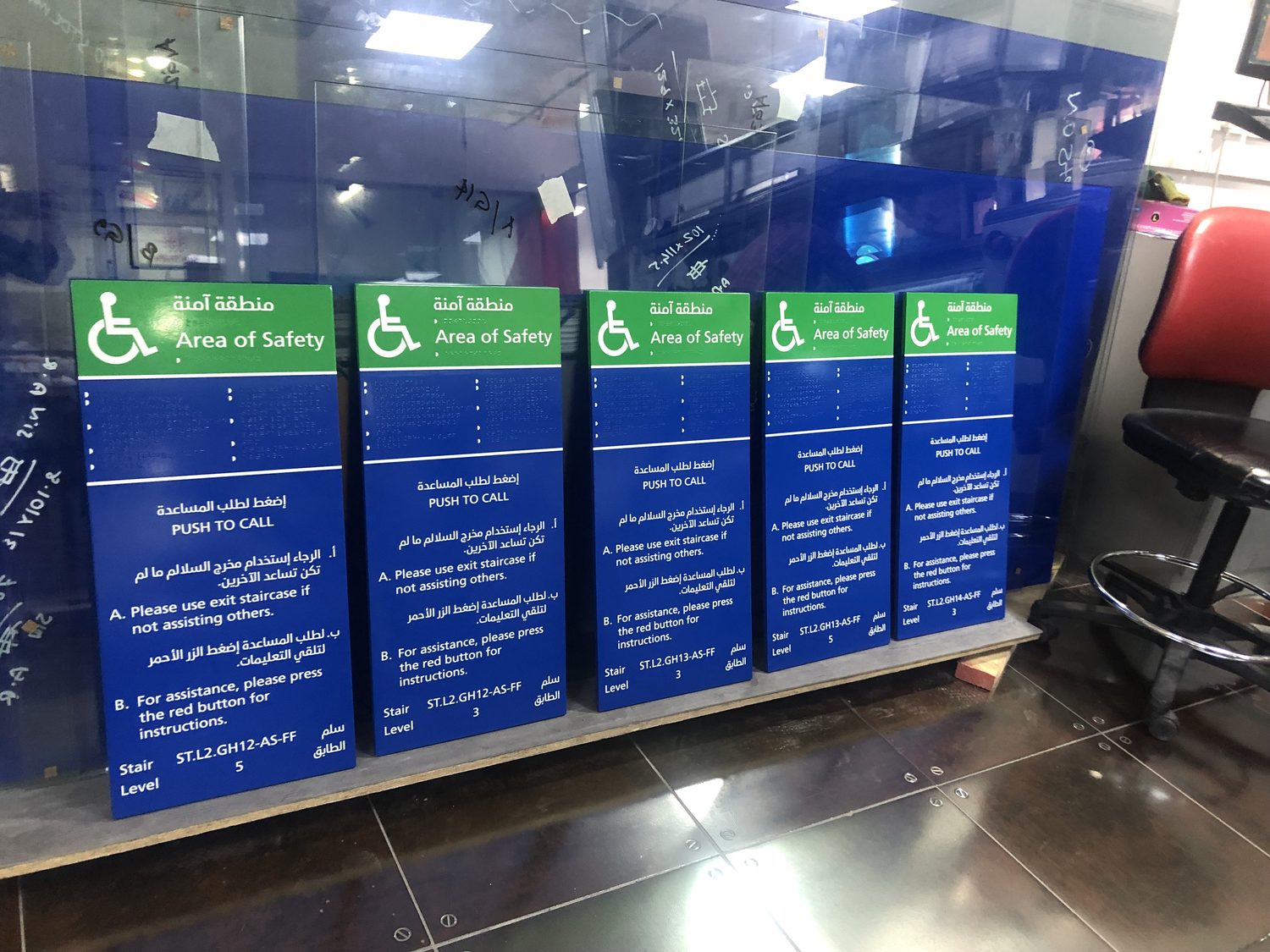
The third method builds the raised content out of ink. Direct Color Systems pioneered printing ADA and Braille signage with UV LED inkjet: raised characters and Braille domes are printed in the same job as the artwork, with no separate raster beads, no engraving and no tooling. The artwork, the contrast, the tactile characters and the Braille all arrive in one pass on one machine, and a revised plate is a revised file rather than a new setup.
That capability comes from the same engine as TEXTUR3D, the patented raised and embossed printing DCS is known for: colour, white and clear are laid down together and the tonal value of the artwork controls the height, so the relief is real rather than a printed shadow. Applied to signage, it means the height of a character or a dome is a property of the file, repeatable across a run of one or a run of five hundred.
Why Arabic changes the economics
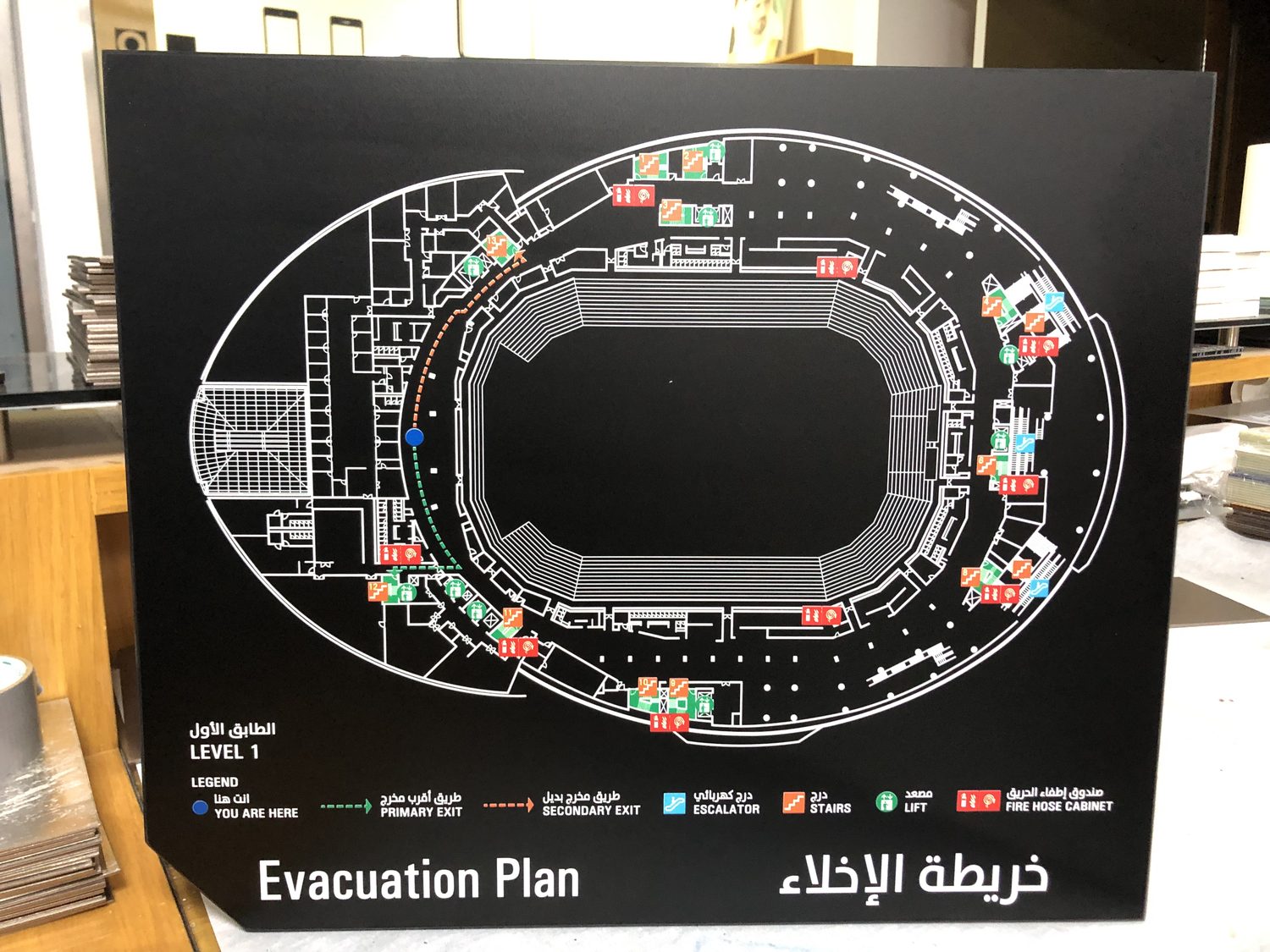
A bilingual sign is not an English sign with a second line added. It carries two scripts, two reading directions and two sets of tactile content on a single plate, usually with the Arabic and English versions of every room name, floor level and instruction kept in a fixed relationship to each other. On a drilled-and-glued line, that roughly doubles the dot count and the handling per plate, and doubles the opportunity for a misplaced bead.
It also removes any possibility of buying signage off a catalogue. Bilingual accessible signage for a specific building is bespoke by definition, in short runs, revised repeatedly during fit-out and handover. Printing the tactile content in place is the method that matches that reality, because the marginal cost of a different layout is close to zero and a one-off replacement plate is a normal job rather than a special one.
DCS lists wayfinding, room and facility signage, short runs and one-off replacements among the work the technology is built for, and our own division page groups Braille signage, accessible signage and government signage as standard flatbed output rather than as exceptions.
Which flatbed for signage work
All four Direct Color Systems flatbeds carry the same print quality and the same capabilities, including the tactile and Braille work described above. The choice is the size and weight of the plates you produce and how many of them you make, not the quality you get.
| Model | Print area | Substrate weight | Typical signage fit |
|---|---|---|---|
| UV21 | 44 x 61 cm | 8 kg | Room and door plates, small tactile jobs, replacements |
| UV32 | 60 x 90 cm | 32 kg | Directional and floor signage, larger plates |
| UV44 | 130 x 130 cm | 111.4 kg | Named by DCS for ADA Braille, decor, wood and metal sheet |
| UV84 | 250 x 130 cm | 193 kg | Directory boards, evacuation plans, full-sheet production |
Two practical notes on throughput. Rated production across the range runs from 4.5 to 10 square metres per hour, or roughly 36 to 80 square metres over an eight-hour shift, and textured and tactile work runs slower than flat colour work because considerably more ink is laid down. Plan accessible signage capacity from a tactile sample of your own artwork, not from the flat-colour figure. Maximum print height also matters if you print onto anything with depth: 18 cm on the UV21, 32 cm on the UV32 and 30.5 cm on the UV44.
Substrate, adhesion and how long the sign survives being touched
A tactile sign is, by design, the one sign in the building that people put their hands on. That changes the durability question from a printing question into an adhesion question, and it is where accessible signage programmes most often fail eighteen months after handover rather than at installation.
DCS flatbeds print directly onto acrylic, wood, glass, metal and plastics, which covers essentially every substrate used for signage in the region. Whether the ink stays there is decided by the surface rather than the printer. Acrylic and many coated boards accept UV ink well after a proper clean; glass, bare metal and some coated or laminated sheet need surface preparation first. MODICO ModiTreat pre-treatment raises the surface energy so the ink bonds into the surface instead of sitting on top of it, and Marabu primers and adhesion promoters cover the cases where treatment alone is not enough.
Qualify the combination before a production run, not after. Print a sample plate, leave it to finish cross-linking, then run a cross-hatch test to ISO 2409 or ASTM D3359, a tape pull and an isopropanol rub, and judge the result against the cleaning regime the building will actually use. Our adhesion testing guide sets out the method, and for metal plates specifically our guide to UV printing on anodised aluminium covers why two sheets that look identical can behave completely differently.
Bringing it in-house, or keeping it outsourced
The honest answer depends on how much of this work crosses your desk. A machine earns its place when accessible signage is a recurring line in your projects rather than an occasional request, and the case is built on three things that rarely appear on a quotation:
- Revisions. Room names and numbers change during fit-out and handover. If every revision is a purchase order to a sub-contractor with a lead time attached, the cost is the programme delay, not the plate.
- Replacements. Signs get damaged. A single replacement plate is uneconomic to buy and trivial to print, and being able to produce one the same day is a service argument you can sell.
- Everything else the machine does. A signage flatbed is not a single-purpose Braille machine. The same bed prints awards, plaques, panels, promotional items, industrial parts and decor sheet, so utilisation is not limited to accessible work.
If the volume does not yet justify a machine, the sensible route is to have the work produced by someone who already runs one. Sun Studio, our group's production studio in Al Quoz, runs a large-format DCS UV84 Gen 2 in daily production and produces this work as a service. For a full signage programme, our guide to specialist UV printing companies in the UAE also covers a signage contractor that prints Braille in place.
Getting the compliance right
We supply and support the machines. We are deliberately not the right source for the dimensional detail of the code, and neither is any equipment vendor, because those figures are revised, they differ between authorities, and a wrong number is paid for in re-manufactured signage on a live site.
For the compliance side, our group's signage studio has written it up properly: what the Dubai code actually requires for Braille and wayfinding signage covers how the Dubai Universal Design Code differs from ADA, contrast and glare, bilingual Arabic and English layouts, the approval process, and how the Braille itself is manufactured. Read that alongside this page: it answers what the sign has to be, and this one answers what makes it.
Then verify the current figures against the code and the authority responsible for your project before anything is manufactured.
Buying signage production equipment in the UAE, Saudi Arabia or the GCC
PRO TECHnology has worked in digital printing since 2011 and is the authorised distributor and partner in the Middle East for Direct Color Systems, alongside the other brands in its Digital Printing division. We supply and support signage production equipment from Dubai across the UAE, Saudi Arabia, Qatar, Kuwait, Bahrain, Oman and the wider Middle East.
What that covers in practice: installation and commissioning by our own engineers, operator training included with the installation, UV inks, primers, cleaners and spare parts held in Dubai rather than imported per order, and machines demonstrated on your own substrate before any purchase. Call +971 4 343 5501, email sales@protech.ae, or use the contact page and tell us the plate size, the substrate and the monthly volume you are planning for.
Frequently asked questions
Can a UV printer print Braille?
Yes. Direct Color Systems pioneered printing ADA and Braille signage with UV LED inkjet. The raised characters and the Braille domes are built up in ink and printed in the same job as the artwork, with no separate raster beads, no engraving and no tooling. The height comes from the file, so it repeats across a run of one or a run of hundreds.
Is printed Braille durable enough for a building?
Durability is decided by the substrate and its preparation rather than by the printing. UV ink cures as a film on the surface, so on a properly prepared substrate it holds well, and on an untreated or contaminated one it will eventually lift no matter how it was applied. Qualify the exact material with a cross-hatch and tape test before production, and match the result to the cleaning regime the building will use.
Does Dubai follow ADA for accessible signage?
No. The binding instrument in Dubai is the Dubai Universal Design Code, not the American ADA. The two overlap in intent but differ in detail, and Arabic content sits alongside English in a way ADA does not address. A sign package specified to a US standard is not automatically compliant here, which is why the code and the relevant authority should be treated as the source of truth for any specific project.
What is the difference between tactile signage and Braille signage?
They are two requirements usually delivered on the same plate. Tactile characters are raised letters and numbers that can be read by touch by someone who does not read Braille. Braille is a separate system of raised dots. Accessible signage generally has to carry both, which is one reason a method that produces raised content and dots in a single operation is attractive.
Can Arabic Braille be printed as well as English?
Yes. Because the raised content is generated from the artwork file rather than from tooling, a bilingual plate carrying Arabic and English tactile text and Braille is the same kind of job as a single-language plate. That is the main practical advantage over drilled-and-glued production, where a bilingual sign roughly doubles the dot count and the handling per plate.
How does printed Braille compare with drilled and glued raster beads?
Raster beads are drilled and inserted by hand, so the cost sits in labour and consistency, and a revision means remaking the plate. Printing places the domes and the raised characters with the artwork in one pass, so a revised layout is a revised file. For projects with many unique plates and constant late changes, that difference dominates the economics.
Which DCS printer is best for signage production?
All four models share the same quality and capability, so the choice is plate size and volume. The UV21 at 44 x 61 cm suits room plates and replacements, the UV32 at 60 x 90 cm handles directional signage, the UV44 at 130 x 130 cm is the model DCS names for ADA Braille and sheet work, and the UV84 at 250 x 130 cm takes directory boards and evacuation plans.
How fast can a flatbed produce tactile signage?
Rated production across the DCS range runs from 4.5 to 10 square metres per hour, roughly 36 to 80 square metres over an eight-hour shift. Treat those as flat-colour maximums. Textured and tactile work lays down considerably more ink and therefore runs slower, so plan capacity from a tactile sample of your own artwork rather than from the headline figure.
What materials can accessible signage be printed on?
DCS flatbeds print directly onto acrylic, wood, glass, metal and plastics, which covers the substrates used for signage in this region. Acrylic and many coated boards print well after cleaning. Glass, bare metal and some laminated or coated sheet need pre-treatment, a primer, or both, and that should be settled by testing the actual material.
Should we buy a machine or outsource accessible signage?
Buy when the work recurs. The case is built on revisions and one-off replacements, which are expensive to sub-contract and cheap to print, plus the fact that the same bed also produces awards, panels, promotional items and decor work. If the volume is not there yet, have it produced by someone already running the machine rather than carrying the asset.
Can I test my own signage material before buying a printer?
Yes, and it is the step we recommend most. Send or bring the actual substrate you intend to use, and we will print a tactile sample, run the adhesion tests on it and give you a realistic production figure for your own artwork. Book a demonstration at Sun Studio in Al Quoz, Dubai, and watch the plate come off the bed before any machine conversation starts.
Who supplies Braille signage printers in the UAE and Saudi Arabia?
PRO TECHnology is the authorised Middle East distributor and partner for Direct Color Systems, supplying and supporting the flatbed range from Dubai across the UAE, Saudi Arabia, Qatar, Kuwait, Bahrain, Oman and the wider region, with installation, operator training, inks and spare parts held locally.
طباعة لافتات برايل واللافتات اللمسية في الإمارات: الجانب المتعلق بالمعدات
أصبحت اللافتات الميسّرة متطلبًا ثابتًا في المباني الجديدة بالإمارات ودول الخليج، من المستشفيات والمدارس والفنادق إلى المرافق الحكومية، وبلغتين عربية وإنجليزية معًا. المرجع المُلزم في دبي هو كود دبي للتصميم الشامل وليس معيار ADA الأمريكي، لذا لا تُعد اللافتة المصممة وفق المعيار الأمريكي مطابقة تلقائيًا هنا، ويبقى الرجوع إلى الكود والجهة المختصة هو المصدر الموثوق للأبعاد. من ناحية التصنيع، كانت شركة Direct Color Systems رائدة في طباعة لافتات برايل واللافتات اللمسية بتقنية UV LED، حيث تُطبع الحروف البارزة ونقاط برايل ضمن نفس المهمة مع التصميم، دون حبيبات مركّبة ولا حفر ولا قوالب. هذا ما يجعل الطريقة مناسبة للعمل ثنائي اللغة وللكميات الصغيرة ولاستبدال لوحة واحدة عند الحاجة. تتوفر أربعة مقاسات من طاولات الطباعة من 44×61 سم حتى 250×130 سم بالجودة نفسها، ويبقى الالتصاق مرهونًا بتحضير السطح عبر أنظمة MODICO وبرايمر Marabu مع اختبار الالتصاق قبل الإنتاج. توفّر بروتكنولوجي التوريد والتركيب وتدريب المشغلين وقطع الغيار من دبي إلى الإمارات والسعودية ودول الخليج.
Send us the plate before you specify the machine
Send the substrate you intend to use and the artwork for a real bilingual plate, and we will print it with the tactile characters and Braille in place, run the adhesion tests on it and give you a production figure for your own work rather than a brochure figure. Every machine we sell runs daily at Sun Studio in Al Quoz, so you can watch a plate come off the bed and handle it before deciding anything.