MODICO surface pre-treatmentAdhesion is decided
before you print.
Most UV printing failures are not printing failures. The ink was fine, the machine was fine, and the artwork was fine. The surface was never prepared to hold it. MODICO ModiTreat systems solve that step, so the print stays on the product through washing, handling, sunlight and alcohol.
Built by MODICO Graphic Systems for industrial surface preparation.
The most complete solution for optimising ink adhesion on different materials.
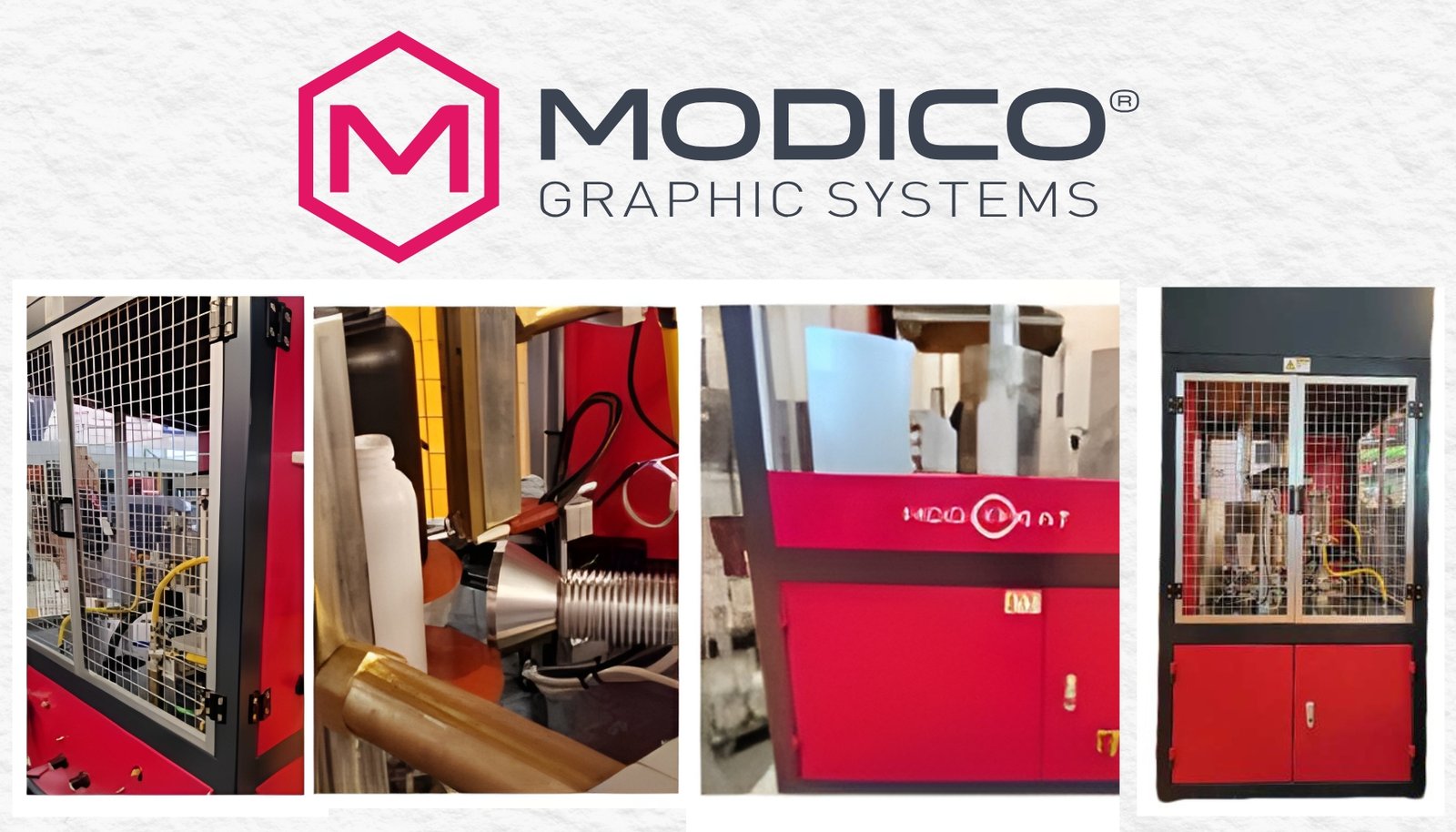
Up to four pre-treatment technologies integrated in a single machine, used independently or combined.
PRO TECHnology supplies, installs and supports ModiTreat across the UAE, GCC and MENA.
On an untreated surface the ink beads up and sits on top, held only by its own skin. After treatment the surface energy rises, the droplet spreads and wets the material, and the ink bonds into the surface instead of resting on it. That difference is what you feel three months later.
ModiTreat M360-8 and P360-1.
Both prepare the surface before printing. The choice comes down to how many parts you treat per shift and how the treatment sits inside your production flow.
M360-8
For production environments where pre-treatment runs continuously alongside printing.
- Ink adhesion on difficult materials
- Surface activation before UV printing
- Material preparation in a single pass
P360-1
For sampling, short runs and businesses adding pre-treatment to an existing UV printer.
- Ink adhesion on difficult materials
- Surface activation before UV printing
- Material preparation in a single pass
The print bonds to the material instead of sitting on top of it, so it survives handling, cleaning and time.
Surface energy is raised so the ink wets the material properly rather than beading up and pulling away.
Dust, oils, release agents and handling residue are dealt with before they become an adhesion failure.
The print looked perfect. Then it came off.
Every one of these is an adhesion problem, not a print quality problem. None of them is fixed by better artwork, more ink or a different printer.
Pre-treatment is where these are solved, and it happens before a single drop of ink is laid down.
Four steps, one of which most people skip.
Remove dust, oils, fingerprints and release agents left from moulding, coating or transport.
Raise the surface energy of the material so it accepts ink instead of repelling it.
Print within the working window while the surface is still activated.
Cross hatch, tape and rub testing on your own material before the run is approved.
General guidance only. The correct treatment depends on your exact material, coating and end use, which is why we test your own parts before recommending anything.
Why your print is coming off.
Why is my UV print peeling off outdoors in the UAE?
Outdoor failure in the Gulf usually comes from three things stacking up: strong UV exposure, surface temperatures that swing sharply between day and night, and humidity or salt in coastal areas. If the ink is only sitting on the surface rather than bonded into it, that cycle lifts it within months.
Pre-treatment raises the surface energy so the bond starts stronger. A suitable clear protective coating on top extends outdoor life further. Neither one alone makes a print permanent outdoors, and any supplier who promises that has not tested your material.
Why does my printing come off in the dishwasher?
Dishwashers combine hot water, alkaline detergent and mechanical spray pressure. That is a harsher test than most people expect, and it is where printed tumblers, mugs and drinkware usually fail first.
Untreated coated metal, stainless steel and some plastics give the ink very little to hold on to. Treating the surface first, choosing the right ink, and curing it properly all matter. If you sell drinkware, run a real dishwasher cycle test before you promise anything to a client, not a hand wash.
Why does perfume remove the print from my bottles?
Perfume, especially eau de parfum, is largely alcohol. Alcohol attacks unprotected UV ink directly, and a drip down the side of the bottle during filling or spraying is enough to soften and lift the print.
Three things decide whether the print survives: how the bottle surface is prepared, whether a clear varnish protects the artwork, and the concentration of the fragrance itself. We do not promise a perfume proof result before testing. Send us your actual bottle and your actual fragrance and we will run adhesion and rub tests on it.
Why does ink not stick to plastics like PP and PE?
Polypropylene and polyethylene have very low surface energy. They are the same materials that make food containers easy to empty and hard to glue. Ink lands on them and beads up rather than wetting the surface.
Pre-treatment raises that surface energy to a level where the ink can wet and bond. Without it, adhesion on these plastics is unreliable no matter which printer or ink you use.
What is surface energy and why does it matter?
Surface energy determines whether a liquid spreads across a material or pulls into a bead. Ink needs to spread. If the surface energy of the material is lower than the surface tension of the ink, the ink cannot wet it and the bond is weak from the first second.
The practical version: pour a drop of water on the part. If it beads up like on a waxed car, the surface needs treatment. If it spreads flat, you are in better shape.
Do I still need a primer if I pre-treat the surface?
Sometimes. Pre-treatment and primer solve overlapping but different problems. Treatment activates the surface physically. Primer adds a chemical bridge between the material and the ink.
On many materials good treatment removes the need for primer, which saves cost, drying time and a manual step. On some difficult substrates the two are used together. The only way to know for your part is to test both.
How long does the treatment last before I have to print?
Activation is not permanent. Surface energy starts to decay after treatment, and how fast depends on the material, the storage conditions and how the parts are handled afterwards.
In practice that means treatment should sit close to printing in your workflow, and treated parts should not be stacked, touched with bare hands or left for days before printing. We help set the working window during commissioning.
How do I actually test whether the print will hold?
Do not judge adhesion by eye. The standard checks are quick and worth building into your process:
- Cross hatch test, cutting a grid into the print and lifting it with tape, per ISO 2409 or ASTM D3359
- Tape pull on a flat printed area
- Rub test with isopropyl alcohol, which is the closest quick check to perfume exposure
- A real dishwasher cycle for drinkware, and outdoor or accelerated weathering for signage
We run these on your own material during testing and give you the results, not a general claim.
Do I need pre-treatment for glass?
Often yes. Glass looks clean but usually carries handling residue, mould release or coating from the supplier, and results vary between batches from the same factory. That is why the same bottle can print perfectly one month and fail the next.
Treating glass before printing gives a consistent starting surface. For perfume and cosmetics work, where alcohol exposure is guaranteed, it matters more than anywhere else.
Can pre-treatment fix a print that is already peeling?
No. Pre-treatment happens before printing, not after. Once a print is lifting, the bond underneath has already failed and the only fix is to strip and reprint properly.
If you have a batch failing in the field, send us a failed piece and an unprinted piece. The failed one tells us how the bond broke and the unprinted one tells us what to change.
Does the Dubai climate really change the result?
Yes. Ambient temperature and humidity affect both the surface condition of incoming parts and the way ink cures. Summer conditions in the UAE are not the conditions the machine was tested in at the factory in Europe.
This is exactly why we test locally at our Dubai facility rather than quoting European results back to you.
Which industries in the region use this most?
- Perfume and cosmetics manufacturers printing directly on bottles and jars
- Corporate gifting suppliers printing drinkware and tumblers
- Signage companies producing outdoor and architectural panels
- Packaging manufacturers working with plastics and coated board
- Anyone who has had a client return a batch because the print came off
Can I test my own product before buying anything?
Yes, and you should. Send us your parts and we treat and print them at our Dubai facility. You get printed samples back plus the adhesion test results on your own material, and only then does a machine conversation make sense.
Do you supply and support ModiTreat across the GCC?
Yes. PRO TECHnology handles supply, installation, operator training, consumables and ongoing technical support across the UAE, GCC and wider MENA region from our base in Dubai.
Send us the part that keeps failing.
We will treat it, print it, and run cross hatch and alcohol rub tests on your own material. You get the samples and the results before any machine discussion starts.