Aerosol and Body Spray Can Printing Machines: Choosing an LSINC System and Understanding Its Capacity
Published · Updated · PRO TECHnology Digital Printing
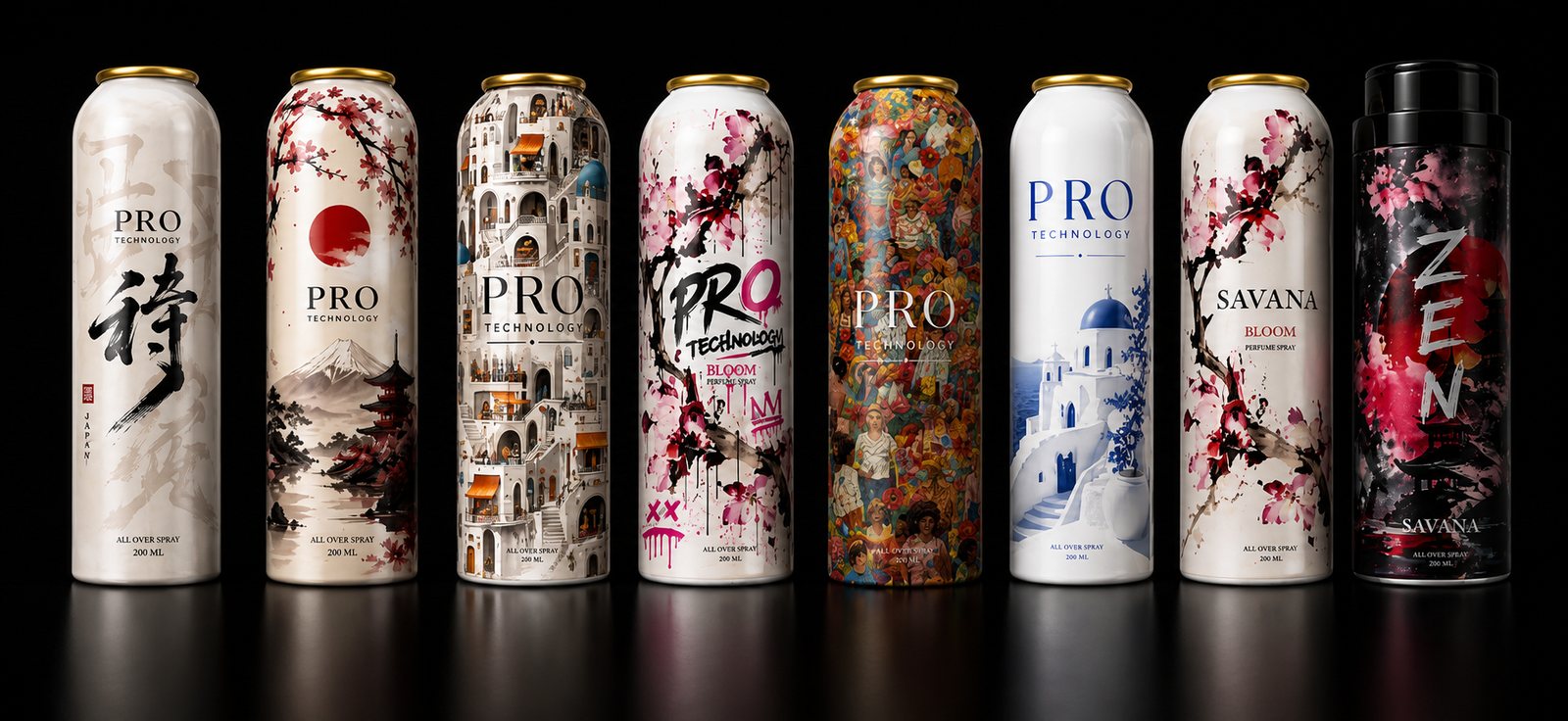
The all-over printed aerosol can is a common look for body spray and fragrance in the Gulf: artwork wrapping the full can, no label edge, no sleeve, often with a raised or gloss finish that a label cannot reproduce. Producing it in-house comes down to two questions, which LSINC machine matches your volume, and what capacity you can realistically expect from it. This guide answers both, and separates rated machine speed from the throughput a real production floor achieves.
Key takeaways
- LSINC rates the PeriOne at a maximum of 282 pieces per hour (manual feed, one object) and the PeriQ360 at 1,146 (semi-automatic, four objects), both at a 4-inch (101.6 mm) artwork height; a full-wrap can carries taller artwork, so it runs slower.
- LSINC rates the Perivallo360m at a maximum of 174 pieces per hour at the same artwork height; its single-spindle shuttle and contour-adapting printheads follow tapers up to ±30° for irregular containers.
- All three of the LSINC Peri models we supply carry a minimum run length of one piece, so no order quantity floor applies to samples or launch batches.
- Aluminium cans vary by supplier and coating, so clean them, prime where required, print a test batch and run adhesion tests before production.
What all-over printing actually means on a can
All-over, sometimes written as 360 degree printing, means the decoration covers the full circumference of the container with no start and no finish. There is no paper label, no shrink sleeve and no adhesive anywhere in the process. The can rotates while printheads lay down CMYK together with white and varnish: white gives colours a base to sit on so they stay dense over bare or coloured aluminium, and varnish adds gloss, matte, or raised and embossed effects. The result is decoration that belongs to the can rather than something applied to it.
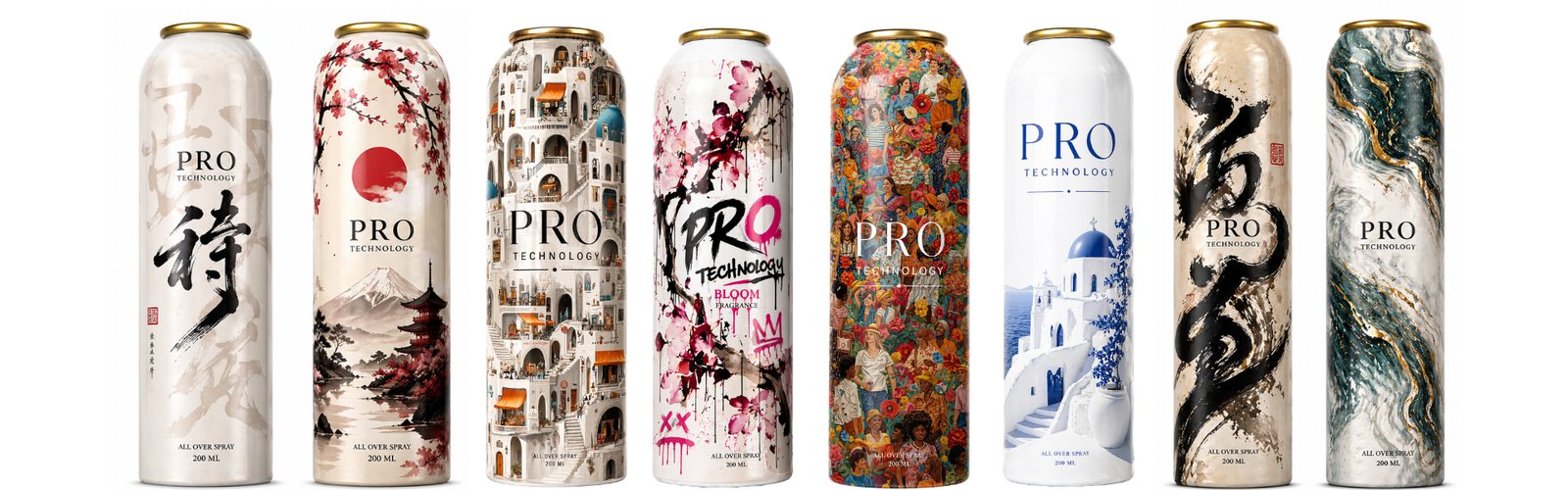
That freedom changes what a fragrance brand can put on shelf. Photographic artwork, gradients, dense illustration and fine calligraphy all print in a single pass, and because nothing is pre-printed, every can in a run can differ from the one before it.
The three LSINC Peri models we supply, and the capacity each is built for
LSINC’s cylindrical range is deliberately split by production scale rather than by print quality, and the published rated speeds make the intended fit clear.
| Model | Rated speed | Feed | Objects | Operators | Built for |
|---|---|---|---|---|---|
| PeriOne | 282 pieces per hour | Manual | 1 | 1 | Low to mid volume, sampling and short runs |
| PeriQ360 | 1,146 pieces per hour | Semi automatic | 4 | 1 to 2 | High volume, multi shift body spray production |
| Perivallo360m | 174 pieces per hour | Manual, single-spindle shuttle | 1 | 1 | Contoured and irregular containers |
All three carry a minimum run length of one piece, which is worth stating plainly: there is no tooling-driven minimum order quantity, although artwork set-up and a test print are part of every run, so short runs cost more per can. Full specifications and the model comparison table are on the LSINC bottle printing machines page. The same three machines on perfume bottles, cosmetics, candle jars and drinkware are covered in our LSINC applications guide, and fragrance houses choosing between can, bottle and flatbed decoration will find the buying questions on our page on perfume and cosmetic bottle printing machines.
Rated speed is not the same as your output
Rated speed is LSINC's maximum at a 4-inch (101.6 mm) artwork height, set by image height, resolution and print mode. What a production floor actually achieves depends on variables the datasheet cannot know: can diameter and height, how much of the surface the artwork covers, whether white is being laid as a base, how cans are loaded and unloaded, how many operators are on the cell, and whether pre-treatment or priming sits in the same workflow. A can with full-coverage artwork over a white base is a different job from a two-colour logo, even on the same machine.
The practical way to plan is to work from your own numbers rather than from a headline figure. Take the target daily volume, divide by realistic working hours, and check the result against rated speed with sensible headroom for changeovers and handling. When we quote a machine we run this calculation against real cans and real artwork, because a capacity figure that ignores your packaging is not a useful basis for an investment decision.
Adhesion on aluminium cans: the part to test
Aluminium spray cans are not a single substrate. Coatings, lacquers, finishes and suppliers vary, and the same artwork that holds perfectly on one batch can fail a tape test on the next. The correct sequence is the same one we apply across every substrate: clean the cans, establish whether a primer or pre-treatment is needed for that specific can, print a test batch, and run adhesion tests before approving production. Our guides to UV printing adhesion and surface pre-treatment cover the methods, and Marabu inks and primers are stocked locally for the cases that need them.
In production environments we recommend qualifying the exact can, from the exact supplier, before committing to a run, and re-testing when the supplier or the can specification changes.
LSINC machines and support in the Middle East
PRO TECHnology is LSINC’s exclusive dealer for the Middle East and North Africa, appointed on 7 December 2023, supplying the Peri series from Dubai as part of its Digital Printing division. That covers the machine, installation and commissioning, operator training, inks and primers, and local technical support across the UAE, Saudi Arabia and the wider GCC, the practical infrastructure that decides whether a printer stays productive after month one. See our full guide to LSINC cylindrical UV and bottle printing machines for the model-by-model specifications.
Two routes exist depending on where you are. Brands and contract decorators building capacity buy the machine and run it in-house, with material trials on their own cans before committing. Brands that want printed product without owning hardware run volume through Sun Studio, the group UV printing studio in Al Quoz; that operation and its economics are documented in our PeriQ360 production line case study. The wider technology comparison sits in our cylindrical UV printing guide.
Frequently asked questions
Which LSINC machine prints all-over body spray cans?
All three models print cylindrical containers, but they target different volumes. LSINC rates the PeriOne at a maximum of 282 pieces per hour at a 4-inch artwork height, with manual feed and one object at a time, suited to low and mid volume. The PeriQ360 is rated at a maximum of 1,146 pieces per hour at the same artwork height, with semi-automatic feed handling four objects, built for high-volume multi-shift production. The Perivallo360m is rated at a maximum of 174 pieces per hour and uses a single-spindle shuttle with printheads that adapt to contours, so it handles shapes the other models cannot.
What is the capacity of the LSINC PeriQ360?
LSINC rates the PeriQ360 at a maximum of 1,146 pieces per hour at a 4-inch (101.6 mm) artwork height. It uses semi-automatic feed, handles four objects at a time and runs with one to two operators. Rated speed is a machine capability figure; the output a specific site achieves depends on can geometry, artwork coverage, feed method and operator staffing.
What does all-over printing mean on a body spray can?
The artwork wraps the full 360 degrees of the can with no label, no shrink sleeve and no adhesive, and no seam or gap where a label would start and end. LSINC printers lay down CMYK plus white and varnish, so white can act as a base coat on metal and varnish can add gloss, matte or raised and embossed effects.
Can I print short runs or a single can?
Yes. LSINC lists a minimum run length of one piece. Because the process is digital there are no plates, screens or tooling per design, so a one-off sample, a fifty-piece launch batch and a full production run go through the same digital workflow; each still needs artwork preparation, a recipe check and a test print, so the cost per can falls as the run grows.
Can each can carry different artwork or a different name?
Yes. Variable data and personalisation print piece by piece without stopping the line, which is what makes named editions, numbered runs and event-specific packaging practical on the same machine that runs standard production.
Does ink stick to an aluminium spray can?
With correct preparation, yes, and this is the part that deserves testing rather than assumption. Aluminium cans vary by supplier, coating and finish, so the right approach is to clean the cans, apply a primer or pre-treatment where the specific can requires it, print a test batch and run adhesion tests before approving production.
Who supplies and supports LSINC printers in the Middle East?
PRO TECHnology is LSINC's exclusive dealer for the Middle East and North Africa, appointed on 7 December 2023, based in Dubai, and supplies the machines together with installation, operator training, inks, primers and local technical support across the UAE, Saudi Arabia and the wider GCC.
Can I see a body spray can printed before I buy a machine?
Yes. Send your actual cans and artwork and we will print and test them, which is the only reliable way to see both the finish quality and the adhesion result on your own packaging. Production volumes can also run through Sun Studio, the group UV printing studio in Al Quoz, if you want output before owning hardware.
طباعة علب بخاخ الجسم بالكامل: ماكينات LSINC وطاقتها الإنتاجية
الطباعة الشاملة 360 درجة على علب بخاخ الجسم والعطور تعني تغطية كامل محيط العلبة دون ملصق ورقي أو غلاف انكماشي أو مادة لاصقة، مع ألوان CMYK والأبيض والورنيش الذي يمنح لمعانًا أو تأثيرًا بارزًا. تختلف الطاقة الإنتاجية بحسب الطراز: PeriOne بمعدل أقصى 282 قطعة في الساعة عند ارتفاع تصميم 4 بوصات للإنتاج المنخفض والمتوسط، وPeriQ360 بمعدل 1,146 قطعة في الساعة للإنتاج الكبير متعدد الورديات، وPerivallo360m بمعدل 174 قطعة في الساعة برؤوس طباعة تتكيف مع الأشكال المنحنية. الحد الأدنى للتشغيل قطعة واحدة، مع إمكانية طباعة بيانات متغيرة وتخصيص كل علبة. تعتمد النتيجة الفعلية على شكل العلبة ونسبة التغطية وطريقة التلقيم، كما يتطلب الألومنيوم تنظيفًا واختبار التصاق وربما برايمر قبل الإنتاج. بروتكنولوجي هي الموزع المعتمد لماكينات LSINC في الشرق الأوسط من دبي، مع التركيب والتدريب والأحبار والدعم الفني في الإمارات والسعودية ودول الخليج.
Send us your cans before you decide
Send the actual cans and the artwork. We will print them, test adhesion and calculate realistic throughput against your target volume, so the machine you choose is sized on your production, not on a datasheet.