Cylindrical UV Printer Buying Guide: LSINC PeriOne, PeriQ360 and Perivallo360m Compared
Published · PRO TECHnology Digital Printing
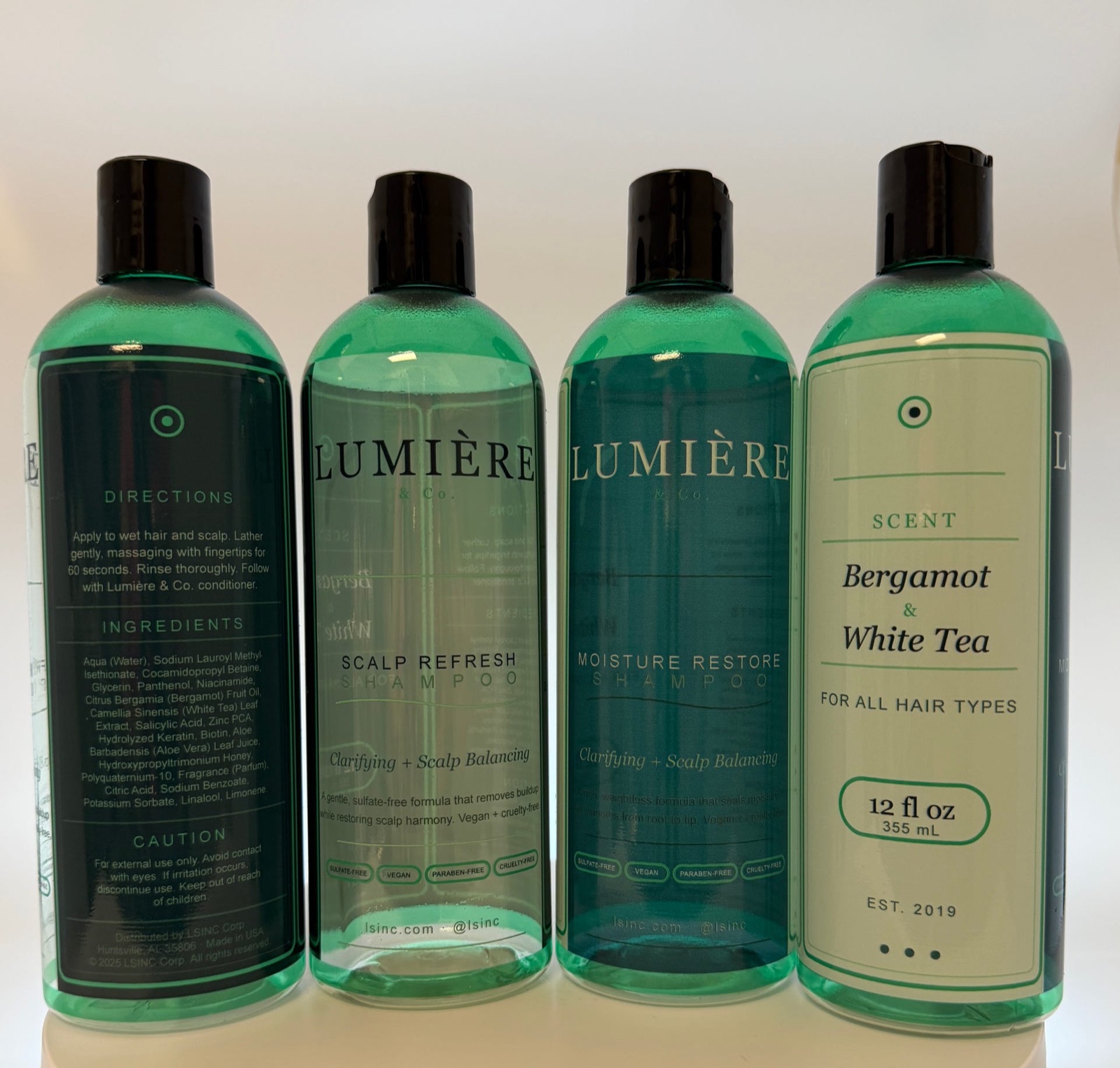
A cylindrical bottle printer prints artwork straight onto a bottle or can while the item turns on a spindle, so the design wraps the whole container and no label is used. The engineering terms follow below; this is the plain version. LSINC Corporation is a US manufacturer of direct-to-object printers, based in Huntsville, Alabama, and the maker of the Peri Series: the PeriOne, the PeriQ360 and the Perivallo360m. An LSINC cylindrical UV printer decorates a finished container by holding it on a spindle and jetting UV-curable ink onto the surface as the piece rotates, so the artwork wraps a seamless 360° round the item and is cured by LED lamps on the machine, with no label, adhesive or sleeve involved. PRO TECHnology, in Dubai, is LSINC's exclusive dealer for the Middle East and North Africa, and supplies, installs and supports the machines across the UAE, Saudi Arabia, Qatar, Kuwait, Bahrain, Oman, Jordan and Egypt. They print glass and PET bottles, perfume and cosmetic containers, beverage and aerosol cans, drinkware, and glass and ceramic candle vessels.
Key takeaways
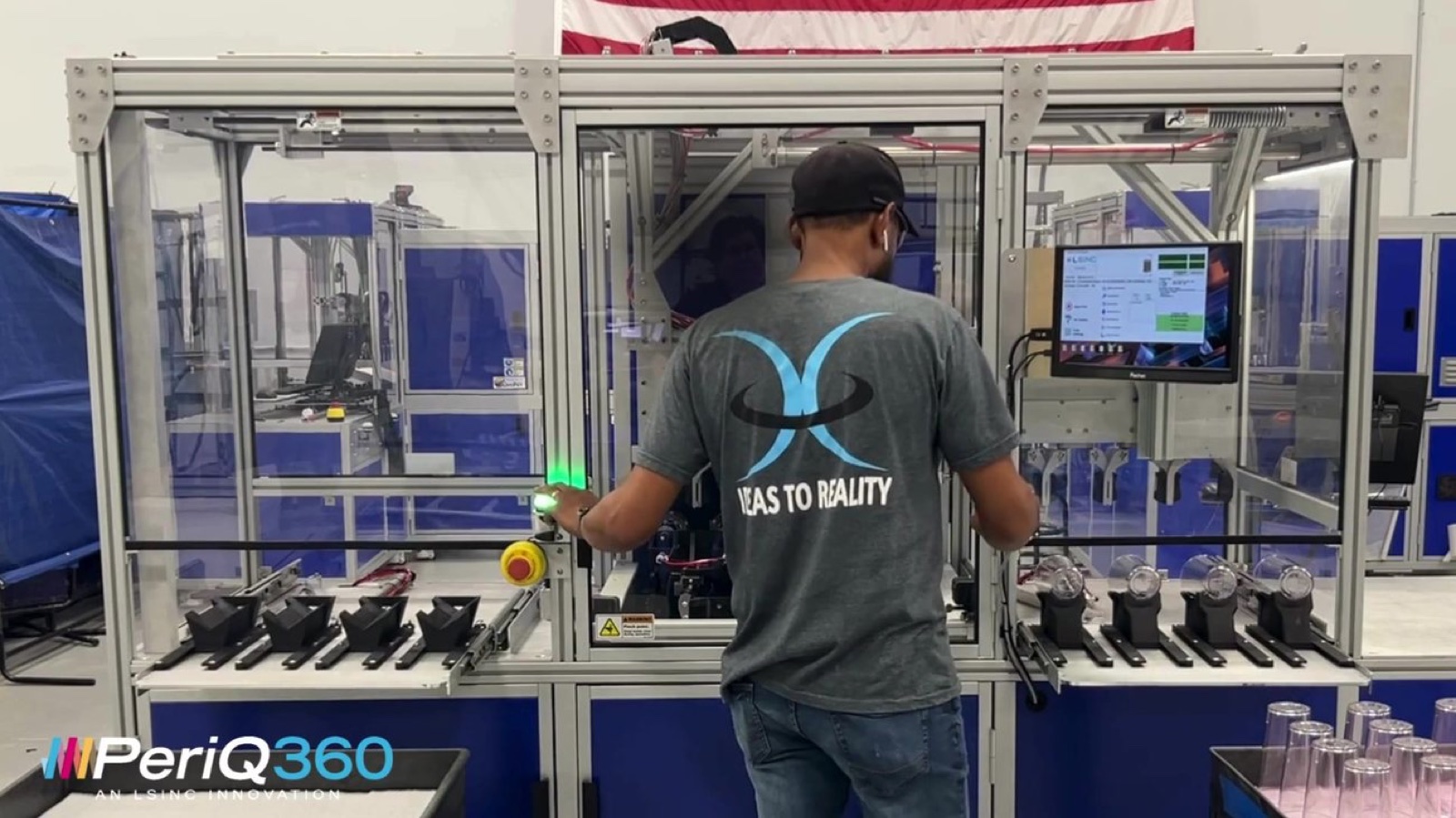
- Three models, one architecture. The PeriOne, PeriQ360 and Perivallo360m are helical printers built on the JetINX print engine with Ricoh Gen4 piezoelectric heads, up to seven inks as standard, Onyx Thrive RIP and a 21 inch on-board controller. Item diameters run from 0.75 inch (20 mm) on the Perivallo360m up to 6 inch (152 mm) on the PeriOne.
- Throughput at 4 inch (101.6 mm) artwork height: PeriQ360 up to 19.1 pieces per minute, 1,146 per hour or 9,168 per 8-hour shift; PeriOne up to 4.7 per minute, 282 per hour or 2,256 per shift; Perivallo360m up to 2.9 per minute, 174 per hour or 1,392 per shift. These are maximums that depend on image height, resolution and mode.
- Clear glass without a barrier. The PeriOne and the PeriQ360 print clear or coloured glass with no barrier required — LSINC calls this "Barrier-Free Printing on Clear Media" — and on the Perivallo360m clear media is an upgrade rather than standard. It is a machine capability, not a substitute for white ink: white remains part of the CMYKW, CMYKWV and PCMYKWV sets and is still laid down where the artwork needs opacity.
- Independently recognised. The PeriQ360 won the 2021 Pinnacle Award in the PRINTING United Alliance's Direct to Shape Printers (not flatbed) category, and the PeriOne won the 2022 Pinnacle Award for Best Direct-to-Object Printer (non-flatbed).
- Installed and supported in the region. PRO TECHnology has been LSINC's exclusive MENA dealer since December 2023 and exhibited alongside LSINC at FESPA Middle East, Dubai Exhibition Centre, 29-31 January 2024. In Saudi Arabia, Pure Beverages Industry Company integrated a PeriOne in Q2 2024 and added a PeriQ360 in April 2025.
What is a cylindrical UV printer?
A cylindrical UV printer decorates round objects — bottles, cans, tumblers, jars — by jetting UV-curable ink straight onto the item while it rotates on a spindle. LED lamps cure the ink on the machine as the job runs. The artwork wraps a full 360° around the object itself, so the decoration is part of the piece rather than a label, sleeve or transfer applied to it afterwards.
How the ink goes down and how it cures
The process is non-contact. Piezoelectric print heads jet droplets of UV ink at the surface as it passes beneath them; nothing touches the object except the ink. Curing then happens in two stages. During printing the ink is pinned, which fixes each droplet enough to control spread before the next colour lands on it. Once printing is complete, a final UV cure is applied to the finished image. The curing lamps are LED.
Rotation is what makes the wrap possible. The object is held on a spindle and turned while the heads lay the image down, so the artwork runs continuously round the circumference instead of stopping at a panel edge. On the PeriOne, the PeriQ360 and the Perivallo360m the print type is helical: the piece rotates and the image is written in a spiral path, which is how a seamless, edge-to-edge 360° print is produced in one pass of the object through the engine.
The architecture shared across the Peri Series
These machines are built on the JetINX print engine. The three helical models — PeriOne, PeriQ360 and Perivallo360m — use Ricoh Gen4 piezoelectric print heads with the JetINX Printhead Drive and an ink recirculation system for ink management and delivery, and they run LSINC's proprietary Perivallo Workbench software, which is what provides the seamless 360° helical printing. Up to seven inks can be loaded in the standard configuration, with ink levels monitored on the HMI. The operator works at an on-board controller on a 21 inch display, which doubles as the print queue and stores recipes for commonly manufactured products; the RIP is Onyx Thrive. Diameter Independent Resolution holds a fixed resolution so colour stays constant regardless of the diameter of the media on the spindle.
What the machine does not decide for you is adhesion. Pretreatment is listed as dependent upon substrate on every LSINC spec sheet, so a new material is tested before it goes into production. Our notes on adhesion testing and surface pre-treatment cover how that is done.
What is direct-to-object bottle printing?
Direct-to-object bottle printing is inkjet decoration applied straight onto a finished bottle or can. The container is held on a spindle and rotated past the print heads, so the artwork is laid down on the glass or metal itself. There is no label, no adhesive and no sleeve, and a run can be as short as a single piece.
One process, several names
The same process is called direct-to-object printing, direct-to-cylinder printing, direct-to-shape printing and digital bottle decoration. The wording changes with the audience rather than the method. LSINC markets its Peri Series as direct-to-object printers, while the PRINTING United Alliance judged the PeriQ360 in its "Direct to Shape Printers (not flatbed)" category when the machine won the 2021 Pinnacle Award. Packaging and marketing teams tend to say digital bottle decoration; production engineers tend to say direct-to-cylinder. It is worth asking which is meant when a specification is unclear, because the terms are used loosely across the market.
How it differs from a label or a shrink sleeve
A label or a sleeve is a separate printed carrier applied to the container. Direct-to-object printing removes that carrier: there is no label stock, no adhesive and no sleeve to buy, hold, apply or dispose of, and the decoration sits on the bottle surface itself. That changes the economics of short runs. LSINC lists a minimum run length of just one piece for the Perivallo360m, so a single named bottle, a proof or a small gift set can be produced without spreading an origination cost across a print run. The artwork is a file, so changing it between pieces is a software step rather than a new plate or die.
The ink is applied by a JetINX print engine, pinned during printing to control spread, then given a final UV cure once the image is complete. Adhesion is not automatic: LSINC specifies pretreatment as "dependent upon substrate" on every model, so each new combination of bottle, coating and ink should be tested before a production commitment. For a fuller comparison of printed glass against applied labels, see glass bottle printing methods.
How LSINC's helical 360° printing works
In helical printing the object rotates continuously on its spindle while the print head advances along the object's axis. The image is laid down as one continuous spiral rather than in discrete bands, so there is no seam between passes and no start and no finish to the wrap. That is how the Peri Series lays an edge-to-edge seamless 360° print around a bottle, tumbler or can.
The two motions are tied together: for every revolution of the object the head steps a set distance along it, so the printed path spirals across the artwork area in a single unbroken run. LSINC's proprietary Perivallo Workbench software provides the seamless 360° helical printing, driving the JetINX print engine with Ricoh Gen4 piezoelectric print heads, the JetINX Printhead Drive and ink recirculation. Ink is pinned during printing to control spread, and a final UV cure by LED lamp is applied once printing is complete. Up to seven inks can be loaded in the standard configuration.
Contour following on the Perivallo360m
PeriOne and PeriQ360 are helical machines rated to a maximum taper of +10°/-2°. The Perivallo360m is helical with contour following — LSINC describes it as a Seamless Full-Color Helical Printer with contour printing technology — and it prints cylinders, cones, tapers and contours to a maximum taper of ±30°, on items from 0.75 in (20 mm) to 5.5 in (139 mm) in diameter and up to 16 in (406 mm) long. Contour following is what carries the helical principle onto a shape whose diameter changes along its length.
Diameter Independent Resolution
Diameter Independent Resolution (DIR) enforces a fixed resolution so colour matching holds regardless of media diameter. It matters because a wider object presents more surface for every revolution than a narrow one. Without a fixed resolution the same file would be resolved differently on a 38 mm item and a 152 mm one, and the colour would drift between the two. DIR holds the resolution steady, so one brand colour reads the same across a family of container sizes. On the PeriQ360, G7 calibration between tunnels supports that consistency as well. It is one reason a dedicated cylindrical machine holds colour across several diameters.
Dedicated cylindrical printer or a flatbed with a rotary attachment?
It depends on how much of your work is round. A rotary attachment on a flatbed is a reasonable answer when cylindrical jobs are occasional and flat production pays for the machine. A dedicated cylindrical printer is built around the round object itself — spindle and shuttle transport, quick-change fixtures, stored recipes — and earns its place when round work is the main line rather than the exception.
What a purpose-built machine is engineered around
In the Peri Series the item is held on a spindle and carried into the print engine by a shuttle. The Perivallo360m uses a single-spindle shuttle system; the PeriQ360 uses a quad-spindle carriage that transports four pieces at a time. Fixtures are quick-change on both, so a line can move between products without rebuilding the way each piece is held. Around that transport sit four things a general-purpose machine is not designed to do:
- Feed and loading. Loading and unloading on the PeriQ360 is semi-automatic, with a feeder capacity of four items moved by pneumatic grippers and a pneumatic shuttle. Media can be loaded into the shuttle during the print cycle, which contributes to overall system speed. The PeriOne and Perivallo360m load manually, one item at a time.
- Colour across diameters. Diameter Independent Resolution (DIR) enforces a fixed resolution so colour stays constant regardless of media diameter. On the PeriQ360, G7 calibration between tunnels holds colour consistent across the four lanes.
- Repeatability between runs. The HMI is the print queue and stores recipes for commonly manufactured products, so a repeat order starts from a saved setup rather than a fresh one.
- Head upkeep. The PeriOne performs automatic wiping and capping of the inkjet heads.
When a rotary attachment is the right answer
If most of your output is flat and round items arrive now and then, a rotary accessory on a flatbed is a sensible piece of kit. It uses a machine you already own, it covers sampling and short one-off runs, and it does not ask for a second footprint or a second operator. The trade is simply what an accessory is not built around: the transport, fixturing, feed and colour controls above exist because on these machines the round object is the whole job.
So the decision is one of proportion, and of what you are being asked to hold. Our guide to choosing a UV printing machine works through the machine families in more detail. Whichever route you take, fixture suitability, geometry and configuration have to be confirmed for each application, and pretreatment is dependent upon substrate.
The LSINC Peri Series: three machines
PRO TECHnology supplies three of LSINC's helical direct-to-object printers for cylindrical work: the PeriOne, the PeriQ360 and the Perivallo360m. They share the same JetINX print engine with Ricoh Gen4 piezoelectric print heads and all print helically, so artwork wraps a full 360° without a seam. All three are driven from an on-board controller with a 21 inch display and ripped through Onyx Thrive, so the operator experience is consistent across the range. The specifications are set out below, then a short note on where each model sits.
| Model | Print type | Diameter range | Max item length | Max taper | Feed | Speed at 4 inch artwork |
|---|---|---|---|---|---|---|
| PeriOne | Helical | 1.5 to 6 in (38 to 152 mm) | 18 in (457 mm) | +10° / -2° | Manual, 1 item | Up to 4.7 per minute · 282 per hour · 2,256 per 8-hour shift |
| PeriQ360 | Helical | 1.5 to 4.5 in (38 to 114 mm) | 16 in (406 mm) | +10° / -2° | Semi-automatic, 4 items; pneumatic grippers and pneumatic shuttle | Up to 19.1 per minute · 1,146 per hour · 9,168 per 8-hour shift |
| Perivallo360m | Helical, contour following | 0.75 to 5.5 in (20 to 139 mm) | 16 in (406 mm) | +/- 30° | Manual, 1 item; single-spindle shuttle | Up to 2.9 per minute · 174 per hour · 1,392 per 8-hour shift |
Where each model sits
LSINC positions the PeriOne single-spindle printer as the ease of entry into direct-to-object printing: light production, prototyping and personalised media, loaded and unloaded by hand, one item at a time. It takes the widest diameter and the longest item in the series, and it prints on clear or coloured glass with no barrier required. The PeriOne won the 2022 Pinnacle Award for Best Direct-to-Object Printer (non-flatbed).
The PeriQ360 quad-spindle printer is the production model. Its carriage moves four pieces at a time into the print engine, and media can be loaded into the shuttle during the print cycle, which LSINC says contributes to the overall speed of the system. Barrier-Free Printing on Clear Media is listed among its features. That is a machine capability: no physical barrier is placed inside or behind the bottle to stop the UV light curing ink on the far wall. It does not mean white ink is unnecessary. White stays in the ink set and is still laid down wherever the artwork needs opacity or accurate colour on clear or dark media. The PeriQ360 won the 2021 Pinnacle Award for Best Direct-to-Object Printer (non-flatbed).
The Perivallo360m contour-following printer trades throughput for shape. Its +/- 30° taper and 0.75 in (20 mm) minimum diameter let it print cylinders, cones, tapers and contours, with a minimum run length of one piece. Clear media on this model is an upgrade rather than standard, which is the single most important thing to settle before specifying it for glass.
If you are weighing these three against each other for a specific product, our guide to choosing a UV printing machine works through the selection in order, and the commercial side — applications, model positioning, capacity and what an installation involves — is set out on our LSINC glass bottle printing machines page.
PeriQ360: printing four items at a time
The PeriQ360 is the production machine in the Peri Series. LSINC positions it as a "Production Focused · Quad Spindle Direct-to-Object Printer" and as the fastest production unit in its class, with the ability to print four items at a time. It won the 2021 Pinnacle Award for Best Direct-to-Object Printer (non-flatbed), in the PRINTING United Alliance competition's direct-to-shape category.
The quad-spindle carriage
A quad-spindle carriage transports four pieces at a time into the print engine. Loading and unloading are semi-automatic: the feeder holds four items, and pneumatic grippers and a pneumatic shuttle move them through. Media can also be loaded into the shuttle during the print cycle, so an operator fills the next set while the current four are printing; LSINC says that overlap contributes to overall system speed. Formats run from 1.5 inch (38 mm) to 4.5 inch (114 mm) diameter, up to 16 inch (406 mm) item length, with a maximum taper of +10°/-2°.
Rated speeds
| Interval | Items |
|---|---|
| Per minute | up to 19.1 |
| Per hour | up to 1,146 |
| Per 8-hour shift | up to 9,168 |
These are maximums at 4 inch (101.6 mm) artwork height. LSINC states that speed is determined by image height, resolution and mode, so a taller image or a higher resolution will bring the figure down. Real output also depends on artwork, coverage, part geometry, handling and staffing, so throughput for a given product should be confirmed against a sample and a run profile rather than read off the spec sheet.
Installation requirements
- Footprint: L 123 inch (312 cm) × W 95 inch (241 cm) × H 83.5 inch (212 cm).
- Weight: 3,600 lbs (1,632 kg), including infeed and delivery.
- Electrical: 16 A, 230 VAC, 50/60 Hz, single phase.
- Factory air: continuously available compressed air at a minimum of 120 psi (8.2 bar). If a feed system is installed, that rises to a minimum of 150 psi (10.3 bar).
Colour, data and fixtures
Three listed features matter once volume is the point. G7 calibration between tunnels is LSINC's stated method for colour consistency, which counts when four pieces are printed in the same cycle and have to match each other. Variable Data File Advanced Caching is the listed feature for variable-data work, where each item carries its own artwork or code. Quick-change fixtures let a line switch between products without a long changeover, and LSINC offers custom integration into an existing workflow. Ink handling is CMYKW, CMYKWV or PCMYKWV across seven standard ink channels.
The PeriQ360 prints on clear or coloured glass with no barrier required. LSINC calls this "Barrier-Free Printing on Clear Media", and it is a machine capability, not an ink one: white is still in the ink set and is still laid down whenever the artwork needs opacity or accurate colour on a transparent or dark substrate. Pretreatment remains dependent upon substrate and has to be confirmed by testing. Full specifications are on LSINC's PeriQ360 page, and our own Sun Studio PeriQ360 production case study shows the machine running.
Can LSINC printers print directly on clear glass bottles?
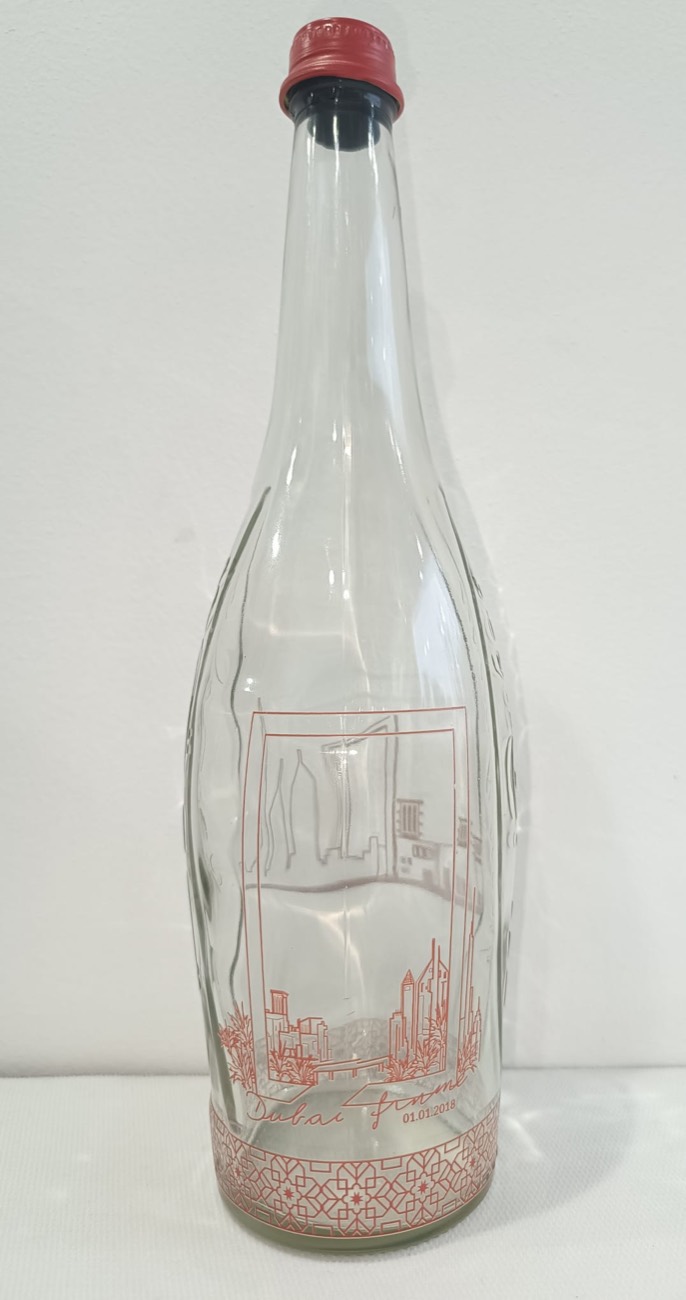
Yes. The PeriOne and the PeriQ360 print on clear or coloured glass with no barrier required, which LSINC calls Barrier-Free Printing on Clear Media. On the Perivallo360m, clear media is an available upgrade rather than a standard capability. Barrier-free describes what the machine can handle; it does not mean white ink is unnecessary, and pretreatment remains dependent upon substrate.
What barrier-free actually refers to
UV ink cures under light. On an opaque object that light stops at the wall it strikes. On clear glass it does not: the curing light passes through the bottle and can reach ink already laid on the far wall. The barrier some cylindrical processes use is a physical one, placed inside or behind the bottle to stop that light. LSINC's term means that step is not needed. The PeriOne and the PeriQ360 both state, on their specification sheets, that they print on clear or coloured glass with no barrier required. Ink is pinned during printing to control spread, and a final UV cure is applied once printing completes, with LED curing lamps.
Barrier-free does not mean white ink is unnecessary
This is the part that gets misread. Barrier-free is a description of what the machine can handle. It is not a claim that white ink can be left out. White is in the ink set on all three helical models: the PeriOne handles CMYKW, CMYKWV, PCMYKWV and CMYKCMWV, and the PeriQ360 and Perivallo360m handle CMYKW, CMYKWV and PCMYKWV, with seven ink channels standard on each. White is still laid down whenever the artwork needs opacity, or needs colours to read accurately on transparent glass rather than take on whatever sits behind the bottle. Multi-layer printing is how that white layer is placed under the colour where the design calls for it.
Where the Perivallo360m sits
Clear media is not standard on the Perivallo360m. Its brochure lists an upgrade available to print to clear media, so if transparent glass is part of the brief that model has to be specified with the upgrade rather than assumed to cover it. The PeriOne and the PeriQ360 are no-barrier as standard. The Perivallo360m earns its place for a different reason: it is a helical, contour-following machine that prints cylinders, cones, tapers and contours, with a maximum taper of plus or minus 30°.
None of this removes the need to test. Pretreatment is dependent upon substrate on every LSINC specification sheet, and a jettable primer is available on the PeriOne and the PeriQ360 subject to customer application, so adhesion on a particular glass has to be confirmed before a run is committed. Our guide to glass bottle printing methods covers the decoration decision, and our adhesion testing notes cover the checks themselves.
White ink, layered printing and tactile effects
Process colour is only part of what these machines lay down. LSINC lists the ink handling as CMYKW, CMYKWV and PCMYKWV, with a fourth configuration, CMYKCMWV, on the PeriOne only. The PeriOne, PeriQ360 and Perivallo360m each carry seven ink channels in the standard configuration. Beyond process colour those configurations carry white and at least one further channel, and it is those extra channels that do most of the work separating a printed object from a printed label. LSINC's published documents list the configurations as strings rather than expanding what each letter carries, so the exact ink set for a given machine is confirmed at specification.
What white does
White makes artwork read on media that is not white to begin with. On clear glass, colour on its own is seen against whatever sits behind the bottle; on a dark substrate it is seen against the substrate. A white layer underneath gives the design something to sit on, so it holds its opacity and its colours land as intended.
Two ideas are easy to confuse here. The PeriOne and PeriQ360 print on clear or coloured glass with no barrier required, and LSINC calls this Barrier-Free Printing on Clear Media. That is a machine capability: no physical barrier has to sit behind the glass to stop the UV lamp curing ink on the far wall. It does not mean white ink is unnecessary. White stays in the ink set and is laid down wherever the artwork needs opacity or accurate colour.
Layering, and what it makes possible
Every channel is jetted and cured the same way, and stacking them is what builds the raised finishes in LSINC's feature lists. Ink is pinned during printing to control spread and a final UV cure follows, so layers can be stacked deliberately rather than left to run together: multi-layer printing, listed on the PeriOne, PeriQ360 and Perivallo360m.
One use of that stack is reverse viewing. LSINC says multi-layer printing lets you create designs that can be viewed from both sides of clear media: the layers are ordered so the design also reads through the glass from the far side. On the Perivallo360m, clear media is an upgrade rather than standard, so this applies only where the upgrade is fitted.
Tactile effects and faux embossing
LSINC's own terms are tactile effects and faux embossing, both listed on the PeriOne and the PeriQ360. The Perivallo360m brochure lists tactile effects (cartouche) and says tactile effects can be used to simulate embossing. In LSINC's PBIC case study, the PeriOne let the customer personalise glass bottles with high-resolution images, tactile effects and faux embossing.
Be clear about what faux embossing is. The relief is built up from cured ink layers on the surface of the object; the glass, metal or plastic underneath is untouched. It is not true embossed or moulded glass, where the relief is formed in the material itself. It is a printed effect you can feel, on a standard container — which is why it suits short runs and personalisation.
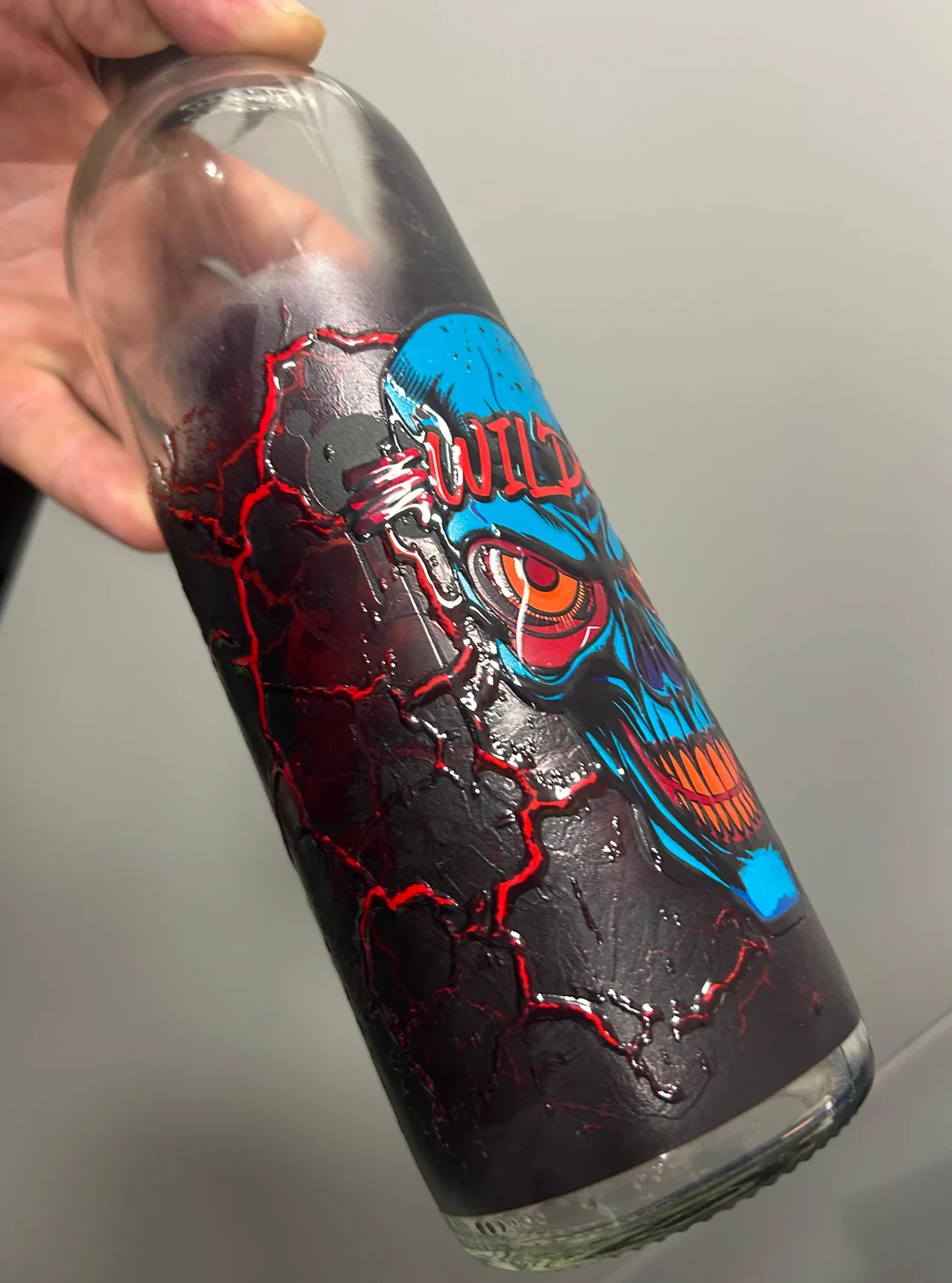
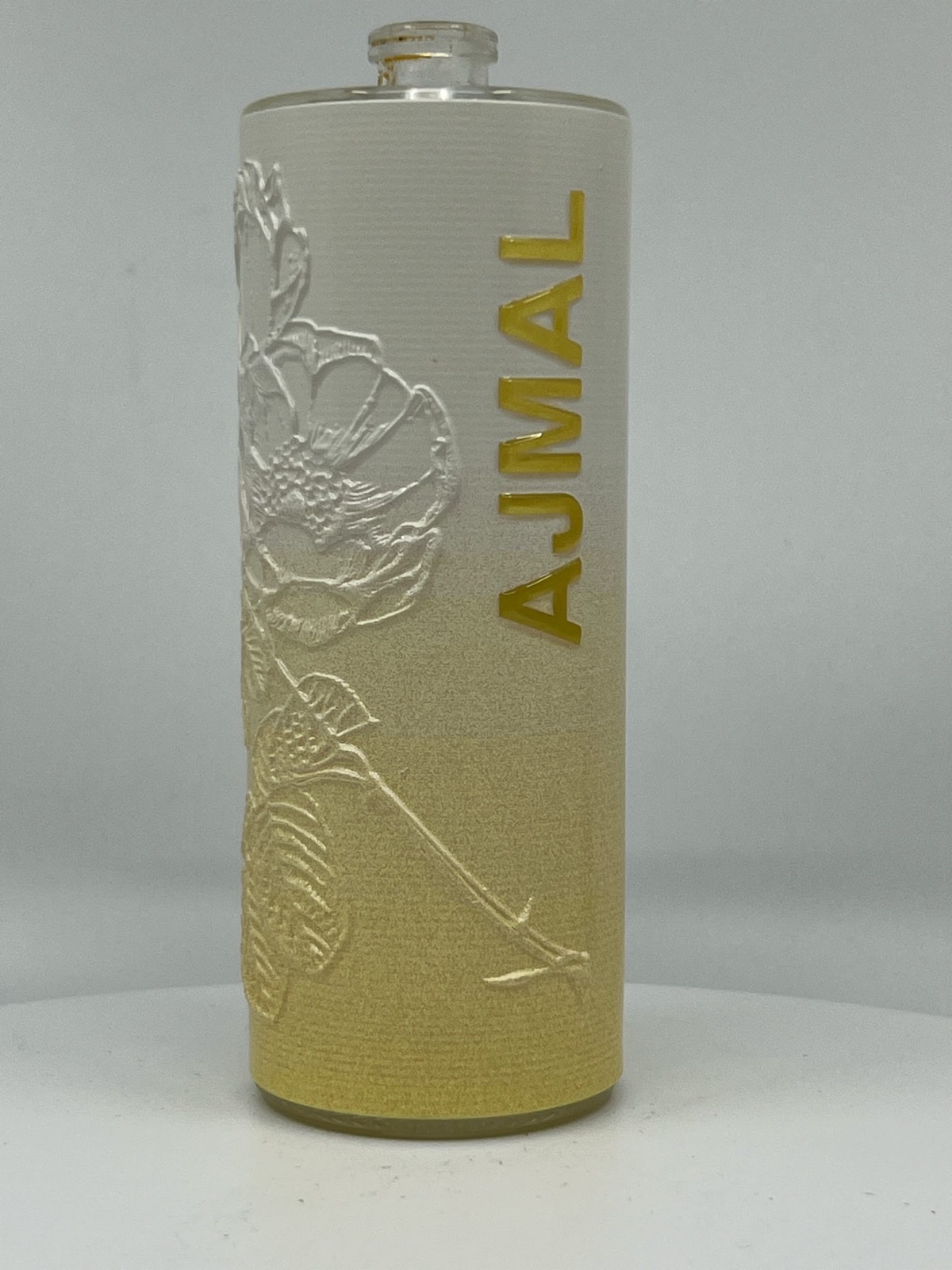
Pretreatment is dependent upon substrate on every model, so white opacity, the built-up relief and adhesion should all be proved on your own container first. Our notes on adhesion testing set out how.
UV printing on perfume bottles and cosmetic packaging
Cosmetics are a named application for every helical machine in the Peri Series. PeriOne, PeriQ360 and Perivallo360m all list cosmetic work on their published application sheets, and the same JetINX engine handles perfume and fragrance bottles, body spray containers, skincare and serum bottles, jars, and cylindrical caps and tubes wherever the shape sits inside the machine's geometry envelope. The artwork goes onto the container itself: no label, no sleeve, no separate decorating step. Flat-fronted perfume bottles are a flatbed job rather than a cylindrical one; our flat perfume bottle printing article and the UAE perfume manufacturer case study cover that route.
Clear glass is where one distinction has to be right. PeriOne and PeriQ360 print on clear or coloured glass with no barrier required, which LSINC markets as Barrier-Free Printing on Clear Media; on the Perivallo360m, clear media is an upgrade rather than a standard capability. Barrier-free describes the machine, not the ink. White remains part of the CMYKW, CMYKWV and PCMYKWV ink sets and is still laid down whenever the design needs opacity or accurate colour on transparent or dark glass. Multi-layer printing, tactile effects and faux embossing are available on all three machines.
The commercial case for short runs
Fragrance and beauty run on versions: limited and seasonal editions, gift sets, regional and language variants, influencer and event pieces, and personalisation down to a single name. Decorating the container directly means each version is a file rather than a new printed label commissioned, approved and stocked for every variant. The Perivallo360m has a minimum run length of just one piece and is built for print on demand; the PeriQ360 adds Variable Data File Advanced Caching for personalised production; both use quick-change fixtures, and the HMI stores recipes for products you make repeatedly.
Not every bottle shape qualifies
Fragrance packaging is designed for the shelf, not for a spindle, so each container has to be assessed before anything is promised. What gets checked:
- Diameter and length against the model's published limits.
- Taper. The Perivallo360m accommodates the widest range of shapes in the family, printing cylinders, cones, tapers and contours at up to +/- 30° taper and down to a 0.75 in (20 mm) minimum diameter, against +10°/-2° taper and a 1.5 in (38 mm) minimum on PeriOne and PeriQ360.
- Shoulder and neck geometry, and how much continuous print area the decorated band actually leaves.
- Fixture requirements, since fixture suitability, geometry and configuration must be confirmed per application.
- Substrate chemistry. Pretreatment is dependent upon substrate on every LSINC spec sheet, so adhesion is proven by testing on the real container, never assumed.
Some shapes fall outside the envelope, and it is better to establish that with a sample than after a purchase order. For a working example, see our Sun Studio body spray and perfume printing case study, and can and container capacity model by model for the published diameter and length limits in full.
Water, wine, spirits and beverage bottles
Beverage runs through the whole range. Wine and spirits are in the listed applications of all three helical machines; the PeriOne also lists beverage cans, the PeriQ360 lists beverage and the Perivallo360m specialty beverage. What differs between them is the shape each will hold, the run length it suits and how fast it moves.
Glass water bottles and premium water packaging
Clear glass is where these machines are unusual. The PeriOne and the PeriQ360 print on clear or coloured glass with no barrier required, which LSINC markets on the PeriQ360 as "Barrier-Free Printing on Clear Media". That is a machine capability, and it needs stating plainly: no physical barrier has to be placed inside or behind the bottle to stop the UV light curing ink on the far wall. It does not mean white ink is unnecessary. White remains part of the ink set — CMYKW, CMYKWV, PCMYKWV — and is still laid down whenever the artwork needs opacity or accurate colour on a transparent substrate. On the Perivallo360m, clear media is an upgrade rather than a standard capability.
Size covers most of the category: the PeriOne takes bottles up to 6 inches (152 mm) in diameter and 18 inches (457 mm) long, the PeriQ360 up to 4.5 inches (114 mm) and 16 inches (406 mm). Multi-layer printing, tactile effects and faux embossing are how a premium water bottle gets decoration that is felt as well as seen.
Wine, spirits and distillery packaging
Bottle shape decides the machine. The Perivallo360m prints helically with contour following on cylinders, cones, tapers and contours, to a maximum taper of +/- 30° and down to a 0.75 inch (20 mm) minimum diameter, which is what a shouldered or necked bottle asks for. Its minimum run length is one piece, so a single sample or a short distillery release is a legitimate job. Where volume matters, the PeriQ360 carries four pieces at a time and holds Variable Data File Advanced Caching, for numbered or individually addressed limited editions.
Beverage bottles and cans
The PeriQ360 is the production unit: a quad-spindle carriage transports four pieces into the print engine at once, and media can be loaded into the shuttle during the print cycle. At a 4 inch (101.6 mm) artwork height it runs up to 19.1 pieces per minute, up to 1,146 per hour and up to 9,168 per 8-hour shift — maximums determined by image height, resolution and mode. Cans are listed too, beverage cans on the PeriOne and paint and aerosol cans on both, with capacity by model on our can printing page.
PBIC, Saudi Arabia: Ival and Oska
Pure Beverages Industry Company (PBIC) in Saudi Arabia, which owns the Ival and Oska bottled water brands, integrated a PeriOne in Q2 2024 and added a PeriQ360 in April 2025 to scale production. LSINC states that the PeriOne supported glass, metal, wood, plastic and ceramic, and let PBIC personalise glass bottles with high-resolution images, tactile effects and faux embossing. The full write-up is on our PBIC case study page, and LSINC publishes its own account of the installation.
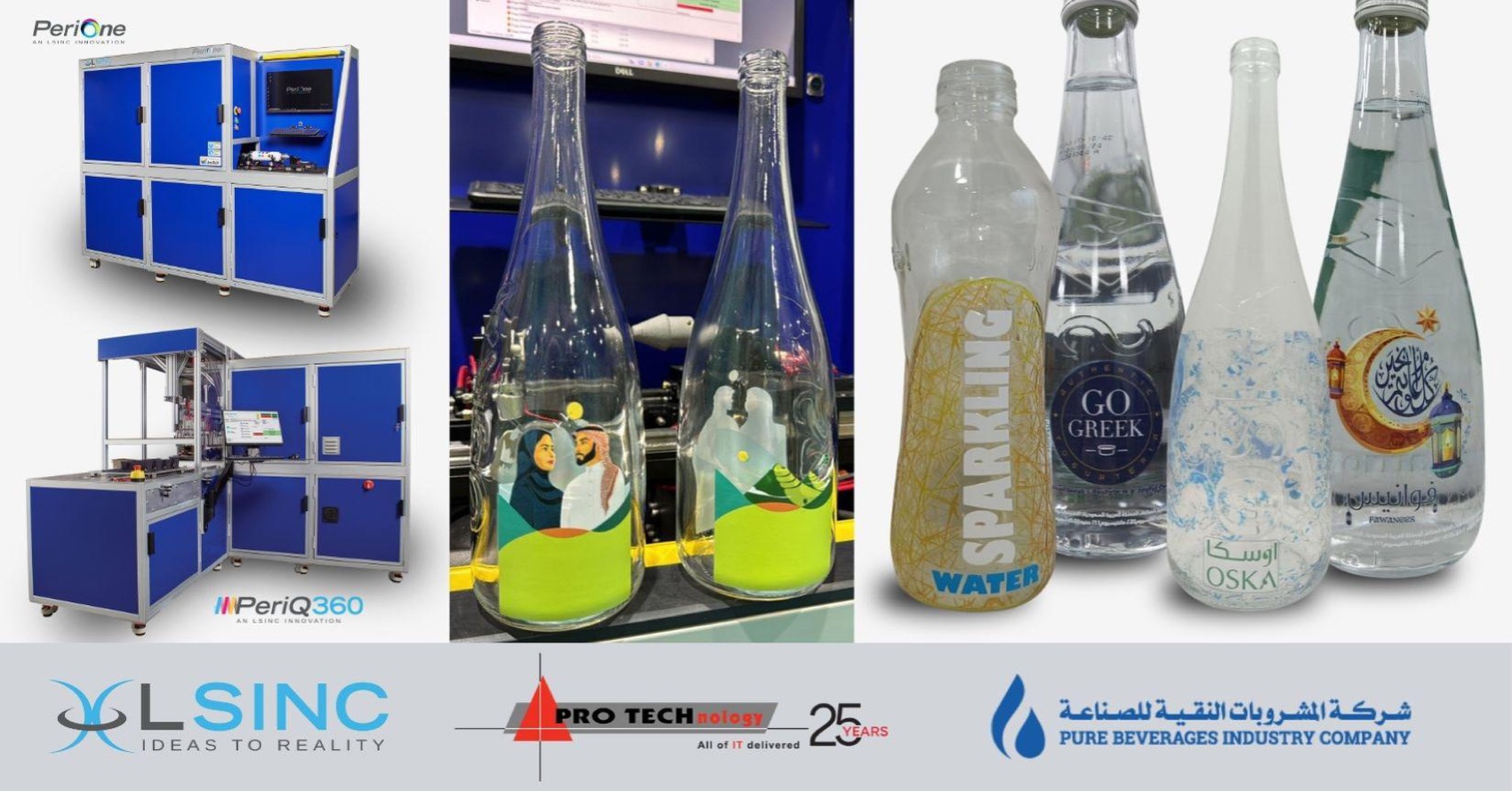
Our page on direct-to-bottle printing for beverage manufacturers covers R&D and procurement. Two things apply to every bottle: pretreatment is dependent upon substrate, so a new glass or PET is tested before production, and fixture suitability, geometry and configuration have to be confirmed for each application.
Which materials can be decorated, and what pre-treatment is needed?
LSINC names glass, metal, wood, plastic, paper and ceramic as substrates its direct-to-object printers decorate. Whether a particular item holds the ink is a separate question from whether the machine can hold and print it. Adhesion is decided at the surface, and every LSINC spec sheet lists pre-treatment as "Dependent upon substrate", so the only reliable answer for a new product is the one a test on that product gives you.
The substrates LSINC names
The PeriOne and PeriQ360 sheets both list printing on glass, metal, wood, plastic and paper. Ceramic appears as well: LSINC groups glass and ceramic candle vessels among PeriOne applications, and in its published account of Pure Beverages Industry Company in Saudi Arabia it states that the PeriOne supported glass, metal, wood, plastic and ceramic. That is the list, and it is not a claim that these machines print on anything. A substrate outside it, or an unfamiliar coating on one inside it, stays an open question until it has been run.
Adhesion is a surface question, not a printer question
Two bottles of the same material can behave differently. What decides the outcome is surface chemistry, any coating, lacquer or release agent already on the part, surface energy, and how clean the item is when it reaches the fixture. Ink configuration counts too. On the PeriOne, PeriQ360 and Perivallo360m up to seven inks are available in the standard configuration, in sets such as CMYKW, CMYKWV and PCMYKWV, and white is laid down where the artwork needs opacity. So does curing: ink is pinned during printing to control spread, with a final UV cure from LED lamps once printing completes.
A jettable primer is available on the PeriOne and the PeriQ360, subject to customer application. Where a surface needs conditioning before it reaches the printer rather than a primer jetted by the machine, that is a separate step. Our notes on surface pre-treatment and on inks and primers set out the options we work with in the region.
Test on the actual product first
Send us the real item in the state it will arrive in production: same supplier, same coating, same handling. We print it, cure it, and put it through the checks that matter to your customer before anyone commits to a run. Our guide to adhesion testing covers how that is done and what a pass should look like. We will not promise adhesion on an untested substrate, and LSINC's own documentation does not either.
Direct printing compared with labels and screen printing
Direct-to-object printing puts the image on the item itself. A label or sleeve puts it on a carrier made separately and applied afterwards. Screen printing decorates the object directly too, but through a screen prepared for each colour. None replaces the others; the split is run length, artwork and how often it changes.
Against labels and sleeves
Direct decoration removes the carrier and everything attached to it: label stock, adhesive, the application step on the line, and a separately held inventory for every version and market variant. Because the artwork is a file, the run can be as short as the order — the Perivallo360m lists a minimum run length of just one piece, and is sold for print on demand — and a revised design leaves no obsolete stock behind.
Labels still make sense in plenty of cases. They go onto shapes a fixture cannot hold, and onto substrates that have not yet passed adhesion testing. They carry content that changes late, or that is controlled separately from the decoration. And on a filling line already built around a labeller, direct printing is a change to the line rather than a straight swap. See how direct printing compares with labels, sleeves, screen printing and fired decoration in our guide to glass bottle printing methods.
Against screen printing
| Consideration | Digital direct-to-object | Screen printing |
|---|---|---|
| Setup and tooling | A file moves from the Onyx Thrive RIP to the HMI queue. Quick-change fixtures, stored recipes. | A screen prepared and registered per colour: a fixed cost before the first piece. |
| Artwork changes | A revised file replaces the old one; nothing is remade. | New screens for the colours affected. |
| Short runs | Suited to them; the Perivallo360m lists a minimum run of just one piece. | Setup is spread across few pieces, so it weighs heavily. |
| Full-colour imagery | Photographic and gradient artwork, up to seven inks standard, white in every ink set. | Discrete colours, one screen at a time; strongest on solid, defined colour. |
| Variable data and personalisation | Every piece can differ. The PeriQ360 lists Variable Data File Advanced Caching. | Fixed by the screen; it does not vary piece to piece. |
| High-volume repeat work | The PeriQ360 prints four at a time: up to 19.1 per minute, 1,146 per hour, 9,168 per 8-hour shift. | Efficient for very long unchanging runs: tooling is made once and amortised across the order. |
| Specialty finishes | Multi-layer printing, tactile effects and faux embossing on the PeriOne and PeriQ360; tactile effects on the Perivallo360m. | Long-established specialty effects of its own, set when the screens are made. |
Variable data, and what it does not settle
Variable data is the clearest dividing line: a screen carries one fixed image. The PeriQ360 lists Variable Data File Advanced Caching, which matters when a job is made of many individual files rather than one repeated image. Names, codes and market variants run as one job, which is what makes short personalised work such as printed perfume and body spray practical.
Regulatory serialisation is a separate question. Whether a machine can put a unique code on each item is not the same as whether the scheme satisfies a regulator; that needs its own validation with the authority and the brand owner. Fixture suitability, geometry and configuration are confirmed per application, and pretreatment is dependent upon substrate.
How a bottle actually gets printed
The machine is only part of the job. On a helical Peri Series printer, the PeriOne, PeriQ360 or Perivallo360m, the sequence is the same every time, and most of what decides the result is settled before the first drop of ink reaches the glass.
- Assess the product and confirm the geometry. Diameter, length and taper are checked against the envelope of the machine that will run the work, because each model has its own diameter range, maximum length and maximum taper. Fixture suitability, geometry and configuration have to be confirmed per application.
- Clean and, where the substrate requires it, pre-treat or prime. LSINC lists pretreatment as dependent upon substrate on every model's spec sheet, and a jettable primer is available on the PeriOne and the PeriQ360, subject to the customer application. What a given bottle needs is settled by adhesion testing on the real item, not by assumption.
- Prepare the artwork and separate the layers. Colour, white and any additional channels are built as separate layers, so opacity, image and any tactile effect are prepared as distinct layers rather than one flattened file. Files are ripped in Onyx Thrive.
- Fit the fixture. The item is held on the spindle by the fixture made for its shape. Quick-change fixtures are a listed feature on the PeriQ360 and Perivallo360m, so a line can change product without a long changeover.
- Select or build the recipe. The HMI is the print queue and stores recipes for commonly manufactured products, driven from an on-board controller on a 21 inch display. Ink configuration is set here, CMYKW, CMYKWV or PCMYKWV, with seven ink channels standard, and ink levels are monitored on the same screen.
- Load the item. The PeriOne and Perivallo360m are loaded manually, one piece at a time. The PeriQ360 takes four, carried into the print engine by a quad-spindle carriage, and media can be loaded into the shuttle during the print cycle.
- Print. The object rotates for seamless 360° helical printing under the Ricoh Gen4 heads, and the ink is pinned as it goes down to control spread. Diameter Independent Resolution holds a fixed resolution so colour stays constant regardless of media diameter.
- Cure. A final UV cure, by LED lamp, is applied once printing completes.
- Inspect, then release. Colour, registration and adhesion are checked before the run is released.
LSINC cylindrical printers in the UAE, Saudi Arabia and the wider MENA region
PRO TECHnology is based in Dubai and is LSINC's exclusive dealer for the Middle East and North Africa, an appointment announced in December 2023. The two companies exhibited together at FESPA Middle East, held at the Dubai Exhibition Centre from 29 to 31 January 2024. LSINC Corporation itself is in Huntsville, Alabama, and published its own announcement of the partnership. Under that appointment the Peri Series is sold into this region through PRO TECHnology.
The markets we already serve include the United Arab Emirates, Saudi Arabia, Qatar, Kuwait, Bahrain, Oman, Jordan and Egypt. The current full territory list is published on LSINC's Global Distributors page, which is the reference to check rather than any list reproduced here. Separately from the regional dealership, Roland DG holds a global distribution partnership with LSINC and lists the Peri Series among its printers.
What sits around the machine
A direct-to-object printer is a production machine rather than a boxed product, and LSINC treats it that way: alongside the printers the company provides consulting and custom engineering to integrate its technology into existing manufacturing operations. That is the part that matters when a printer has to take its place in a line that already exists, with the containers, volumes and handling that line already has.
One thing no specification settles in advance is adhesion. Pretreatment is listed as "Dependent upon substrate" on every LSINC spec sheet, which puts the ink-to-surface question with the container in front of you rather than with the model on the order. Our separate notes on adhesion testing, surface pre-treatment and inks and primers cover that ground, and how to choose a UV printing machine works through the selection questions in order.
The Peri Series already running in the region
LSINC's published regional reference is Pure Beverages Industry Company (PBIC) in Saudi Arabia, which integrated a PeriOne in the second quarter of 2024 and then added a PeriQ360 in April 2025. The detail is on our PBIC case study page. Within the group, Sun Studio, our production studio, is the subject of a PeriQ360 production case study covering body spray and perfume bottles — printed work you can look at before you read another specification table.
The rest of the company is set out on our about us page and on the Digital Printing division page. To take a machine question further, book a demo or contact us.
Frequently asked questions
What is a cylindrical UV printer?
A cylindrical UV printer prints artwork directly onto round objects such as bottles, cans, jars and drinkware, with no label and no transfer. The object rotates on a spindle while inkjet heads lay down ink and LED lamps cure it. LSINC calls this category direct-to-object printing. Its PeriOne, PeriQ360 and Perivallo360m print helically, so artwork can wrap the full circumference in one continuous pass.
What is a UV bottle printing machine?
A UV bottle printing machine is a direct-to-object printer built around container handling: fixtures that hold and rotate the bottle, an inkjet engine, and LED curing. LSINC machines use the JetINX print engine with Ricoh Gen4 piezoelectric print heads, up to seven ink channels in the standard configuration, and Onyx Thrive RIP software. Ink is pinned during printing to control spread, and a final UV cure is applied once printing completes.
Can you print 360 degrees around a glass bottle?
Yes. The LSINC PeriOne, PeriQ360 and Perivallo360m are helical printers running LSINC proprietary Perivallo Workbench software, which provides seamless 360 degree printing. The bottle rotates continuously as the head prints, so artwork wraps edge to edge without a visible seam or start point. How much of the bottle can actually carry artwork still depends on its geometry, the fixture used and the printable area confirmed for that specific container.
Can LSINC print directly on clear glass bottles?
Yes. The PeriOne and the PeriQ360 print on clear or coloured glass with no barrier required, and LSINC markets this as Barrier-Free Printing on Clear Media. On the Perivallo360m, clear media is an available upgrade rather than a standard feature. Barrier-free describes the machine, not the artwork. White ink remains part of the ink set and is still laid down whenever a design needs opacity or accurate colour on transparent glass.
What is the difference between a cylindrical UV printer and a flatbed with a rotary attachment?
A rotary attachment adapts a flatbed printer to occasional round work, which suits low volumes and mixed jobs on equipment a company already owns. A dedicated cylindrical machine is engineered around the container instead: helical printing for seamless 360 degree coverage, Diameter Independent Resolution so colour stays constant regardless of media diameter, quick-change fixtures, recipes stored on the HMI, and, on the PeriQ360, a quad-spindle carriage that moves four pieces at a time.
Can LSINC printers print perfume and cosmetic bottles?
Cosmetic containers are a listed application for the PeriOne, the PeriQ360 and the Perivallo360m, and the Perivallo360m also lists personalised gifts and prototyping. Suitability depends on the individual bottle: diameter, length and taper must fall inside the model limits, and fixture suitability, geometry and configuration have to be confirmed for each application. Pretreatment is dependent upon substrate, so adhesion should be tested on your own container before production.
Can a cylindrical UV printer print wine and spirit bottles?
Wine and spirits is a listed application for the PeriOne, the PeriQ360 and the Perivallo360m. The PeriOne accepts items up to 6 inches (152 mm) in diameter and 18 inches (457 mm) long. The Perivallo360m accepts up to 5.5 inches (139 mm) and 16 inches (406 mm). The PeriQ360 accepts up to 4.5 inches (114 mm) and 16 inches (406 mm). Check your bottle against those limits and confirm fixture suitability for its shape.
Can LSINC print on tapered bottles?
Yes, within defined limits. The PeriOne and the PeriQ360 accept a maximum taper of plus 10 degrees to minus 2 degrees. The Perivallo360m is a helical, contour-following printer built for cylinders, cones, tapers and contours, and accepts up to plus or minus 30 degrees, with a minimum item diameter of 0.75 inches (20 mm). Shape, fixture suitability and configuration should be confirmed for each specific container before production begins.
What is the difference between the LSINC PeriOne and the PeriQ360?
The PeriOne is a single-spindle machine LSINC positions as the ease of entry into direct-to-object printing, for light production, prototyping and personalised media. Loading is manual and feeder capacity is one item. The PeriQ360 is the production unit: a quad-spindle carriage takes four pieces at a time, loading and unloading are semi-automatic, and media can be loaded into the shuttle during the print cycle. The PeriOne accepts the larger diameter, up to 6 inches (152 mm).
How many bottles can the PeriQ360 print at one time?
Four. The PeriQ360 is a quad-spindle direct-to-object printer, and its carriage transports four pieces at a time into the print engine. Feeder capacity is four items, loading and unloading are semi-automatic, and pneumatic grippers and a pneumatic shuttle move the media. Because pieces can be loaded into the shuttle during the print cycle, loading overlaps printing, which contributes to the overall speed of the system.
How fast is the LSINC PeriQ360?
With artwork 4 inch (101.6 mm) high, the PeriQ360 is rated at up to 19.1 items per minute, up to 1,146 per hour and up to 9,168 per 8-hour shift. Those are maximums that depend on image height, resolution and mode. Actual output depends on your artwork, ink coverage, container geometry, handling and staffing, so treat the published figures as a ceiling rather than a planning number.
Can cylindrical UV printing use white ink and a clear finish?
Yes. LSINC lists ink handling options of CMYKW, CMYKWV and PCMYKWV, with up to seven ink channels in the standard configuration, so white and further channels beyond process colour can both sit in the set. White provides opacity on clear or dark containers. Multi-layer printing supports tactile effects and faux embossing, where layers are built up to create raised detail you can feel. Ink is pinned during printing and fully cured once printing completes.
Does UV printing on glass need pre-treatment?
Every LSINC spec sheet states that pretreatment is dependent upon substrate, so the honest answer is that it depends on the specific glass, its coating and the ink set. A jettable primer is available for the PeriOne and the PeriQ360, subject to the customer application. Adhesion should never be assumed. Send a sample container for testing and qualify the result on your own bottle before committing to production.
Who is the LSINC distributor in the UAE and the Middle East?
PRO TECHnology, based in Dubai, is the exclusive LSINC dealer for the Middle East and North Africa. The partnership was announced in December 2023, and the two companies exhibited together at FESPA Middle East at the Dubai Exhibition Centre from 29 to 31 January 2024. PRO TECHnology supplies, installs and services the Peri Series across markets including the UAE, Saudi Arabia, Qatar, Kuwait, Bahrain, Oman, Jordan and Egypt. The full territory list is published on the LSINC Global Distributors page.
ملخص بالعربية
الطباعة الأسطوانية المباشرة على المجسمات هي طباعة التصميم مباشرة على جسم العبوة نفسها، سواء كانت زجاجة أو علبة معدنية أو برطماناً أو كوباً، دون ملصق أو ورق لاصق. تصنع شركة LSINC الأمريكية عائلة Peri Series تعمل بمحرك الطباعة JetINX ومصابيح LED للتثبيت والمعالجة النهائية: PeriOne للإنتاج الخفيف والنماذج الأولية والتخصيص، وPeriQ360 وهي وحدة الإنتاج رباعية المغازل التي تحمل أربع قطع في الدورة الواحدة، وPerivallo360m التي تتبع محيط الجسم وتطبع على الأشكال الأسطوانية والمخروطية والمدببة. تطبع PeriOne وPeriQ360 على الزجاج الشفاف والملون دون الحاجة إلى حاجز داخلي، بينما يأتي الزجاج الشفاف في Perivallo360m كخيار ترقية. ولا يعني ذلك الاستغناء عن الحبر الأبيض، فهو يبقى جزءاً من مجموعة الأحبار ويُستخدم كلما احتاج التصميم إلى تغطية أو دقة لونية على سطح شفاف أو داكن. أما المعالجة التمهيدية للسطح فتعتمد على نوع الخامة، ولذلك يوصى باختبار الالتصاق على العبوة نفسها قبل بدء الإنتاج. وشركة PRO TECHnology في دبي هي الوكيل الحصري لشركة LSINC في الشرق الأوسط وشمال أفريقيا، وتتولى التوريد والتركيب والصيانة والدعم الفني انطلاقاً من دبي.
Send us your bottle and let the sample answer the question
Specifications tell you what a machine can hold. Only a printed sample tells you how your own container behaves. Send a bottle, jar or can to our Digital Printing team in Dubai and we will check diameter, length and taper against the model limits, confirm fixture suitability for the shape, establish whether the substrate needs pretreatment, and print it so you can judge the result in your hand. You are also welcome to visit and watch a Peri Series machine running a live job before you commit to anything.