Candle Jar Printing Machines: Decorating Glass and Ceramic Candle Vessels In-House
Published · PRO TECHnology Digital Printing
For candle and home-fragrance manufacturers deciding whether to print their own vessels: which jars an LSINC cylindrical printer takes, printing before or after the wax is poured, what still has to be tested, and which model fits.
This page is for companies that pour candles and want the vessel branded in their own workshop, rather than buying printed jars or sending finished candles out for decoration. It covers the machine decision only. If you would rather have candle jars printed for you in the UAE, Sun Studio, the group's printing studio in Dubai, offers that as a candle and jar printing service. PRO TECHnology supplies the LSINC printers as LSINC's exclusive dealer for the Middle East and North Africa.
- Vessels
- Round and gently tapered glass and ceramic candle vessels within each model's limits
- Diameter
- 38 to 152 mm on the PeriOne, 38 to 114 mm on the PeriQ360, 20 to 139 mm on the Perivallo360m
- Workflow
- Print empty vessels before pouring, or finished candles after the wax has set
- Not claimed
- No burn or temperature rating: every candle design is burn-tested by the maker
Key takeaways
- LSINC lists glass and ceramic candle vessels among the PeriOne's applications, and Sun Studio in Dubai prints candle jars on its PeriOne and PeriQ360, including jars that already hold their wax.
- Vessel geometry decides the machine: 38 to 152 mm diameter on the PeriOne, 38 to 114 mm on the four-spindle PeriQ360, and 20 to 139 mm with tapers up to ±30° on the Perivallo360m.
- Vessels can be printed empty before pouring or as finished candles after the wax has set. Each route has its own test: the hot pour for the first, fixture clearance and handling for the second.
- A burning candle heats its own vessel. No temperature or burn rating is claimed here; the print on each vessel and wax combination is burn-tested by the candle maker before release.
- Finishes include full or partial wraps, white under the colour on clear or coloured glass, tactile monograms built in layers, and a different name on every jar. Gold and silver are printed as colours, not metallic ink.
- Start with a trial on your own vessels at Sun Studio, then size the machine on measured output, ink use and your annual volume.
Which candle vessels a cylindrical printer can take
A cylindrical UV printer holds the vessel on a spindle and turns it under the print heads, so the design wraps the jar. That works for round vessels and for tapers within the machine's limits. It does not suit square or faceted vessels, which are a flatbed job, or flared and footed shapes outside the taper range.
| Model | Vessel diameter | Maximum item length | Taper | Loading |
|---|---|---|---|---|
| PeriOne | 38 to 152 mm (1.5 to 6 in) | 457 mm (18 in) | +10° / −2° | Manual, one item |
| PeriQ360 | 38 to 114 mm (1.5 to 4.5 in) | 406 mm (16 in) | +10° / −2° | Semi-automatic, four items |
| Perivallo360m | 20 to 139 mm (0.75 to 5.5 in) | 406 mm (16 in) | ±30°, contour following | Manual, one item |
LSINC published figures for the item, not the printable area. The printable band on a particular jar is confirmed with its fixture, after allowing for the rim, the base and any shoulder.
- Straight tumblers and gently tapered jars are the PeriOne and PeriQ360's territory. Wider vessels, up to 152 mm, go on the PeriOne.
- Contoured or strongly tapered vessels need the Perivallo360m, whose heads follow the contour up to ±30°. On clear glass it needs the clear-media upgrade, which is standard on the other two.
- Ceramic, coated and concrete-look vessels are printed on their outer finish, so the finish decides adhesion. Porous or powdery surfaces are tested, and may need sealing or pretreatment, before a design is approved.
- Lids are a separate part with a separate shape. Which machine and method suits a lid is assessed on its own.
Print before pouring, or after: two workflows
Printing empty vessels before the pour
Vessels are printed in batches and held as decorated stock, then cleaned and filled. This keeps printing separate from pouring and suits planned collections. The test that matters is the pour: the print meets hot wax through the glass, and the vessel warms and cools as the candle sets. Run your own wax at your own pouring temperature on printed vessels during the trial, and check the print again after the candle has cured.
Printing finished candles after the wax has set
Finished candles are decorated when the order arrives, which suits personalised, corporate and hotel orders and stock that was poured before the branding was decided. Sun Studio has printed poured candle jars on its PeriQ360, with the wax and wick untouched: the ink only meets the outside of the vessel and is cured by LED light rather than heat. The vessel must be at room temperature, the wax fully set, and the wick clear of the fixture. Sun Studio's video of the PeriQ360 printing filled bottles and poured candle jars shows the run.
Heat, burning and safety labelling
A candle is the one product here that heats its own container. The glass or ceramic warms as the candle burns, and the heat it sees changes as the candle burns down. How a printed vessel behaves through that cycle depends on the vessel, its wall thickness, the wax, the wick, the design's position and the ink recipe, so it cannot be promised from a specification sheet.
This page therefore claims no temperature rating and no burn result. The candle maker burn-tests each vessel, wax and wick combination with the printed design, in the way its own safety testing already requires, before a design is released. Where the print sits relative to the hottest part of the vessel is part of that test.
Direct printing also does not remove the safety and product information your markets require on a candle or its packaging, such as burning instructions and warnings. If that information is to be printed on the vessel, check that the printed text, size and contrast meet the applicable rules.
Finishes candle brands ask for
- Full wraps and partial wraps. A design can cover the vessel or leave clear glass so the wax colour shows through.
- White under the colour. On clear, amber or coloured glass, a white layer under the artwork keeps it opaque and true in colour. The PeriOne and PeriQ360 print clear glass with no barrier behind it, which LSINC calls Barrier-Free Printing on Clear Media; white ink is still used wherever the design needs opacity.
- Single colour on frosted glass. A dark single-colour design can read directly on a frosted surface without a white base.
- Tactile monograms. Ink built up in layers gives a raised logo you can feel. LSINC lists tactile effects and faux embossing on the PeriOne and PeriQ360; the glass itself is not embossed.
- Gloss and matte effects where the ink configuration includes a varnish channel, which is confirmed when the machine is specified.
- A different name on every jar. Each piece can carry its own file, and the PeriQ360 lists variable-data caching for personalised production.
- Gold and silver. None of LSINC's listed ink configurations includes a metallic ink, so gold and silver are printed as colours. A true metallic or foil finish needs a different process.
Printing on the wax itself, rather than the vessel, is a separate question with different limits; Sun Studio's guide to printing candles and candle jars explains why the vessel is usually the surface that carries a design reliably.
What has been printed, and what has not been shown
The evidence on this page comes from two sources, kept apart on purpose:
- LSINC lists glass and ceramic candle vessels among the applications on its PeriOne product sheet.
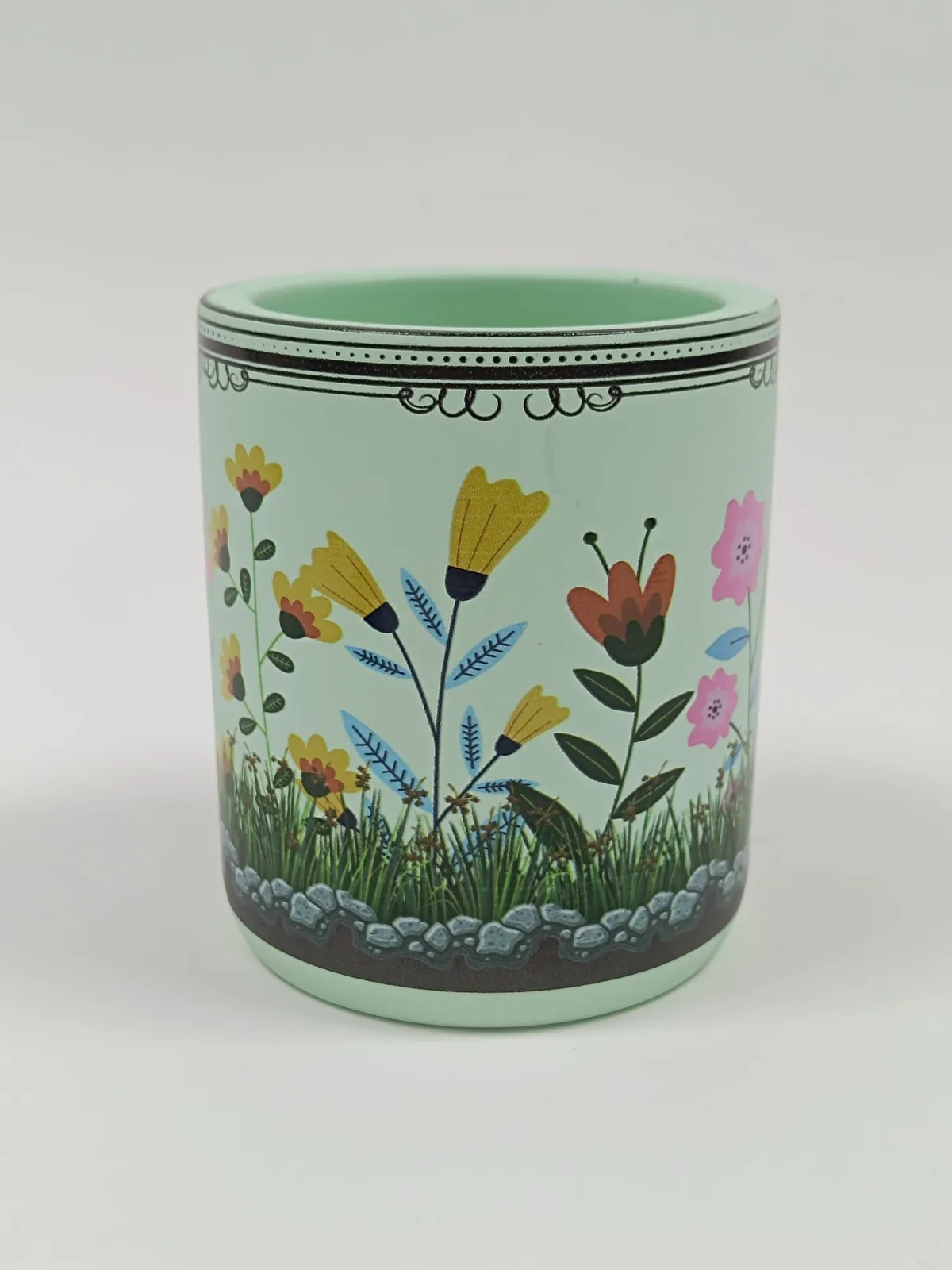
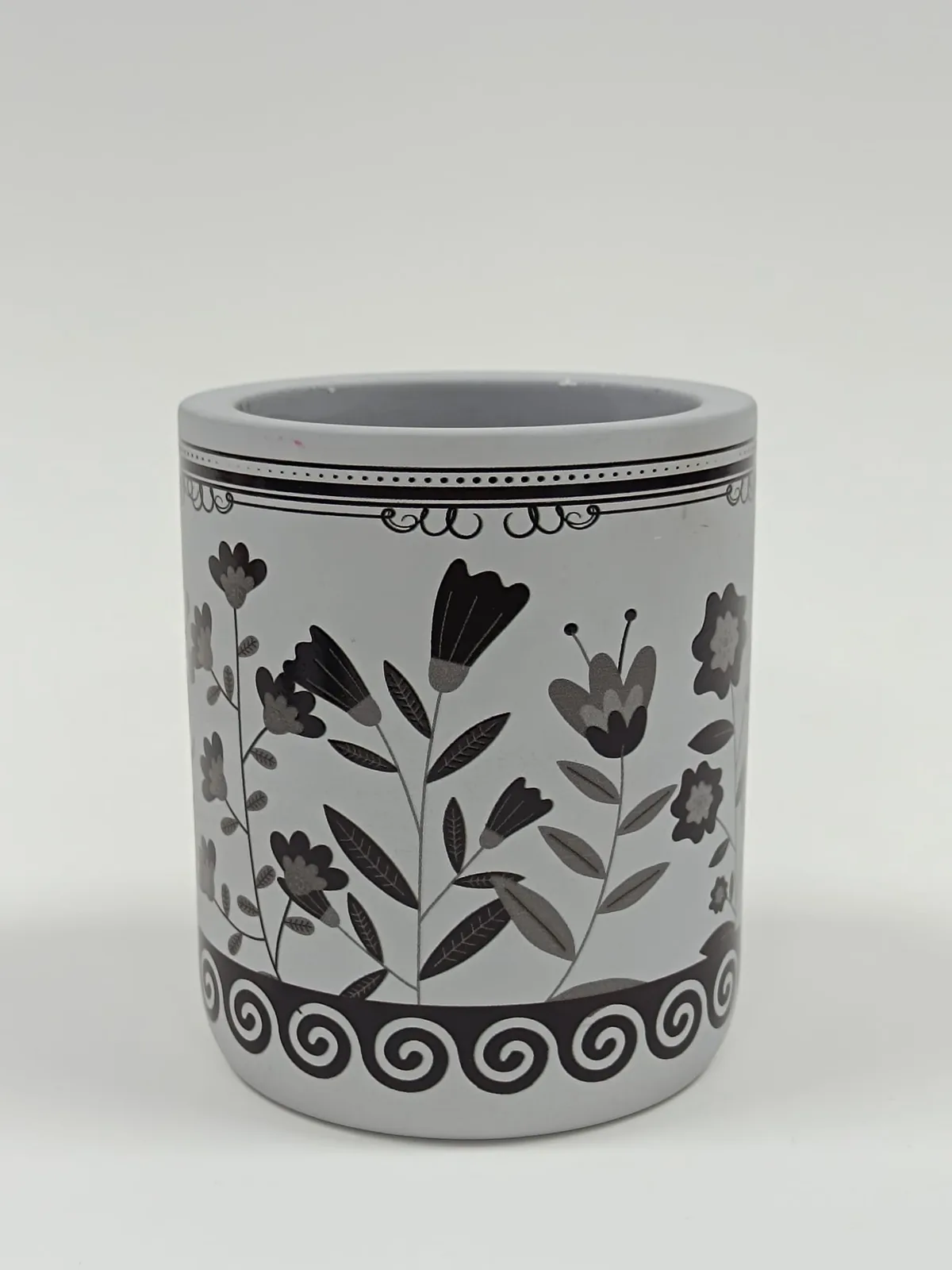
- Sun Studio, the group's printing studio in Al Quoz, Dubai, prints candle jars on its PeriOne and PeriQ360 as a service, and has printed jars that already held their wax. The jars on this page are its production examples.
What has not been published is a burn-test result, a temperature rating, a printed tealight cup or pillar candle, or a candle manufacturer running its own LSINC printer in this region. Those are the questions your trial and your own testing answer.
Choosing a model for a candle workshop
| If your production looks like this | The model that usually fits | Why |
|---|---|---|
| Boutique collections, many designs, prototypes, vessels up to 152 mm | PeriOne | One vessel at a time by hand, the largest diameter and length in the range; rated at up to 282 pieces an hour at a 4 inch artwork height |
| Volume production of vessels between 38 and 114 mm | PeriQ360 | Four vessels per cycle, loading while the previous set prints, variable data; rated at up to 1,146 pieces an hour at a 4 inch artwork height |
| Contoured or strongly tapered vessels, or slim vessels from 20 mm | Perivallo360m | Contour-following heads up to ±30°; rated at up to 174 pieces an hour; clear glass needs the upgrade |
Rated speeds are LSINC's maximums at a 4 inch (101.6 mm) artwork height and depend on image height, resolution and mode. A tall wrap, white under colour or a tactile layer prints more slowly; measure your own design at the trial.
Full specifications for the three models are in our LSINC buying guide. The cost lines to model before buying, from fixtures and operators to rejects and annual utilisation, are set out in the cost-of-ownership framework in our beverage manufacturing guide, and apply equally to a candle workshop.
How a candle vessel trial runs
- Send vessels and the brief. Empty vessels, or finished candles if you print after pouring, with the artwork, finish and quantities you have in mind.
- Geometry and fixture check. Diameter, height, taper and the printable band are checked against the model limits.
- Surface and pretreatment. Adhesion is tested on the vessel as it arrives from your supplier; LSINC lists pretreatment as dependent upon substrate, and its 2024 sheets list a jettable primer for the PeriOne and PeriQ360, subject to the application.
- Print on a PeriOne or PeriQ360 at Sun Studio, Dubai, with white, colour and any tactile layer.
- Your tests. Pour, cure and burn tests in your own facility, plus handling and packing.
- Measure for the cost model. Net output, ink and primer per piece, and operator time, recorded for the quotation. Adhesion testing is described in our adhesion best-practice guide.
Request a candle vessel print trial
Tell us about the vessel, whether you print before or after pouring, and the volume. Trials run on the PeriOne or PeriQ360 at Sun Studio, Dubai; a contoured vessel for the Perivallo360m is assessed with LSINC. The Digital Printing team replies by email, usually within one working day.
Frequently asked questions
What machine prints on candle jars?
A cylindrical UV printer, which turns the jar on a spindle while inkjet heads print around it and LED lamps cure the ink. LSINC lists glass and ceramic candle vessels among the PeriOne's applications, and the PeriQ360 and Perivallo360m print round and tapered vessels within their own limits.
Can candle jars be printed after the wax is poured?
Yes, within limits. Sun Studio has printed poured candle jars on its PeriQ360 with the wax and wick untouched. The vessel must be at room temperature, the wax fully set and the wick clear of the fixture. Confirm it on your own finished candle first.
Will the print survive the heat of a burning candle?
That has to be proven by the candle maker's own burn test on each vessel, wax and wick combination with the printed design. No temperature or burn rating is claimed for the print, because the result depends on the vessel, the wax, the wick, the design position and the ink recipe.
Which candle vessel sizes fit?
LSINC publishes item diameters of 38 to 152 mm for the PeriOne, 38 to 114 mm for the PeriQ360 and 20 to 139 mm for the Perivallo360m, with tapers up to +10/−2 degrees on the first two and ±30 degrees on the Perivallo360m. The printable band on a specific jar is confirmed with its fixture.
Can square candle vessels be printed on a cylindrical printer?
No. A cylindrical printer needs a round or tapered vessel to turn on its spindle. Square and faceted vessels are printed flat, face by face, on a UV flatbed printer instead.
Can each candle jar carry a different name?
Yes. Direct printing works from a file per piece, with no plate or screen, so names, dates and designs can change from jar to jar. The PeriQ360 lists variable-data caching for personalised production.
Can the print be gold or metallic?
Gold and silver can be printed as colours. None of LSINC's listed ink configurations includes a metallic ink, so a true metallic or foil finish needs a different decoration process.
Can we see our own candle jar printed before buying a machine?
Yes. Send vessels or finished candles to PRO TECHnology, and they are printed on a PeriOne or PeriQ360 at Sun Studio in Al Quoz, Dubai. You then run your own pour, cure and burn tests on the samples before any purchase decision.
ماكينات الطباعة على عبوات الشموع لمصانع الشموع
تطبع طابعات LSINC الأسطوانية التصميم مباشرة حول عبوة الشمعة الزجاجية أو الخزفية وهي تدور على محور، فلا حاجة إلى ملصق. يقبل PeriOne عبوات بقطر من 38 إلى 152 ملم، ويطبع PeriQ360 أربع عبوات في الدورة الواحدة بقطر من 38 إلى 114 ملم، ويتبع Perivallo360m الأشكال المخروطية والمنحنية حتى 30 درجة وبقطر يبدأ من 20 ملم.
يمكن طباعة العبوات فارغة قبل صب الشمع، أو طباعة الشموع الجاهزة بعد أن يتماسك الشمع، وقد طبع صن ستوديو في دبي عبوات شموع مصبوبة على PeriQ360 دون المساس بالشمع أو الفتيل. ولأن الشمعة المشتعلة تسخّن عبوتها، لا نعلن أي تصنيف حراري للطباعة، ويجب على مصنع الشموع اختبار الاحتراق لكل عبوة وشمع وفتيل مع التصميم المطبوع قبل الإنتاج.
أرسلوا عبواتكم إلى بروتكنولوجي، الوكيل الحصري لشركة LSINC في الشرق الأوسط وشمال أفريقيا، لتُطبع تجريبياً على PeriOne أو PeriQ360 في صن ستوديو بمنطقة القوز، ثم اختبروها في مصنعكم واختاروا الطراز المناسب بناءً على الإنتاج الفعلي واستهلاك الحبر والكمية السنوية.
Sources
Machine facts are taken from LSINC's product sheets for the PeriOne (PO-05-2024), PeriQ360 (PQ-07-2024) and Perivallo360m (PM-07-2022), held by PRO TECHnology as LSINC's regional dealer. Production examples are Sun Studio's.
Send a vessel before you choose a machine
A printed sample of your own jar answers what a specification cannot: adhesion on your vessel, how the design looks with your wax, and how fast your artwork really prints.