Water and Beverage Bottle Printing Machines: Direct-to-Bottle Printing for Bottlers in the UAE, Saudi Arabia and the GCC
Published · Updated · PRO TECHnology Digital Printing
When a water or beverage producer should decorate bottles in-house with an LSINC cylindrical printer, when labels and sleeves remain the better tool, and how to test, plan and cost the decision before buying.
This guide is for the R&D, operations and procurement people in a water or beverage bottling plant in the UAE, Saudi Arabia or elsewhere in the GCC who are asked whether a bottle printing machine could replace some of their labels or sleeves. It separates what a direct-to-object printer does from what labellers and coders do, shows how the machine fits a plant that already fills thousands of bottles an hour, and sets out the trial and the cost model that should come before a purchase. PRO TECHnology is LSINC's exclusive dealer for the Middle East and North Africa, appointed on 7 December 2023; the machines themselves are introduced on our LSINC bottle printing machines page.
- Machines
- LSINC PeriOne, PeriQ360 and Perivallo360m cylindrical UV printers
- Rated maximum
- 174 to 1,146 pieces an hour at a 4 inch (101.6 mm) artwork height, by model
- Workflow
- Stand-alone, operator-loaded; inline integration is a separate engineering project
- Trials
- Your own bottles printed on a PeriOne or PeriQ360 at Sun Studio, Dubai
Key takeaways
- Direct printing decorates the bottle itself on a stand-alone cylindrical UV printer. It is a decoration process, not a labeller, a label printer or a date and batch coder, and it does not remove the legal labelling a beverage must carry.
- It earns its place on premium glass lines, short and seasonal runs, personalised and co-branded bottles, and portfolios with many SKUs. Long, unchanging, high-speed SKUs usually stay on labels or sleeves.
- LSINC rates the PeriQ360 at up to 1,146 pieces an hour at a 4 inch artwork height, far below a typical filling line, so most plants run the printer offline, on empty or on filled and capped bottles, rather than in series with the filler.
- A trial on your own bottle settles adhesion, colour on clear glass, net output, ink and primer use and the tests your QA needs, before any capital decision.
- Digital printing removes plates and screens, but it does not make one bottle cost the same as ten thousand: artwork preparation, fixtures, set-up, test prints, loading and changeover are real costs that fall per piece as the run grows.
- Model the full cost of ownership against an equivalent decoration scope: equipment, installation, fixtures, finance, operators, ink, primer, varnish, maintenance, utilities, rejects, downtime and annual utilisation.
What in-house bottle decoration means
In-house decoration means the artwork is printed onto the bottle in your own plant, on a cylindrical UV printer, instead of arriving as a printed label, a shrink sleeve or a bottle screen-printed by a glass decorator. The bottle turns on a spindle while inkjet heads print around it and LED lamps cure the ink, so the design wraps the container and there is no label stock, adhesive or sleeve film for that decoration. How the helical process works is explained in our cylindrical UV printing explainer.
It is a good fit when the decoration changes more often than a label supplier's minimum order can follow, or when the bottle itself is the premium product. It is a poor fit when one design runs unchanged for months at full line speed, when the container falls outside the machine's size and taper limits, or when the surface has not passed adhesion testing.
| Situation | Direct printing usually suits it | Labels or sleeves usually suit it |
|---|---|---|
| Run length | Short, seasonal and personalised runs; many small batches | Long runs of one settled design |
| Number of SKUs | Many variants, markets, partners and limited editions | A few high-volume SKUs |
| Container | Round or gently tapered glass, PET, aluminium within the model limits, surface qualified by testing | Shapes a fixture cannot hold; untested surfaces; returnable bottles that must be relabelled |
| Line speed | Decoration can be decoupled from filling | Decoration must keep pace with a high-speed filler |
| Look | No label edge, full wrap, white under colour on clear glass, tactile effects | Paper textures, foils and effects tied to label stock |
A rule of thumb, not a verdict: many plants keep labels on core SKUs and use a printer for everything that changes.
What a direct-to-object printer is not: labellers, label printers and coders
Three other machines in a bottling hall are easily confused with a cylindrical printer, and buying one in place of another is an expensive mistake.
- Label printers print labels, on rolls or sheets, for a labeller to apply. A direct-to-object printer prints on the bottle, so it replaces the decoration the label carried, not the labeller's job on every SKU.
- Labellers and sleeve applicators apply pressure-sensitive labels, wet-glue labels or shrink sleeves at line speed. If some SKUs stay on labels, the labeller stays.
- Date and batch coders (inkjet, thermal or laser) mark each container with the production date, batch and expiry at filling speed. A Peri Series printer is not a coder and is not placed to replace one: traceability marking stays where the filler and the quality system need it.
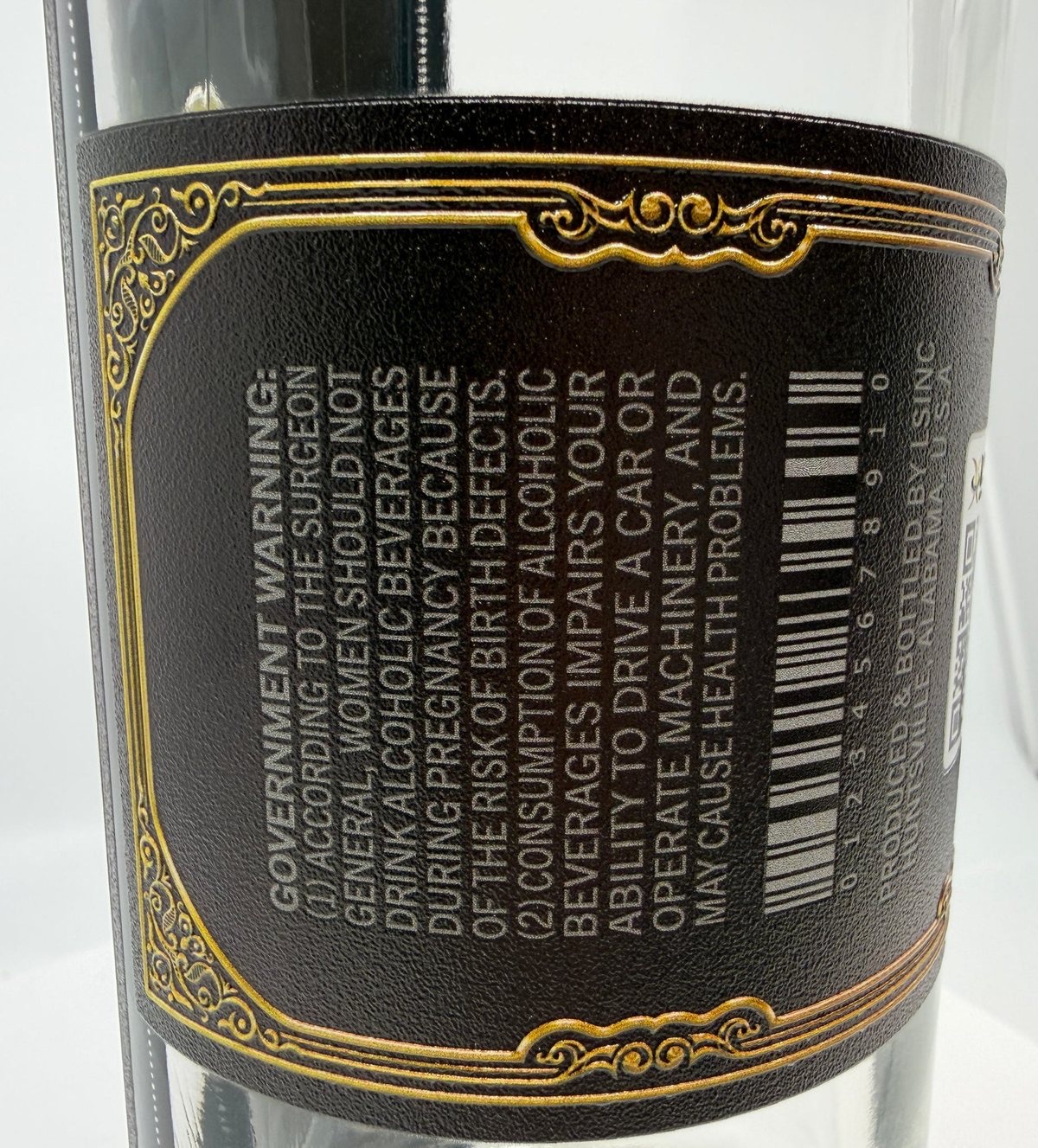
Mandatory label information still has to appear on the pack: product name, volume, ingredients and nutrition where required, producer, origin, and the market's own requirements, which in the Gulf include the GCC standard for labelling prepackaged food and the rules of each national authority. A printer can put text and a barcode on the bottle, but whether a printed panel satisfies a regulator, and whether a barcode printed on curved, clear or coloured glass scans reliably at retail, has to be checked with your regulatory team and a barcode verifier before the design is approved.
Premium, personalised, seasonal and multi-SKU production
These are the four reasons beverage producers in the Gulf look at direct printing, and the check each one needs before it becomes a business case.
Premium glass lines
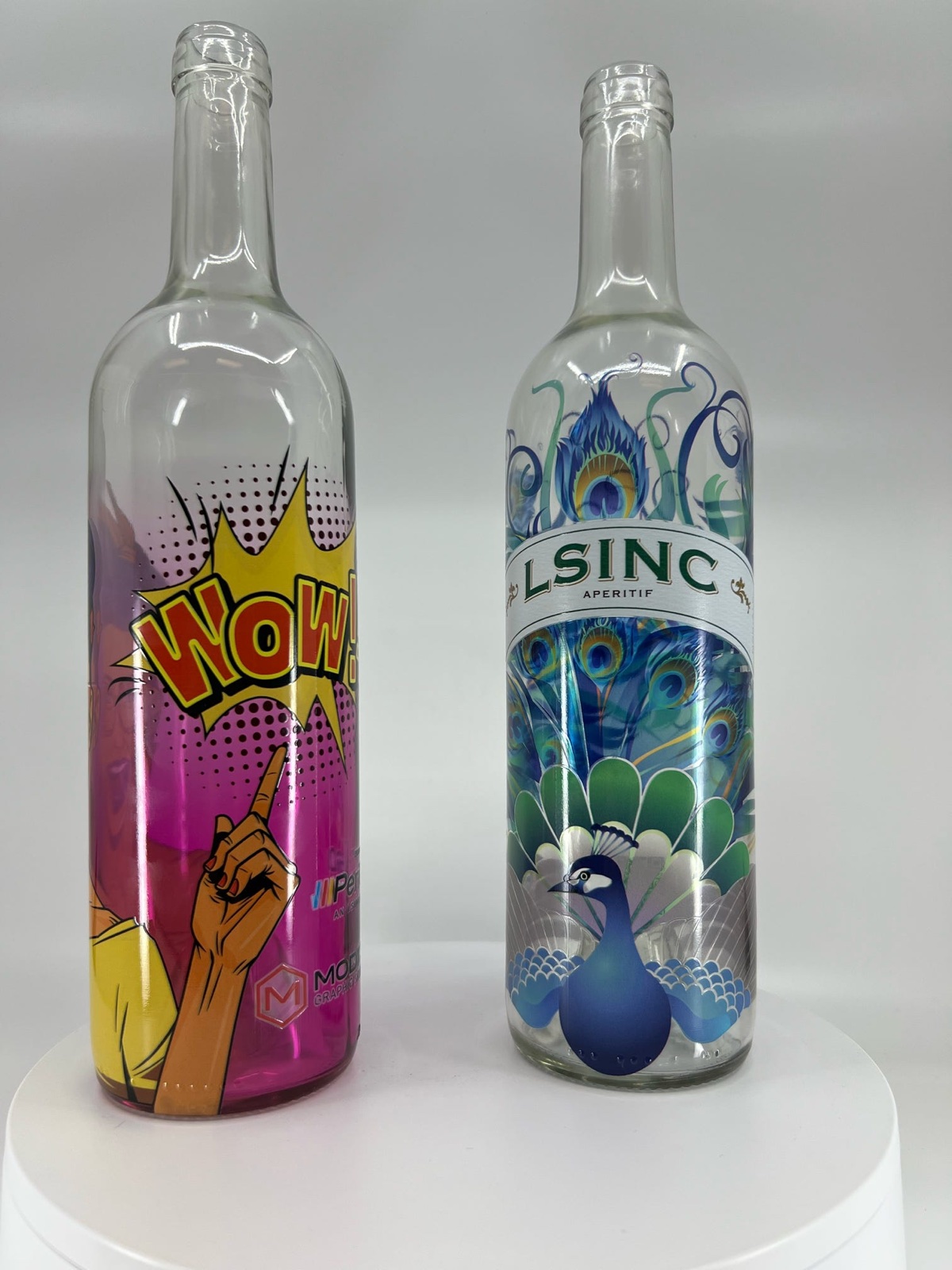
Still and sparkling water in glass for hotels, restaurants and gifting, where a printed bottle with no label edge is the product. On clear glass, the PeriOne and the PeriQ360 print with no physical barrier behind the glass, which LSINC calls Barrier-Free Printing on Clear Media. That is a machine capability, not an ink one: white is still printed under the colour wherever the design must be opaque or read true against the water. On the Perivallo360m, clear media is an upgrade that has to be specified.
Personalised and co-branded bottles
Hotel, venue, airline and corporate bottles carrying the client's brand, and event runs carrying a sponsor. Each piece can carry different artwork with no new plate or screen, and the PeriQ360 lists Variable Data File Advanced Caching for files that change from bottle to bottle. Check who supplies and approves the artwork, how short the shortest run really is, and how often the fixture changes.
Seasonal and campaign artwork
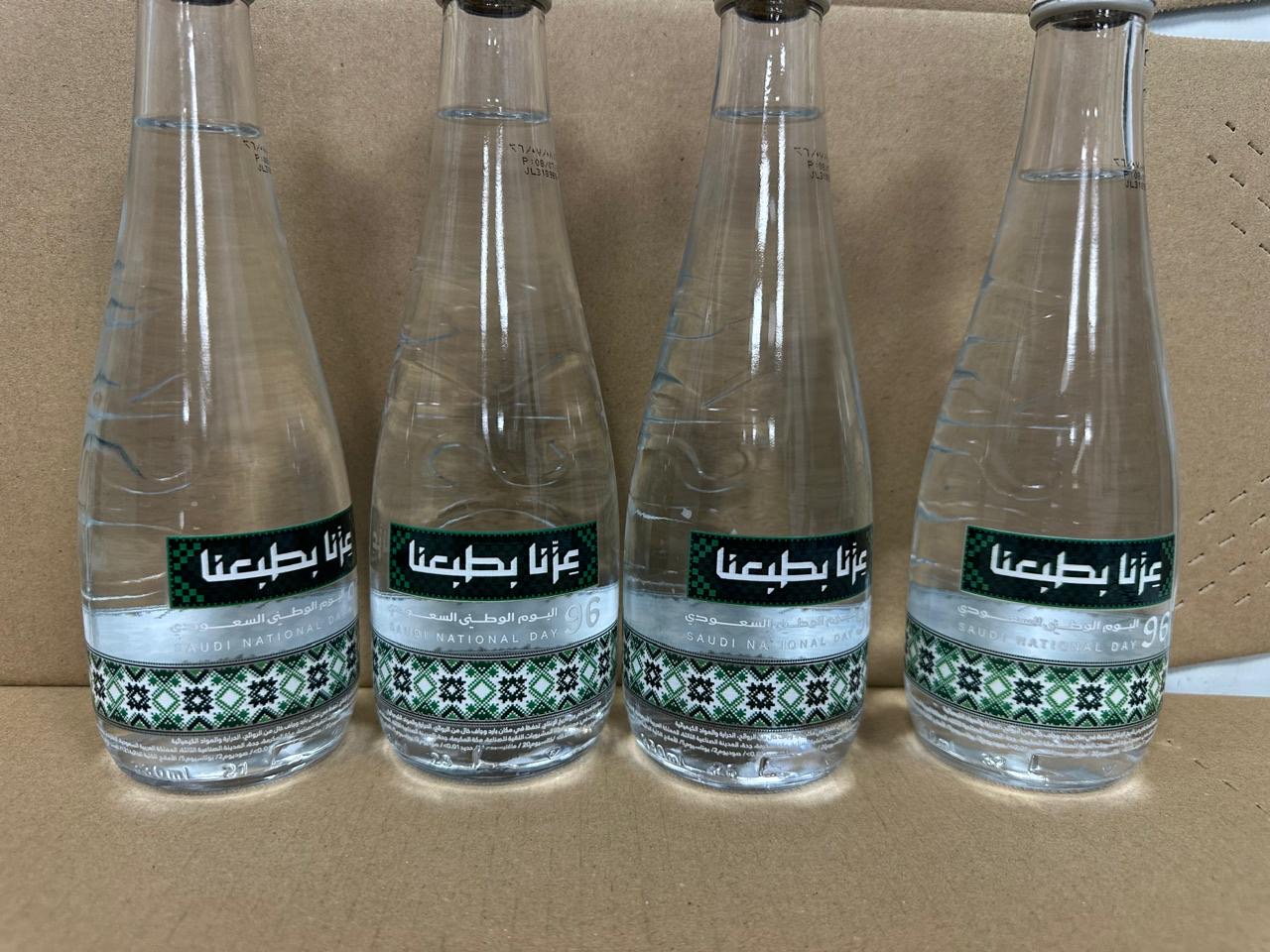
Ramadan, Eid, National Day and sporting events, produced in the quantity each market needs rather than the quantity a label minimum dictates. The saving is the obsolete stock and the minimum-order overrun; the cost is planning press time around the campaign calendar.
Portfolios with many SKUs
Export variants, retailer exclusives and pack sizes that each need their own label. A file per SKU is cheaper to hold than a pallet of labels per SKU, provided each container size has a fixture and a stored recipe, and changeovers are planned rather than improvised.
Offline or inline: how the printer fits the plant
The Peri Series machines are stand-alone production printers that an operator loads. The PeriOne and the Perivallo360m take one item at a time by hand; the PeriQ360 carries four items on a quad-spindle carriage, with semi-automatic loading and unloading and the next set loaded while the current one prints. None of them is a plug-in module for a filling line.
That leaves three realistic workflows:
- Decorate empties, then fill. Bottles are printed before the filler and held as decorated stock. This keeps the printer independent of line speed and is the simplest place to start; the printed surface then has to survive the filler, capping, conveyors and packing, so those steps belong in the trial.
- Decorate filled, capped bottles. Finished stock is printed after filling, for example for a hospitality order. Sun Studio has printed filled, sealed glass water bottles on its PeriQ360. Bottles must arrive dry and at room temperature, because condensation stops ink bonding, and the closure must clear the fixture.
- Inline integration. Feeding the printer from conveyors, with accumulation and rejection, is an engineering project. LSINC offers consulting and custom engineering to integrate its printers into existing manufacturing operations, and the PeriQ360 lists custom integration into an existing workflow; scope, cost and timing are agreed per site, not assumed.
A rated maximum of 1,146 pieces an hour on the PeriQ360 is about 19 bottles a minute. A filling line usually runs far faster, so a printer placed in series with the filler would set the pace of the whole line. That is why most plants run decoration offline, or on a dedicated line for the decorated SKUs.
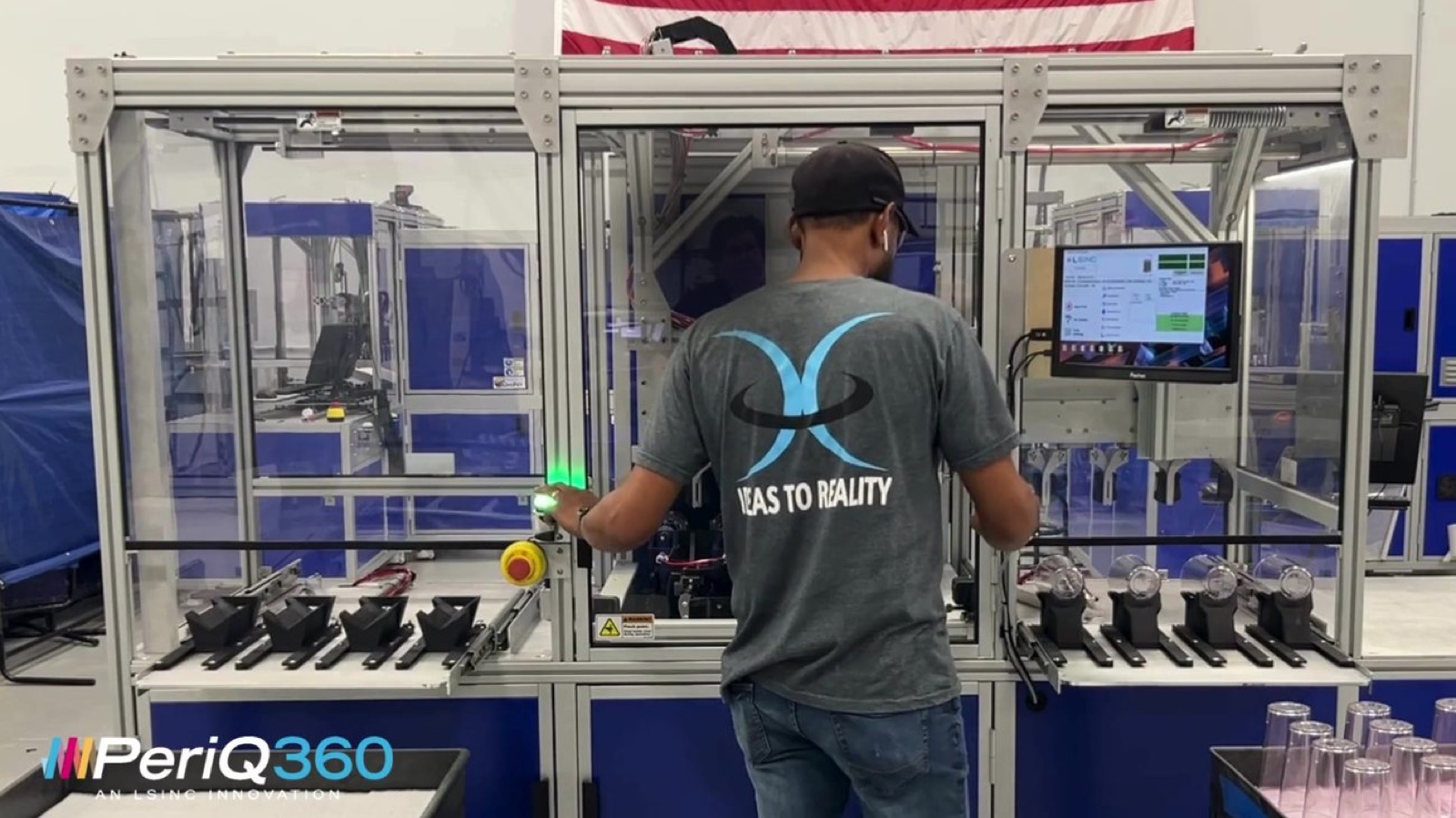
Site requirements are modest but specific. The PeriQ360 occupies about 312 × 241 × 212 cm and needs a 16 A single-phase supply and continuously available compressed air at a minimum of 120 psi (8.2 bar), or 150 psi (10.3 bar) with a feed system. All the Peri Series machines are specified for indoor use at 18 to 30 °C and 40 to 70% relative humidity, non-condensing, with fumes ventilated as local rules require and an internet connection for LSINC's remote diagnostics. LSINC's 2024 and 2026 sheets differ on the supply voltage (230 VAC against 200 to 240 VAC) and on weight, so confirm both for the configuration you are quoted. The full figures for each model are in the LSINC buying guide.
Planning real output: rated speed, loading, changeovers and rejects
LSINC publishes maximum rated speeds at a 4 inch (101.6 mm) artwork height: up to 282 pieces an hour on the PeriOne, 1,146 on the PeriQ360 and 174 on the Perivallo360m. Its reference object for those figures is a 50 mL bottle, and LSINC states that speed depends on image height, resolution and mode, so a 330 mL or 750 mL bottle with a taller wrap, white under the colour or a raised layer prints more slowly. The rated figure is a ceiling, not a production plan.
| Factor | What it does to output | How to measure it at the trial |
|---|---|---|
| Artwork height and mode | Taller artwork and higher-resolution modes lower the pieces per hour | Print your real artwork in the mode you will sell, and time it |
| Loading and unloading | Manual loading on the PeriOne and Perivallo360m paces the machine to the operator | Time a sustained run with your operator, not a single cycle |
| Pretreatment | Cleaning, flame, plasma or a jetted primer can add a step or a pass | Run the pretreatment the adhesion test requires, at production pace |
| Curing and extra layers | White under colour, varnish and tactile layers add passes | Print the full finish, not a colour-only proof |
| Changeovers | Fixture swaps, recipe loading and test prints between SKUs | Count changeovers per shift from your real SKU plan |
| New bottle shapes | Each shape needs its own fixture and geometry profile, which LSINC designs, makes and tests over weeks, not hours | Put new shapes into the launch plan, not the week of the launch |
| Rejects and reprints | Misloads, adhesion failures and print defects | Agree a reject allowance and inspect a full trial batch |
| Maintenance and start-up | Daily head checks, cleaning and planned service | Ask for the daily and weekly routine and its duration |
Illustrative planning method, not a forecast. Net good output per shift = rated speed for your artwork × hours × share of time actually printing × (1 − reject rate). For example, if a trial showed 900 pieces an hour for your artwork, and loading, changeovers and maintenance left the machine printing 70% of an 8-hour shift with a 2% reject rate, the shift would yield about 900 × 8 × 0.70 × 0.98 ≈ 4,940 good bottles. Every number in that example is hypothetical; replace each with a measured figure from your own trial.
The LSINC machines page has a calculator for the same first-pass estimate, and the trial below replaces the assumptions with measurements.
A practical sample-validation process
Adhesion is decided at the surface, not by the printer. LSINC lists pretreatment as "dependent upon substrate" on every specification sheet, its 2024 sheets list a jettable primer for the PeriOne and the PeriQ360 subject to the customer application, and it offers adhesion and abrasion testing as a paid service to set the layering, print set-up and pretreatment for an application. LSINC does not publish durability results for printed goods, so the sequence below is how a bottler gets an answer it can defend internally.
- Write the specification. Container drawing and supplier, any coating on the glass or PET, artwork, finish (white, varnish, tactile), the durability tests your customers and QA require, and whether bottles are printed empty or filled.
- Check the geometry. Diameter, length, taper and the printable band are checked against the model limits, and the fixture is confirmed for the shape.
- Choose the pretreatment. Cleaning only, primer, flame, plasma or another conditioning step, chosen from adhesion tests on your real bottles in the state they arrive from the supplier.
- Print the trial. Your bottles are printed on a PeriOne or a PeriQ360 at Sun Studio in Al Quoz, Dubai, with your artwork and finish.
- Test after full cure. Typical checks are a cross-cut tape adhesion test, rub and abrasion, water immersion, chilled storage and condensation, and crate or case abrasion; returnable bottles add washing. Your QA team decides the pass criteria.
- Run the pack through your process. Filling, capping, shrink-wrapping, palletising and transport, because the line is often harder on the print than the lab.
- Time a production-length run. Record net output, ink and primer consumption per piece, operator time and rejects, which feed the cost model below.
- Freeze the recipe. The approved pretreatment, ink set, layers, cure and fixture are stored as a recipe on the machine, so the first production run repeats the trial.
Two cautions keep the trial honest. A result on one bottle supplier or coating does not transfer automatically to another. And an ink's safety data sheet, or a laboratory report on the ink itself, such as a heavy-metal screening of the wet ink, describes the ink, not your decorated bottle: it does not by itself approve a finished beverage package, which is assessed within your own food-safety and packaging system for the markets you sell into. Our adhesion best-practice guide covers the tests in more detail.
Direct printing compared with labels, sleeves and screen printing
No single method wins every SKU. The table compares them on the points a bottler actually decides on; the wider comparison, including fired ceramic decoration, is in our guide to glass bottle printing methods.
| Method | Strong where | Weak where | Typical fit for a bottler |
|---|---|---|---|
| Pressure-sensitive labels | Fast application, many label materials and finishes, easy to change label supplier | Minimum orders, stocked inventory per SKU, label edge on the bottle | Core SKUs with steady demand |
| Wet-glue labels | Low cost per label at very high volume | Long runs and dedicated application equipment | Very long runs of one design |
| Shrink sleeves | Full-body coverage at line speed, shape-tolerant | Sleeve tooling and minimums per design, film to remove at recycling | High-volume full-wrap designs |
| Screen printing (organic or ceramic) | Durable, opaque solid colours; long established on glass | Screens and set-up per colour; usually done by an outside decorator for glass | Long runs of a few spot colours |
| Direct digital UV (LSINC) | No plates or screens, full colour and white, variable data, tactile effects, decoration in-house | Slower than a label line; surfaces need qualifying; operators and maintenance in-house | Premium, seasonal, personalised and multi-SKU work |
A full cost-of-ownership framework
A fair comparison sets the cost of decorating a bottle in-house against what the current method costs for the same scope and quality. The ink is rarely the deciding number. The lines below are what a procurement model should hold.
| Cost line | What it covers | Where the number comes from |
|---|---|---|
| Equipment and installation | The printer and options, freight and duties, installation, commissioning and initial training | The LSINC quotation and installation plan |
| Fixtures and geometry profiles | A fixture and a geometry profile for each container shape; LSINC supplies one fixture, made for the container named at purchase, with the printer | Quotation, multiplied by the number of shapes you run |
| Finance or depreciation | Purchase or lease, the years written off, interest | Your finance team's assumptions |
| Operators and training | Operators per shift, shifts per day, loaded labour cost, supervision, initial and refresher training | Measured operator time from the trial; the PeriQ360 can be run by one or two operators |
| Ink | Colour, white and any additional channels, per piece | Consumption measured on your artwork at the trial |
| Primer and pretreatment | Jetted primer, flame or plasma consumables, cleaning materials | The recipe approved in the trial |
| Varnish and special layers | Gloss, matte or tactile layers where the design uses them | Measured on the approved finish |
| Maintenance | Service contract, wipers and filters, print heads and lamps over the machine's life, spare parts | Service quotation and the manufacturer's maintenance schedule |
| Utilities | Electricity, compressed air, air conditioning for the print room | Site survey and the model's site requirements |
| Rejects | Bottles lost to misloads, defects or failed adhesion | Reject rate from a production-length trial run |
| Downtime | Changeovers, planned service and unplanned stops | SKU plan and service schedule |
| Annual utilisation | Good bottles printed a year, which spreads every fixed cost | Your demand plan for the decorated SKUs |
Compare like with like. If coding stays on the line, it belongs on both sides or neither. If a labeller is retired, include the labels, sleeve tooling, minimum-order overruns, obsolete stock written off and warehouse space that genuinely disappear; if the labeller stays for other SKUs, its cost does not move. And compare equal quality: a full-wrap, full-colour print with white on clear glass is not the same product as a four-colour paper label.
Illustrative scenario, hypothetical figures. Cost per good bottle = (annual fixed costs ÷ good bottles per year) + variable cost per bottle ÷ (1 − reject rate). Fixed costs are depreciation or lease, finance, fixtures, the service contract, operators and the print room's share of utilities; variable costs are ink, primer and varnish. Suppose fixed costs of 300,000 currency units a year and a variable cost of 0.20 units a bottle with a 2% reject rate: at 500,000 good bottles a year the decoration costs about 0.60 + 0.20 = 0.80 units a bottle, and at 1,500,000 bottles about 0.20 + 0.20 = 0.40. The same machine costs half as much per bottle at three times the utilisation, which is why the demand plan matters more than the ink price. These figures illustrate the arithmetic only; they are not PRO TECHnology prices or a forecast of savings.
No responsible supplier can promise a saving before the trial and the cost model are done. What a trial can give you is measured inputs for every line above.
What the PBIC installation in Saudi Arabia shows
Pure Beverages Industry Company (PBIC), the Saudi water producer behind the Oska and Ival brands and part of Almarai since 31 July 2025, decorates glass bottles for its OSKA range directly. It came to PRO TECHnology to make its glass bottles stand out for hospitality customers, integrated a PeriOne on PRO TECHnology's recommendation in the second quarter of 2024, and added a PeriQ360 in April 2025 for capacity, as PrintWeek MENA reported in July 2025. Our PBIC case study sets out what is documented, with the sources.
What it does not show is your result. PBIC's output, costs and savings are not published, so none are quoted here, and LSINC's rated speeds are maximums, not PBIC's measured production. Your own trial is the evidence that matters.
Trials, supply and support
PRO TECHnology, in Dubai, supplies, installs and supports LSINC printers as LSINC's exclusive dealer for the Middle East and North Africa; LSINC's Global Distributors page lists the countries in that territory, including the UAE, Saudi Arabia and the rest of the GCC. Application trials are printed at Sun Studio, the group's printing studio in Al Quoz, which runs a PeriOne and a PeriQ360. A Perivallo360m application, for a shouldered or strongly tapered bottle, is assessed with LSINC. If you would rather have bottles printed than buy a machine, Sun Studio prints as a service in the UAE. Product-by-product guidance for perfume, cosmetics and candles is in our LSINC applications guide.
Assess capacity and cost on your own bottle
Tell us about the bottle, the decoration and the volume. We will propose a trial on a PeriOne or PeriQ360 at Sun Studio, Dubai, and use the measured results for a capacity and cost estimate. The Digital Printing team replies by email, usually within one working day.
Frequently asked questions
Can a beverage manufacturer print bottles in-house instead of buying labels?
For some SKUs, yes. A cylindrical UV printer such as the LSINC PeriOne or PeriQ360 prints the decoration directly onto glass, PET or aluminium containers inside the plant. It suits premium, seasonal, personalised and multi-SKU work; long, unchanging, high-speed SKUs usually stay on labels or sleeves, and the legally required label information and date coding still have to be provided.
Does direct printing replace our labeller and date coder?
No. A direct-to-object printer replaces the decoration a label carried on the SKUs you move to it. Labellers remain for SKUs that stay on labels, and date and batch coders remain for traceability marking at filling speed.
Can the printer run inline with our filling line?
Not as a plug-in. The Peri Series machines are stand-alone and operator-loaded, and the fastest, the PeriQ360, is rated at up to 1,146 pieces an hour at a 4 inch artwork height. Most plants decorate offline, before or after filling. LSINC offers custom engineering for integration into existing operations, scoped per site.
Can filled and capped bottles be printed?
Yes, within limits. Sun Studio has printed filled, sealed glass water bottles on its PeriQ360. Bottles must be dry and at room temperature, the closure must clear the fixture, and the printed band must sit on the body. Confirm it on your own filled bottle first.
Is direct printing cheaper than labels?
It depends on run length, SKU count, utilisation and the scope you compare. Digital printing removes plates, screens and label minimums, but artwork preparation, fixtures, set-up, test prints, operators, maintenance and rejects remain. Build the full cost of ownership with figures measured on your own bottle before deciding.
What throughput can a beverage plant plan for?
LSINC rates the PeriOne at up to 282, the PeriQ360 at up to 1,146 and the Perivallo360m at up to 174 pieces an hour at a 4 inch artwork height. Net output is lower once artwork height, loading, pretreatment, changeovers, rejects and maintenance are counted, so plan with a figure measured on your own bottle.
Does the print survive chilling, condensation and handling?
That is what the trial is for. The print has no paper or film to wrinkle or peel, but durability depends on the glass or PET, its coating, the pretreatment, the ink set and the cure. Test chilled storage, condensation, water immersion and crate abrasion on your own bottles after full cure.
Are the inks approved for beverage packaging?
The print sits on the outside of the container, but an ink's safety data sheet or supplier statement does not by itself approve a finished beverage package. Assess the decorated bottle within your own food-safety and packaging system for each market, and ask for the ink documents before artwork goes to production.
Where can we test our bottles?
At Sun Studio in Al Quoz, Dubai, the group printing studio, on a PeriOne or a PeriQ360. Send your bottles, artwork and finish requirements, and the trial records adhesion, colour, net output and ink use. Perivallo360m applications are assessed with LSINC.
Who supplies LSINC printers to beverage manufacturers in the Gulf?
PRO TECHnology in Dubai, LSINC's exclusive dealer for the Middle East and North Africa since 7 December 2023. It supplies, installs and supports the machines across the territory listed on LSINC's Global Distributors page, which includes the UAE, Saudi Arabia and the rest of the GCC.
Sources
Machine facts are taken from LSINC's product sheets for the PeriOne (PO-05-2024), PeriQ360 (PQ-07-2024) and Perivallo360m (PM-07-2022), held by PRO TECHnology as LSINC's regional dealer, and from lsinc.com.
Print your own bottle before you specify a machine
The sample answers the questions a specification sheet cannot: adhesion on your glass or PET, colour on clear glass, net output and cost per piece.