Glass Bottle Printing: Methods, Machines & Direct UV Printing
Published · Updated · PRO TECHnology Digital Printing
Glass bottles can be decorated using screen printing, ceramic or fired decoration, labels, shrink sleeves and digital UV printing. The right method depends on production volume, artwork, the number of colours, bottle shape, durability requirements and how often designs change. This guide explains how companies print glass bottles, what large manufacturers use, and where direct 360° UV bottle printing fits.
Key takeaways
- Glass bottles are decorated in five main ways: labels, shrink sleeves, screen printing, ceramic or fired decoration, and direct digital UV printing onto the glass itself.
- Volume, the number of colours, bottle shape, durability requirements and how often the design changes decide which method fits. None of them is the right answer for every job.
- Direct UV printing uses no plates and no screens, so the minimum run is one bottle and every piece can carry different artwork.
- LSINC rated speeds are 282 pieces per hour on the PeriOne, 1,146 on the PeriQ360 and 174 on the contour-following Perivallo360m, all maximums at a 4 inch (101.6 mm) artwork height.
- Glass is smooth and non-porous, so clean containers, a matched primer or pre-treatment and adhesion testing come before any approved production run.
How do companies print on glass bottles?
Companies use one of five approaches, and most large producers run more than one. Screen printing pushes ink through a mesh screen, one screen per colour, and is common where an established design repeats in large volume. Ceramic or fired decoration bakes the decoration onto the glass at high temperature and is used where the application is demanding. Labels and shrink sleeves are applied to the finished bottle and remain very widely used across the industry. Digital UV bottle printing jets ink straight onto the rotating container and cures it with UV light, which suits full-colour artwork, multiple SKUs, personalisation, frequent design changes and digitally driven production. Which one fits is a question of volume, colour count, bottle shape, durability requirement and how often the artwork changes.
The five ways to decorate a glass bottle
Almost every decorated bottle you have held used one of five methods. The plain name comes first below; the industry term follows it.
Labels, or pressure-sensitive labels, are fast and widely available, but they announce themselves: a visible edge, a separate substrate and an adhesive. Shrink sleeves wrap the full container and suit complex shapes, but read as packaging film rather than glass. Screen printing puts ink on the glass itself and is a long-run tool, because it needs a screen for each colour in each design, so colour count and design changes both add cost and changeover time. Ceramic or fired decoration applies enamels that are then fired onto the glass, and is used where the application is demanding; it carries the tooling and the firing step that go with it. Digital UV bottle printing, also called direct-to-object or direct-to-cylinder printing, jets ink straight onto the rotating container and cures it with UV light: no plates, no screens and no tooling per design.
For long single-design runs, screens, fired decoration, labels and sleeves all still earn their place, and the tooling cost per bottle keeps falling as the run gets longer. Digital printing changes the picture at the other end: seasonal editions, multi-fragrance families, gifting, personalisation, and any brand whose designs change faster than tooling can be made.
| Method | Best suited to | Setup / tooling | Full colour | Artwork changes | Personalisation | Typical production use | Key consideration |
|---|---|---|---|---|---|---|---|
| Labels (pressure-sensitive) | Established products in wide distribution | Plates, or a digital label press; label stock is held | Yes, on the label | A new label order and new stock | Possible on digital label presses | Used at every volume across the industry | The label is a separate applied material with a visible edge |
| Shrink sleeves | Full-height decoration and complex bottle shapes | Sleeve tooling plus an application and shrink step | Yes, on the film | A new sleeve order and new stock | Limited in practice | High-volume beverage and household lines | Reads as packaging film rather than as decorated glass |
| Screen printing | One settled design repeated in large volume | One screen per colour, per design | Limited by colour count; each colour is another screen | New screens for each change | Not practical | Long production runs of a fixed design | Screen cost and changeover time rise with colours and with design changes |
| Ceramic or fired decoration | Applications with demanding durability requirements | Screens or transfers, plus firing | Limited by colour count | New tooling for each change | Not practical | Established container lines with firing capacity | Needs the firing step and the equipment to do it |
| Digital UV bottle printing | Full colour, multiple SKUs, short runs and frequent changes | No plates or screens per design; an artwork file, a recipe check and a test print | Yes, CMYK plus white and varnish | A file change | Yes, piece by piece | Short run to high volume, depending on the machine | Adhesion depends on the glass, any coating, pre-treatment and the ink system, so the actual bottle is tested first |
What direct-to-glass printing actually delivers
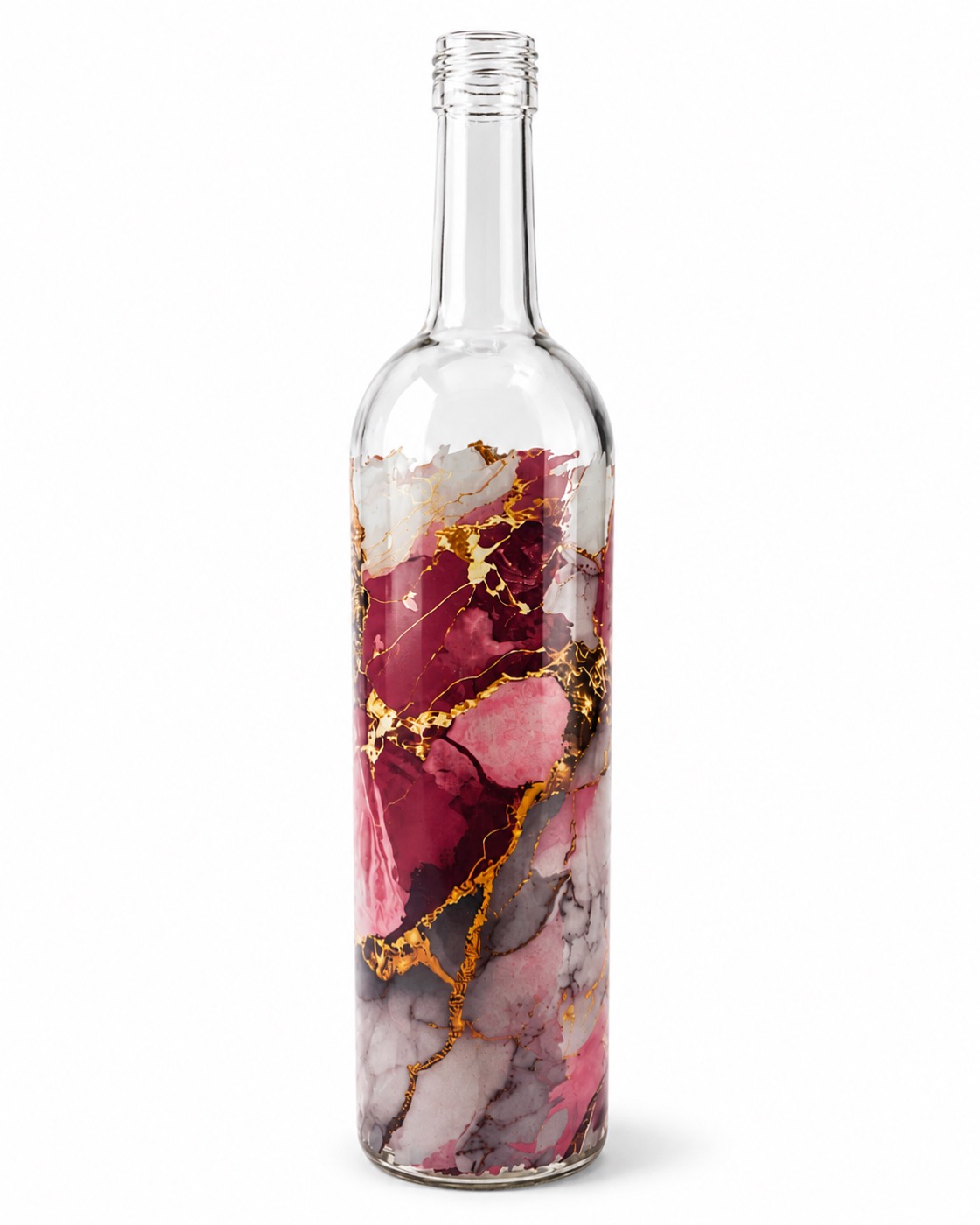
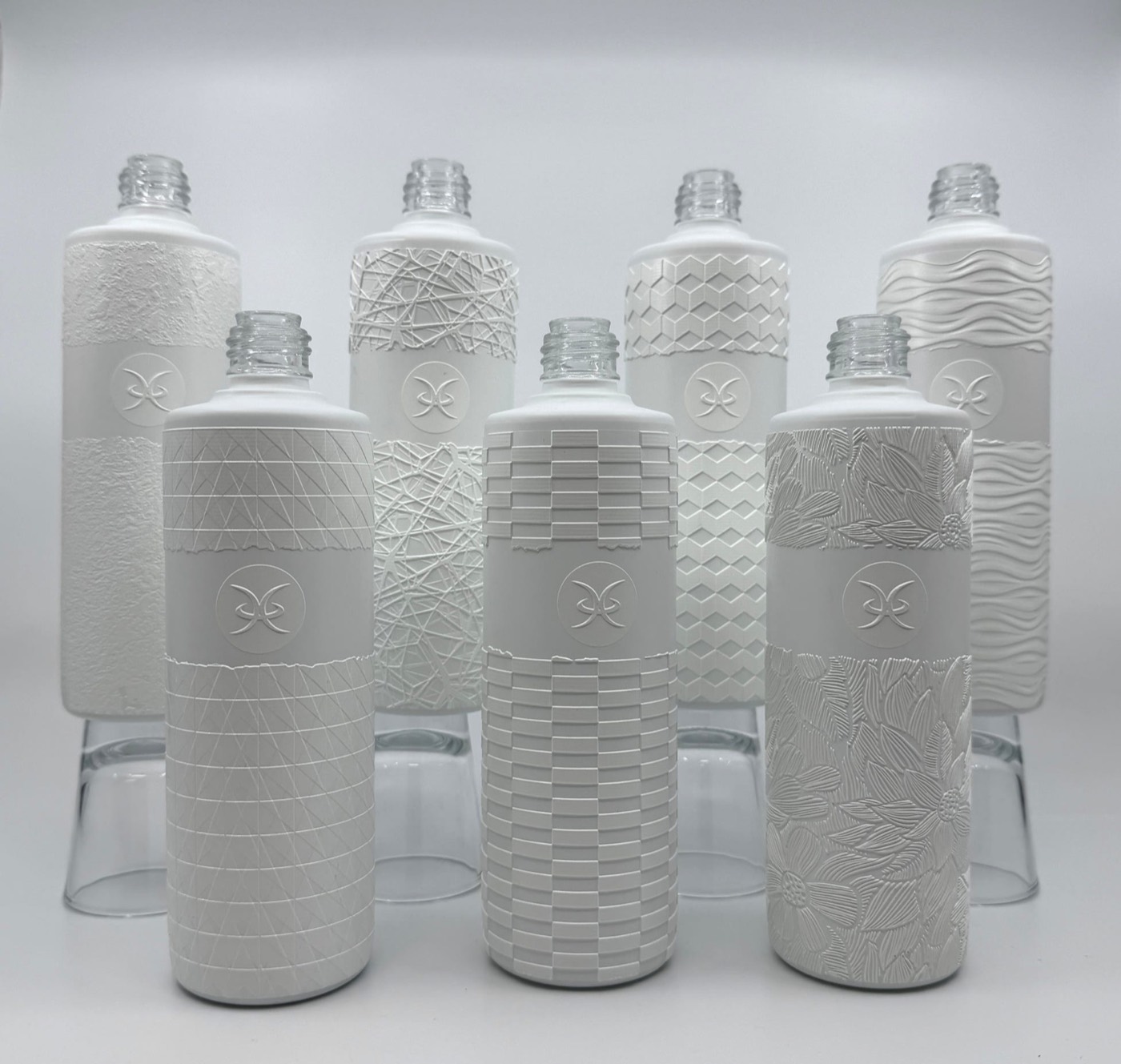
On an LSINC cylindrical printer the bottle rotates while printheads lay down CMYK, white and varnish through a full 360 degrees. White works as a base coat on clear or dark glass so colours stay vivid; varnish adds gloss, matte or raised and embossed effects that give the “etched and enamelled” feel labels cannot imitate. There is no paper label, no shrink sleeve and no adhesive anywhere in the process: the artwork is the surface. Properly prepared and cured UV printing can give strong adhesion on glass, but performance depends on the bottle surface, any coating applied to it, the pre-treatment, the ink system and the end-use conditions, so production bottles should be tested before approval.
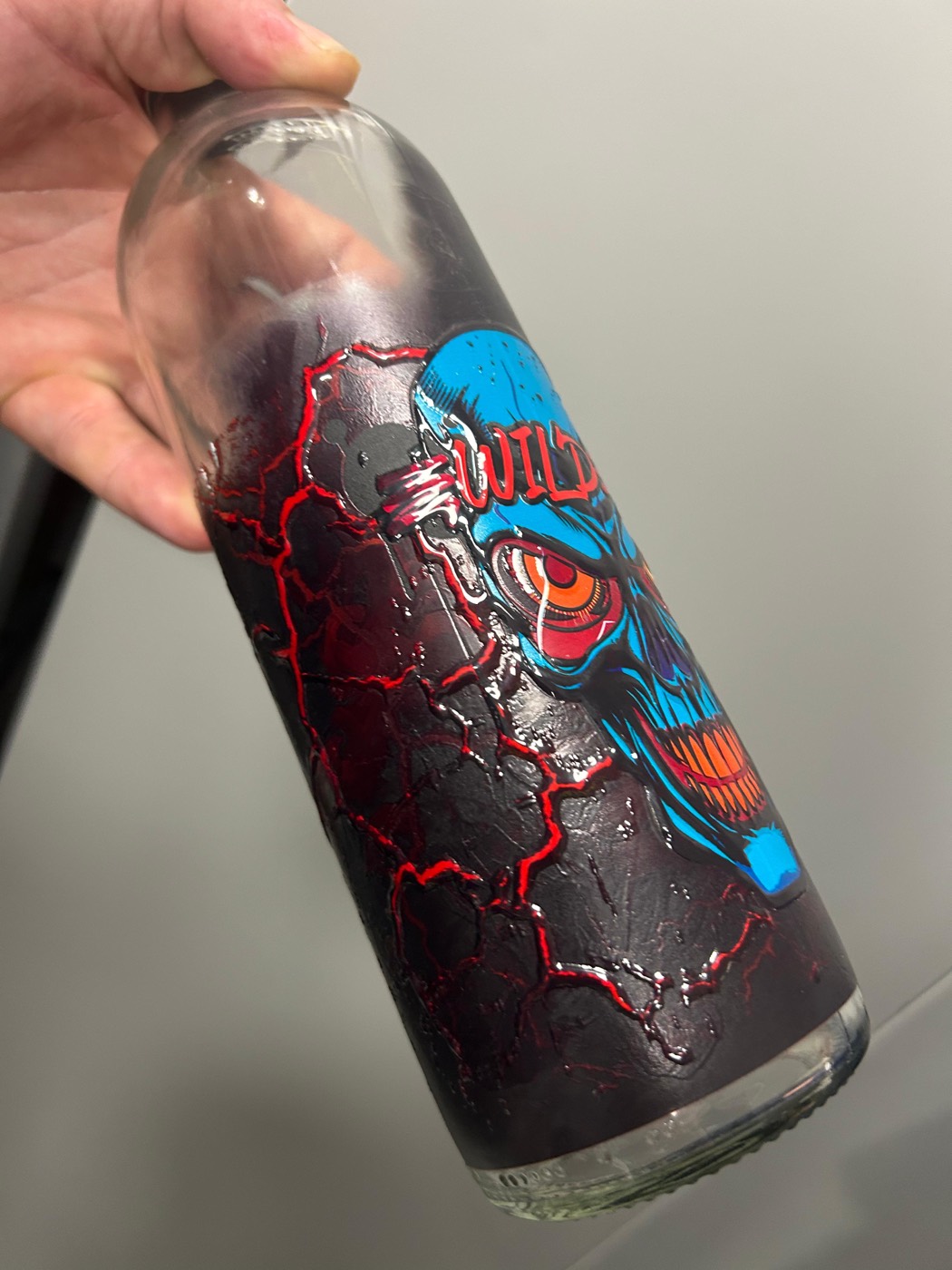
Because the process is digital, variable data and personalisation print piece by piece: names on gift bottles, numbered editions, event dates, with no tooling and no line stop between designs. That single fact reshapes what a brand can offer at retail.
Production reality: speeds and machine fit
LSINC’s published ratings, all maximums at a 4-inch (101.6 mm) artwork height, put PeriOne at 282 pieces per hour, PeriQ360 at 1,146 and Perivallo360m, whose printheads adapt to contours, at 174, reflecting the different jobs they are built for: entry and sampling, high-volume multi-shift production, and complex contoured containers respectively. The full line-up, with specifications and applications, is on our LSINC bottle printing machines page, models are compared side by side in our LSINC buying guide, and how helical 360° printing works is explained in our guide to cylindrical UV printing.
What machine is used to print directly on glass bottles?
Companies use a dedicated cylindrical or direct-to-object digital printer when they want artwork printed directly around a finished bottle. The bottle is held on a spindle and rotated while inkjet heads print onto the surface and UV light cures the ink, so the design wraps the full circumference instead of stopping at a label edge. Diameter, item length and taper are the limits that decide whether a given bottle will run.
For industrial digital applications, LSINC manufactures dedicated cylindrical direct-to-object systems including the PeriOne, PeriQ360 and Perivallo360m. Each model publishes its own maximum diameter, item length and taper angle, so the container is checked against the machine before anything is promised. Our guide to glass bottle printing machines sets out the range, the applications and the specifications side by side, and our guide to cylindrical UV printing explains how the helical 360° process works.
What do large manufacturers use to print glass bottles?
It depends on volume and on how often the design changes, and most large producers use more than one method. Lines running a settled design in high volume still use screen printing, ceramic or fired decoration, applied labels and shrink sleeves, because the cost of tooling per bottle keeps falling as the run gets longer and the equipment is already installed.
Dedicated industrial digital printing becomes attractive at the other end of that trade: multiple SKUs, seasonal and regional variants, personalisation, short runs, launch samples, and any programme where artwork changes faster than tooling can be made. Because there are no plates and no screens, a design change costs a file rather than a new set of tooling, and the minimum run can be a single bottle. In beverage production the two often sit side by side rather than replacing one another — the PBIC case in Saudi Arabia is a working example of digital printing running alongside an existing bottling operation. Our guide for beverage manufacturers covers the procurement and R&D questions.
The honest part: adhesion on glass
Glass is one of the harder surfaces for UV ink, smooth, non-porous and often coated, so a credible supplier talks about preparation before they talk about resolution. In practice that means clean bottles, a primer or pre-treatment matched to the ink system where the specific glass needs it, and an adhesion test on the actual containers before a production run is approved, the same discipline we apply to every substrate. Our guide to printing on glass: primer, plasma or neither covers the chemistry and testing in depth, and Marabu inks and primers, which we stock locally, are part of the answer for demanding applications such as drinkware.
Buy the machine, or buy the result
Both routes run through Dubai. Brands and decorators building in-house capacity buy LSINC machines through PRO TECHnology’s Digital Printing division, with installation, training, inks and local technical support, and material trials on your own bottles before you commit. Brands that want decorated product without owning hardware use Sun Studio, our group UV printing studio in Al Quoz, which runs LSINC cylindrical printers in production for perfume bottles, candles, qahwa cups, drinkware and corporate gifting. What the same machines do beyond glass bottles, from perfume and cosmetics to candle jars and tumblers, is in our LSINC applications guide.
Frequently asked questions
How are glass bottles printed?
Glass bottles are decorated in five main ways: pressure-sensitive labels, shrink sleeves, screen printing, ceramic or fired decoration, and direct digital UV printing onto the glass. Labels and sleeves are separate materials applied to the finished bottle. Screen printing and fired decoration put the design on the glass itself but need tooling for each colour in each design. Digital UV printing jets ink straight onto the rotating bottle and cures it with UV light, with no plates and no screens.
Can you print directly onto glass bottles?
Yes. Cylindrical UV printers such as the LSINC Peri Series print directly onto glass bottles, jars and drinkware through a full 360 degrees. There is no paper label, no shrink sleeve and no adhesive; the artwork is cured ink on the glass itself.
What machine prints directly on glass bottles?
A dedicated cylindrical or direct-to-object UV printer. The bottle is held on a spindle and rotated while inkjet heads print onto the surface and UV light cures the ink. PRO TECHnology supplies three such LSINC machines, the PeriOne, the PeriQ360 and the Perivallo360m, each with its own published diameter, item length and taper limits.
Can a printer print 360 degrees around a bottle?
Yes. The Peri Series prints helically: the bottle rotates while the print head advances along it, so the image is laid down as a continuous spiral and wraps the circumference without a seam or a panel edge.
Does UV printing stick to glass?
It can, but not automatically. Glass is smooth, non-porous and often coated, so adhesion depends on cleaning, a primer or pre-treatment matched to the ink system, correct curing and the conditions the bottle will meet in use. LSINC lists pre-treatment as dependent upon substrate on every model, which is why the actual container is tested before a run is approved.
Is screen printing or UV printing better for bottles?
Neither is better in general. Screen printing is efficient where one design runs in large volume, because the cost of the screens is spread across a long run. Digital UV printing is efficient where artwork changes often, where there are many SKUs, or where runs are short, because there is no tooling per design. Colour count, bottle shape and durability requirements decide the rest.
Can clear glass bottles be printed?
Yes. The LSINC PeriOne and PeriQ360 print on clear or coloured glass with no barrier required, which LSINC calls Barrier-Free Printing on Clear Media. That describes what the machine can handle rather than the ink: white is still laid down wherever the artwork needs opacity or accurate colour on transparent glass.
Can each bottle have different artwork?
Yes. Because the process is digital, variable data prints piece by piece, including names, numbering, codes and event editions, with no plates, no screens and no line stop between designs.
Can companies print bottles without labels?
Yes, for the decoration. Direct printing replaces the decorative label or sleeve, which removes label stock, sleeve tooling and label minimums and the obsolete artwork left over after an SKU change. Mandatory text, barcodes and batch or date codes still have to be printed or coded on each bottle, and a barcode printed on curved glass is scan-checked before approval.
Can I outsource glass bottle printing in Dubai instead of buying a machine?
Yes. Sun Studio, our group UV printing studio in Al Quoz, runs LSINC cylindrical printers as a production service, printing perfume bottles, candles, drinkware and giftware for brands that want the result without owning the machine.
طباعة الزجاجات الزجاجية: الطرق والماكينات والطباعة المباشرة
تُزخرف الزجاجات الزجاجية بخمس طرق رئيسية: الملصقات، والأغلفة الانكماشية، وطباعة الشاشة الحريرية، والزخرفة السيراميكية المحروقة، والطباعة الرقمية المباشرة بالأشعة فوق البنفسجية على الزجاج نفسه. ويعتمد الاختيار على حجم الإنتاج وعدد الألوان وشكل الزجاجة ومتطلبات المتانة وتكرار تغيير التصميم. وتتيح طابعات LSINC الأسطوانية الطباعة المباشرة على الزجاجات والبرطمانات والأكواب بزاوية 360 درجة بألوان CMYK مع الأبيض والورنيش، بلا ملصق ورقي ولا غلاف انكماشي ولا مادة لاصقة. الأبيض يُستخدم أساسًا على الزجاج الشفاف أو الداكن، والورنيش يمنح تأثيرات لامعة أو مطفية أو بارزة. السرعات القصوى المعلنة عند ارتفاع تصميم 4 بوصات: 282 قطعة في الساعة لطراز PeriOne و1,146 لطراز PeriQ360 و174 لطراز Perivallo360m. وتتيح الطباعة الرقمية تخصيص كل قطعة باسم أو رقم دون قوالب أو شاشات، وهو ما يناسب العطور والشموع ومستحضرات التجميل والهدايا المؤسسية. للراغبين بالإنتاج دون شراء الماكينة، يوفر صن ستوديو في القوز بدبي خدمة الطباعة على الزجاج والعطور والأكواب. بروتكنولوجي هي الموزع المعتمد لطابعات LSINC وأحبار ماربو في الإمارات والسعودية ودول الخليج، مع التدريب والدعم الفني واختبار المواد قبل الشراء.
Send us your bottles
Bring the actual containers, glass, ceramic or metal, and the artwork. We will print them, test adhesion, and show you the per-piece reality of direct decoration, on the machine or as a production service through Sun Studio.