The Business Case for Wall Printing: ROI, Lifespan, and Why Vinyl Keeps Getting Replaced
Published · PRO TECHnology Digital Printing
Every commercial space in the Gulf and India redecorates on a cycle: retail refits, hotel refreshes, office rebrands, school corridors, showroom walls. Most of that work still runs on wallpaper, vinyl and mural painters, methods that are cheap on day one and expensive across their life. Direct wall printing inverts the equation: a vertical UV printer such as the German-built wallPen prints the artwork straight onto the finished wall, on site, in hours, and the result is rated to outlast vinyl several times over. This is the honest business case, with the numbers.
Key takeaways
- Direct UV wall printing can last up to 12 years indoors, depending on the surface, location and wear, and outdoors about 2 years, often over 5 with pre-treatment and a UV protective clear coat.
- Printed wallpaper and adhesive vinyl typically last 1 to 2 years indoors, closer to 1 to 1.5 years in schools and retail.
- wallPen's regional model assumes USD 250 to 380 per square metre selling price against roughly USD 6 ink cost, breaking even at 210 to 290 square metres.
- Print quality follows pass count, from four passes for construction markings to eight for commercial jobs, sixteen for HD and thirty-two for photographic murals.
Why walls keep getting reprinted: the traditional cycle
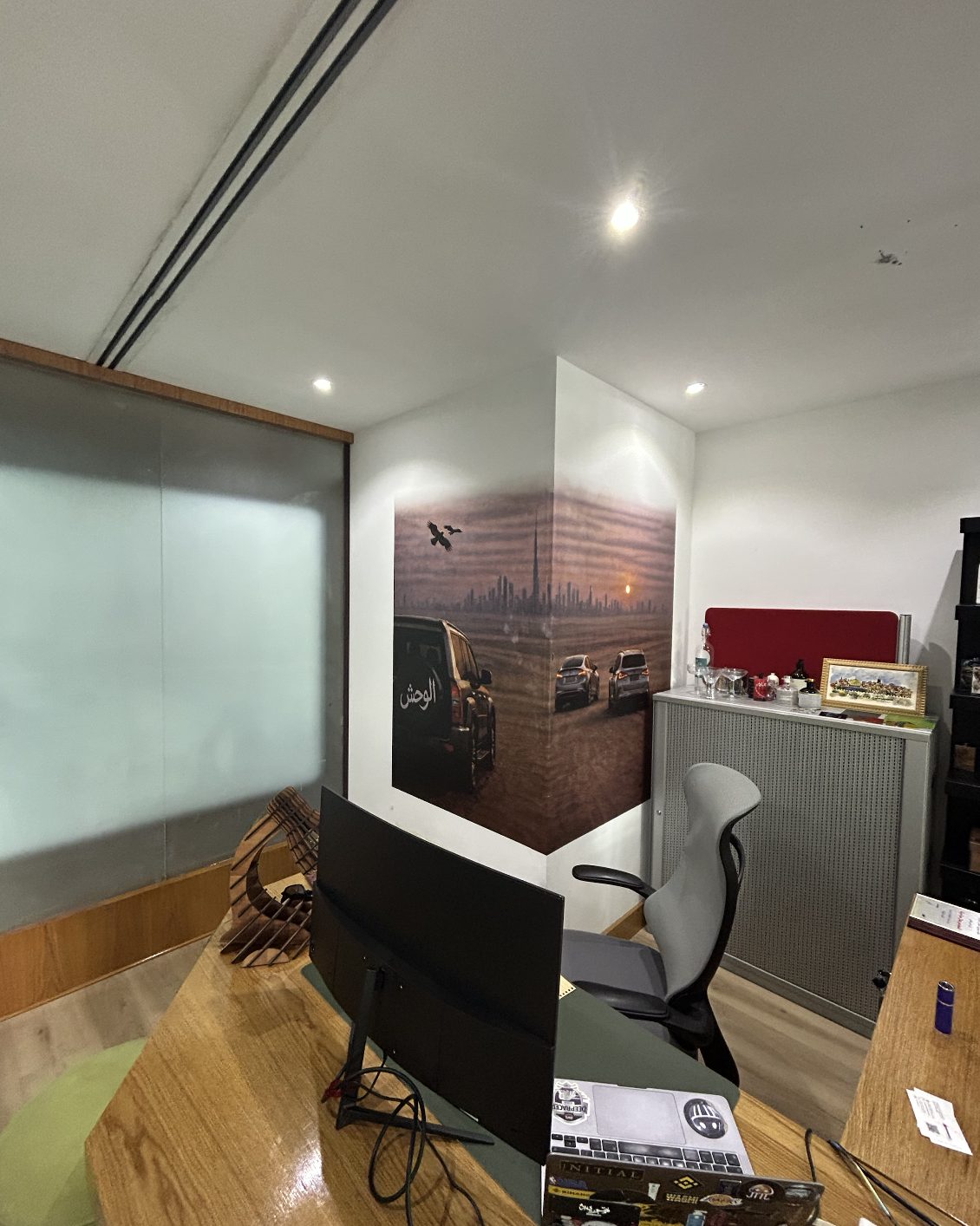
Consider how large installed surfaces, glass partitions, wooden panels, feature walls, are decorated traditionally: the panel is removed, transported to a print house, printed, transported back, and reinstalled, with the glue smell, installation noise and workspace disruption that follow. In many real projects that cycle takes 2 to 4 working days with the office or showroom partially closed, and the logistics alone can cost more than the printing. Whether a particular panel can stay in place depends on its relief, finish and access, covered in whether an installed panel can be printed where it hangs. Printed wallpaper and adhesive vinyl carry a second, quieter cost: indoors they typically last 1 to 2 years, and in high-traffic spaces such as schools, retail and public environments closer to 1 to 1.5 years before scratches, peeling and lifted edges force replacement. Removing vinyl often leaves adhesive marks that need repainting before the next installation, adding yet another line to the lifecycle bill.
What direct wall printing changes
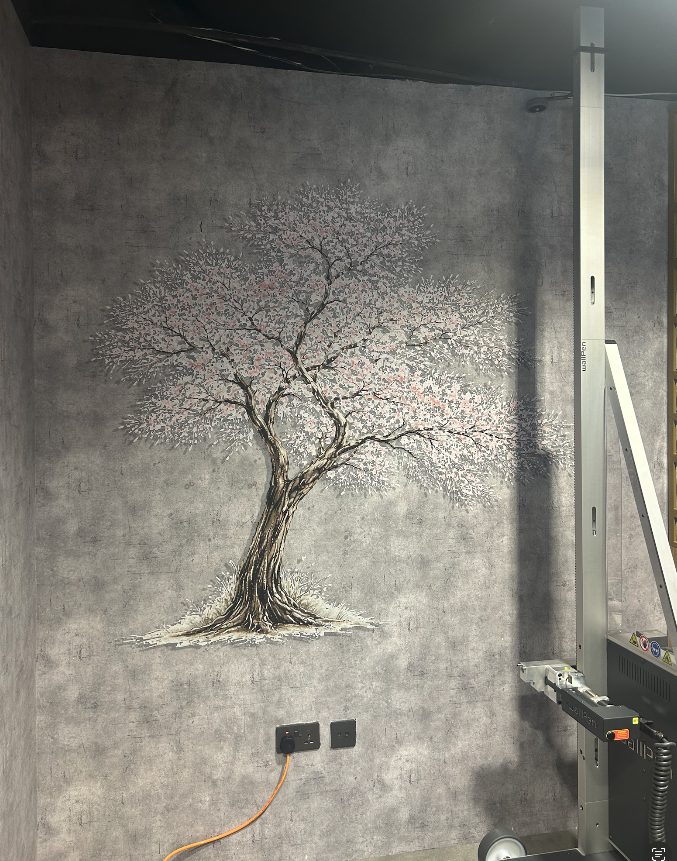
A wall printer removes the logistics entirely: the machine comes to the wall, and the artwork is UV-printed directly onto the final surface. One person can set the machine up in under 30 minutes, according to wallPen. There is no glue and no installation noise, the ink is low-odour, and the space stays in use around the work. Because the ink is UV-cured onto the wall itself, there is nothing to peel: with correct surface pre-treatment the print can last up to 12 years indoors, depending on the surface, location and wear, and outdoors about 2 years, often over 5 when paired with a UV protective clear coat. The cured film is scratch-resistant and water-resistant, printed with vegan, solvent-free inks, which is why the honest comparison is not wall printing versus cheap vinyl, but wall printing versus the full cycle of panel logistics, repainting and repeat replacement.
The machine behind this is the wallPen, German-built, printing up to 4 metres high, at unlimited width, on almost any wall surface, painted, plastered, wood, glass, even textured finishes, because the printhead never touches the wall. Our UV wall printing guide covers the technology itself in detail.
Quality is a dial, not a fixed property
Wall printing quality scales with print passes, and pricing follows. Four passes is fast, low-ink work, construction markings and temporary graphics. Eight passes covers most commercial jobs: offices, logos, brand walls. Sixteen passes delivers HD for homes, portraits and hospitality interiors, and thirty-two passes is ultra-HD for art and photographic murals. Printing runs roughly 33 to 50 minutes per square metre depending on that quality level, which is why two identical-sized walls can be quoted differently: the artwork decides the passes, and the passes decide the time and ink.
The operator’s numbers: what a wall printing business earns
In wallPen’s regional commercial model for signage companies, fit-out contractors and decoration businesses, selling prices run from roughly USD 250 per square metre for straightforward work to USD 380 for complex, premium projects, while ink cost sits around USD 6 per square metre at typical coverage of 7.4 ml. Glass work adds primer at about 15 ml per square metre, using Marabu primer we stock locally. On those numbers the model puts margin per square metre in the hundreds of dollars and machine break-even at roughly 210 to 290 square metres of billed work, a threshold that a single hotel corridor programme or a run of showroom walls can cross. Final pricing always follows a site inspection, because wall condition, accessibility, artwork complexity and white-ink requirements move the quote.
That break-even arithmetic is what makes wall printing interesting as a business rather than a gadget: the consumable cost is a rounding error against the sell price, so utilisation, not margin, is the variable that matters. The Digital Printing division supplies the machine, training, inks and local technical support from Dubai, and demonstrates the maths on your own artwork before you commit. Our guide to comparing wall printing machines and local support sets out what to ask any supplier. How a new operator builds that utilisation, with a demonstration wall and referrals from designers and fit-out firms, is set out in how to launch a wall printing service in the Gulf.
Across the GCC and India
The regional fit is obvious once you look at the refurbishment cycles. In the GCC, hotels, malls, offices and schools rebrand and refresh continuously, and Dubai’s fit-out market alone turns walls over at a pace paint crews struggle to match. In India, the same logic applies at larger scale: commercial fit-outs, retail chains, education campuses, hospitality and event spaces, plus a deep mural culture that direct printing serves faster than hand painting and more durably than vinyl. PRO TECHnology is the exclusive distributor of wallPen in the Middle East, with its own team of engineers, local support, spare parts held locally, installation and operator training. From Dubai it also works with buyers across the GCC and India on supply, training and applications. PRO TECHnology has been wallPen's exclusive distributor for the Middle East since January 2026; see the partnership announcement.
And if your walls are in the UAE and you want the result before, or instead of, the machine: our sister company in the same Dubai group, Sun Studio, runs wallPen wall printing on site across the UAE as a service with no minimum order. It charges a flat AED 950 per square metre, excluding VAT. For one lobby feature wall or a floor of meeting rooms, compare that rate with the full panel-logistics cycle, not with the price of vinyl alone.
Frequently asked questions
What is direct wall printing?
A vertical UV printer such as the German-built wallPen prints artwork straight onto the finished wall, on site, with UV-cured ink. No wallpaper, no vinyl, no adhesive: the wall itself carries the image. Height reaches 4 metres, with unlimited width.
How long does wall printing last compared with wallpaper or vinyl?
With correct surface pre-treatment, direct wall printing can last up to 12 years indoors, depending on the surface, location and wear. Outdoors it lasts about 2 years, often over 5 with pre-treatment and a UV protective clear coat. Printed wallpaper and adhesive vinyl typically last 1 to 2 years indoors, and closer to 1 to 1.5 years in high-traffic spaces such as schools and retail, before scratching, peeling or edge damage forces replacement.
Is wall printing cheaper than wallpaper?
Per square metre of material, vinyl is cheaper on day one. The comparison changes when you price the whole cycle: removal and reinstallation of panels, transport, site disruption of 2 to 4 working days for traditional methods, repainting after vinyl removal, and replacement every year or two. On installed glass, wooden panels and feature walls, printing directly on site is often the cheaper option over the life of the wall, not just the more premium-looking one.
What surfaces can a wall printer handle?
Almost all common wall surfaces, including painted walls, plaster, wallpaper, wood and glass; textured surfaces print too, up to a contour depth of about 10 mm, because the printhead does not touch the wall. Bare metal or concrete needs surface preparation first. Glass takes a primer, applied at roughly 15 ml per square metre.
What does wall printing quality depend on?
Mainly the number of print passes. Four passes suits fast work like construction markings; eight passes covers most commercial jobs, offices and logos; sixteen passes gives HD quality for homes and portraits; thirty-two passes is ultra-HD for art and photographic murals. More passes means more ink and more time per square metre, which is why artwork and quality level drive the quote.
What can a wallPen operator actually earn?
wallPen's regional commercial modelling assumes selling prices of roughly USD 250 to 380 per square metre depending on complexity, against ink cost of about USD 6 per square metre at typical coverage, and puts machine break-even at roughly 210 to 290 square metres of billed work. One person can set the machine up in under 30 minutes, according to wallPen, and printing runs 33 to 50 minutes per square metre depending on quality.
Can I get wall printing as a service in Dubai without buying a machine?
Yes. Sun Studio, our sister company in the same Dubai group, offers wallPen wall printing on site across the UAE as a service with no minimum order. It charges a flat AED 950 per square metre, excluding VAT.
Is wallPen available in India and across the GCC?
PRO TECHnology is the exclusive distributor of wallPen in the Middle East, with its own team of engineers, local support, spare parts held locally, installation and operator training. From Dubai it also works with buyers across the GCC and India on machine supply, training and applications. The technology suits the region's fit-out cycles: hotels, malls, offices, schools and event spaces that rebrand and refresh far faster than paint crews and wallpaper cycles can keep up with.
الطباعة المباشرة على الجدران: دراسة الجدوى مقابل ورق الجدران والفينيل
تعتمد المساحات التجارية في الخليج والهند على ورق الجدران والفينيل الذي يحتاج استبدالًا كل سنة إلى سنتين في المساحات عالية الاستخدام، مع تكاليف الفك والنقل وإعادة التركيب وتعطيل الموقع من يومين إلى أربعة أيام. طابعة الجدران الألمانية wallPen تطبع مباشرة على الجدار النهائي في الموقع بحبر UV: ارتفاع حتى 4 أمتار، بعرض غير محدود، وعمر يصل إلى 12 عامًا داخليًا حسب السطح والموقع والاستخدام، ونحو عامين خارجيًا يمتد غالبًا إلى أكثر من 5 أعوام مع طبقة حماية شفافة من الأشعة فوق البنفسجية، مقاومة للخدش والماء. نموذج الربحية يضع نقطة استرداد ثمن الماكينة عند نحو 210 إلى 290 مترًا مربعًا من الأعمال المفوترة. ولمن يريد طباعة جدرانه في الإمارات دون شراء الماكينة، يقدم صن ستوديو في دبي خدمة طباعة الجدران في الموقع في أنحاء الإمارات دون حد أدنى للطلب، بتعرفة ثابتة قدرها 950 درهماً للمتر المربع، غير شاملة ضريبة القيمة المضافة. بروتكنولوجي توفر wallPen والتدريب والدعم الفني من دبي للخليج والشرق الأوسط والهند.
Run the numbers on your own walls
Bring the artwork and the wall dimensions. We will demonstrate the wallPen on a comparable surface, walk through pass levels and consumable costs, and give you the honest break-even for your market, or, for walls in the UAE, connect you to Sun Studio for service work with no minimum order.