MedicAir Air Purifiers in the UAE
Published · PRO TECHnology Air Quality Solutions
MedicAir is a British air purification brand whose units combine HEPA filtration, an activated carbon stage and a UV-C chamber in one machine. PRO TECHnology is the exclusive distributor for the GCC, including the United Arab Emirates, supplying, sizing, installing and servicing all three models.
There are three units: the Pro Mini for bedrooms, single offices and consultation rooms, the Pro for larger rooms and meeting spaces, and the wheeled Pro Max for open-plan floors, lobbies and function rooms. Apartments, villas, offices, hotels, clinics and schools all use them, and the only thing that changes between those settings is how many units a space needs and how quietly they have to run. This page gives the verified specifications, the independent test evidence, and the arithmetic that decides which model belongs in which room.
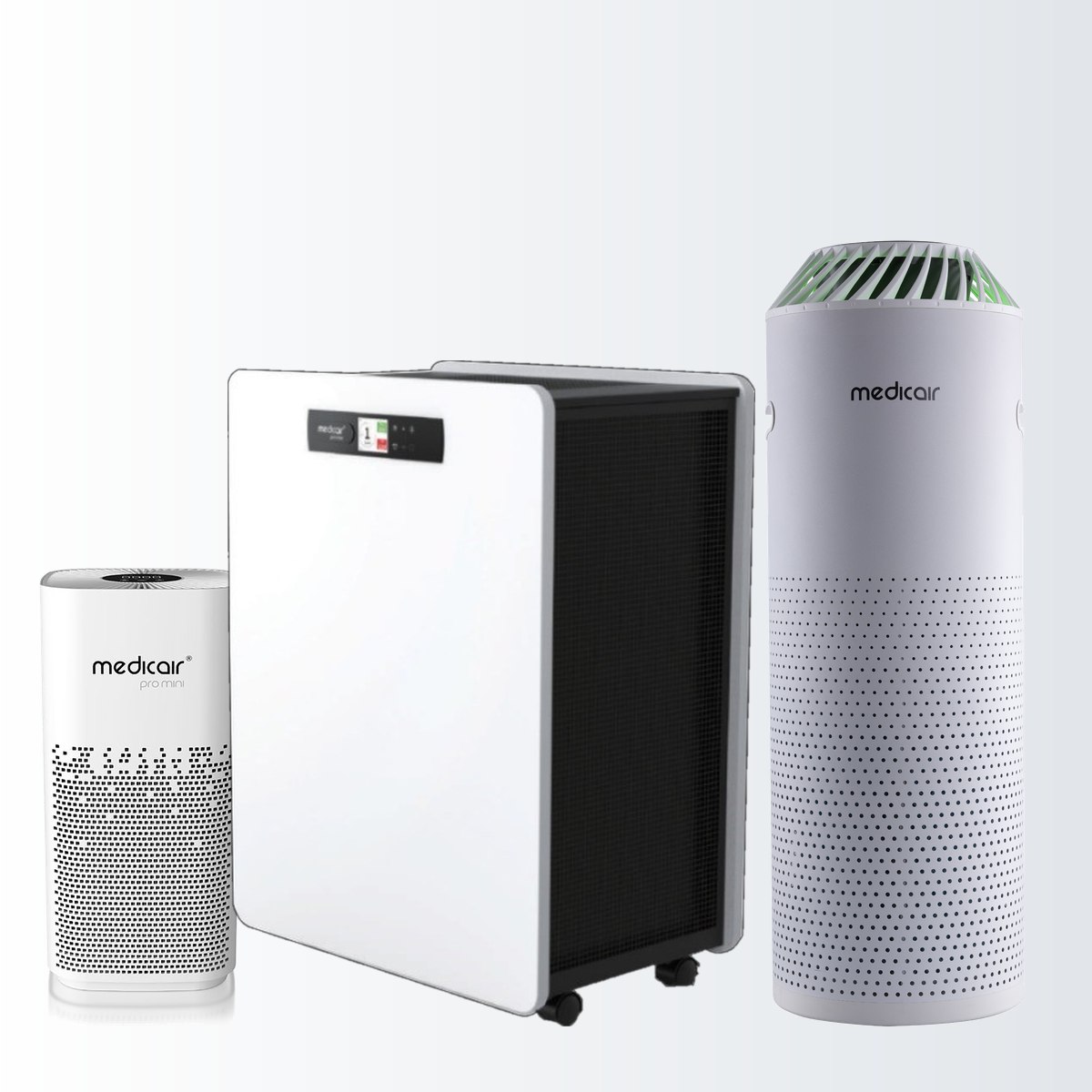
- 3 modelsPro Mini, Pro and Pro Max
- H13 and H14HEPA grades under EN 1822
- 400 to 1,500 m³/hmanufacturer-stated capacity
- GCCexclusive distribution, service from Dubai
- Brand
- MedicAir, a trading name of MedicAir DentAir Ltd, United Kingdom
- Models supplied here
- MedicAir Pro Mini, MedicAir Pro, MedicAir Pro Max
- Filtration
- Pre-filter, ATP-HEPA (H14 on Pro Mini and Pro Max, H13 on Pro), activated carbon, UV-C reaction chamber
- Capacity
- Pro Mini up to 400 m³/h; Pro up to 605 m³/h; Pro Max 1,500 m³/h. See the comparison table for what each figure means
- Sound
- Pro Mini 21 dB lowest setting, ≤55 dB(A) maximum; Pro 28 to 60 dB; Pro Max 28 to 54 dB
- Sensors
- Laser particulate 0.1 to 0.3 µm, temperature and humidity, TVOC. The Pro Max adds a CO₂ sensor
- Control
- Touchscreen on the unit, MedicAir mobile app, MedicAir Data app for multi-site monitoring. The Pro adds a remote control
- Filter life
- 5,000 hours, and MedicAir recommends replacement at least every twelve months
- Regulatory status
- Not medical devices. The Pro Mini manual states this in terms: the unit helps protect against certain particulate contaminants but does not eliminate exposure to, or the risk of contracting, disease or infection
- Distribution
- PRO TECHnology Co. L.L.C. is the exclusive MedicAir distributor for the GCC, including the United Arab Emirates, with supply, installation, replacement filters and service handled in Dubai
Key takeaways
- PRO TECHnology is the exclusive MedicAir distributor for the GCC, including the United Arab Emirates. Units, replacement filters and service come from Dubai rather than from a European supply chain.
- MedicAir is not a hospital-only product. The same three machines are specified for apartments, villas, offices, meeting rooms, hotel guest rooms, clinics and schools. What changes is the model, the number of units and the speed they can be run at.
- Size from room volume, never floor area. Required clean air in m³/h equals length x width x ceiling height, multiplied by your target air changes per hour.
- One unit does not clean a whole villa. Air that never reaches an intake never gets cleaned, and a closed door is a wall.
- Independent testing by Dr Iyad Al-Attar in Kuwait in 2025 measured 98 to 100% removal of particles above 1 micron on the MedicAir Pro, and VOC concentrations above 8,000 ppm reduced to zero in under 30 seconds.
- MedicAir states its units are used by more than 20 NHS Trusts in the United Kingdom and are available through NHS Supply Chain. That is documented healthcare adoption, not an NHS approval or endorsement, and we do not describe it as one.
- These are not medical devices and no UAE regulation requires an air purifier in any building. Purification supplements ventilation; it never replaces it.
Choosing MedicAir for your environment
The honest starting point is that the same machine behaves differently in different buildings, and the constraint that decides the specification changes from setting to setting. In a bedroom it is noise. In a villa it is the number of separate rooms. In an office it is whether the problem is actually particles at all. In a hotel it is who controls the switch. Below is what each setting normally comes down to.
Apartments
An apartment is usually the simplest case and the one where a single unit genuinely can cover most of the lived-in space, because the living area, kitchen and hallway are often one connected volume. Work out that connected volume, not the total apartment area on the title deed. A 60 m² living and dining space with a 3 m ceiling is 180 m³, which at three air changes an hour needs about 540 m³/h and therefore points at a Pro rather than a Pro Mini. Bedrooms are treated separately because their doors are shut at night, and a Pro Mini running on a low setting is the usual answer there.
Villas and larger homes
A villa needs more than one unit, and any supplier who tells you otherwise is selling you a number rather than a result. A purifier only cleans air that reaches its intake, and a closed bedroom door is a wall as far as air movement is concerned. The practical pattern in UAE villas is a Pro or Pro Max in the main living and majlis volume, a Pro Mini in each bedroom that matters, and nothing at all in rooms nobody uses. Villas also tend to have double-height entrance volumes that swallow capacity, and heavy outdoor dust ingress at the entrance doors, which shortens pre-filter intervals. Our guide to choosing an air purifier for villas and apartments works through the room-by-room arithmetic.
Offices, meeting rooms and reception areas
Meeting rooms are the sharpest case in an office, because occupancy is high, the door is shut and the room is small. Open-plan floors are a volume problem and usually need either a Pro Max or several distributed units rather than one machine in a corner. Reception areas sit in between and carry the extra load of the front door opening onto Sheikh Zayed Road or a car park. One caution before you buy anything: if carbon dioxide climbs through the working day, the building needs ventilation and a purifier will not help. Filtration removes particles and, through the carbon stage, gases and odours. It does not introduce outdoor air and it does not remove CO₂.
Hotels
Guest rooms and public areas are two different problems and should not be specified together. In a guest room the deciding factor is almost always night-time noise, not airflow, which points at a Pro Mini on a low setting; a unit a guest switches off at midnight delivers nothing for the rest of the night. Lobbies, function rooms, ballrooms, gyms and spa areas are volume problems and point at the Pro Max, usually more than one. Corridors are a poor use of a portable unit because the air moves through them rather than sitting in them. Smoking-permitted areas are their own category and are covered in our guide to air purification for cigar lounges and smoking rooms. Our offices and hotels buying guide covers placement, procurement and housekeeping.
Clinics, dental practices and healthcare facilities
This is where MedicAir began, and it remains a strong fit: most outpatient rooms are modest in volume, occupancy turns over quickly, and the ventilation was often designed to a general commercial standard. It is also where the claims need most discipline. Portable purification supplements a building's ventilation design and cannot deliver the outdoor-air fraction, pressure relationships or exhaust routes that a licensed clinical room's design requires. No UAE rule requires a purifier in a clinic or a dental operatory. Our guide to air purifiers for clinics and healthcare facilities sets out where it fits and where it does not.
Schools and other commercial settings
Classrooms are high-occupancy rooms with fixed timetables, which makes them easy to size and easy to get wrong: a unit chosen on its maximum-speed figure and then run on low because it interferes with teaching is not delivering the air changes the calculation assumed. Size generously and run at a middle speed. The same logic applies to gyms, salons, nurseries, laboratories and showrooms. Our indoor air quality guide for UAE schools and clinics covers what to measure before you specify anything.
Bedroom, guest room, single office, consultation room
MedicAir Pro Mini. Small volume, and the constraint is noise rather than airflow.
Living and majlis space, meeting room, treatment room, classroom
MedicAir Pro. More volume than a Pro Mini covers, and a fan speed range that lets you run below maximum.
Open-plan floor, lobby, function room, gym, large waiting area
MedicAir Pro Max. Wheeled, the highest capacity of the three, and the only model with a CO₂ sensor.
A whole villa, floor or venue
More than one unit, distributed. Send us the room schedule and we will do the arithmetic per room.
MedicAir Pro Mini vs Pro vs Pro Max
All three share the same filtration principle: a pre-filter, an antimicrobial-treated HEPA stage, an activated carbon layer and a UV-C chamber. They differ in capacity, in physical size and, importantly, in how quiet they can be while still doing useful work.
| Pro Mini | Pro | Pro Max | |
|---|---|---|---|
| Suited to | Bedrooms, single offices, consultation rooms, hotel guest rooms | Living and majlis spaces, meeting rooms, treatment rooms, classrooms | Open-plan floors, lobbies, function rooms, gyms, large waiting areas |
| Capacity | Up to 400 m³/h †, stated as clean air delivery rate with the H14 filter, ±10% | Up to 605 m³/h †, stated as maximum airflow | 1,500 m³/h †, labelled CADR on the spec sheet and maximum airflow on the website |
| HEPA grade | H14 | H13 | H14 |
| Activated carbon | nano hybrid layer | honeycomb layer | high-efficiency layer |
| UV-C | TiO₂ reaction chamber | 24 W bulb in a TiO₂ chamber | reaction chamber |
| Sound | 21 dB at the lowest setting; ≤55 dB(A) maximum † | 28 to 60 dB across the range | 28 to 54 dB across the range |
| Dimensions | 510 mm high x 250 mm wide † | 880 mm high, 330 mm base diameter | 580 x 380 x 750 mm, wheeled † |
| Weight | 5.6 kg † | 14 kg | 29 kg † |
| Fan settings | Six: 1, 2, 3, 4, ReAKT and Sleep | Four, plus ReAKT | Six |
| Oscillation | 360 degrees | 360 degrees | 180 degrees |
| CO₂ sensor | No | No | Yes |
| Remote control | app and touchscreen | plus app and touchscreen | app and touchscreen |
| Input power | 42 W † | Not confirmed, see the Pro page | Not published |
| Filter life | 5,000 hours | 5,000 hours | 5,000 hours |
| Read more | Pro Mini | Pro | Pro Max |
† From the MedicAir documents supplied with the units sold in the UAE: the Pro Mini user manual (IFU_EM_REV1.1, April 2022), the MedicAir 2.0 product brochure (January 2022) and the Pro Max specification sheet. Every other figure is from medicair.co, read on 27 September 2026.
Where the documents disagree, and what we publish
We would rather show you the conflict than pick a number quietly. Four figures do not reconcile between the manual supplied with the product and the manufacturer's current website, and one does not reconcile inside the manual itself.
| Figure | Supplied document | medicair.co |
|---|---|---|
| Pro Mini capacity | Up to 400 m³/h, described as clean air delivery rate | 410 m³/h, described as airflow at maximum setting |
| Pro Mini weight | 5.6 kg | 5 kg |
| Pro Mini dimensions | 510 x 250 mm | 52 cm high, 27 cm base |
| Pro Mini warranty | 2 years | 2 years on the product page, 3 years on the home page |
| Pro Mini timer | 1 to 8 hours on the specification page, up to 24 hours on the controls page of the same manual | Not stated |
| Pro lowest sound level | 30 dB in the brochure text, 35 dB in the brochure's own speed table | 28 dB |
Ask us before you write any of these into a tender document and we will get the manufacturer's written confirmation for the revision we are quoting you.
What the three filter stages actually do
Three different technologies are stacked in one machine, and each does a job the others cannot. Understanding which is which is the difference between buying the right unit and being disappointed by the right unit.
HEPA: particles, and only particles
The HEPA stage is a mechanical filter. Air is pushed through a dense pleated medium and particles are physically caught in it: dust, sand, pollen, mould spores, skin flakes, pet dander and the fine particulate that carries respiratory droplets. Under the European standard EN 1822, H13 captures at least 99.95% and H14 at least 99.995% of particles at the most penetrating particle size, which is around 0.12 to 0.25 microns, not a fixed 0.3 microns. The 0.3 micron figure quoted in most online comparisons belongs to the American convention and is the wrong standard to quote in a Dubai specification. What HEPA does not do is touch gases. A gas molecule passes straight through.
Activated carbon: gases, odours and VOCs
The carbon stage works by adsorption rather than straining: an enormous internal surface area gives gas molecules somewhere to stick. This is the stage that addresses cooking smells, solvent and paint odours, disinfectant, tobacco smoke odour and volatile organic compounds. Two things are worth knowing. Carbon has a finite capacity and stops working once it is loaded, with no visible sign, which is why replacement schedules matter more in a busy or smoky room than in a bedroom. And performance depends on the specific compound, the depth of the carbon bed and how fast air passes through it, so no single percentage covers odours as a category.
UV-C: a treatment stage, not the main mechanism
Air passing through the unit crosses a UV-C chamber, where ultraviolet light damages the genetic material of micro-organisms. MedicAir describes its implementation as safe UV on the basis that the chamber is designed not to emit ozone, and the lamp is enclosed inside the machine rather than exposed to the room. Treat UV as an additional treatment stage rather than the reason to buy the machine: the HEPA and carbon stages do the filtration work, and the independent testing available on these units measures particle and VOC removal rather than what the lamp contributes.
ReAKT and the sensors
All three models carry a laser particulate sensor reading from 0.1 to 0.3 microns, a temperature and humidity sensor and a TVOC sensor, and the Pro Max adds a carbon dioxide sensor. In ReAKT mode the unit raises and lowers its own fan speed in response to what the sensors read, which preserves filter life compared with running flat out and means the machine responds to a real event, such as cooking or a room filling up, rather than to a timer.
Independent laboratory testing and UK healthcare use
MedicAir's credibility rests on testing that was commissioned by the manufacturer but carried out by people who do not work for it, and on documented adoption by healthcare organisations that had to justify the purchase. Below is each piece of evidence, what was tested, what was found and where it came from. Where we have not seen the underlying report, we say so.
MedicAir Pro: independent examination in Kuwait, September 2025
- Who
- Dr Iyad Al-Attar, an air filtration specialist who consults to international standards bodies. Commissioned by MedicAir.
- Device
- MedicAir Pro, the single-stage composite filter with an H13 medium, a carbon layer and a UV-C element.
- Conditions
- Kuwait, chosen for high outdoor particulate, high VOC load and high thermal load. Tested across all four fan speeds, with the UV element on and off.
- Particles
- 98 to 100% removal above 1 micron and 99% below 1 micron, measured at 0.3, 0.5, 1.0, 3.0, 5.0 and 10.0 microns.
- Gases
- VOC concentrations raised above 8,000 ppm were reduced to zero in under 30 seconds with the UV element off, and to between 0.47 and 0.51 ppm with it on.
- What the report also says
- It recommends longitudinal testing to confirm the result holds as the filter loads, and an investigation into whether the unit generates chemical by-products.
- Date and source
- Report dated 2 September 2025; summary published by MedicAir on 3 September 2025.
MedicAir Pro Max: independent examination in Kuwait, August 2025
- Who
- Dr Iyad Al-Attar, in the same programme of work.
- Device
- MedicAir Pro Max.
- Particles
- 96 to 100% removal for particles above 1 micron and up to 96% for particles below 1 micron, as summarised by the manufacturer.
- What the report also says
- It recommends a deeper granular activated carbon stage, separated from the particulate filter, where gas-phase loading is the main concern. If odour and VOC control is the reason you are buying, discuss this with us before choosing the Pro Max.
- Date and source
- Report dated 30 August 2025; summary published by MedicAir on 3 September 2025.
MedicAir: Independent Global Testing Confirms MedicAir's Filtration Excellence
Airmid Healthgroup, Ireland and CremCo, Canada
- Who
- Named in MedicAir's own product brochure as the laboratories that tested the unit independently. MedicAir separately attributes a Cystovirus Phi6 test on the MedicAir Pro to Crem Co.
- Device
- MedicAir 2.0, the unit the brochure describes, whose published figures match the current MedicAir Pro.
- What was tested
- Airborne virus removal in a 25 m³ test chamber built to comply with US EPA (2012) guidance, control against efficacy over 60 minutes.
- Result as published
- The brochure's chart is captioned as airborne virus removal from the chamber within 16 minutes, and marks reductions of 3 log₁₀ and 4.42 log₁₀.
- What we can and cannot confirm
- The brochure names both laboratories but does not say which produced the chart, and we have not seen either underlying report. Treat it as a manufacturer-published chamber result on the 2.0 unit, not as a result that transfers to the Pro Mini or the Pro Max.
- Date and source
- MedicAir 2.0 product brochure, January 2022.
MedicAir 2.0 product brochure, supplied by the manufacturer. Ask us for a copy.
Use by NHS Trusts and UK healthcare facilities
- What MedicAir states
- That its units are used by more than 20 NHS Trusts and by thousands of healthcare organisations, and that MedicAir is available through NHS Supply Chain, the framework NHS organisations buy through.
- How firm is it
- This is the manufacturer's own figure and we attribute it as such. MedicAir's home page says more than 20 Trusts and its hospitals page says over 25, so the exact number is unsettled. Availability on NHS Supply Chain is a procurement listing, not a clinical endorsement.
- Wording we use, and why
- Used by NHS Trusts and UK healthcare facilities. We do not write NHS approved, NHS certified or NHS endorsed, because the NHS issues no such approval for air purifiers and those phrases would be false.
- The Cardiff example
- MedicAir publishes a testimonial from Professor Mike Lewis at the University Dental Hospital in Cardiff describing 180 machines placed beside dental chairs. Those are DentAir units, a different MedicAir product from the three sold here, and we name it accordingly.
- Date and source
- medicair.co, read 27 September 2026.
What the evidence does not say
A laboratory reduction figure is a measurement of what a machine did to a defined challenge under defined conditions. It is not a promise about a real room, where air mixes imperfectly, doors open, people come and go and the source keeps producing. Particle filtration efficiency, laboratory microbial reduction and real-world infection rates are three different measures, and a result in the first two does not entitle anyone to claim the third. Nobody can tell you that a purifier will stop an infection, and we will not.
How many units does a space need?
Required clean air in cubic metres per hour = room volume in cubic metres x your target air changes per hour. Room volume is length x width x ceiling height. That is the whole method, and it is why floor area on its own is useless: two 40 m² rooms with 2.7 m and 4 m ceilings differ by almost half in the air they contain.
A meeting room 6 m x 5 m with a 3 m ceiling holds 6 x 5 x 3 = 90 m³ of air.
At a target of five air changes an hour it needs 90 x 5 = 450 m³/h of clean air. A Pro Mini is rated at up to 400 m³/h, so this room is a Pro, or two Pro Minis.
At ten air changes an hour the same room needs 900 m³/h, which is beyond a single Pro and points to a Pro Max or to multiple units.
Same room, same people, different target. This is why the useful question is not which model is best but what the room is and what you are trying to achieve in it.
Which air change target should you use?
| Setting | Source | Figure and status |
|---|---|---|
| Homes | MedicAir | 3 air changes per hour. Manufacturer's sizing guidance, not a standard |
| Offices and general indoor spaces | US CDC | At least 5 air changes per hour of clean air. A voluntary public health recommendation |
| Offices | MedicAir | 5 air changes per hour. Manufacturer's sizing guidance |
| Healthcare | MedicAir | 10 air changes per hour. Manufacturer's sizing guidance, and higher than ASHRAE 170 requires for most outpatient rooms |
| Licensed healthcare rooms in Dubai | ASHRAE 170, adopted by the Dubai Health Authority | From 2 air changes per hour in a general examination room to 20 in an operating theatre. A design requirement for the building's ventilation, not for plug-in equipment |
Our guide to sizing a medical-grade air purifier sets out the full ASHRAE 170 table and what each figure governs.
Four corrections to make before you trust the number
- Rated capacity is measured at maximum fan speed. If the unit will actually be run at speed two, the delivered figure is lower and usually not published. Size generously and run at a middle speed rather than buying the smallest unit that technically qualifies.
- A purifier's air changes and a building's air changes are different things. A recirculating unit cleans air already in the room. Where a standard requires a proportion of outdoor air, no amount of filtration satisfies that part.
- Distribution beats brute force. Two units placed apart in a long or subdivided room outperform one large unit in a corner, because air that never reaches an intake never gets cleaned.
- The room has to be the volume you calculated. A door propped open all day, a mezzanine or a double-height void changes the answer.
MedicAir publishes a calculator on its own product pages that takes length, width and height and returns a unit count. It is a reasonable first pass. We would rather you sent us the room schedule, because the answer for a real building depends on ceiling heights, door discipline, occupancy and what the ventilation is already doing.
Filters, maintenance, warranty and local support
The purchase is the smaller half of the decision. A purifier is a consumable-driven machine, and a unit with an exhausted filter is a fan.
Filters
Each model takes a single combined cartridge holding the pre-filter, the HEPA medium and the carbon layer, which is why changing it takes minutes and needs no technician. MedicAir publishes a filter life of 5,000 hours for all three models and recommends replacing the cartridge at least once every twelve months even where the unit has not asked for it. The unit tracks its own filter life and signals when a change is due. Treat the published hours as a ceiling rather than a plan: a unit running twelve hours a day in a Dubai reception area, with the front door opening onto the street, will not hold a residential interval. Local dust is the reason Dubai's healthcare engineering guidelines require sand trap louvers on outdoor air intakes, and the same dust reaches the rooms your units sit in. Vacuum or wipe the intake grille regularly, and budget for filters as a running cost from day one.
Maintenance
There is very little of it. Power the unit down and unplug it before cleaning or changing a filter, keep the intakes more than 20 cm clear of walls and furniture so the machine is not recirculating its own output, and never attack the filter medium with a brush or a scouring pad. The UV-C emitter is enclosed and is part of the cartridge assembly; the manual is explicit that it must not be operated outside the appliance.
Warranty
The Pro Mini manual states a two-year warranty from MedicAir DentAir Ltd against structural or electrical defects, excluding negligence, modification, unauthorised repair and accidental damage. The manufacturer's website states three years on the Pro and Pro Max and is inconsistent about the Pro Mini. Ask us to confirm the warranty term in writing on your quotation rather than relying on a figure from a web page, and we will state what applies to the revision we are supplying you.
Local supply and support
PRO TECHnology has been trading in Dubai since 1998 and is the exclusive MedicAir distributor for the GCC, including the United Arab Emirates. Units, replacement cartridges and service are handled here rather than through a European supply chain, our Air Quality Solutions team will size a building against its actual room schedule, and the machines can be seen running before you commit at our Business Bay showroom. We do not publish stock levels, delivery times or free-survey offers on this page, because those depend on the model and the quantity; ask and we will tell you what is true this week.
- MedicAir Pro Mini user manual (PDF)Specifications, controls, filter change, warranty terms. 1.3 MB
- MedicAir Pro Max specification sheet (PDF)Dimensions, capacity, filters and sensors. 163 KB
- MedicAir Pro brochureAvailable on request: the manufacturer's current brochure quotes UK retail prices, so we send a UAE copy
Where MedicAir sits in our air quality range
MedicAir is one of several manufacturers in PRO TECHnology's Air Quality Solutions division, and they are not variants of one another. Choosing between them starts with what you are actually trying to change.
- MedicAir purifies: HEPA, carbon and UV-C, for particles, odours and VOCs in rooms of any size from a bedroom to a ballroom.
- Air quality monitors measure: they tell you what the problem is before you buy equipment to solve it, and they tell you whether the equipment worked. Many projects need both.
- **Stadler Form dehumidifiers** control humidity, which purification does not touch. If the complaint is condensation, damp or musty smells rather than dust, the dehumidifier is the machine.
- **Bellaria AirCube** neutralises odours at source in washrooms and similar spaces, which is a different job from filtering a room's air.
If you are not sure which of those describes your problem, say what you are noticing rather than what you think you need. Dust settling on surfaces, a smell that will not shift, a room that feels stuffy by mid-afternoon and condensation on the glass are four different faults with four different answers.
MedicAir in the UAE: frequently asked questions
Who is the MedicAir distributor in the UAE?
PRO TECHnology Co. L.L.C. is the exclusive MedicAir distributor for the GCC, including the United Arab Emirates. All three models, the replacement filter cartridges and the service are supplied from Dubai. You can see the units running at our showroom in Business Bay before committing, and our Air Quality Solutions team will size a building against its real room schedule rather than a coverage claim.
Which MedicAir model should I buy?
It depends on room volume rather than on the type of building. The Pro Mini suits bedrooms, single offices, consultation rooms and hotel guest rooms. The Pro suits living and majlis spaces, meeting rooms, treatment rooms and classrooms. The Pro Max suits open-plan floors, lobbies, function rooms and gyms. Multiply length by width by ceiling height, multiply that by your target air changes per hour, and compare the result with each unit's capacity.
Are MedicAir air purifiers only for hospitals and clinics?
No. The brand began in dentistry and is used in healthcare, but the same three machines are specified for apartments, villas, offices, meeting rooms, hotel guest rooms, function spaces, schools and showrooms. The healthcare background is why the filtration specification is what it is; it is not a restriction on where the units belong.
Is MedicAir a medical device?
No. The Pro Mini's own manual states that the unit helps protect against certain particulate contaminants but does not eliminate exposure to, or the risk of contracting, disease or infection, and that it is not a medical device. The phrase medical-grade describes the filtration approach, not a regulatory class, and MedicAir's management-system certificate certifies the company's quality system rather than approving the products as medical devices.
What is the difference between H13 and H14 HEPA?
Under the European standard EN 1822, H13 captures at least 99.95% and H14 at least 99.995% of particles at the most penetrating particle size, which is around 0.12 to 0.25 microns rather than a fixed 0.3 microns. H14 is the finer grade. It also has a higher pressure drop, so how well the filter is sealed into the machine matters as much as the grade printed on it. The MedicAir Pro Mini and Pro Max are specified at H14 and the Pro at H13.
Has MedicAir been independently tested?
Yes. The most detailed testing available is by Dr Iyad Al-Attar in Kuwait in 2025: the MedicAir Pro removed 98 to 100% of particles above 1 micron and 99% below 1 micron, and reduced VOC concentrations above 8,000 ppm to zero in under 30 seconds. The Pro Max was measured at 96 to 100% for particles above 1 micron. MedicAir's brochure also names Airmid Healthgroup in Ireland and CremCo in Canada as independent laboratories that tested the 2.0 unit.
Is MedicAir used by the NHS?
MedicAir states that its units are used by more than 20 NHS Trusts in the United Kingdom and are available through NHS Supply Chain. That is the manufacturer's own figure and it describes adoption and procurement availability. It is not an NHS approval, certification or endorsement, and no supplier should describe it as one, because the NHS does not issue such approvals for air purifiers.
How many MedicAir units does a villa need?
More than one, almost always. A purifier only cleans air that reaches its intake, and a closed bedroom door is a wall. The usual pattern is a Pro or Pro Max for the main living and majlis volume and a Pro Mini in each bedroom that matters. Send us the room dimensions, ceiling heights and which doors stay shut, and we will work through it room by room.
Will a MedicAir purifier reduce carbon dioxide or humidity?
No to both. A purifier filters and recirculates air that is already in the room; it introduces no outdoor air, so it cannot lower CO₂, even on the Pro Max where the built-in sensor shows you the reading. A rising CO₂ level means the building needs ventilation. Purification also does not dehumidify. Humidity control is a separate machine and we supply Stadler Form dehumidifiers for that.
How often do MedicAir filters need changing, and can I get them in the UAE?
MedicAir publishes a 5,000-hour filter life for all three models and recommends replacing the cartridge at least once every twelve months even if the unit has not signalled a change. Expect the shorter end of that in a dusty or heavily used space. Replacement cartridges are supplied locally by PRO TECHnology, so you are not waiting on a European order, and the change takes a couple of minutes without a technician.
How loud is a MedicAir air purifier?
The Pro Mini's lowest published level is 21 dB and its manual states a maximum of 55 dB(A). The Pro publishes 28 to 60 dB and the Pro Max 28 to 54 dB. The low figure and the maximum capacity never happen at the same moment, which is the single most useful thing to know when specifying for a bedroom, a hotel guest room or a classroom. Size generously so the unit can do its work at a middle speed.
Can I see MedicAir units before buying?
Yes. Our indoor air quality showroom on Sheikh Zayed Road in Business Bay, Dubai displays MedicAir purification alongside air quality monitors and Stadler Form dehumidifiers, so you can hear how loud a unit is at each setting rather than reading a decibel figure. Call +971 4 343 5501 or email sales@protech.ae to arrange a time.
أجهزة تنقية الهواء ميديكإير في الإمارات
ميديكإير (MedicAir) علامة بريطانية لأجهزة تنقية الهواء تجمع في وحدة واحدة بين فلتر HEPA وطبقة كربون نشط وحجرة أشعة فوق بنفسجية UV-C، وبروتكنولوجي هي الموزّع الحصري لها في دول مجلس التعاون الخليجي، ومنها دولة الإمارات، توريدًا وتركيبًا وصيانة وفلاتر بديلة من دبي.
الطرازات ثلاثة: Pro Mini بسعة تصل إلى 400 متر مكعّب في الساعة وفلتر H14، وهو المناسب لغرف النوم والمكاتب الفردية وغرف الفنادق وعيادات الكشف؛ وPro بتدفّق يصل إلى 605 وفلتر H13 للمجالس وغرف الاجتماعات والفصول الدراسية؛ وPro Max بسعة 1500 وفلتر H14 وعجلات، للمساحات المفتوحة واللوبي والقاعات والصالات الرياضية.
لاحتساب السعة المطلوبة يُضرب الطول في العرض في ارتفاع السقف للحصول على حجم الغرفة، ثم يُضرب الناتج في عدد تغييرات الهواء المستهدفة في الساعة. ومن المهم العلم أن أرقام الأداء تُقاس عند أعلى سرعة للمروحة، بينما تُقاس أرقام الضجيج عند أدناها، فهما لا يجتمعان في اللحظة نفسها. والفيلا الواحدة تحتاج عادة إلى أكثر من جهاز، لأن الجهاز لا ينقّي إلا الهواء الذي يصل إلى مدخله.
خضعت الأجهزة لاختبارات مستقلة أجراها الدكتور إياد العطّار في الكويت عام 2025، وأظهرت إزالة من 98 إلى 100% من الجسيمات الأكبر من ميكرون واحد في طراز Pro. وتذكر الشركة المصنّعة أن أجهزتها مستخدمة لدى أكثر من 20 من مؤسسات هيئة الخدمات الصحية الوطنية البريطانية، وهذا استخدام موثّق وليس اعتمادًا أو تزكية رسمية. كما أن هذه الوحدات ليست أجهزة طبية، والتنقية مُكمّلة للتهوية وليست بديلاً عنها.
للاستفسار أو لمعاينة الأجهزة في صالة العرض في الخليج التجاري بدبي: هاتف 5501 343 4 971+ أو بريد sales@protech.ae.
Sources and how we checked them
Specifications on this page come first from the MedicAir documents supplied with the units sold in the UAE, and second from the manufacturer's own website, read on 27 September 2026. Where the two disagree we publish the supplied document's figure and show the conflict rather than choosing silently. Test results are attributed to the person or laboratory that produced them, with the date. Figures that are a manufacturer's own recommendation rather than a standard or a public health position are labelled as such. This is engineering and procurement guidance, not medical advice.
- MedicAir Pro Mini user manual, IFU_EM_REV1.1, April 2022 (model PFACOABBD)
- MedicAir Pro Max specification sheet
- MedicAir 2.0 product brochure, January 2022 (unit FZHCE05-MWEM). Supplied by the manufacturer; available from us on request
- MedicAir product pages: Pro Mini, Pro and Pro Max specifications
- MedicAir: Hospitals and NHS Trusts
- MedicAir: Independent Global Testing Confirms MedicAir's Filtration Excellence, 3 September 2025, with the Dr Iyad Al-Attar report summaries
- EN 1822 filter classification: H13 and H14 efficiencies at the most penetrating particle size
- US CDC, ventilation in buildings: the 5 air changes per hour target, published as a voluntary recommendation
- ASHRAE Standard 170-2021 Addendum h, ventilation of health care facilities
Send us the rooms, not the question
The fastest route to a specification you can defend is a room schedule rather than a request for the best model. For each space we need length, width and ceiling height, what the room is used for, typical and peak occupancy, daily operating hours, and whether it has mechanical ventilation. Our Air Quality Solutions team will work through the arithmetic, tell you how many units each space needs, and say plainly where purification is not the answer and the ventilation has to be addressed instead. Call +971 4 343 5501 or email sales@protech.ae.