
Air Purifiers for Hotels in the UAE and GCC: Guest Rooms, Lobbies and Meeting Spaces
Published · PRO TECHnology Air Quality Solutions
A hotel is not one air quality problem but three, bought by different people against different criteria. A guest room is decided by noise, because a stranger switches the machine off. A lobby or ballroom is decided by volume. Back of house is decided by whether anyone owns the filters. This guide is about specifying and buying against those three, not about the physics, which is covered in our sizing guide.
If you are writing a specification for a property or a portfolio, the useful questions are narrower than the ones most purifier pages answer. What setting will a sleeping guest tolerate, and what does the machine actually deliver at that setting? How many units does a 1,000 m³ lobby need, and will the operations team accept them on the floor? Who changes the cartridges, and out of whose budget? What do you require in a demonstration before you sign? This page works through each of those. The room-sizing arithmetic itself lives on our medical-grade air purifier sizing guide, and the broader commercial picture across offices and hotels is on our offices and hotels buying guide.
- 35 dB(A)the ASHRAE design target in a guest room
- 3 problemsguest rooms, public areas, back of house
- Per roomspecified from volume, not from star rating
- Filtersthe cost that outlives the purchase order
Key takeaways
- A guest room is a noise specification before it is an air specification. ASHRAE's design guideline for HVAC background sound in a hotel guest room is NC/RC 30, roughly 35 dB(A), and WHO reports indoor noise events peaking at 32 dB starting to provoke body movement in sleepers.
- Ask what the machine delivers at the speed you will run it, not at maximum. Of the three MedicAir models only the Pro publishes airflow by fan speed, and at its 35 dB Low setting that is up to 180 m³/h, which is the honest ceiling for a genuinely quiet guest room, not the headline figure.
- Public areas are a volume problem and routinely need several units. A 200 m² lobby with a 5 m ceiling holds 1,000 m³ and needs 5,000 m³/h at five air changes an hour: four Pro Max units, not one.
- ASHRAE 62.1 gives a hotel guest room the lowest outdoor air rate of any occupancy category in its table, about 11 cfm per person at the standard's own default density, while a gym gets 20 cfm per person. That is useful context for where supplementary cleaning earns its place.
- Smoking rooms are a ventilation and licensing matter, not a filtration one. Dubai permits an indoor hotel smoking area for cigarettes only, at four stars and above, served by a fresh air handling unit and mechanical extract at no less than 25 litres per second per person. Shisha may not be served indoors in a hotel at all.
- No UAE or Saudi rule allows an air cleaner to substitute for the exhaust ventilation of a designated smoking area. Any supplier offering one as a compliance solution is selling you a problem.
- Decide who owns the filters before the first unit is installed. A cartridge nobody is responsible for does not get changed, and an exhausted filter is a fan with a running cost.
- Require a demonstration in a real room of yours, at the speed you intend to run, with the sound measured. It settles in an afternoon what a specification sheet cannot settle at all.
A hotel is three purchases, not one
The single most common procurement error is to run one tender for the whole property. The three spaces have different deciding criteria, different budget holders and, usually, different machines.
| Space | What decides the specification | Who lives with the consequence |
|---|---|---|
| Guest rooms and suites | Noise at the speed the unit will run, then the size and appearance of the machine | The guest, every night, with a switch |
| Lobbies, function and meeting rooms | Room volume and how many units the space needs; then whether operations will tolerate them on the floor | Banqueting and front of house |
| Gyms, spas, back of house | Volume and occupancy; noise is rarely the constraint | Engineering and housekeeping |
Specify each separately from its own room volume. A property-wide recommendation, or a figure per star rating, is not a specification.
Guest rooms: the noise limit decides the airflow, not the other way round
This is the section worth reading twice, because it is where hotel specifications most often fail quietly. The machine is sized on its maximum figure, installed, found intrusive, turned down or switched off, and the installation stops delivering what the calculation assumed. Nobody reports it.
What the sound target actually is
- ASHRAE's design guideline for HVAC background sound in a hotel guest room or suite is NC/RC 30, roughly 35 dB(A). Corridors and lobbies are allowed NC/RC 40, about 45 dB(A).
- The World Health Organization reports indoor noise events peaking at 32 dB beginning to provoke body movement in sleepers, 35 dB capable of causing EEG awakening, and 42 dB associated with waking in the night. Those are measured in the bedroom.
- WHO's better-known 40 dB night-noise guideline is an outdoor, annual-average figure measured at the building facade. It is not an indoor appliance benchmark and should not be quoted as one, by us or by anyone bidding against us.
- NC and RC are octave-band ratings. A product's single dB(A) number is an approximate comparison only: a room can sit at 35 dB(A) overall and still fail NC-30 if one octave band stands out, which is why a tonal hum can be more objectionable than a higher broadband reading.
What that costs you in airflow, honestly
Put the two together and the guest-room question becomes: what does the machine deliver at or below about 35 dB(A)? For most products, including two of the three MedicAir models, that figure is not published. A machine advertised at 21 dB and 400 m³/h is telling you its quietest sound and its fastest airflow, and those two numbers never occur together.
The MedicAir Pro is the one model in the range with a published airflow-and-noise table, and it is worth walking through because it is the honest shape of the problem rather than a MedicAir-specific weakness.
| Fan setting | Published airflow | Published sound | Air changes per hour in a 76 m³ room |
|---|---|---|---|
| Low | up to 180 m³/h | 35 dB | about 2.4 |
| Medium | up to 360 m³/h | 45 dB | about 4.7 |
| High | up to 500 m³/h | 57 dB | about 6.6 |
| Maximum | up to 605 m³/h | 60 dB | about 8.0 |
Read the first row against the sound target. At the ASHRAE guest-room guideline of about 35 dB(A) this machine is delivering up to 180 m³/h, which is roughly 2.4 air changes an hour in a standard room, not the five air changes an hour a specification is likely to name. The figures are also the manufacturer's rated airflow at each setting, so the delivered clean air will be lower again. This is not an argument against the machine. It is an argument for deciding what you are actually buying in a guest room.
So what should a guest-room specification say?
- State the sound limit first, as a measured level in the room at the guest's head position, not as a manufacturer's published minimum.
- Ask every bidder for delivered airflow at that sound level. If they cannot produce it, the correct conclusion is that the performance at your operating point is unknown, not that it is adequate.
- Set a realistic air change target for a bedroom. Three air changes an hour is a defensible general-improvement target for a low-load room and is MedicAir's own residential guidance; five is the US CDC's voluntary recommendation for general indoor spaces and is a stretch for a silent guest room.
- Size generously so the unit runs below maximum. A larger machine at a middle speed is quieter than a smaller machine flat out, and it is the single most reliable way to make a guest-room installation survive.
- Check what sleep mode does to the display, not only to the fan. A glowing air-quality indicator across a dark room is one of the two commonest reasons a guest switches a unit off.
- Then prove it in one of your own rooms before the order is placed.
Lobbies, function rooms and meeting spaces
Public areas are the opposite problem. Nobody is trying to sleep, the permitted background sound is higher (ASHRAE allows NC/RC 40, about 45 dB(A), in a hotel lobby), and the constraint is volume. This is also where floor-area thinking fails hardest, because the ceilings are high.
A 200 m² lobby with a 5 m ceiling holds 1,000 m³.
At five air changes an hour it needs 5,000 m³/h of clean air.
Against a Pro Max rated at 1,500 m³/h, that is four units, and four distributed around the space will outperform four in one corner, because air that never reaches an intake never gets cleaned.
At three air changes an hour it is 3,000 m³/h, or two units. Which target you choose is a judgement about occupancy and outdoor conditions, not a rule.
- Function rooms have an advantage: predictable, intermittent loading. An automatic mode that responds to occupancy is genuinely useful here, where in a guest room it is mostly a way of making the machine unpredictably loud.
- Castors are a specification feature, not a detail. The Pro Max is wheeled, which is why venues favour it: the same machines serve a ballroom in the evening and the lobby the next morning, and the capital is not stranded in one room.
- Meeting rooms are the sharpest case in the building, small volume, closed door, high occupancy for an hour at a time. Size them from volume like any other room; our offices and hotels guide works through the meeting-room arithmetic.
- Corridors are usually a poor use of a portable unit. Air moves through them rather than sitting in them. If corridor air is a genuine concern it is a pressurisation question for the building.
- Gyms and fitness suites combine high occupancy, high respiration and a tolerance for background noise, which makes them one of the easier rooms to specify. Wet spa areas are a humidity problem, not a filtration one.
Smoking rooms and shisha: what the rules actually allow
Hotels ask about this more than any other single application, and it is the one where a supplier can do real damage. The rules are ventilation rules, and no air cleaner satisfies them.
- Dubai. Dubai Municipality's smoking-area permit guideline provides for an indoor designated smoking area in a hotel for cigarettes only, and only where the hotel holds a classification of four stars or above. The area must be completely isolated, at least 3 metres high, with self-closing doors and no route through it for non-smokers, and served by a mechanically processed fresh air handling unit and extract at not less than 25 litres per second per person at maximum occupancy.
- Shisha indoors: no. In Dubai shisha may not be served inside a hotel at all. A four-star-or-above property may serve it only in an outdoor area within its own plot, subject to distance rules from housing, schools and mosques.
- Federal. The executive regulation of the UAE tobacco control law sets the underlying specification for an indoor designated smoking area: 5 to 7 pascals below the surrounding spaces, at least 25 litres per second per person, at least ten air changes an hour on a completely separate system, exhausted mechanically straight to outside, with that air not recirculated.
- Saudi Arabia. The Anti-Smoking Law's implementing regulations set the same shape of requirement in the Kingdom, and its definition of smoking includes shisha. A designated area must be licensed, separately ventilated, and may provide no food, drinks or entertainment of any kind.
- Non-smoking room quotas. Abu Dhabi's hotel classification manual requires at least 30% of guest rooms to be non-smoking, grouped on designated floors with smoking banned in their corridors. Dubai's DET sustainability requirements state that at least 75% of guest rooms should be designated non-smoking.
Housekeeping, filter ownership and the operating model
Equipment that nobody owns stops working within a year, and in a hotel the ownership question has an extra dimension because the machine is in a revenue-generating room that other people clean.
Fixture or amenity?
Decide this before you buy, because it changes the machine. A permanent fixture in every room of a floor argues for the smallest, quietest unit and a fixed cleaning and filter routine. An on-request amenity (offered to allergy-sensitive guests, executive floors or long-stay) is a strong product and a much smaller capital commitment, but it needs a storage location, a cleaning protocol between rooms, a delivery and collection route, and housekeeping's agreement to all three before the first unit arrives. Portability then becomes a specification item: a 5.6 kg Pro Mini moves between rooms in a guest lift and a 29 kg wheeled cabinet does not.
The four operational decisions
- Who wipes it, and how often. A purifier is a touched surface in a guest room and belongs on the housekeeping checklist by name, not by inference.
- Who checks the pre-filter. In this region the pre-filter is the part that loads first. A quick vacuum on a schedule protects the expensive cartridge behind it and is the cheapest maintenance in the building.
- Who changes the cartridge, and from whose budget. Our replacement filters and maintenance page has the cartridge reference for each model and the ownership arithmetic. MedicAir publishes a 5,000-hour filter life and recommends replacement at least every twelve months even where the unit has not signalled a change. Assign it to a named role with a schedule at handover, an exhausted cartridge gives no visible sign, particularly on the carbon side.
- Who notices when one is switched off. In a guest room, nobody, unless someone is asked to look. If the specification matters, put it on the room-check list.
Demonstrations, acceptance criteria and total cost
What to require in a demonstration
For a hotel this is worth insisting on, and it is cheap. A demonstration in a real room of yours settles in an afternoon what no specification sheet can settle at all.
- In one of your own guest rooms, not a showroom and not an empty conference suite, with the door shut and the air conditioning running as it normally would.
- At the fan setting you intend to run overnight, with the sound measured at the pillow rather than at the machine.
- With the display in its night state, so you can see what a guest sees at 2am.
- Long enough to judge tonal character, not just level: a hum at one frequency is more objectionable than a higher broadband reading, which is the practical reason a dB(A) figure alone is not an acceptance criterion.
- With the housekeeping and engineering leads present, because they will raise the objections that decide whether the rollout survives.
Total cost, honestly assembled
Four components, and only the first is usually in the tender: the units themselves; the replacement cartridges, one per machine per interval, which is the recurring number that outlives the purchase order; electricity at the unit's rated input power and your actual operating hours; and the labour to clean, check and change. For a portfolio, the cartridge line is the one that decides whether the programme is affordable in year three, and it is the one to model before the capital approval rather than after.
Does air quality affect guest satisfaction? What the evidence supports
This question comes up in every hotel tender, and the honest answer is more limited than the industry's marketing suggests.
There is real published research. A 2025 study in *Building and Environment* applied natural-language analysis to guest reviews of Australian hotels and serviced apartments and found that indoor environmental quality factors (cleanliness, air quality and acoustics chief among them) accounted for around a third of rating variation in budget accommodation and roughly a quarter in luxury properties. That is a meaningful finding, and it puts acoustics alongside air quality, which is consistent with everything above about guest rooms.
Shortlisting the MedicAir models for a hotel
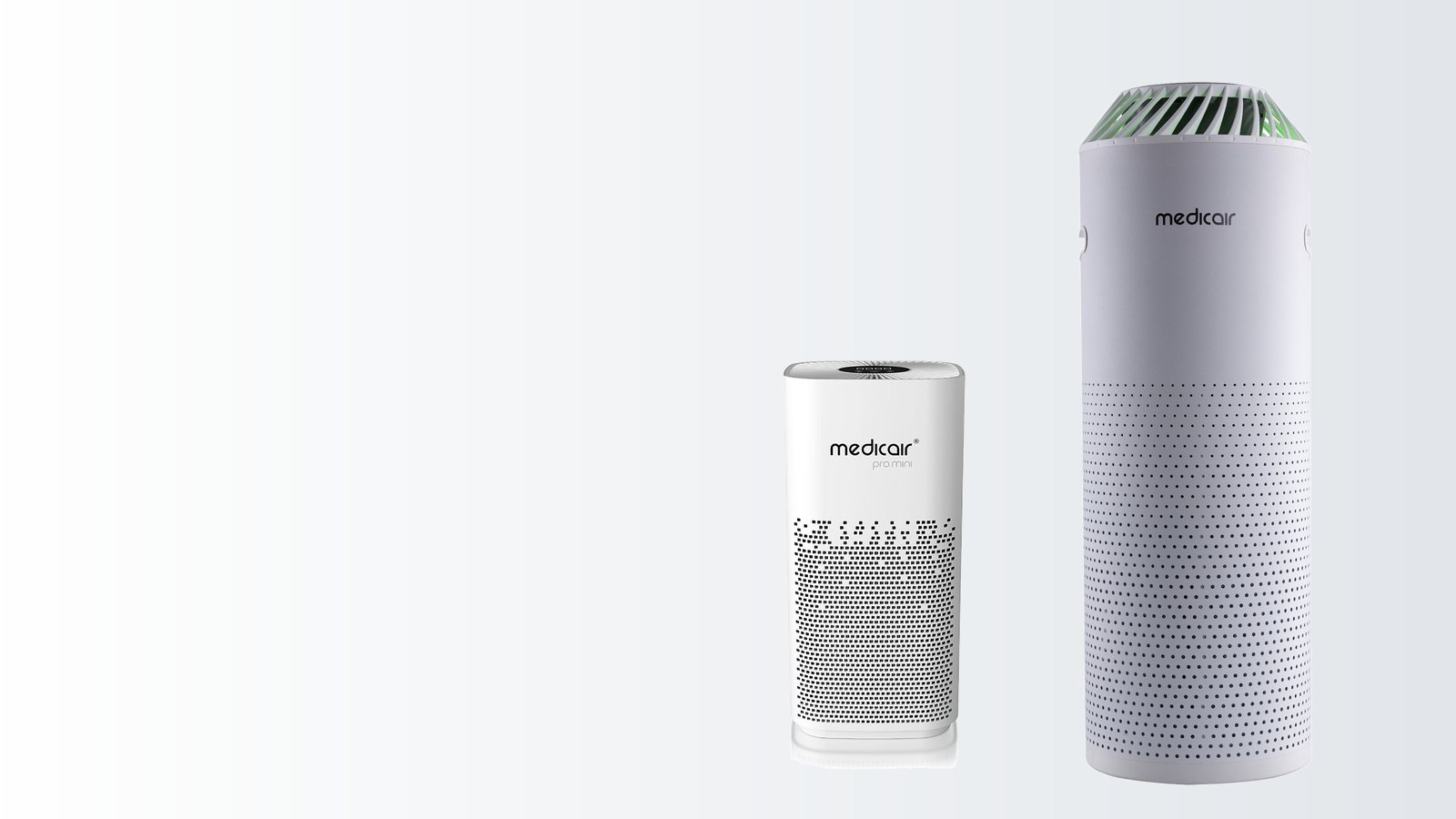
PRO TECHnology is the exclusive MedicAir distributor and partner for the GCC, including the United Arab Emirates, and supplies, sizes and supports the range from Dubai. Three models, with the conditions that actually apply.
Pro Mini for guest rooms and small suites
Up to 400 m³/h, H14 media, 21 dB at its lowest setting and ≤55 dB(A) at maximum, 5.6 kg and 510 mm tall. The right shape and weight for a guest room, and portable enough to run as an on-request amenity. Condition: MedicAir publishes no airflow figure below maximum for this model, so confirm the delivered performance at your night setting by demonstration rather than from the data sheet.
Pro for suites, meeting rooms and larger spaces
Up to 605 m³/h, H13 media, 880 mm tall and 14 kg, and the only model with published airflow and sound at each of four fan speeds, which makes it the one you can specify against a noise limit on paper. It also carries the strongest independent test result in the range: in examination by Dr Iyad Al-Attar in Kuwait in September 2025 it removed 98 to 100% of particles above one micron and reduced VOC concentrations above 8,000 ppm to zero in under thirty seconds. Condition: at 35 dB it is a 180 m³/h machine, so size the room for the setting, not the maximum.
Pro Max for lobbies, ballrooms, gyms and large waiting areas
1,500 m³/h manufacturer-stated capacity, H14 media, 28 to 54 dB, 29 kg on castors, and the only model with a carbon dioxide sensor. Conditions: the 54 dB maximum is fine in a lobby or a gym and wrong in a guest room; the capacity figure is a manufacturer specification with no test method named, which matters if you are comparing it against a bidder quoting a figure measured under a named standard; and the published independent report on this model notes that VOC removal did not reach zero and recommends a deeper carbon stage for gas-heavy duty, which is worth knowing if odour rather than particulate is the complaint.
Air purifiers for hotels: frequently asked questions
How quiet does an air purifier need to be for a hotel guest room?
ASHRAE's design guideline for HVAC background sound in a hotel guest room or suite is NC/RC 30, roughly 35 dB(A). The World Health Organization reports that indoor noise events peaking at 32 dB begin to provoke body movement in sleepers, 35 dB can cause EEG awakening and 42 dB is associated with waking in the night. Note that WHO's better-known 40 dB night-noise guideline is an outdoor annual-average figure at the building facade and is not an indoor appliance benchmark. Specify the limit as a measured level at the pillow, then ask what the machine delivers at that level.
Which MedicAir model suits a hotel guest room?
The Pro Mini is the usual candidate on size, weight and its 21 dB lowest setting, and at 5.6 kg it moves between rooms if you run purifiers as an on-request amenity. The important condition is that MedicAir publishes no airflow figure for it below maximum fan speed, so its 400 m3/h rating is a shortlisting figure rather than a performance guarantee at a quiet setting. Confirm the delivered performance at your night setting with a demonstration in one of your own rooms.
How many air purifiers does a hotel lobby need?
Work from volume rather than floor area, because lobby ceilings are high. A 200 square metre lobby with a 5 metre ceiling holds 1,000 cubic metres, which needs 5,000 cubic metres per hour of clean air at five air changes an hour, or 3,000 at three. Against a MedicAir Pro Max rated at 1,500 cubic metres per hour that is four units at the higher target and two at the lower, and distributing them around the space will outperform grouping them, because air that never reaches an intake never gets cleaned.
Can an air purifier be used instead of extraction in a hotel smoking room?
No. Dubai Municipality's permit guideline requires a designated smoking area to be served by a mechanically processed fresh air handling unit and extract delivering at least 25 litres per second per person, fully isolated from its surroundings, and the federal executive regulation requires the area to be held 5 to 7 pascals below the spaces around it, ventilated at no fewer than ten air changes an hour on a separate system and exhausted straight to outside, with that air not recirculated. Saudi Arabia's rules are of the same shape. No UAE or Saudi rule permits an air cleaner to substitute for that exhaust ventilation, and neither document specifies an air-cleaning device at all. A purifier can reduce haze and airborne odour in a compliant room; it is not a route to compliance.
Can a hotel in Dubai have an indoor smoking area, and can it serve shisha?
Dubai Municipality's smoking-area permit guideline provides for an indoor designated smoking area in a hotel for cigarettes only, and only where the hotel holds a classification of four stars or above, with the area fully isolated, at least 3 metres high, self-closing doors and no through-route for non-smokers. Shisha may not be served inside a hotel at all; a four-star-or-above property may serve it only in an outdoor area within its own plot, subject to distance rules from housing, schools and mosques. Confirm the current permit requirements with Dubai Municipality before designing anything.
Should hotel air purifiers be permanent or offered on request?
Both work, and the choice changes the machine. A permanent fixture argues for the smallest, quietest unit and a fixed cleaning and filter routine. An on-request amenity is a strong offering for allergy-sensitive guests, executive floors and long-stay, with a much smaller capital commitment, but it needs a storage location, a cleaning protocol between rooms, a delivery and collection route and housekeeping's agreement before the first unit arrives. Portability then matters: a 5.6 kg unit moves between rooms and a 29 kg wheeled cabinet does not.
What should a hotel ask for in an air purifier demonstration?
Ask for it in one of your own guest rooms with the door shut and the air conditioning running normally, at the fan setting you intend to run overnight, with the sound measured at the pillow rather than at the machine, and with the display in its night state. Listen for tonal character rather than only the level, because a hum at one frequency is more objectionable than a higher broadband reading. Have the housekeeping and engineering leads in the room, because they raise the objections that decide whether a rollout survives.
What does it cost to run air purifiers across a hotel?
Four components, and usually only the first is in the tender: the units, the replacement cartridges at one per machine per interval, electricity at the unit's rated input power and your real operating hours, and the labour to clean, check and change. MedicAir publishes a 5,000-hour filter life and recommends replacement at least every twelve months. For a portfolio the cartridge line is what decides affordability in year three, so model it before the capital approval. We quote against a room schedule including the first year of cartridges rather than publishing prices here.
Does better air quality improve hotel guest satisfaction?
There is real but limited published evidence. A 2025 study in Building and Environment analysed guest reviews of Australian hotels and serviced apartments and found that indoor environmental quality factors, chiefly cleanliness, air quality and acoustics, accounted for around a third of rating variation in budget accommodation and roughly a quarter in luxury properties. We deliberately do not quote the widely circulated figures claiming that a given percentage of travellers would pay more for better air quality; those trace to a commercial press release with no disclosed method or sample.
أجهزة تنقية الهواء للفنادق في الإمارات ودول الخليج
الفندق ليس مسألة واحدة بل ثلاث: غرف النزلاء يحسمها مستوى الصوت، والمساحات العامة يحسمها حجم الفراغ، والمناطق الخلفية تحسمها مسؤولية تغيير الفلاتر. والمعيار التصميمي لمستوى الضوضاء في غرفة النزيل وفق ASHRAE هو نحو 35 ديسيبل (A).
النقطة الجوهرية: اسألوا عن معدل التدفق عند السرعة التي سيُشغّل عليها الجهاز فعليًا، وليس عند أقصى سرعة. من بين الطرازات الثلاثة ينشر طراز Pro وحده الأرقام عند كل سرعة، وعند 35 ديسيبل يبلغ تدفقه 180 مترًا مكعبًا في الساعة، أي نحو 2.4 تغيير هواء في الساعة لغرفة بحجم 76 مترًا مكعبًا.
أما اللوبي والقاعات فهي مسألة حجم: لوبي بمساحة 200 متر مربع وارتفاع 5 أمتار يبلغ حجمه 1000 متر مكعب ويحتاج إلى 5000 متر مكعب في الساعة عند خمسة تغييرات، أي أربع وحدات Pro Max موزعة وليست وحدة واحدة.
أما غرف التدخين فهي مسألة تهوية وترخيص وليست مسألة ترشيح. تشترط بلدية دبي وحدة هواء نقي ميكانيكية وشفطًا بما لا يقل عن 25 لترًا في الثانية لكل شخص، ولا تسمح أي لائحة في الإمارات أو السعودية بأن يحل جهاز تنقية محل الشفط الميكانيكي.
Sources and how we checked them
Ventilation and acoustic figures are attributed to the standard that publishes them, and we distinguish a voluntary consensus standard from a legal requirement throughout. Regulatory statements are attributed to the instrument that sets them, and UAE and Saudi rules are kept separate. Product figures come from the MedicAir documents supplied with the units and from the manufacturer's website, read on 27 September 2026.
- ANSI/ASHRAE Standard 62.1, Ventilation and Acceptable Indoor Air Quality, Table 6-1: outdoor air rates for hotel bedrooms, lobbies, conference rooms and fitness spaces, with Addendum w (30 September 2025) leaving the hotel rows unchanged
- ASHRAE Handbook, Noise and Vibration Control, Table 1: design guidelines for HVAC background sound, hotel guest rooms at NC/RC 30 and lobbies at NC/RC 40
- World Health Organization Regional Office for Europe, Night Noise Guidelines for Europe (2009): indoor effect thresholds and the definition of the outdoor Lnight guideline
- Dubai Municipality, Technical Guidelines for Issuing Smoking Areas Permits (DM-HSD-GU70-PIGSA2): hotel smoking areas, the four-star condition, fresh air and extract rates, and the position on shisha
- Department of Culture and Tourism Abu Dhabi, Hotel Classification Manual: the minimum 30% non-smoking room requirement and the inspected ventilation criteria
- Dubai Department of Economy and Tourism, Hotel Classification System Sustainability Requirements (2025): the 75% non-smoking guest room requirement
- Ministry of Health, Kingdom of Saudi Arabia, Anti-Smoking Law (Royal Decree M/56) Implementing Regulations, Version 3, 2019
- The impact of indoor environmental quality on tourist accommodation ratings using guest reviews, Building and Environment, 2025
- MedicAir 2.0 product brochure, January 2022: airflow and sound at each of the Pro's four fan settings
- MedicAir Pro Mini user manual, IFU_EM_REV1.1, April 2022
Send us the room schedule
For a hotel the useful brief is a list of room types rather than a request for a recommendation: guest room dimensions and ceiling height, the lobby and function spaces with their volumes, the gym, and how many of each. Tell us the operating hours, whether purifiers will be fixtures or an on-request amenity, the country the property is in, and the main air quality concern, dust, odour, smoke or general air quality. We will come back with a model per room type, how many units each space needs, the first year of cartridges, and a demonstration in one of your own rooms before anything is committed.