
Medical-Grade Air Purifiers in the UAE: How to Choose and Size the Right System
Published · PRO TECHnology Air Quality Solutions
Most air purifier guides are written for a bedroom. They assume square feet, eight-foot ceilings and a single occupant. If you are specifying equipment for a clinic, a ward, a hotel floor or an office fit-out in the UAE, almost none of that transfers. This guide covers what actually decides the specification: what filter grades really mean under the European standard, how to size a unit from room volume in metric, what air change rates are genuinely required here versus merely recommended, and where the three MedicAir models fit.
The short answer
- Size from room volume, not floor area. Required clean air (m³/h) = room volume (m³) × your target air changes per hour. Ceiling height changes the answer.
- “Medical-grade” is a marketing phrase, not a legal class. What matters is the filter grade under EN 1822, whether the filter is properly sealed in the machine, and what the manufacturer has actually tested.
- H13 and H14 are not “99.97% at 0.3 microns”. That is the US convention. Under EN 1822, H13 is ≥99.95% and H14 ≥99.995%, measured at the most penetrating particle size.
- A rated airflow figure is not clean air delivery. Never size a room by dividing its volume into a purifier’s maximum airflow number.
- Portable purification supplements ventilation. It does not replace it, and no UAE regulation requires it. Dubai’s healthcare ventilation rules are HVAC design rules.
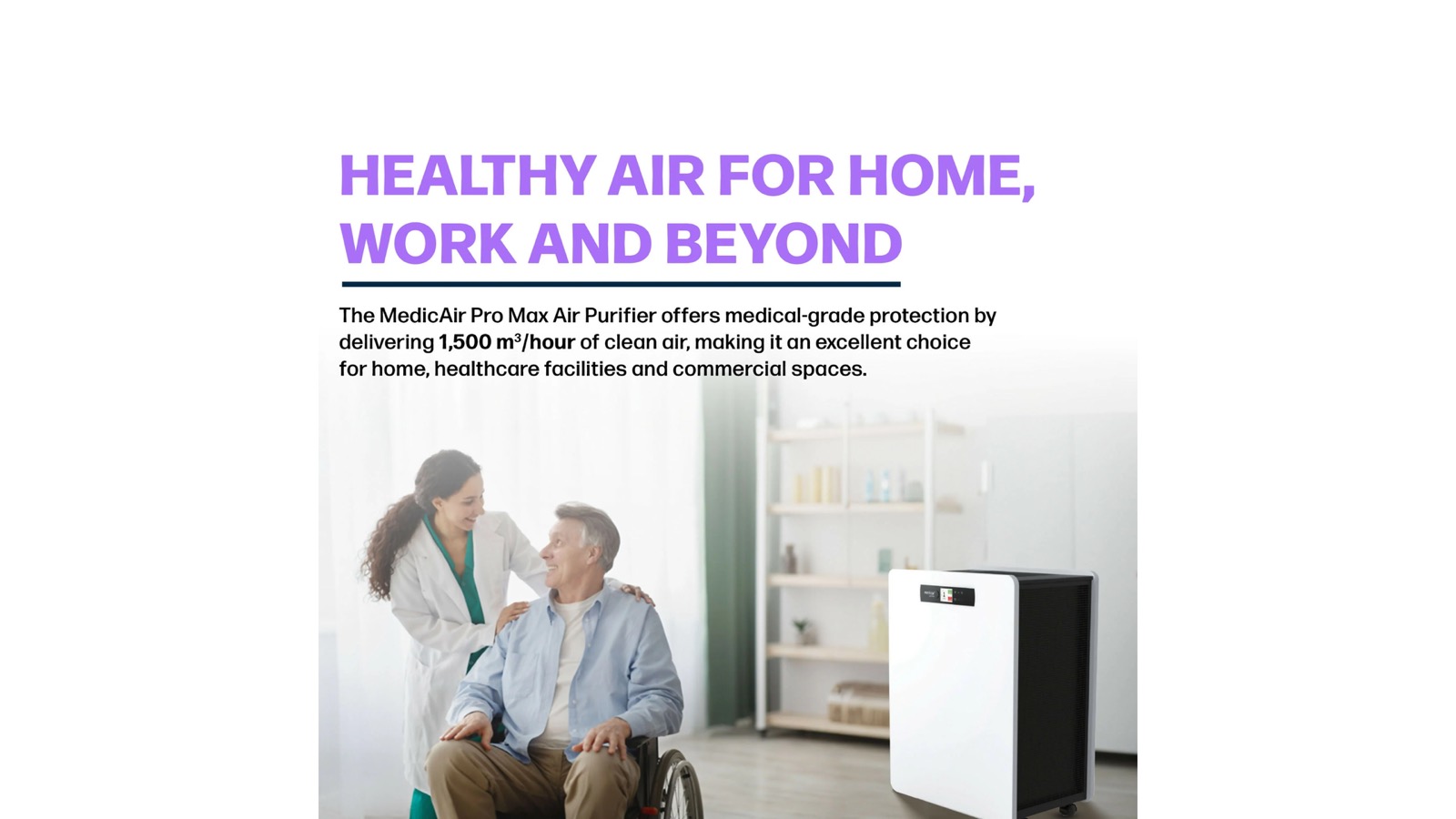
- MedicAir publishes three models — Pro Mini 410 m³/h (H14), Pro 605 m³/h (H13), Pro Max 1,500 m³/h (H14), all with activated carbon and UV.
What does “medical-grade” actually mean?
It has no legal or regulatory definition. Any manufacturer can print it on a box, and in this market many do — the phrase appears on UAE listings for consumer units with night lights. So it is worth being concrete about what a professional buyer should actually be checking.
- Filter grade under a stated standard — EN 1822 (or its international equivalent ISO 29463), not an unattributed percentage.
- How the filter is sealed into the machine. An H14 filter in a poorly sealed housing lets air bypass the medium. System performance is not the same as filter performance.
- A gas-phase stage — activated carbon — because HEPA captures particles and does nothing for gases, VOCs or odours.
- What has actually been tested, by whom, and against what. A percentage with no test method behind it is not a specification.
- Whether the unit can run continuously at a speed people will tolerate, because a purifier that gets switched off for noise delivers nothing.
H13 vs H14 HEPA, correctly
This is where most published comparisons go wrong, including the page currently ranking highest for the question. They describe H13 as “99.97% at 0.3 microns”. That figure belongs to the US convention for HEPA, and it is not how H13 and H14 are defined.
Under EN 1822, HEPA grades are measured at the most penetrating particle size (MPPS) — the particle size a filter is worst at catching, typically around 0.12–0.25 µm, not a fixed 0.3 µm. On that basis:
- H13 — at least 99.95% efficiency at MPPS
- H14 — at least 99.995% efficiency at MPPS
The distinction matters in this region because it is the convention the local rules use. Dubai Health Authority’s engineering guidelines specify operating-room filtration as “99.995% MPPS as per EN 1822” — the European convention, not the American one. If you are writing a specification for a Dubai healthcare project, quoting a 0.3-micron figure is quoting the wrong standard.
Why a higher grade is not automatically the right answer
H14 is the finer filter, but finer media is denser media, and denser media resists airflow more. The practical consequences are a higher pressure drop across the filter, more fan energy to move the same air, and more incentive for any leak path around the filter to become the route of least resistance. That is a real engineering trade-off, not a reason to avoid H14 — it is a reason to ask how the filter is sealed and what airflow the machine actually achieves with that filter fitted, rather than treating the grade on its own as the answer.
How to size an air purifier for a room
Two numbers decide everything: the volume of the room, and how many times an hour you want that volume worth of clean air delivered into it.
The arithmetic
Room volume (m³) = length × width × ceiling height
Required clean air (m³/h) = room volume × target air changes per hour
Inverted, to check a unit against a room: air changes delivered = clean air delivered (m³/h) ÷ room volume (m³). That is the whole method. It is also why floor area on its own is useless — two rooms of 40 m² with 2.7 m and 4 m ceilings differ by almost 50% in volume and therefore in the equipment they need.
A worked example
A consulting room measuring 6 m × 5 m with a 3 m ceiling:
- Volume = 6 × 5 × 3 = 90 m³
- At a 5 air-changes-per-hour target: 90 × 5 = 450 m³/h of clean air required
- At a 10 air-changes-per-hour target: 90 × 10 = 900 m³/h
Now compare that against the machines. A MedicAir Pro Mini is rated at 410 m³/h maximum airflow — already below the 450 figure before any correction, so for this room at 5 ACH you would be looking at a Pro rather than a Pro Mini, or two Pro Minis. At a 10 ACH target the same room needs 900 m³/h, which is beyond a single Pro and points either to a Pro Max or to multiple units. That is how the calculation should drive the decision — and it is why the honest answer to “which model do I need?” is sometimes “more than one”.
The correction most guides never make: rated airflow is not clean air
A purifier’s headline airflow figure is how much air the fan moves. It is not how much clean air the machine delivers. The US EPA defines clean air delivery rate as the product of the removal efficiency for a pollutant and the airflow rate through the cleaner — so the two figures are equal only if the machine captured everything on a single pass, which nothing does.
Three consequences that matter when you are specifying:
- Performance figures are quoted at maximum fan speed. AHAM, which owns the test method, states that clean air delivery is measured at the highest fan speed as a uniform condition, and that airflow and clean air delivery should not be confused. At a quieter setting the delivered figure is lower, and often not published at all.
- Noise is part of the calculation, not a footnote. A unit sized on its maximum-speed figure and then run on low because staff find it intrusive is not delivering the air changes the specification assumed.
- Very large figures cannot be certified clean air delivery. The AHAM test method tops out around 450 CADR for smoke and pollen — roughly 765 m³/h — so any number above that is a rated airflow figure, not an AHAM-verified clean air delivery rate, whoever is quoting it.
Worth knowing before you compare brochures. MedicAir’s own materials use both descriptions for the same numbers: its product specification tables label 410–1,500 m³/h as “Airflow at Max. Settings”, while its home-page banner describes the same range as a “clean air delivery rate”. Those are two different physical quantities. We use the specification-table wording — maximum airflow — throughout this guide, and we would encourage you to size against measured clean air delivery wherever a manufacturer publishes it. This is a general point about the category rather than a criticism of one brand: the conflation is widespread. Our guide to choosing an air purifier for dust covers the consumer-side version of the same problem.
What air change rate should you actually target?
This is where a lot of marketing goes wrong, in both directions. Some vendors quote hospital isolation-room figures at people fitting out an office. Others quote a single “healthcare” number as if one figure covered every clinical room. Neither is right, and the difference between the tiers below is the difference between a defensible specification and an expensive guess.
| Space or setting | Source | Figure | Status |
|---|---|---|---|
| Operating room | ASHRAE 170, adopted by DHA for Dubai licensing | 20 total air changes per hour, 4 of them outdoor air, with HEPA-grade final filtration | Design requirement |
| Procedure room | ASHRAE 170 | 15 total, 3 outdoor | Design requirement |
| Airborne infection isolation room | ASHRAE 170 / DHA | 12 total, 2 outdoor, negative pressure, exhausted outdoors | Design requirement |
| Protective environment room | ASHRAE 170 / DHA | 12 total, 2 outdoor, positive pressure, HEPA supply | Design requirement |
| Emergency department exam room | ASHRAE 170 | 6 total, 2 outdoor | Design requirement |
| General examination room | ASHRAE 170 | 2 total, 2 outdoor | Design requirement |
| General indoor spaces | US CDC | 5 or more air changes per hour of clean air | Voluntary recommendation |
| Healthcare / office / home | MedicAir (manufacturer) | 10 / 5 / 3 air changes per hour | Manufacturer sizing guidance |
What is actually required in the UAE
For healthcare facilities in Dubai, the DHA Health Facility Guidelines are the licensing basis, and their engineering part adopts ASHRAE Standard 170 as the minimum ventilation requirement. Those are real, enforceable numbers — and they are HVAC design requirements for the building, not requirements for plug-in equipment.
The single most useful figure in that table is the last of the design requirements: a general examination room is set at just 2 air changes per hour. That is the same standard that requires 20 in an operating theatre. If a supplier tells you “healthcare needs 10 air changes” as a blanket statement, they are not describing the standard that governs your building.
What public health bodies recommend
The US CDC recommends a target of at least 5 air changes per hour of clean air in general indoor spaces. That is explicitly a voluntary recommendation rather than a requirement, and CDC notes separately that healthcare facilities have their own requirements. It is a sensible planning figure for an office, a meeting room or a hotel space; it is not a substitute for the design standard in a licensed clinical room.
What the manufacturer suggests
MedicAir publishes its own sizing guidance — 3 air changes per hour for a home, 5 for an office, 10 for healthcare — alongside a calculator that takes room length, width and height and returns the number of units required. That guidance is useful for a first pass, and we use it as such. It should be labelled for what it is: a manufacturer’s recommendation. It does not trace back to a standards body or a public-health authority, and its healthcare figure is considerably higher than what ASHRAE 170 requires for most outpatient rooms.
One thing a purifier cannot do. Air changes from a recirculating purifier and air changes from ventilation are not the same thing. A purifier cleans air that is already in the room; it introduces no outdoor air and removes no carbon dioxide. When a standard specifies a proportion of outdoor air — 4 of the 20 changes in an operating room, for instance — no amount of recirculating filtration satisfies that part of the requirement.
MedicAir Pro Mini vs Pro vs Pro Max
MedicAir is a British manufacturer whose units combine HEPA filtration, an activated carbon stage and a UV-C lamp that the manufacturer describes as “safe UV” on the basis that it is designed not to emit ozone. There are three current models.
| Model | Maximum airflow | HEPA (EN 1822) | Activated carbon | UV technology | Published sound | Volume at 5 ACH | Volume at 10 ACH |
|---|---|---|---|---|---|---|---|
| MedicAir Pro Mini | 410 m³/h | H14 | Yes | Yes | 21 dB (single figure published) | ~82 m³ | ~41 m³ |
| MedicAir Pro | 605 m³/h | H13 | Yes | Yes | 28–60 dB | ~121 m³ | ~60 m³ |
| MedicAir Pro Max | 1,500 m³/h | H14 | Yes | Yes | 28–54 dB | ~300 m³ | ~150 m³ |
How to read the last two columns. They are the rated airflow divided by 5 and by 10 — the largest room each unit could theoretically serve at those air change rates if every cubic metre it moved were perfectly clean and perfectly mixed. Neither is true in practice, and the figures are taken at maximum fan speed. Treat them as an upper bound for shortlisting and expect the real-world figure to be lower, particularly if the unit will be run at a quieter setting.
MedicAir Pro Mini
410 m³/h, H14 filtration, 52 cm tall on a 27 cm base, 5 kg, six fan settings and 360-degree oscillation. It is the unit for genuinely small rooms: single consultation rooms, treatment rooms, private offices, hotel guest rooms and small waiting areas. Its published filter life is stated inconsistently by the manufacturer — see the maintenance section below.
Two honest caveats. Its sound figure is published as a bare “21 dB” with no upper bound, no A-weighting and no measurement distance stated — unlike the Pro and Pro Max, which publish ranges. And MedicAir’s own pages are inconsistent about its airflow: the product specification block says 410 m³/h while two of its marketing pages say 400. We use the figure in the dedicated specification table, which is also the one used in every comparison table on the manufacturer’s site.
MedicAir Pro
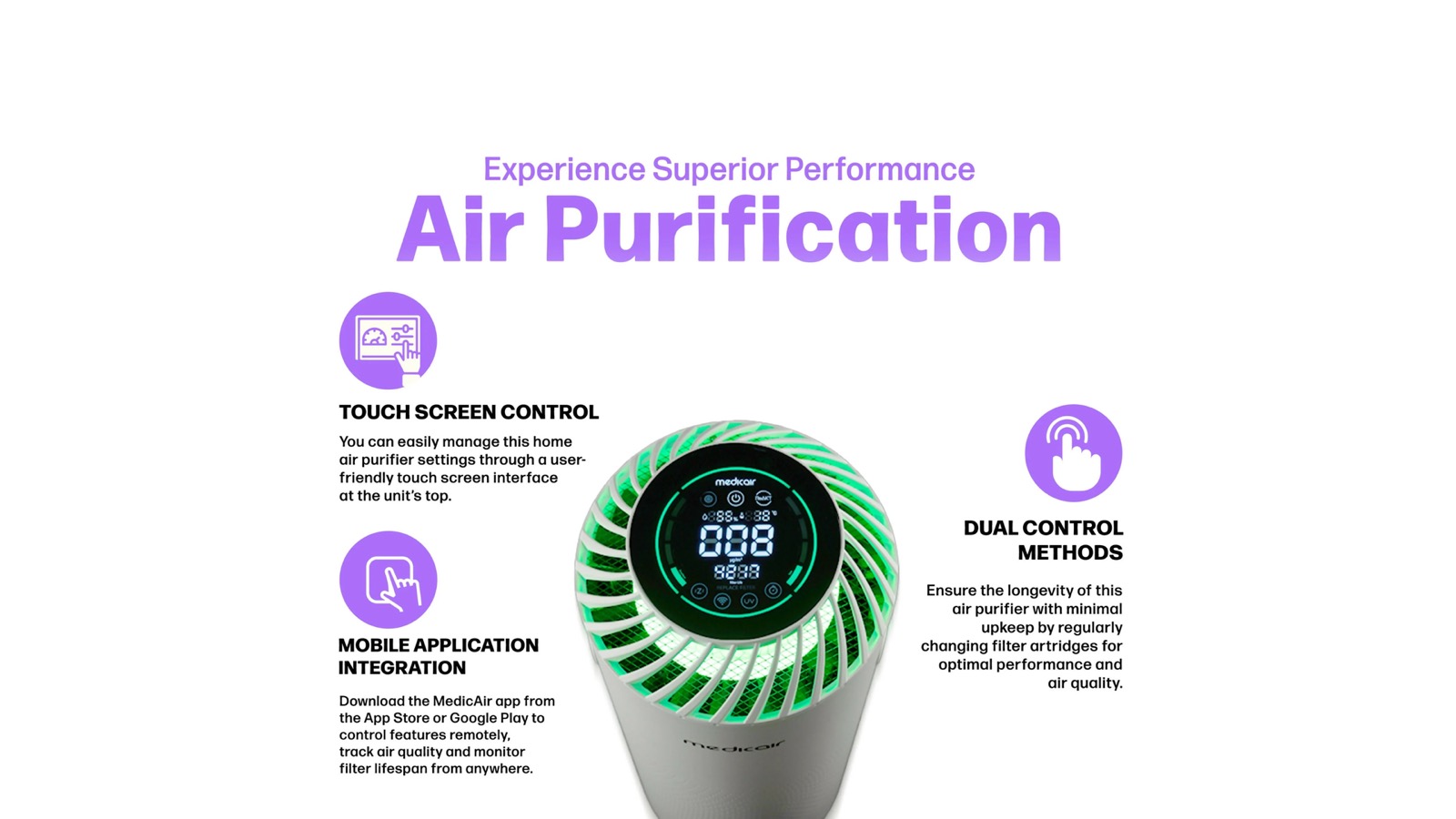
605 m³/h, H13 filtration, 88 cm tall on a 33 cm base, 14 kg, published sound range 28–60 dB. The mid unit for larger consultation and treatment rooms, meeting rooms, larger waiting areas and back-of-house spaces.
Note that it is specified at H13 while both the smaller and larger models are H14. That is not an oversight to be embarrassed about — H13 is a HEPA grade, it is what ASHRAE-level filtration in most outpatient rooms is built around, and a coarser medium at higher airflow is a legitimate engineering choice. It is worth knowing if a specification you are answering to names H14 explicitly.
MedicAir Pro Max
1,500 m³/h, H14 filtration, 38 cm base, 29 kg, published sound range 28–54 dB, 180-degree oscillation. This is the model for volume: large waiting areas, open-plan offices, hotel function and lobby spaces, gyms, and any room where a single smaller unit would need to run flat out to keep up.
Its 1,500 m³/h is a rated airflow figure. It is above the ceiling of the AHAM test method, so it is not — and cannot be — an independently certified clean air delivery rate. That does not make it wrong; it makes it a different kind of number, and worth understanding before it goes into a tender comparison against a competitor quoting tested clean air delivery.
Which model suits which application?
Hospitals
The governing document is the building’s ventilation design, not the purifier. Operating theatres, isolation rooms and protective environment rooms have specific pressure relationships, outdoor-air fractions and exhaust routes that a portable unit cannot provide and must not be presented as providing. Portable purification is useful in the spaces around those rooms — waiting areas, corridors, administrative and staff areas, outpatient rooms, and as a temporary measure during construction or a surge. Pro Max for the large open areas, Pro or Pro Mini for individual rooms.
Clinics and dental practices
This is the clearest fit. Most clinical outpatient rooms are modest in volume, occupancy turns over frequently, and the ventilation was often designed to a general commercial standard rather than a clinical one. A Pro Mini in a consultation room and a Pro or Pro Max in the waiting area is a common shape.
For dental specifically: the DHA’s current infection control guideline for dentistry manages aerosol risk through PPE, high-volume suction and cleaning practice. It sets no air-change or filtration requirement, and no UAE rule requires a purifier in a dental operatory. Air purification here is a supplementary measure a practice may choose, positioned to draw air away from the breathing zone — not a compliance item. Our healthcare deployment guide covers the clinical context in more detail.
Hotels
Two different problems. Guest rooms are small, and the deciding factor is almost always noise at night rather than airflow — a Pro Mini at a low setting. Public areas, lobbies, function rooms and gyms are volume problems and point to the Pro Max. Smoking-permitted areas are a category of their own, because tobacco smoke is both particles and gases; that is covered separately in our guide to air purification for cigar lounges and smoking rooms.
Offices and commercial spaces
CDC’s 5 air changes per hour is a reasonable planning target here. Sizing follows the arithmetic above from the actual room volume. The one thing worth measuring first is carbon dioxide: if CO₂ is climbing through the day, the building needs ventilation, and a purifier will not fix it. Our guide to measuring indoor air quality in UAE buildings covers what to measure and what the numbers mean.
Large and high-occupancy spaces
Above roughly 300 m³ at a 5 ACH target, a single Pro Max is already at its rated ceiling, so plan on multiple units. Distributing several units through a large space also generally outperforms one unit in a corner: air that never reaches the intake never gets cleaned, and a long or subdivided room can leave whole zones effectively untreated no matter what the total airflow number says.
Portable purification does not replace ventilation or HVAC
This needs stating plainly because a great deal of marketing blurs it. Four different jobs:
- Air conditioning controls temperature. It introduces no outdoor air of itself and removes no pollutants.
- Ventilation brings in outdoor air and dilutes what has accumulated indoors — including carbon dioxide, which filtration cannot touch.
- Extraction removes contaminated air from a space and discharges it outside.
- Air purification filters and recirculates air already in the room.
The World Health Organization states the position directly in its ventilation guidance: air filters do not provide ventilation and do not replace other ventilation methods. A purifier adds cleaning capacity. It adds no fresh air.
It is also worth knowing what Dubai’s rules actually say, because it cuts both ways. The DHA Health Facility Guidelines discourage electronic air filters and photocatalytic oxidation air cleaners in healthcare facilities over ozone concerns, and state that where such devices are used they are not a replacement for mechanical filtration. Mechanical HEPA filtration with a non-ozone-emitting UV stage is a different technology from those, but the principle stands: in a licensed healthcare facility, plug-in equipment supplements the ventilation design and never substitutes for it.
Placement, noise and actually running the unit
A correctly sized purifier in the wrong place, or switched off, delivers nothing. Four things decide whether the specification survives contact with the building:
- Intake and discharge must not be obstructed. Pushed against a wall, behind a curtain or under a desk, a unit recirculates its own output instead of the room’s air.
- Position relative to people and the source. In a treatment room the useful position draws air away from the breathing zone rather than across it.
- Noise is a specification input, not an afterthought. Published sound figures are at the quietest setting and published performance is at the loudest. A unit that has to run at maximum to hit its numbers will be turned down by staff, and a turned-down unit delivers less air than the calculation assumed. This is the single most common reason a paper-compliant installation underperforms — and it is an argument for sizing generously and running at a middle speed rather than buying the smallest unit that technically qualifies.
- Doors and adjacent spaces. A room with a door propped open all day is not the sealed volume the arithmetic assumed.
Filter replacement and maintenance
Both filter stages consume their capacity in use, and the carbon stage in particular has a finite adsorption capacity — once it is loaded it stops removing odours and VOCs, with no visible sign. MedicAir publishes a filter life of 5,000 hours for the Pro and Pro Max filters, and recommends replacing filters at least once every twelve months even where the unit has not indicated that a change is required. For the Pro Mini its own pages disagree with each other: the product page states 5,000 hours while the dedicated replacement-filter pages state 4,000. Budget against the shorter figure and ask your supplier to confirm it in writing before it goes into a maintenance contract.
Those are general figures. Real interval depends on how many hours a day the unit runs, how heavy the particulate and gas load is, and how much outdoor dust the building admits — which in this region is not a trivial factor. Dubai’s healthcare engineering guidelines require sand trap louvers on outdoor air intakes precisely because of local dust conditions, and the same dust reaches the rooms your purifiers sit in. A unit running 12 hours a day in a busy clinic will not hold a residential filter interval. Our guide to air purifiers and UAE dust covers pre-filter care in more detail.
Budget for filters as a running cost from the start, and track the unit’s filter indicator rather than a calendar alone.
A claim circulating in the UAE market that you should check before repeating
While researching this guide we found several UAE indoor-air-quality vendor pages stating that a “Federal Law No. 5 of 2025, Article 33” makes annual indoor air quality testing mandatory for offices, schools and hospitals. We were unable to find that law on the official UAE legislation portal, and Dubai Municipality’s own indoor air quality guideline cites no such federal law.
We are not asserting that no relevant legislation exists — only that we could not verify this specific claim, and that several pages repeating it also misstate Dubai Municipality’s published limits. For the record, the actual Dubai Municipality guideline sets carbon dioxide at 800 ppm over 8 hours and PM2.5 at 35 µg/m³ over 24 hours, its certificate is optional rather than mandatory, and it explicitly excludes hospitals and the medical sector from its scope.
If a supplier justifies a purchase to you on the basis of a compliance obligation, ask them for the instrument and the article number. It is a fair question, and a supplier who cannot answer it is selling you something other than compliance.
MedicAir and PRO TECHnology in the UAE
PRO TECHnology is a Dubai-based technology company operating since 1998. Its Air Quality Solutions division supplies, installs and supports indoor air quality equipment across the UAE and the wider region, including MedicAir purification, air quality monitoring, and humidity control.
What that means practically for a specification: units can be sized against your actual room schedule rather than a coverage claim, seen running before purchase at our Business Bay showroom, and supported locally for filters and service rather than through a European supply chain. The wider division is described on our indoor air quality solutions page.
Frequently asked questions
What is a medical-grade air purifier?
There is no legal definition — it is a marketing phrase. In practice a professional buyer should read it as: a HEPA filter graded under a stated standard such as EN 1822, sealed properly into the machine so air cannot bypass it, an activated carbon stage for gases and odours, and published test results that say what was tested and against what.
What is the difference between H13 and H14 HEPA?
Under EN 1822, H13 captures at least 99.95% and H14 at least 99.995% of particles at the most penetrating particle size — roughly 0.12 to 0.25 microns. They are not defined at 0.3 microns; that figure comes from the US convention and is a common error in online comparisons. H14 is the finer grade, but it also has a higher pressure drop, so system design and filter sealing matter as much as the grade itself.
Does MedicAir use H13 or H14 filtration?
Both, depending on the model. The Pro Mini and Pro Max are specified at H14; the Pro is specified at H13. All three include an activated carbon stage and a UV lamp that MedicAir describes as safe UV.
How do I calculate the air purifier capacity a room needs?
Multiply length by width by ceiling height to get the room volume in cubic metres, then multiply that by your target air changes per hour. The result is the clean air in cubic metres per hour the room needs. A 6 × 5 × 3 m room is 90 m³, so at 5 air changes per hour it needs 450 m³/h. Compare that against the unit's rated airflow, and expect the delivered figure to be lower than the rating.
What does ACH mean?
Air changes per hour — how many times in an hour a volume of air equal to the room's volume is delivered to it. It is the standard way ventilation and air-cleaning capacity are expressed, and it is the reason room volume rather than floor area is the number to work from.
Does UAE regulation require air purifiers in clinics or hospitals?
No. Dubai Health Authority's Health Facility Guidelines set ventilation requirements for healthcare buildings — for example a minimum of about 20 air changes per hour in an operating room — by adopting ASHRAE Standard 170. Those are HVAC design requirements. We found no UAE requirement for portable or plug-in air purifiers in any healthcare setting, and the DHA's dental infection control guideline sets none either.
Can an air purifier replace hospital ventilation or HVAC?
No. A purifier filters and recirculates air already in the room. It introduces no outdoor air, removes no carbon dioxide, and cannot deliver the outdoor-air fraction or the pressure relationships a clinical room's design requires. The World Health Organization states that air filters do not provide ventilation and do not replace other ventilation methods.
Does MedicAir use UV-C, and is it safe?
MedicAir units include a UV-C lamp which the manufacturer describes as safe UV on the basis that it is designed not to emit ozone. Treat the safety characterisation as the manufacturer's, and note that UV is an additional treatment stage rather than the main mechanism — the HEPA and carbon stages do the filtration work. Dubai's healthcare engineering guidelines discourage photocatalytic and electronic air cleaners over ozone concerns, which is a different technology, but it is the reason the ozone question is worth asking of any UV product.
Can MedicAir help with odours and VOCs?
Yes — that is what the activated carbon stage is for. HEPA captures particles and does nothing for gases, so any purifier expected to deal with odours, solvents, disinfectant smells or VOCs needs a meaningful carbon stage. Carbon has a finite capacity and needs replacing on schedule to keep working.
Which MedicAir suits a hotel guest room, and which suits a large commercial space?
For a guest room the deciding factor is usually night-time noise rather than airflow, which points to the Pro Mini. For lobbies, function rooms, gyms and open-plan offices the deciding factor is volume, which points to the Pro Max. Work it out from the room volume and your target air change rate rather than from floor area.
How often should MedicAir filters be replaced?
MedicAir publishes a 5,000-hour filter life for the Pro Mini filter and recommends replacing filters at least every twelve months even if the unit has not signalled a change. In a heavily used clinical or commercial space with high dust load, expect to be at the shorter end of that. Follow the unit's own filter indicator alongside the calendar.
Can I use more than one air purifier in a large room?
Yes, and in larger or subdivided spaces it is usually better than one large unit. Several distributed units cover the room more evenly — air that never reaches an intake never gets cleaned — and units running at a middle speed are quieter than a single unit at maximum. If the sizing arithmetic gives a figure above one unit's rated airflow, multiple units is the correct answer rather than a compromise.
ملخص باللغة العربية: أجهزة تنقية الهواء الطبية في الإمارات
عبارة «بمواصفات طبية» ليست تصنيفًا قانونيًا، لذا ينبغي للمشتري المحترف أن ينظر إلى ما هو قابل للتحقق: درجة فلتر HEPA وفق معيار EN 1822، وطريقة إحكام تثبيت الفلتر داخل الجهاز، ووجود مرحلة كربون نشط للغازات والروائح. وفق معيار EN 1822 يلتقط فلتر H13 ما لا يقل عن 99.95% ويلتقط H14 ما لا يقل عن 99.995% عند حجم الجسيمات الأصعب التقاطًا، وليس عند 0.3 ميكرون كما يُنشر خطأً في كثير من المقارنات. ولتحديد السعة المطلوبة يُحسب حجم الغرفة بضرب الطول في العرض في ارتفاع السقف، ثم يُضرب الناتج في عدد تغييرات الهواء المستهدفة في الساعة؛ فغرفة بأبعاد 6 × 5 × 3 أمتار حجمها 90 مترًا مكعبًا وتحتاج إلى 450 متر مكعب في الساعة عند خمس تغييرات. وتجدر الإشارة إلى أن معدل التدفق المُعلن ليس معدل الهواء النظيف المُسلَّم فعليًا، وأن الأرقام تُقاس عند أعلى سرعة للمروحة. تقدّم MedicAir ثلاثة طرازات: Pro Mini بتدفق 410 متر مكعب في الساعة وفلتر H14، وPro بتدفق 605 وفلتر H13، وPro Max بتدفق 1500 وفلتر H14، وجميعها تضم كربونًا نشطًا وتقنية أشعة فوق بنفسجية. من المهم التوضيح أن أجهزة التنقية المحمولة تُكمّل التهوية وأنظمة التكييف ولا تحل محلها، ولا توجد لائحة في الإمارات تُلزم باستخدامها في المنشآت الصحية؛ فمتطلبات هيئة الصحة بدبي تتعلق بتصميم أنظمة التهوية في المبنى. يوفّر فريق حلول جودة الهواء لدى بروتكنولوجي في دبي احتساب السعة المناسبة وفق أبعاد الغرف الفعلية، مع التوريد والتركيب والدعم الفني محليًا.
Sources
Figures in this guide are attributed to the body that published them. Where a number is a manufacturer’s own recommendation rather than a standard or a public-health position, we have said so in the text.
- ASHRAE Standard 170-2021, Addendum h — ventilation of health care facilities; the outpatient air-change tables.
- Dubai Health Authority Health Facility Guidelines — the licensing basis for healthcare facilities in Dubai, whose engineering part adopts ASHRAE 170.
- US CDC, ventilation in buildings — the 5 air changes per hour target, published as a voluntary recommendation.
- World Health Organization, natural ventilation for infection control in health-care settings — on air filters not replacing ventilation.
- US EPA, Guide to Air Cleaners in the Home — the definition of clean air delivery rate and why it is not the same as rated airflow.
- EN 1822 filter classification — H13 and H14 efficiencies at the most penetrating particle size.
- MedicAir product specifications — airflow, filter grade, sound and filter life figures for each model, as published by the manufacturer.
- Dubai Municipality Technical Guidelines for Indoor Air Quality — the published indoor pollutant limits and the scope of the optional certificate.
Written by the PRO TECHnology Air Quality Solutions team. Specifications were checked against the manufacturer’s published figures on 16 September 2026. Where a manufacturer publishes conflicting figures, we say so rather than choosing silently. This guide is engineering and procurement guidance, not medical advice.
Send us the room schedule
The fastest way to a defensible specification is to send the rooms rather than ask which model is best. For each space we need:
- length, width and ceiling height
- what the room is used for, and typical and peak occupancy
- daily operating hours
- whether it has mechanical ventilation, and any outdoor-air figure if you have it
- any air change rate the project or licensing authority has specified
Our Air Quality Solutions team will work through the arithmetic, tell you how many units each space needs, and say plainly where purification is not the right answer and the ventilation design has to be addressed instead. Call +971 4 343 5501 or email sales@protech.ae.