How to Choose an Air Purifier for Clinics and Healthcare Facilities in the UAE
Published · PRO TECHnology Air Quality Solutions
A clinic buys air purification for four kinds of room, and each is a different decision: the waiting area, the consultation or treatment room, the dental operatory and the staff spaces. This guide works through where a portable unit genuinely earns its place in a UAE healthcare facility, how to size one against the room rather than the practice, what the governing standards require of the building around it, and what the test evidence behind a machine does and does not prove.
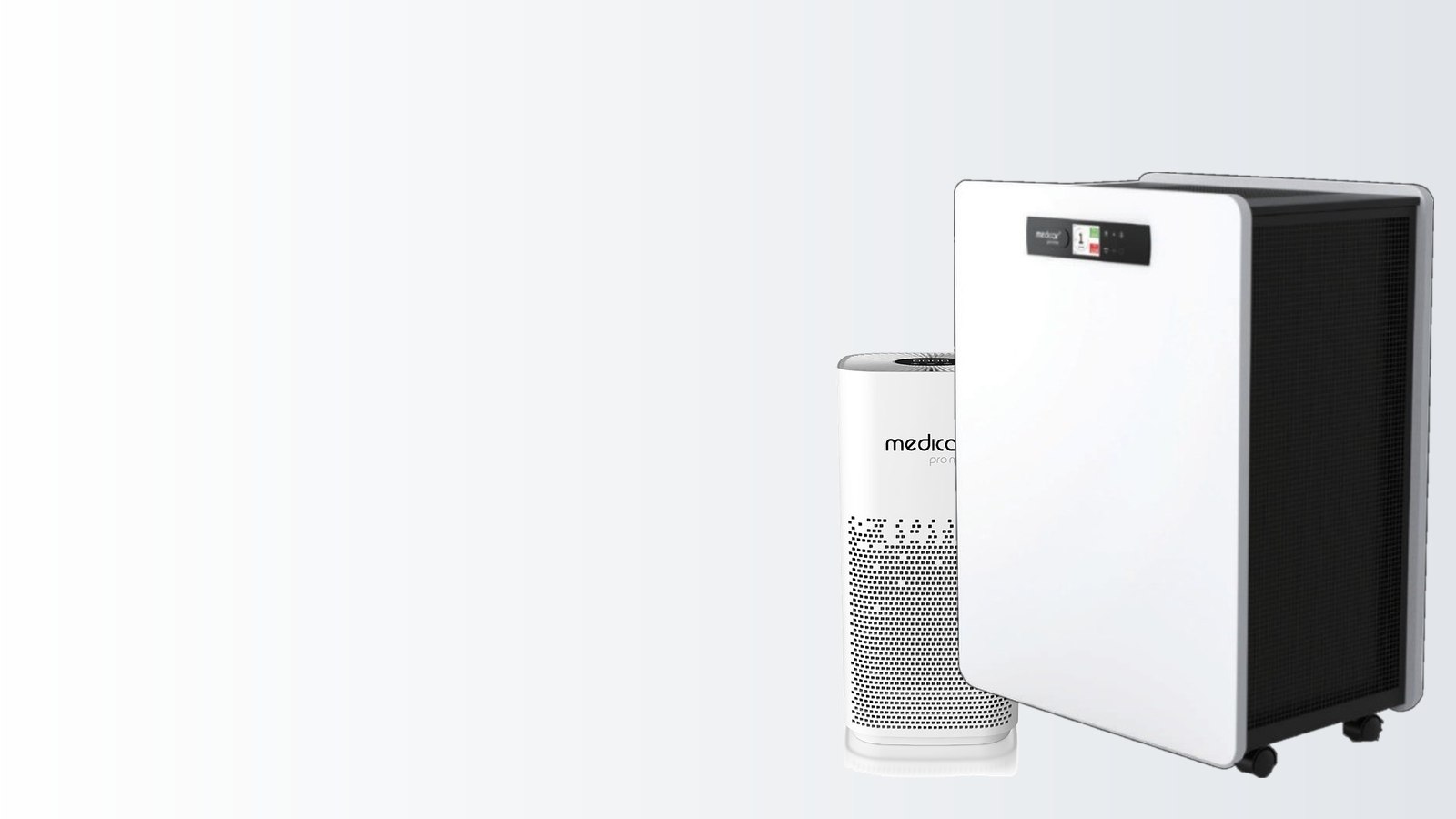
Portable air purification has a real and useful place in a UAE clinic, dental practice or hospital, and the strongest cases are the ordinary rooms: waiting areas, consultation and treatment rooms, dental operatories alongside suction and PPE, and the staff rooms nobody designed clinical ventilation for. Inside the highly engineered rooms it has a narrower, supervised role that CDC and ASHRAE both recognise, covered below. What it never does is replace the building's ventilation. Where we name equipment we use the MedicAir range PRO TECHnology distributes here, a brand founded by British healthcare professionals for the dental environment, but the selection method applies to any product.
- 4 room typeswaiting, consulting, operatory, staff
- Per roomsized from volume, not from the practice
- Supplementadds clean air, never outdoor air
- Evidencewhat the tests do and do not show
Key takeaways
- The strongest cases in a UAE practice are the ordinary rooms: waiting and reception, consultation and treatment rooms, dental operatories as a supplement to suction and PPE, and staff areas.
- Size every room on its own volume and target air changes. A practice-wide recommendation is not a specification, and a general examination room and a waiting area are not the same problem.
- Inside operating theatres, airborne infection isolation rooms and protective environment rooms, portable HEPA has a narrow supplemental role that CDC and ASHRAE 170 both recognise, to add equivalent air changes, under facility engineering and infection-control supervision. It is never a substitute for the room's pressure regime, outdoor air or exhaust route.
- No UAE rule we found requires a portable air purifier in a healthcare setting, but real duties do sit on the building: DHA and Abu Dhabi's DoH set MERV 8 and MERV 14 filtration with HEPA in named rooms, and Dubai's Al Sa'fat requires existing healthcare facilities to have their indoor air tested.
- Medical-grade has no legal definition. What is checkable is the filter grade against a stated standard, how the filter is sealed in the machine, whether there is a real gas-phase stage, and what has actually been tested.
- MedicAir states its units are used by more than 20 NHS Trusts and are available through NHS Supply Chain. That is documented adoption, not NHS approval, certification or endorsement.
- These units are not medical devices, and the MedicAir Pro Mini manual says so in terms.
- A laboratory pathogen reduction figure is not a promise about infection. Particle filtration efficiency, chamber microbial reduction and real-world infection outcomes are three different measures.
What is actually required in a UAE healthcare facility
Start here, because this is where most specifications go wrong in one of two directions: quoting operating-theatre figures at a dental practice, or quoting a single healthcare number as though one figure covered every clinical room.
The building's ventilation design
For healthcare facilities in Dubai, the DHA Health Facility Guidelines are the licensing basis, and their engineering part adopts ASHRAE Standard 170 as the minimum ventilation requirement. Those are real, enforceable numbers, and they are requirements for the building's mechanical ventilation, not for plug-in equipment. They range from 20 total air changes per hour in an operating room, four of them outdoor air, down to 2 total air changes per hour in a general examination room. The full table, with what each figure governs, is on our medical-grade air purifier sizing guide.
The most useful single fact in that table is the contrast: the same standard that requires 20 air changes an hour in a theatre requires 2 in a general examination room. If a supplier tells you "healthcare needs 10 air changes an hour" as a blanket statement, they are not describing the standard that governs your building.
What is required of the building, and what is not required of you
- No UAE rule we found requires a portable or plug-in air purifier in a hospital, a clinic or a dental operatory. We reviewed the DHA and Abu Dhabi DoH health facility guidelines, Dubai Municipality's indoor air quality guidelines, Al Sa'fat and the federal air-pollution regulation; we have not reviewed every emirate's rules, so we put that as what we found rather than as a blanket statement.
- Real duties do sit on the building, and they are worth knowing. DHA's Health Facility Guidelines set minimum filtration in the air handling plant at MERV 8 for the first stage and MERV 14 for the final filter, with HEPA required in named rooms and delivered through the ventilation system rather than by portable equipment. Abu Dhabi's Department of Health publishes its own health facility guidelines, which are the equivalent instrument there; check the applicable edition with your consulting engineer rather than assuming the two emirates read identically.
- Dubai also regulates existing buildings. Under Al Sa'fat, Dubai's green building system, air-conditioned buildings must meet ASHRAE 62.1, 62.2 and 170 and be handed over with permanent filters of at least MERV 8; existing healthcare facilities are among the building types required to have indoor air tested by a specialised laboratory against set limits. That is a testing and ventilation duty, not a requirement to buy a purifier, but it is the reason a facilities team may be measuring in the first place.
- The DHA's infection control guideline for dentistry manages aerosol risk through personal protective equipment, high-volume suction and cleaning practice. It sets no air-change or filtration requirement. Air purification in a dental operatory is a supplementary measure a practice may choose, not a compliance item.
- Dubai Municipality's indoor air quality guidelines (DM-HSD-GU119-IAQ, Version 3, July 2024) cover hotels, offices, malls, residential and education premises, and exclude premises dedicated to the medical and industrial sectors from their scope.
- We have also seen UAE vendor pages citing a federal law article that makes annual indoor air quality testing mandatory for hospitals. We could not find that instrument on the UAE legislation portal. If a supplier justifies a purchase to you on a compliance obligation, ask them for the instrument and the article number. It is a fair question.
Where portable purification genuinely helps, and where it does not
| Space | Does a portable unit help? | Why |
|---|---|---|
| Waiting and reception areas | Strongest case | Highest occupancy in the practice, frequent turnover, doors to the outside, and ventilation usually designed to a general commercial standard |
| Outpatient and consultation rooms | Strong case | Modest volumes, quick turnover between patients, and ASHRAE 170 sets only 2 air changes per hour for a general examination room |
| Dental operatories | Supplementary | Aerosol-generating procedures. A supplementary measure alongside PPE and high-volume suction, positioned to draw air away from the breathing zone. Not a compliance requirement |
| Staff rooms, administration, records | Useful | Occupied for long periods, rarely part of the clinical ventilation design |
| Corridors and circulation | Limited | Air moves through rather than sitting in them. Usually a pressurisation question for the building |
| Wards and ICU support areas | Case by case | Depends entirely on the ward's own ventilation design. Ask the estates team before specifying anything |
| Operating theatres | Narrow exception | The room's pressure regime, outdoor-air fraction, laminar supply and exhaust route are the specification and a portable unit provides none of them. CDC's one recognised use is temporary supplemental cleaning during intubation and extubation of a tuberculosis patient requiring surgery, with the unit positioned by engineering consultation and switched off during the procedure itself |
| Airborne infection isolation rooms | Supplemental only | Negative pressure, 12 air changes per hour and exhaust to outside are building systems. But ASHRAE 170 expressly permits supplemental recirculating HEPA devices in an AII room to raise the equivalent room air exchanges, with the minimum outdoor air changes still required, and CDC says an existing room at 6 mechanical air changes should be brought to 12 mechanical or 12 equivalent, preferring fixed ducted recirculation to a portable unit |
| Protective environment rooms | Supplemental only | Positive pressure and HEPA supply air are designed into the building. ASHRAE 170 permits recirculation HEPA to raise the equivalent room air exchanges here too, outdoor air changes still required; CDC additionally recommends portable HEPA where a patient needing protective isolation also has an airborne infection and no anteroom is available, and on a temporary basis where the air supply to a high-risk room is not optimal |
| Construction and refurbishment zones | Temporary | A legitimate and common temporary use while a permanent system is out of service or dust is being generated |
Everywhere in the last three rows the use is supplemental, temporary or both, it is credited as equivalent air changes rather than as ventilation, and CDC is explicit that it should be sited on the advice of facility engineers. None of it is a decision to take from a brochure: in a licensed facility it belongs to the estates team and the infection prevention and control lead, and we will say so rather than sell into it.
What a purifier cannot do, whatever the room
A purifier cleans air that is already in the room. It introduces no outdoor air, removes no carbon dioxide, and cannot create a pressure difference: a machine that draws from a room and returns to the same room moves no net air across the room's envelope. The World Health Organization states the position directly (air filters do not provide ventilation and do not replace other ventilation methods) while also recognising that a single-space HEPA cleaner can meaningfully reduce infectious aerosol concentrations in a room. Both things are true, and the distinction is the whole of the subject. Where a standard specifies a proportion of outdoor air, no amount of recirculating filtration satisfies that part of the requirement, and CDC pairs its portable-HEPA recommendations with a separate instruction to ensure the area's fresh-air requirements are still met.
The DHA Health Facility Guidelines discourage electronic air filters and photocatalytic oxidation air cleaners in healthcare facilities over ozone and its reaction products, and state that where such devices are used they are not a replacement for mechanical filtration but can be considered as aids to better indoor air quality. That passage reaches part of what is inside these machines, and it is better said than skirted. MedicAir's documentation describes a titanium dioxide reaction chamber around the UV-C emitter, the Pro Mini manual lists the cartridge as nano hybrid activated carbon, HEPA H14 and a TiO₂ reaction chamber, and a TiO₂ chamber under UV-C is photocatalytic oxidation. What follows is not that the machine is unsuitable, but that you should specify it on the stages that do the filtration: the HEPA medium and the carbon layer, both mechanical. Treat the UV and TiO₂ stage as DHA treats it, an aid rather than a replacement. Published work on photocatalytic oxidation records partial-oxidation by-products including formaldehyde and acetaldehyde, ozone generation depends on a lamp wavelength MedicAir does not publish, and no CARB certification or UL 2998 zero-ozone validation is published for these models, so "safe UV" is the manufacturer's characterisation and worth asking about. Dr Al-Attar's report on the Pro raises the same point, recommending an investigation into whether the unit generates by-products. The principle stands either way: in a licensed facility, plug-in equipment supplements the design.
What to check on the machine
"Medical-grade" has no legal or regulatory definition and appears on UAE listings for consumer units with night lights. Five things are checkable, and they are what a clinical or estates buyer should be asking about.
- Filter grade against a stated standard. Under EN 1822, H13 is at least 99.95% and H14 at least 99.995% efficiency at the most penetrating particle size, which is around 0.12 to 0.25 microns. That is the convention Dubai's own healthcare engineering guidelines use when they specify operating-room filtration. A percentage quoted at 0.3 microns comes from the American convention and is the wrong standard to cite in a DHA-governed specification. An unattributed percentage is not a specification at all.
- How the filter is sealed into the machine. An H14 medium in a leaky housing lets air bypass it. System performance is not the same as filter performance, and this is the question most datasheets do not answer.
- A real activated carbon stage. HEPA captures particles and does nothing for gases. Disinfectant vapour, fixative and solvent odours, and the general chemical background of a clinic are gas-phase problems, and their control depends on the depth of the carbon bed, not just its presence.
- What has been tested, by whom, on which model. A result on one model does not transfer to another in the same range, and a chamber result is not a room result.
- Whether it can run continuously at a speed staff will tolerate. A unit turned down because it interferes with a consultation delivers less air than the calculation assumed. This is the most common reason a compliant-on-paper installation underperforms.
Sizing a clinical room
Required clean air (m³/h) = room volume (m³) x target air changes per hour. Volume is length x width x ceiling height. Floor area alone is useless.
A consulting room 6 m x 5 m with a 3 m ceiling holds 90 m³.
At five air changes an hour it needs 450 m³/h, which is beyond a MedicAir Pro Mini rated at up to 400 m³/h. This room is a MedicAir Pro, or two Pro Minis.
At ten air changes an hour the same room needs 900 m³/h, beyond a single Pro, which points to a Pro Max or multiple units.
Same room, two targets, two different answers. Which target applies is a clinical and engineering judgement about that room, not a property of the machine.
Choosing the target honestly
For a licensed clinical room, the governing figure is whatever ASHRAE 170 sets for that room type, delivered by the building's ventilation. Portable capacity added on top is a supplement whose contribution should be described as such. For non-clinical spaces in a healthcare building, waiting rooms, offices, staff areas, the US CDC's voluntary recommendation of at least five air changes an hour of clean air is a sensible planning figure. MedicAir's own guidance of ten air changes an hour for healthcare is a manufacturer's recommendation; it does not trace back to a standards body and it is considerably higher than ASHRAE 170 requires for most outpatient rooms. We label it as what it is and use it as a first pass, not as an obligation.
Placement in a clinical room
- Position the unit so it draws air away from the breathing zone rather than across it, particularly in an operatory or a treatment room.
- Keep intakes more than 20 cm clear of walls, cabinets and curtains, or the unit recirculates its own output.
- In an open-plan surgery, one unit per bay or chair is the pattern MedicAir describes, rather than one large unit for the whole room.
- In a waiting area, distribute rather than concentrate: air that never reaches an intake never gets cleaned.
- A room with its door propped open all day is not the sealed volume the arithmetic assumed.
Consultation or examination room
Pro Mini for smaller rooms, Pro from about 80 m³ upwards. Quiet enough not to interfere with a consultation.
Dental operatory
Pro Mini per chair in an open-plan surgery, positioned to draw air away from the breathing zone. Supplementary to PPE and high-volume suction.
Waiting and reception area
Pro or Pro Max depending on volume, plus a shorter pre-filter cleaning interval because of the entrance door.
Large waiting hall or day-case area
Pro Max, usually more than one, distributed rather than grouped.
The evidence behind MedicAir, and what it proves
MedicAir was founded by British healthcare professionals, originally for the dental environment, and its evidence base is better than most in this category. It still needs reading carefully, because the distance between a chamber result and a clinical outcome is large.
- Independent examination in Kuwait, 2025. Dr Iyad Al-Attar measured the MedicAir Pro at 98 to 100% removal of particles above 1 micron and 99% below 1 micron, and VOC concentrations above 8,000 ppm reduced to zero in under 30 seconds. The Pro Max was measured at 96 to 100% above 1 micron. Reports dated 30 August and 2 September 2025.
- Chamber testing named in the product brochure. MedicAir's brochure names Airmid Healthgroup in Ireland and CremCo in Canada and prints a chart showing airborne virus removal from a 25 m³ chamber within 16 minutes, marking 3 log₁₀ and 4.42 log₁₀ reductions. The device is the MedicAir 2.0, and we have not seen the underlying reports.
- Use by NHS Trusts. MedicAir states its units are used by more than 20 NHS Trusts and are available through NHS Supply Chain, the framework NHS organisations procure through. That is documented adoption and procurement availability. It is not an approval or an endorsement, and the exact number varies between the manufacturer's own pages.
- The Cardiff dental hospital example. MedicAir publishes a testimonial from Professor Mike Lewis at the University Dental Hospital in Cardiff describing 180 machines placed beside dental chairs. Those are DentAir units, a different MedicAir product from the three sold here, and we name it correctly rather than letting the result attach to a model it was not measured on.
Every item above, with what was tested, on which model, under what conditions and with source links, is set out in full on the MedicAir brand page.
Filters, hygiene and running a fleet
- Filter intervals. MedicAir publishes 5,000 hours for all three cartridges and recommends replacement at least every twelve months regardless. A unit running twelve hours a day in a busy waiting room will not hold a residential interval. Dubai's healthcare engineering guidelines require sand trap louvers on outdoor air intakes because of local dust, and the same dust reaches the rooms your units sit in.
- The carbon stage is the silent one. It has a finite adsorption capacity and stops working with no visible sign. In a clinic, where disinfectant and fixative vapour are part of the load, this is the stage that determines whether the machine is still doing the job it was bought for.
- Handling used filters. Wear gloves, power down and unplug first, and dispose of the used cartridge in line with the practice's own waste policy. The UV-C emitter is enclosed within the assembly and the manual is explicit that it must not be operated outside the appliance.
- Surfaces. A unit in a clinical room is a surface in a clinical room. Include it in the cleaning schedule, and specify who cleans the intake grille and how often.
- Ownership. Name the role responsible for cartridge changes at handover. An exhausted filter is a fan, and nothing in the machine tells the patient.
Multi-site practices
For a group with several clinics, the reporting matters as much as the equipment. MedicAir's separate Data app logs air quality across multiple units, buildings and locations, which turns a purchase into something a governance report can show. If you are specifying across sites, raise it at the design stage. We will not tell you that air quality logging satisfies a regulatory requirement, because it does not. It is evidence for your own quality processes.
Local supply
PRO TECHnology is the exclusive MedicAir distributor and partner for the GCC, including the United Arab Emirates. Units, replacement cartridges and service are handled from Dubai, our Air Quality Solutions team will size a facility against its actual room schedule, and the machines can be seen and heard running at our Business Bay showroom before anything is committed. We do not publish stock levels or delivery times, because those change; ask and we will tell you what is true this week.
Air purifiers in UAE healthcare: frequently asked questions
Does UAE regulation require air purifiers in clinics or hospitals?
No UAE rule we found requires a portable or plug-in air purifier in any healthcare setting, and the DHA dental infection control guideline sets none either. Real duties do sit on the building. Dubai Health Authority's Health Facility Guidelines adopt ASHRAE Standard 170 for ventilation, for example about 20 air changes per hour in an operating room and 2 in a general examination room, and set minimum filtration in the air handling plant at MERV 8 for the first stage and MERV 14 for the final filter, with HEPA in named rooms. Abu Dhabi's Department of Health publishes the equivalent guidelines for facilities there. Under Al Sa'fat, existing healthcare facilities in Dubai are also among the building types required to have indoor air tested against set limits. Those are requirements on the building and its ventilation, not on plug-in equipment. We reviewed the Dubai and Abu Dhabi instruments rather than every emirate's, so we put this as what we found.
What air purifier is suitable for a clinic in Dubai?
One with a HEPA filter graded against a stated standard such as EN 1822, sealed properly into the machine, a real activated carbon stage for disinfectant and chemical odours, and published test results that say what was tested and on which model. Size it from the room's volume rather than from the type of practice. In most clinics a compact unit suits consultation rooms and a larger one suits the waiting area.
Do air purifiers help in dental practices?
They can, as a supplementary measure. Dental procedures generate aerosols, and a HEPA and carbon unit adds room-level air cleaning positioned to draw air away from the breathing zone. It is not a compliance item: the DHA's dental infection control guideline manages aerosol risk through PPE, high-volume suction and cleaning practice, and sets no air-change or filtration requirement. In an open-plan surgery, one unit per chair is the usual pattern rather than one large unit.
Can an air purifier replace hospital ventilation?
No. A purifier filters and recirculates air that is already in the room. It introduces no outdoor air, removes no carbon dioxide and cannot create the pressure relationships or exhaust routes that an operating theatre, an isolation room or a protective environment room requires. The World Health Organization states that air filters do not provide ventilation and do not replace other ventilation methods.
Can a portable HEPA air purifier be used in an isolation room or an operating theatre?
In a supplemental role and under supervision, yes, and both CDC and ASHRAE recognise it. ASHRAE Standard 170 permits supplemental recirculating HEPA devices in airborne infection isolation and protective environment rooms to increase the equivalent room air exchanges, with the room's minimum outdoor air changes still required. CDC recommends selecting units that deliver at least 12 equivalent air changes per hour, siting them on the advice of facility engineers, and prefers fixed ducted recirculation to a portable machine. For operating theatres the one recognised use is temporary supplemental cleaning during intubation and extubation of a tuberculosis patient requiring surgery, with the unit switched off during the procedure itself. What a portable unit never does is create the negative or positive pressure, supply the outdoor air or provide the exhaust route those rooms require. In a licensed facility this is a decision for the estates team and the infection prevention and control lead, not one to take from a supplier's brochure.
What does medical-grade actually mean on an air purifier?
It has no legal or regulatory definition, so treat it as a marketing phrase and check what is underneath it: the HEPA grade stated against a standard, how the filter is sealed into the machine, whether there is a meaningful activated carbon stage, and what has actually been tested and on which model. A percentage with no test method behind it is not a specification.
Are MedicAir air purifiers medical devices?
No. The MedicAir Pro Mini's manual states in terms that the unit is not a medical device, and that it helps protect against certain particulate contaminants but does not eliminate exposure to, or the risk of contracting, disease or infection. MedicAir lists a medical devices management system certificate, but that certifies the company's quality management system rather than approving the products as medical devices.
Is MedicAir NHS approved?
No, and no air purifier is, because the NHS issues no such approval. What MedicAir states is that its units are used by more than 20 NHS Trusts and are available through NHS Supply Chain, the framework NHS organisations procure through. That is documented adoption and procurement availability, and we describe it in those words rather than as approval, certification or endorsement.
What air change rate should a clinic target with a purifier?
For a licensed clinical room, the governing figure is whatever ASHRAE 170 requires for that room type, delivered by the building's ventilation, with portable capacity described as a supplement. For non-clinical spaces such as waiting rooms and staff areas, the US CDC's voluntary recommendation of at least five air changes an hour is a sensible planning target. MedicAir suggests ten for healthcare, which is a manufacturer's recommendation and higher than the standard requires for most outpatient rooms.
Will an air purifier reduce infections in my practice?
Nobody can honestly tell you that it will. Laboratory testing measures particle removal and microbial reduction in a controlled chamber; those are not the same thing as an infection rate in a working clinic, where air mixes imperfectly, doors open and the source keeps producing. Purification reduces airborne particulate and can reduce airborne microbial load. Treat it as one part of a wider infection control and ventilation approach, not as a preventive measure in its own right.
How often do filters need changing in a clinical setting?
MedicAir publishes a 5,000 hour cartridge life and recommends replacement at least once every twelve months even if the unit has not signalled a change. A unit running twelve hours a day in a busy waiting area will reach the shorter end of that, and local dust shortens it further. The activated carbon stage in particular stops working with no visible sign, which matters in a clinic where disinfectant vapour is part of the load.
اختيار جهاز تنقية الهواء للعيادات والمنشآت الصحية في الإمارات
لا توجد في دولة الإمارات لائحة تلزم باستخدام أجهزة تنقية الهواء المحمولة في المستشفيات أو العيادات. فمتطلبات هيئة الصحة بدبي تخصّ تصميم أنظمة التهوية في المبنى وفق معيار ASHRAE 170، وتتراوح من 20 تغييرًا للهواء في الساعة في غرفة العمليات إلى تغييرين فقط في غرفة الفحص العامة.
التنقية المحمولة مفيدة في صالات الانتظار وغرف الكشف والاستشارة وعيادات الأسنان ومناطق الموظفين، ولكنها لا تغني عن تصميم التهوية في غرف العمليات وغرف العزل والغرف ذات الضغط الموجب، لأن الجهاز لا يُدخل هواءً خارجيًا ولا يولّد فرق ضغط.
عبارة «بمواصفات طبية» ليست تصنيفًا قانونيًا. والقابل للتحقق هو درجة فلتر HEPA وفق معيار EN 1822، وإحكام تثبيت الفلتر داخل الجهاز، ووجود مرحلة كربون نشط فعلية. وأجهزة ميديكإير ليست أجهزة طبية، وهذا منصوص عليه في نشرة المنتج.
وأخيرًا: نتائج المختبر ليست وعدًا بمنع العدوى، وكفاءة إزالة الجسيمات وخفض الأحياء الدقيقة في غرفة اختبار ومعدلات العدوى الواقعية ثلاثة مقاييس مختلفة. للاستفسار أو لتقييم المنشأة غرفة بغرفة: 5501 343 4 971+ أو sales@protech.ae.
Sources and how we checked them
Regulatory statements are attributed to the instrument that sets them and we distinguish requirements from recommendations throughout. Test results are attributed to the person or laboratory that produced them, with the model tested and the date. Product figures come from the MedicAir documents supplied with the units sold in the UAE and from the manufacturer's website, read on 27 September 2026. This is engineering and procurement guidance, not medical advice, and nothing here is clinical direction.
- CDC and HICPAC, Guidelines for Environmental Infection Control in Health-Care Facilities, MMWR 2003;52(RR-10): the portable HEPA recommendations for air handling, construction, PE rooms, AII rooms and operating rooms, with their evidence categories
- CDC, Guidelines for Preventing the Transmission of Mycobacterium tuberculosis in Health-Care Settings, MMWR 2005;54(RR-17): equivalent air changes, the 12 ACH target for AII rooms, and the caution on manufacturers' airflow figures
- ANSI/ASHRAE/ASHE Standard 170, Ventilation of Health Care Facilities, current edition 170-2025: the design parameters table and the normative notes permitting supplemental recirculating HEPA in AII and PE rooms
- Dubai Health Authority Health Facility Guidelines, Part E: Engineering Services: the licensing basis for healthcare facilities in Dubai, adopting ASHRAE 170, setting MERV 8 and MERV 14 filtration, and addressing electronic and photocatalytic air cleaners
- Al Sa'fat, Dubai Green Building System, 2nd edition: ventilation and filtration for air-conditioned buildings, and indoor air testing for existing healthcare facilities among other building types
- World Health Organization, Roadmap to improve and ensure good indoor ventilation in the context of COVID-19: air cleaners reduce infectious aerosols but do not provide ventilation
- MedicAir: Independent Global Testing Confirms MedicAir's Filtration Excellence, 3 September 2025, with the Dr Iyad Al-Attar reports
- MedicAir: Hospitals and NHS Trusts
- MedicAir Pro Mini user manual, IFU_EM_REV1.1, April 2022
Send us the room schedule for the practice
For each space we need length, width and ceiling height, what the room is used for, typical and peak occupancy, daily operating hours, whether it has mechanical ventilation and any air change rate the project or licensing authority has specified. We will work through the arithmetic, tell you how many units each space needs and where they should stand, and say plainly where purification is not the right answer and the ventilation design has to be addressed instead. Call +971 4 343 5501 or email sales@protech.ae.