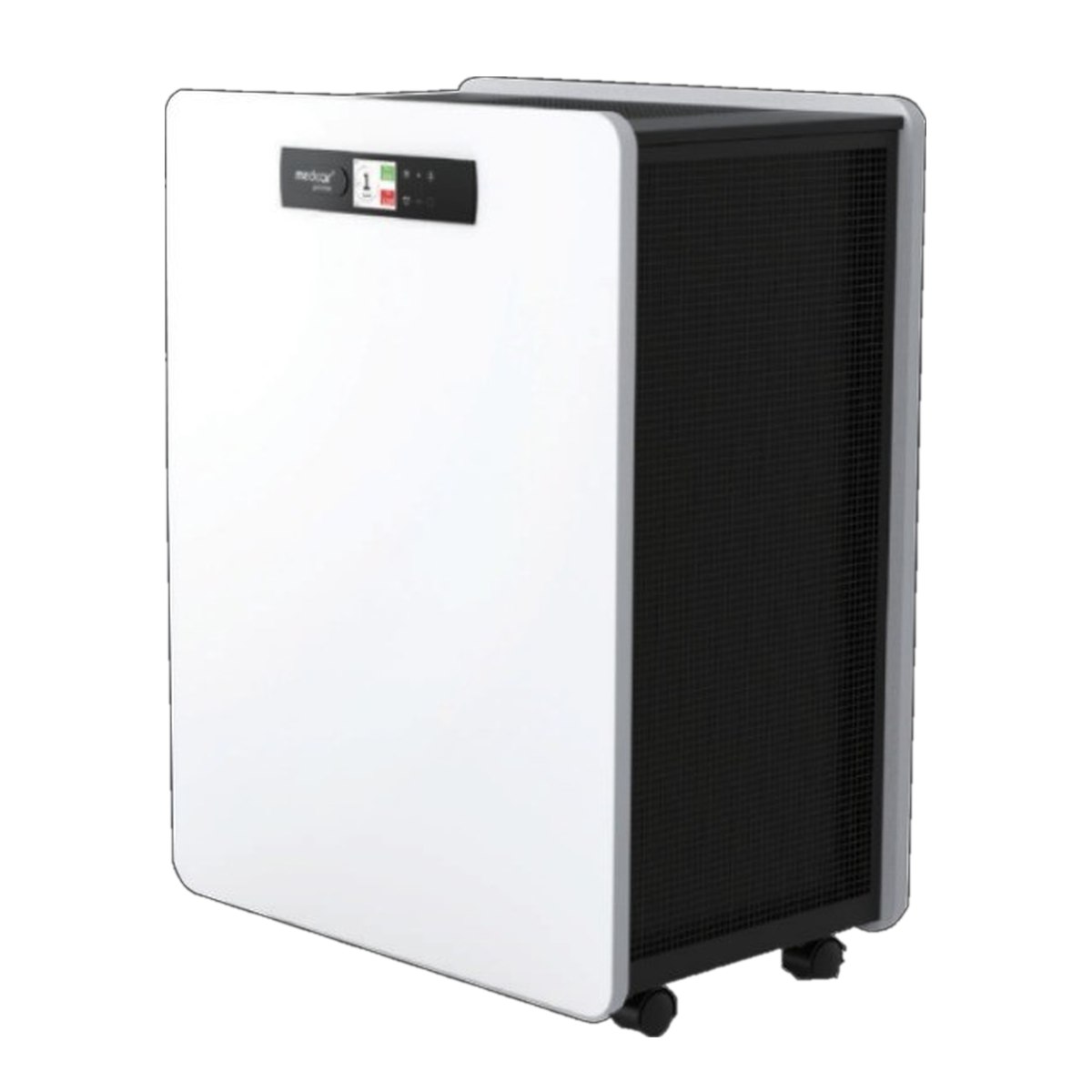
MedicAir Pro Max Air Purifier in the UAE
Published · Updated · PRO TECHnology Air Quality Solutions
The high-capacity MedicAir, built for volume rather than for a single room: open-plan offices, hotel lobbies and function rooms, gyms, large waiting areas and school halls. Stated at up to 1,500 m³/h, wheeled, 29 kg, with H14 HEPA, activated carbon, UV-C and the only carbon dioxide reading in the range.
PRO TECHnology is the exclusive MedicAir distributor and partner for the GCC, including the United Arab Emirates, and supplies the Pro Max and its replacement cartridges from Dubai. Its 1,500 m³/h is roughly two and a half times the Pro and nearly four times the Pro Mini, which makes it the model for spaces where a smaller unit would have to run flat out all day and still fall behind. It is also the model where the difference between a manufacturer's capacity figure and an independently certified clean air delivery rate matters most, and this page explains why.
- 1,500 m³/hmanufacturer-stated maximum, ±10%
- H14HEPA grade, manufacturer specification
- 28 to 54 dBLow to Max, in MedicAir's brochure
- CO₂ readingthe only model in the range with one
- Model
- MedicAir Pro Max, model WAAMSSFL6 (manual IFU_EM_REV1.1, May 2022)
- Capacity
- Up to 1,500 m³/h. The manual and the specification sheet label it clean air delivery rate, ±10%; the manufacturer's website labels the same figure airflow at maximum setting. No test method is named. See the note below
- Filtration
- Pre-filter, ATP-HEPA H14 filter, high-efficiency activated carbon layer, UV-C reaction chamber
- Sound
- 28 dB at Low to 54 dB at Max, by the speed table in MedicAir's January 2024 brochure
- Sensors
- Laser particulate 0.1 to 0.3 µm and TVOC; a CO₂ reading on the display
- Dimensions
- 580 x 380 x 750 mm, wheeled
- Power
- 120 W input, standby ≤2 W, 220 to 230 V, 50/60 Hz
- Warranty
- 3 years against structural or electrical defects (manual)
- Net weight
- 29 kg
- Fan settings
- Six: 1, 2, 3, 4, ReAKT and Sleep
- Filter
- Combined H14 cartridge WAAMSSFL6FC; 69 x 35 x 16 cm, 2.9 kg and 5,000 hours per medicair.co
- Sterilisation rate
- Up to 99.99%, a manufacturer figure with no test method stated
- Independent testing
- Dr Iyad Al-Attar, Kuwait, 30 August 2025: 96 to 100% of particles above 1 µm, up to 96% below 1 µm; the report states the filters did not achieve an H13 or H14 rating under EN 1822
- Regulatory status
- Not a medical device, and not presented as one
Buying summary: MedicAir Pro Max
- Best for
- Open-plan offices, hotel lobbies and function rooms, gyms, large waiting areas, school halls and production floors, sized zone by zone.
- Not for
- Bedrooms, guest rooms, single offices or consultation rooms, where the Pro Mini fits.
- Capacity
- Up to 1,500 m³/h at full speed, labelled clean air delivery rate in the manual (±10%) and airflow on the website; no test method named. At most about 300 m³ of space at five air changes an hour.
- Noise
- 28, 39, 45 and 54 dB at Low, Medium, High and Max (brochure). Hear it before you specify it for an occupied space.
- Limitations
- Its CO₂ reading shows when a space needs ventilation; it cannot lower CO₂. It does not dehumidify or remove settled dust, and its carbon stage is not a fix for heavy odours. 29 kg on wheels. Not a medical device.
- Replacement filters
- One combined cartridge, WAAMSSFL6FC, changed at least every 12 months; supplied from Dubai. See replacement filters.
- Warranty
- Manual: 3 years against structural or electrical defects. Ask us to state the UAE warranty term on your quotation.
- Availability and price
- Supplied by PRO TECHnology from Dubai, for the UAE and the wider GCC; on display at our Business Bay showroom. Delivery, any on-site set-up and after-sales support are confirmed in writing on your quotation. Prices are quoted on request; 120 W input power.
A Pro Max in use: HawaQ's Sun Studio Dubai case study describes units on a UV printing floor in Al Quoz. To compare the three models by room, see HawaQ's decision guide.
Key takeaways
- 1,500 m³/h at full speed covers at most about 300 m³ at five air changes an hour. Above that, or at a quieter setting, the answer is more than one unit.
- It is on castors and weighs 29 kg, which makes it a machine a venue can move between a function room and a lobby rather than a fixed installation.
- It is the only MedicAir that shows a carbon dioxide reading. That tells you when a room needs ventilation. It does not let the machine provide any, and no purifier can.
- MedicAir's brochure gives 28 dB at Low (up to 400 m³/h) and 54 dB at Max (up to 1,500 m³/h). Hear it at the showroom before specifying it for an occupied space.
- The manual and specification sheet call 1,500 m³/h a clean air delivery rate; the website calls it airflow. No test method is named, and at 883 cfm it is above what the AHAM method can measure, so we publish it as a manufacturer-stated maximum and treat it as an upper bound.
- Independent testing measured 96 to 100% particle removal above one micron, and recommended a deeper carbon stage where gas-phase loading is the main problem. If odour control is your reason for buying, talk to us first.
Who the Pro Max is for
This is a volume machine. The question it answers is not which filter grade you need but how much air has to move through a filter in an hour, and that question only arises above roughly 200 cubic metres of connected space.
Open-plan offices
A floor of 60 to 100 people is a volume problem. One Pro Max, or several distributed through a long floor plate, rather than one unit in a corner.
Hotel lobbies and function rooms
High ceilings, large volumes, doors opening onto the street. Wheels matter here: the same unit can serve a ballroom in the evening and a lobby in the morning.
Gyms and studios
High occupancy, high respiration rate and high airflow requirement, and a room where 54 dB at maximum disappears into the background.
Large waiting areas and school halls
Rooms that fill and empty in waves. ReAKT responds to the wave rather than running at one speed all day.
Where it is the wrong machine: a bedroom, a hotel guest room, a private office or a single consultation room. A 29 kg wheeled cabinet is more machine than those rooms need and the Pro Mini is the right answer. For rooms in between, the Pro.
What 1,500 m³/h means, and what it does not
This is the most important paragraph on the page, and it applies to every brand quoting a large number, not only this one.
Clean air delivery rate and airflow are two different quantities. Airflow is how much air the fan moves. Clean air delivery rate is airflow multiplied by the fraction of the pollutant removed on a single pass, so the two are equal only if the machine captured everything first time, which nothing does. The most widely quoted method is the American one, ANSI/AHAM AC-1-2020, which measures clean air delivery by particle decay in a 28.4 m³ chamber. Its own section 2 limits it to rated clean air delivery between 10 and 600 cfm for smoke and dust, about 1,019 m³/h at AHAM's conversion of 1 cfm to 1.699 m³/h, and to 450 cfm, about 765 m³/h, for pollen. Those are limits of the chamber and the statistics, not of any machine. 1,500 m³/h is 883 cfm, so it sits above what that method can measure and cannot be an AHAM-verified figure. What does not follow is that it must therefore be airflow rather than clean air delivery: other recognised methods measure exactly this range. China's GB/T 18801-2022 scales the chamber to the machine and its 81 m³ chamber covers clean air delivery above 800 and up to 2,000 m³/h, and IEC 63086-2-1:2024, adopted in Europe as EN IEC 63086-2-1, sets its own limits. What decides the question is which method a manufacturer names, and for this figure MedicAir names none.
None of this makes the figure wrong or the machine weak. It makes it a specification rather than a verified test result, and worth understanding before it goes into a like-for-like comparison against a competitor quoting a figure measured under a named method. In practice, size the room from the manufacturer's capacity, then apply the usual correction: the real delivered figure is lower, especially at a quieter setting.
What size space does a Pro Max cover?
Room volume, not floor area. Length x width x ceiling height, multiplied by the air changes per hour you are targeting.
| Air changes per hour | Largest volume | Roughly, at a 3 m ceiling |
|---|---|---|
| 3 per hour | About 500 m³ | A floor of about 167 m² |
| 5 per hour (US CDC general recommendation) | About 300 m³ | A floor of about 100 m² |
| 10 per hour | About 150 m³ | A room of about 50 m² |
High-ceilinged spaces eat this quickly. A hotel lobby of 200 m² with a 5 m ceiling is 1,000 m³, which needs 5,000 m³/h at five air changes an hour: four Pro Max units, not one.
Why several units usually beat one big one
In a large or subdivided space, distributing capacity almost always outperforms concentrating it. Air that never reaches an intake never gets cleaned, and a long floor plate or an L-shaped lobby can leave whole zones effectively untreated no matter how impressive the total airflow number is. Several units running at a middle speed are also quieter than one unit running at maximum, and they fail gracefully: if one is out for a filter change, the space is not unprotected.
An open-plan office floor 25 m x 15 m with a 2.9 m ceiling holds 1,088 m³.
At five air changes an hour it needs 5,440 m³/h. That is four Pro Max units at maximum, and in practice five if you want them running below maximum.
Positioning matters as much as the count: four units spread through the floor plate reach far more of the air than four units in a plant room corner.
This is also the point at which it is worth asking whether the building's ventilation, rather than portable filtration, is the thing to address. We will say so if that is the answer.
MedicAir Pro Max specifications
| Specification | Figure | Source |
|---|---|---|
| Capacity | Up to 1,500 m³/h, printed as H14 clean air delivery rate (±10%) in the manual and as CADR on the specification sheet; airflow at maximum setting on medicair.co | Manual; spec sheet; medicair.co |
| HEPA grade | ATP-HEPA H14, manufacturer specification. The August 2025 independent report states the filters did not achieve an H13 or H14 rating under EN 1822 | Manual; spec sheet; Kuwait report |
| Pre-filter | Yes | Spec sheet |
| Gas phase | High-efficiency activated carbon layer | Manual; spec sheet |
| UV | UV-C reaction chamber | Manual; spec sheet |
| Sound | 28 to 54 dB in the manual and specification sheet; by speed, 28 dB at Low, 39 at Medium, 45 at High and 54 at Max in the January 2024 brochure | Manual; spec sheet; brochure |
| Dimensions | 580 x 380 x 750 mm, wheeled | Manual; spec sheet |
| Net weight | 29 kg | Manual; spec sheet |
| Sensors | Laser particulate 0.1 to 0.3 µm and TVOC (manual specification); CO₂ reading on the display (manual) and CO₂ sensor (spec sheet) | Manual; spec sheet |
| Fan settings | Six: 1, 2, 3, 4, ReAKT and Sleep | Manual |
| Sterilisation rate | Up to 99.99%, manufacturer figure with no test method stated | Spec sheet |
| Filter | Combined cartridge WAAMSSFL6FC (pre-filter, H14, carbon); 69 x 35 x 16 cm, 2.9 kg, 5,000 hours per medicair.co | Manual; medicair.co |
| Warranty | 3 years against structural or electrical defects, MedicAir DentAir Ltd | Manual |
| Input power | 120 W; standby ≤2 W; 220 to 230 V, 50/60 Hz | Manual |
| Timer | 1 to 24 hours | Manual |
| Regulatory status | Not a medical device | Manual |
The specification sheet also carries marketing claims we do not repeat, including a comparative statement about virus denaturing and formaldehyde removal rates and an unqualified ISO reference. We publish only what we can attribute.
The carbon dioxide sensor, and what it is for
The Pro Max is the only MedicAir with a CO₂ sensor, and it is genuinely useful, but not for the reason people assume. Carbon dioxide is the standard proxy for whether a room is getting enough outdoor air: if it climbs through a meeting, a class or an evening service, the ventilation is not keeping up with the people in the room. A purifier cannot fix that. Filtration removes particles and, through the carbon stage, gases and odours; it introduces no outdoor air and removes no CO₂. What the sensor gives you is the diagnosis: a reading that keeps rising tells the facilities team that the answer is fresh air, not another purifier. That is worth having, and it is worth being honest that the machine reporting the problem is not the machine that solves it.
What independent testing found
Independent examination, Kuwait, August 2025
- Who
- Dr Iyad Al-Attar, an air filtration specialist who consults to international standards bodies. Commissioned by MedicAir.
- Device
- MedicAir Pro Max.
- Why Kuwait
- Selected for elevated outdoor particulate, high VOC concentrations and high thermal load, closer to conditions in this region than a European laboratory.
- Particle result
- 96 to 100% removal for particles above 1 micron and up to 96% for particles below 1 micron, as summarised by the manufacturer.
- Filter classification
- The report states that, under EN 1822, the filters fitted to the unit “have not achieved an H13 or H14 rating”.
- What the report also recommends
- A deeper granular activated carbon stage, separated from the particulate filter, where gas-phase loading is the main concern. VOC removal on this model did not reach zero.
- What this means for you
- If your reason for buying is airborne dust and particulate in a large space, this is good evidence. If your reason is heavy odour or solvent load, talk to us about the configuration before committing, and read our cigar lounge guide for how gas-phase problems are actually specified.
- Date and source
- Report dated 30 August 2025; summary published by MedicAir on 3 September 2025.
Two things we will not claim about this model
- That its H14 grade is independently verified. H14 is the manufacturer's published specification and that is how we state it. The independent report on this model states that under EN 1822 the filters fitted to the unit “have not achieved an H13 or H14 rating”.
- That 1,500 m³/h is an independently certified clean air delivery rate. At 883 cfm it is above the 600 cfm limit of ANSI/AHAM AC-1-2020, so no AHAM verification can exist for it, and MedicAir names no other test method. Until a method is named it is a manufacturer specification.
The wider evidence for the brand, including the chamber tests summarised in MedicAir's brochure for the MedicAir 2.0 tower and MedicAir's stated use by more than 20 NHS Trusts, is set out on the MedicAir brand page, where each item says what was tested, on which model and by whom. None of those laboratory tests was run on the Pro Max. Results from one model do not transfer to another, and we do not move them around.
Buying and owning a Pro Max in the UAE
- Filters. An H14 cartridge, 69 x 35 x 16 cm and 2.9 kg, published at 5,000 hours, with MedicAir recommending replacement at least every twelve months regardless. Cartridges are stocked locally by PRO TECHnology. The manual lists the cartridge as WAAMSSFL6FC. See replacement filters.
- Dust. In a lobby or a ground-floor reception with doors onto the street, the pre-filter load in this region is heavy. Keep the intake face clear and clean it on a schedule; the cartridge will last nearer its rating.
- Moving it. 29 kg on castors is easy to move across a level floor and awkward on a threshold or in a lift with a lip. Worth planning if the unit is meant to follow events around a venue.
- Placement. Keep the intake face well clear of walls, planters and furniture. A high-capacity unit pushed against a wall recirculates its own output faster than a small one.
- Noise. 54 dB at maximum is the lowest maximum in the range, which is why it works in an occupied lobby. It is still not background noise in a quiet room.
- Seeing one first. MedicAir units are on display at our Business Bay showroom.
- Warranty. The manual states three years against structural or electrical defects. Ask us to state the UAE term on the quotation.
- MedicAir Pro Max specification sheet (PDF)Dimensions, capacity, filter stages and sensors. 163 KB
- MedicAir Pro Max independent test report summary (PDF, manufacturer's site)Dr Iyad Al-Attar, 30 August 2025
MedicAir Pro Max: frequently asked questions
What size space does the MedicAir Pro Max cover?
Its 1,500 m3/h corresponds to about 500 m3 of volume at three air changes an hour, about 300 m3 at five and about 150 m3 at ten. Work from volume: a 200 square metre hotel lobby with a 5 metre ceiling is 1,000 m3 and needs about 5,000 m3/h at five air changes an hour, which is four units rather than one. High ceilings consume capacity much faster than floor area suggests.
Is the MedicAir Pro Max 1,500 m3/h a CADR or an airflow figure?
MedicAir's own documents use both labels for the same number: the manual and the specification sheet call it a clean air delivery rate (the manual adds a tolerance of plus or minus 10%), while the manufacturer's website lists it as airflow at the maximum setting. None of them names a test method, and we have not seen a clean air delivery test for this model, so we publish it as a manufacturer-stated maximum of 1,500 m3/h. It cannot be an AHAM-verified figure: 1,500 m3/h is 883 cfm and ANSI/AHAM AC-1-2020 applies only up to 600 cfm for smoke and dust, roughly 1,019 m3/h. Other standards, such as China's GB/T 18801-2022, do measure this range. One thing is certain either way: clean air delivery is airflow multiplied by the fraction removed on a single pass, so it can never be higher than the airflow figure.
How loud is the MedicAir Pro Max?
The January 2024 MedicAir brochure gives 28 dB at Low (up to 400 m3/h), 39 dB at Medium (up to 720), 45 dB at High (up to 1,000) and 54 dB at Max (up to 1,500 m3/h). The 28 dB figure is not the level at 1,500 m3/h. We have not metered it ourselves, so if the space will be occupied while the unit runs, hear it at our Business Bay showroom and size generously so it can run below full speed.
Does the MedicAir Pro Max reduce carbon dioxide?
No, and no air purifier does. The Pro Max is the only model in the range with a CO2 sensor, and that sensor is a diagnostic: a reading that climbs through the day tells you the space needs more outdoor air. A purifier filters and recirculates air already in the room. It introduces no fresh air and removes no CO2, so the answer to a rising reading is ventilation, not another purifier.
Has the MedicAir Pro Max been independently tested?
Yes. Dr Iyad Al-Attar examined it in Kuwait in August 2025 and measured 96 to 100% removal of particles above one micron and up to 96% below one micron. The same report recommends a deeper granular activated carbon stage where gas-phase loading is the main concern, so if odour or solvent control is your main reason for buying, discuss the application with us before committing.
Is the MedicAir Pro Max H14 filtration independently certified?
H14 is the manufacturer's published specification and that is how we state it. The independent report on this model, by Dr Iyad Al-Attar in August 2025, states that under EN 1822 its filters “have not achieved an H13 or H14 rating”, so we do not describe the grade as independently verified. If a project specification requires a certified H14 filter, tell us and we will get the manufacturer's certification documents before you commit.
Can the Pro Max be moved between rooms?
Yes. It is on castors and weighs 29 kg, which is one of the reasons venues choose it: the same unit can serve a function room in the evening and a lobby in the morning. Plan for thresholds, ramps and lift lips, which are where 29 kg stops being easy, and remember that a unit only works where it is plugged in and switched on.
How often does the Pro Max filter need changing?
MedicAir publishes 5,000 hours for the H14 cartridge and recommends replacement at least once every twelve months even if the unit has not signalled a change. In a lobby or reception with heavy outdoor dust ingress, expect the shorter end. Cartridges are supplied locally in the UAE by PRO TECHnology rather than ordered from Europe.
One Pro Max or several smaller units?
It depends on the shape of the space, not only its volume. In one large open room a single Pro Max is efficient. In a long floor plate, an L-shaped lobby or a space broken up by partitions, several units distributed through it outperform one, because air that never reaches an intake never gets cleaned. Distributed units at a middle speed are also quieter than one unit at maximum.
Sources and how we checked them
Figures above come from the MedicAir Pro Max specification sheet supplied with the unit, from the manufacturer's current product page, read on 27 September 2026, or, for sound by fan speed, from the manufacturer's January 2024 brochure, read on 6 November 2026. The specification table says which. Where the two use different labels for the same number, we say so rather than choosing one. Test results are attributed to the person who produced them, with the date. No price, stock level or delivery time appears on this page.
- MedicAir Pro Max specification sheet, supplied by the manufacturer
- MedicAir: Pro Max product page and specifications
- MedicAir: Independent Global Testing Confirms MedicAir's Filtration Excellence, 3 September 2025, with the Dr Iyad Al-Attar report summary
- Dr Iyad Al-Attar: MedicAir Pro Max test report, Kuwait, 30 August 2025 (PDF, manufacturer's site)
- MedicAir Pro Max product brochure, January 2024 (PDF): airflow and sound by fan speed
- US EPA, Guide to Air Cleaners in the Home: the definition of clean air delivery rate
- US CDC, Ventilation in Buildings (May 2023 update): aim for 5 air changes per hour of clean air. Summarised by AIHA; the CDC page is no longer online
Ask about the Pro Max: price, demonstration or a room schedule
Large spaces are sized zone by zone. Tell us how many units you have in mind and where they are going, and add the floor area, ceiling height and use of each zone; we will work out how many units are needed at a setting the space can live with, and whether a mix of models fits better.