Air Purifier for Cigar Smoke: Medical-Grade Air Purification for Cigar Lounges in the UAE
Published · PRO TECHnology Air Quality Solutions
Cigar smoke is two problems at once. It puts fine particles into the air, and it puts gases and odour compounds into the air. Particle filtration alone will not deal with the smell; odour control alone will not deal with the haze. An air purifier for a cigar lounge needs HEPA filtration, activated carbon and enough airflow to move the room’s air through both, repeatedly, while people are smoking.
At a glance
- HEPA captures the particles. Activated carbon addresses the gases, VOCs and the smell. A cigar lounge needs both stages.
- Airflow decides how fast either stage works. A filter only cleans air that actually passes through it, and a lounge is a continuous source.
- No air purifier makes indoor smoking safe. The US EPA is explicit that ventilation, filtration and air cleaning reduce secondhand smoke but do not eliminate it.
- Purification complements ventilation and extraction — it does not replace them, and air conditioning is not ventilation.
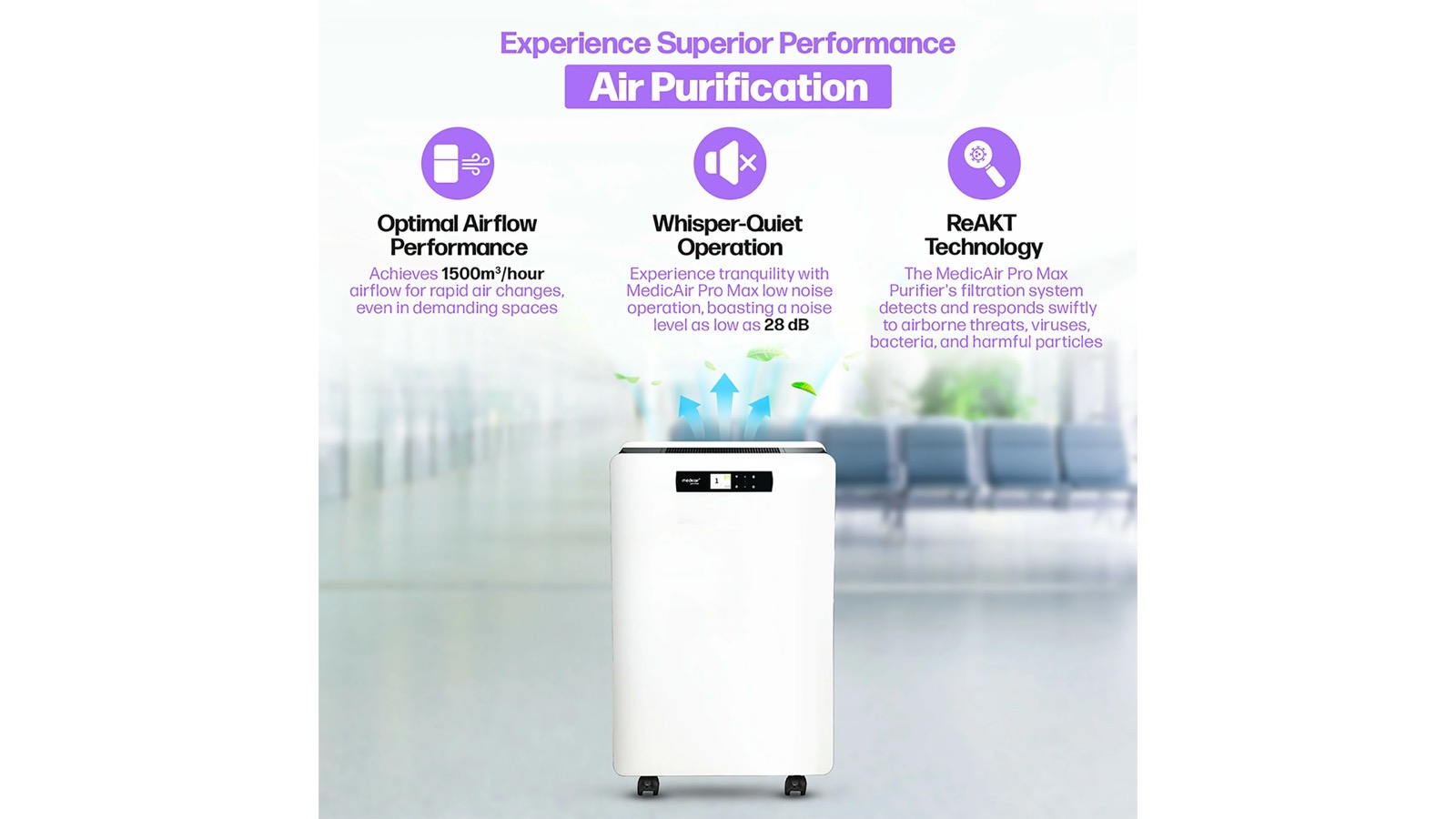
- MedicAir publishes three models at 410, 605 and 1,500 m³/h maximum airflow, all with HEPA, activated carbon and safe UV technology.
What Type of Air Purifier Is Best for Cigar Smoke?
For cigar smoke you want a purifier combining HEPA filtration, a substantial activated carbon stage and high airflow. All three matter, and a unit missing one will disappoint you in a different way.
There is no single machine that is right for every cigar lounge. A private room with two armchairs and a commercial lounge at capacity are different problems. What stays constant is the combination: HEPA for the fine particulate that makes smoke visible, activated carbon for the gas-phase compounds and VOCs behind the smell, and airflow high enough to turn the room volume over repeatedly while people smoke.
A great filter with weak airflow cleans a little air very well while the rest of the room stays hazy. Strong airflow with no carbon thins the haze and leaves the smell. Cigar smoke punishes an incomplete specification.
Why Is Cigar Smoke Difficult to Remove From a Room?
Because it is a mixture, not a single pollutant:
- Fine particles stay airborne a long time and travel with room air currents.
- Gases and VOCs pass straight through a particle filter. Much of what your nose registers as “cigar smell” is gas-phase.
- A continuous source. The equipment is not cleaning up after a problem; it is working against one that is still happening.
- Surface residue deposits into carpet, curtains, leather, timber, walls, ceilings and acoustic panels, then releases odour back into the room.
- Migration. Smoke follows air movement and pressure differences, and does not respect the doorway of the room it started in.
This is why a cigar lounge is treated as a ventilation and filtration problem together.
HEPA vs Activated Carbon for Cigar Smoke
These two stages do completely different jobs. Confusing them is the most common mistake in this category.
HEPA Filtration for Smoke Particles
HEPA is a mechanical filter: it physically traps airborne particles as air passes through the media, including the fine particulate in tobacco smoke. It is the stage that reduces visible haze. H13 and H14 are both HEPA grades, H14 being the higher of the two.
What HEPA does not do is capture gases — a gas molecule passes straight through. This is the key point for cigar smoke: a HEPA-only purifier will not fix the smell.
Activated Carbon for Cigar Odour, Gases and VOCs
Activated carbon works by adsorption rather than straining. Its very large internal surface area gives gas molecules somewhere to stick, which is how it reduces odours and volatile organic compounds. It is the stage that addresses the part of cigar smoke your nose objects to.
Two practical points. Carbon has a finite capacity — once loaded it stops adsorbing, so replacement matters far more in a smoking room than in an office. And the quantity of carbon matters as much as its presence; a token layer in a domestic purifier is not comparable to a commercial carbon stage.
Does an Air Purifier Remove Cigar Smell?
An air purifier with an activated carbon stage can help reduce airborne cigar odour, and one without carbon will do very little for smell at all. But purification treats air, not surfaces.
Smoke residue settles into carpets, curtains, leather and upholstery, fabric wall panels and acoustic treatments, paint and joinery. Those materials re-release odour over time. A purifier running continuously keeps pulling that airborne odour back through its carbon stage, which helps, but it cannot reach inside a sofa. In an established lounge, odour control is air purification plus ventilation plus cleaning — and occasionally replacing soft materials that have absorbed years of smoke.
MedicAir Medical-Grade Air Purification for Cigar Lounges
MedicAir is a British air purification manufacturer whose units were designed by healthcare professionals for demanding indoor environments. Each combines HEPA filtration, an activated carbon filter, safe UV technology and high airflow.
For a cigar lounge the parts that matter are HEPA, carbon and airflow. MedicAir states that all its air purifiers carry a carbon-activated filter that removes odours and other volatile organic compounds — the stage a smoking room needs and the one cheaper purifiers skimp on. The safe UV technology is part of MedicAir’s microbial air-treatment system; it is not a smoke-removal technology and we do not present it as one.
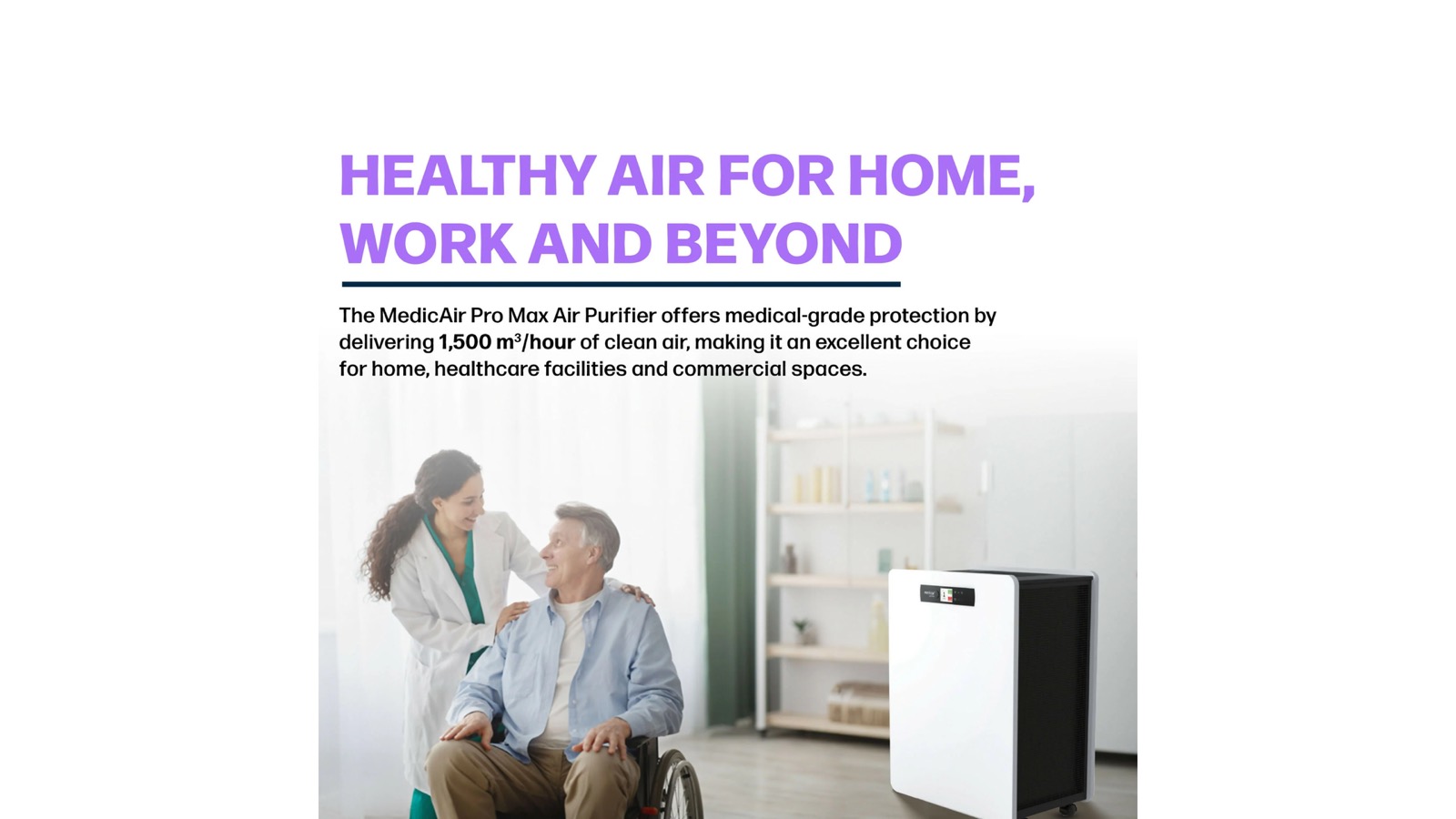
The medical-grade engineering is why the filtration specification is what it is; we cover that side separately in our guide to medical-grade air purification for hospitals and clinics. For a cigar lounge, though, the question is not whether a machine is hospital-grade. It is whether it moves enough air through a good enough filter, with the carbon to handle odour.
Which MedicAir Is Right for a Cigar Lounge?
MedicAir publishes three models. For a smoking room the differences that matter are maximum airflow and the sound range.
| Model | Maximum Airflow | HEPA | Activated Carbon | Safe UV Technology | Lowest Published Sound Level | Possible Application |
|---|---|---|---|---|---|---|
| MedicAir Pro Mini | 410 m³/h | H14 | Yes | Yes | 21 dB | Private cigar rooms and smaller smoking areas |
| MedicAir Pro | 605 m³/h | H13 | Yes | Yes | 28 dB | Medium-demand hospitality and smoking rooms |
| MedicAir Pro Max | 1,500 m³/h | H14 | Yes | Yes | 28 dB | Larger and commercial cigar lounges |
The Pro Mini and Pro Max are specified with H14 filtration while the Pro is specified with H13. Both are HEPA grades; H14 is the higher of the two. All three carry an activated carbon stage, which is what matters most for cigar odour.
MedicAir Pro Mini – For Smaller Cigar Rooms and Private Smoking Areas
At 410 m³/h it is the smallest and quietest of the three (lowest published level 21 dB). It can be considered for private cigar rooms, boutique cigar spaces, hotel smoking rooms and villa cigar rooms. Whether it is enough depends on room volume and how heavily the space is used, not floor area alone.
MedicAir Pro – For Medium-Demand Hospitality Spaces
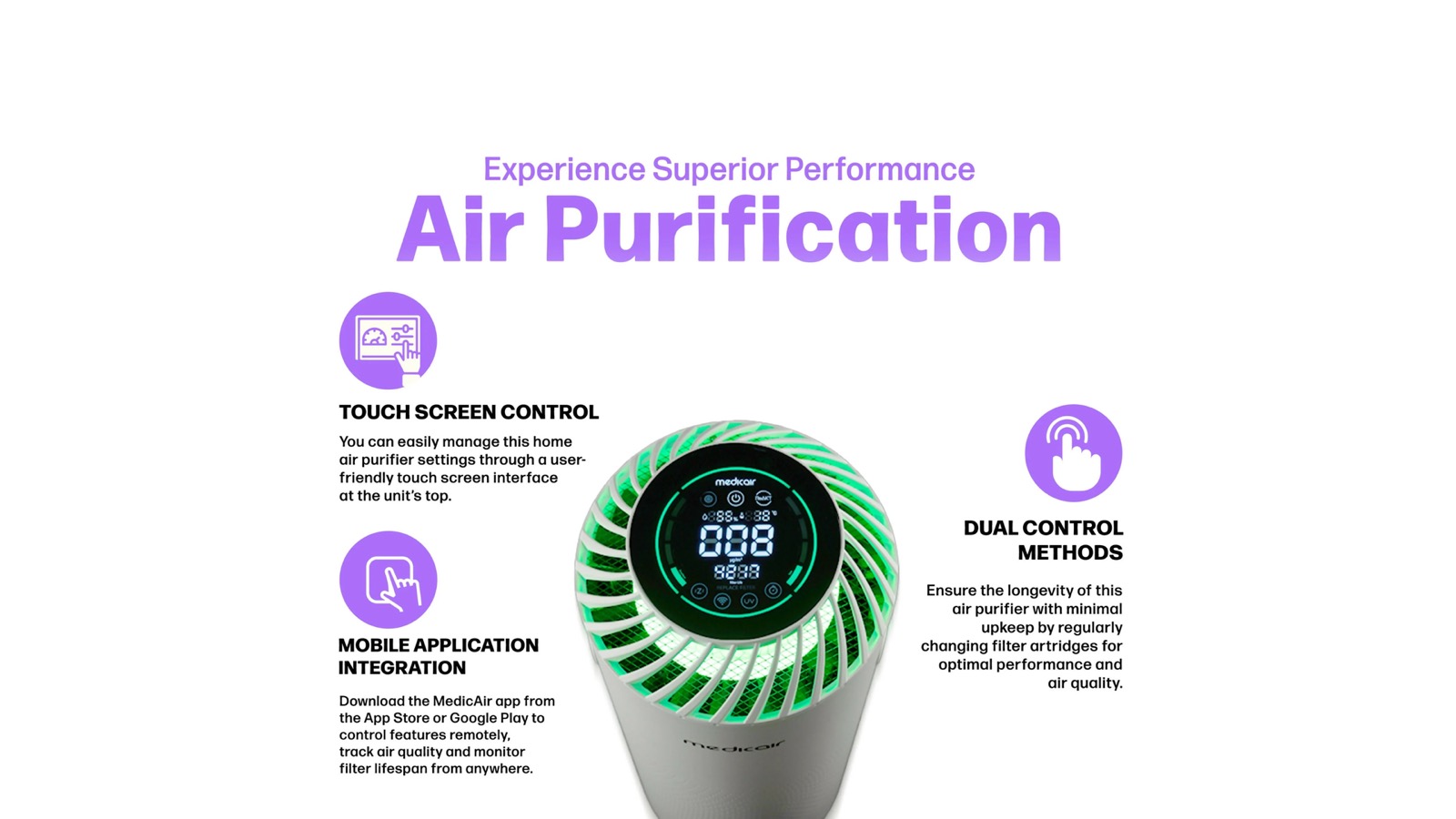
At 605 m³/h, with a published range of 28–60 dB, the Pro may suit medium cigar lounges, private clubs and commercial smoking rooms where the Pro Mini is short of airflow. It is often specified as a pair, because two well-placed units in a longer room frequently outperform one larger unit in a corner.
MedicAir Pro Max – High-Airflow Purification for Commercial Cigar Lounges
The Pro Max is the model most commercial cigar lounges should be evaluating. Its 1,500 m³/h maximum airflow is around two and a half times the Pro and more than three times the Pro Mini, and airflow is usually the constraint that decides whether a busy smoking room stays acceptable. It pairs that with H14 filtration, an activated carbon stage and a published range of 28–54 dB — making it the one to evaluate for larger cigar lounges, premium cigar clubs, hotel cigar lounges and high-occupancy smoking rooms.
What we will not tell you is that one Pro Max is enough for your lounge. That depends on room volume, peak number of smokers, operating hours and existing ventilation. Larger lounges commonly need more than one unit, and usually dedicated mechanical extraction alongside the purification.
Why Airflow Matters in a Cigar Lounge
A filter can only clean the air that passes through it. Filter grade tells you how well a machine cleans the air it processes; airflow tells you how much of the room’s air it processes. The two multiply, and neither works alone.
This matters more in a cigar lounge than almost anywhere else, because the smoke is generated continuously. In an office you are clearing a background load. In a smoking room you are competing with a source that is still producing. If the air is not turned over enough times per hour, the room settles at a level of haze and smell you will not be happy with, however good the filter is.
Airflow is also why room volume, not floor area, is the number to work from. Two rooms of the same floor area with different ceiling heights need different amounts of air moved to achieve the same air changes.
Key Benefits of Air Purification in a Cigar Lounge
Fine Smoke Particle Filtration
HEPA captures the fine airborne particulate that makes a room look hazy. It is usually the first improvement guests and staff notice.
Odour and VOC Management
The activated carbon stage adsorbs gas-phase compounds and VOCs, which is where the smell lives. This is what separates a purifier that helps in a smoking room from one that only makes the air look clearer.
High Airflow
Enough throughput to turn the room volume over repeatedly during trading hours, so the room holds its level through the evening.
Quiet Operation
A cigar lounge is a place for conversation, relaxation and premium hospitality. A purifier that drowns out the room gets switched off, which is worse than not having one.
An honest note on the decibel figures. The 21 dB and 28 dB numbers above are MedicAir’s lowest published sound levels, measured at the quietest fan setting — not the level at maximum airflow. The Pro publishes 28–60 dB and the Pro Max 28–54 dB. A Pro Max running at its full 1,500 m³/h is not operating at 28 dB. In practice this is an argument for sizing generously: a larger unit at a middle speed is quieter than a smaller unit running flat out.
Do I Need a Smoke Eater or an Air Purifier for a Cigar Lounge?
“Smoke eater” is a general commercial term rather than a defined technology. It is widely used for equipment intended to clean air in smoking environments, and depending on the product it may mean electrostatic precipitators, media filtration, high-volume filtration or other commercial designs. Two products both sold as smoke eaters can work in entirely different ways.
MedicAir is not an electrostatic smoke eater and we will not describe it as one. It is a high-performance air purification system combining HEPA filtration, activated carbon and safe UV technology, and for cigar smoke the HEPA and carbon stages do the work.
The more useful question is whether your room addresses both particles and gases with enough air movement. A busy cigar lounge usually needs mechanical ventilation and extraction working with recirculating air purification. Expecting one device to perform every function is how lounges end up with underperforming equipment and a manager who concludes that air purifiers do not work.
Can an Air Purifier Completely Remove Cigar Smoke?
No. No air purifier should be presented as making indoor smoking harmless, and we do not present MedicAir that way.
Filtration and ventilation can reduce airborne particles and some gases and odours, which is a real improvement for a room and the people working in it. But they cannot remove all exposure to secondhand tobacco smoke. The US Environmental Protection Agency states that ventilation, filtration and air cleaning techniques can reduce secondhand smoke indoors but do not eliminate it, and that prohibiting indoor smoking is the only way to eliminate exposure. Air purification improves the air in a room where smoking is permitted; it does not make that room equivalent to a non-smoking one.
Does an Air Purifier Replace Ventilation in a Smoking Room?
No. These are four different jobs, and a smoking room usually needs more than one of them:
- Air conditioning controls temperature. It does not bring in fresh air or remove pollutants.
- Ventilation introduces outdoor air to dilute what has built up indoors.
- Extraction removes contaminated air from the space and discharges it outside.
- Air purification cleans and recirculates the air already in the room.
A recirculating purifier adds cleaning capacity without adding fresh air; extraction removes air without cleaning what remains. Purification should be designed around whatever ventilation and extraction a space has or is required to have, not instead of it. Our guide to indoor air quality in UAE buildings covers the ventilation and CO₂ side in more detail.
Smoke Migration Into Adjacent Areas
Cigar smoke that is not properly contained will find its way into corridors, reception and lobby areas, nearby restaurants and bars, adjoining hotel rooms, and staff or back-of-house areas. In hospitality this is often the complaint that forces the issue, rather than conditions inside the lounge itself.
Purification inside the lounge reduces the pollutant load available to migrate, so it forms part of the strategy. But containment depends on things a purifier does not control: the pressure relationship between the lounge and neighbouring spaces, how the ventilation is designed and balanced, where extraction discharges, and how often doors open. An air purifier does not guarantee containment. If migration is already a problem, it is usually a ventilation design question first.
Filter Maintenance in a Cigar Lounge
A cigar lounge puts a far heavier load on filters than an office or a home. The carbon stage in particular has a finite adsorption capacity — once loaded, odour performance falls away. Filter life varies with smoking frequency, peak occupancy, daily operating hours, the volume of smoke generated, and how much ventilation and extraction the room has.
We are not going to publish a cigar-specific replacement interval, because MedicAir does not publish one and inventing a number would be guesswork. MedicAir’s general guidance is to change the filter at least once every twelve months even if the unit has not indicated a change is required. In a heavy smoking environment, work from the unit’s filter indication and your own observation — a noticeable return of odour is the practical signal — rather than assuming a domestic interval will hold. More frequent filter changes are part of the real running cost of a cigar lounge.
Air Purification for Cigar Lounges in Dubai and the UAE
Cigar lounges across Gulf hospitality operate under a particular set of conditions. For much of the year, outdoor temperatures make opening a room to the outside impractical, so venues run closed and heavily air conditioned.
That is worth stating carefully, because it is where confusion starts: air conditioning is not ventilation. A well-cooled lounge can still be a poorly ventilated one. Cooling conditions air already in the building; it does not by itself introduce the outdoor air that dilutes what smoking puts into the room.
So a cigar lounge here is often relying on a fresh-air supply sized for a normal occupied space rather than for a room where people smoke for hours. Adding recirculating purification is one of the few changes that can be made without rebuilding the ventilation, which is why it comes up so often in existing venues — and why we ask what fresh-air provision and extraction already exist before recommending anything.
PRO TECHnology supplies and supports MedicAir through its indoor air quality solutions division from Dubai, and the equipment can be seen at our Business Bay showroom.
How Do We Choose the Right Air Purifier for a Cigar Lounge?
Not by looking up a floor area on a chart. Floor area ignores ceiling height, and ceiling height changes the volume of air you have to treat. A proper recommendation takes account of:
- room length, width and ceiling height, and therefore total room volume
- room shape, and whether it is open-plan or broken up
- how many people the room holds, and the peak number smoking at once
- how intensively they smoke, and daily operating hours
- whether a dedicated fresh-air supply exists, and its capacity
- whether mechanical extraction exists
- how often doors open, and what is on the other side of them
- the adjacent spaces that must be protected from migration
MedicAir does not publish a smoking-room sizing methodology, so we will not present one as though it came from the manufacturer. What we do is work from room volume and target air changes, treat published maximum airflow as a ceiling rather than an operating point, allow for the fact that a unit running flat out is louder than one at a middle speed, and then say plainly whether the room needs one unit, several, or a conversation with whoever designed the ventilation.
Sometimes the honest recommendation is that purification alone will not get the room where the operator wants it, and extraction has to be addressed.
Frequently asked questions
What is the best type of air purifier for cigar smoke?
One combining HEPA filtration, a substantial activated carbon stage and high airflow. Cigar smoke contains both particles and gases, so the purifier must address both, with enough airflow to move the room's air through the filters repeatedly. There is no single best model for every lounge — room volume and occupancy decide that.
Does HEPA filtration remove cigar smoke?
HEPA captures the fine airborne particles, which reduces the visible haze. It does not capture gases, so a HEPA-only purifier makes a room look clearer while leaving the smell largely untouched. Activated carbon is needed alongside it.
Does activated carbon help remove cigar smell?
Yes. Activated carbon adsorbs the gas-phase compounds and VOCs where most cigar odour comes from. MedicAir states that all its air purifiers include a carbon-activated filter to remove odours and VOCs. Carbon has a finite capacity, so it needs replacing more often in a smoking room.
Can an air purifier completely eliminate cigar smoke?
No. The US EPA states that ventilation, filtration and air cleaning reduce secondhand smoke indoors but do not eliminate it. An air purifier improves the air in a room where smoking is permitted; it does not make indoor smoking harmless.
Do I need a smoke eater for a cigar lounge?
"Smoke eater" is a general commercial term rather than a specific technology; products sold under that name work in different ways. What matters is whether your setup handles both particles and gases with enough airflow. A busy lounge usually needs ventilation and extraction alongside recirculating air purification, rather than one device doing everything.
Does an air purifier replace ventilation in a smoking room?
No. Ventilation brings in outdoor air, extraction removes contaminated air, and purification cleans and recirculates the air already in the room. Air conditioning does none of the three. A smoking room needs purification designed around its ventilation and extraction, not instead of them.
Which MedicAir is suitable for a cigar lounge?
It depends on the room. The Pro Mini (410 m³/h) suits private cigar rooms and smaller smoking areas; the Pro (605 m³/h) medium hospitality spaces; the Pro Max (1,500 m³/h) larger and commercial lounges, where airflow is usually the deciding factor. All three include HEPA, activated carbon and safe UV technology.
Can I use more than one air purifier in a large cigar lounge?
Yes, and in larger or irregularly shaped lounges it is often the better answer. Several distributed units give more even coverage than one large unit in a corner, and units at middle speed are quieter than a single unit at maximum. Placement matters as much as total airflow.
What information do you need to size an air purifier for a cigar lounge?
Room length, width and ceiling height; the peak number of guests and how many smoke; daily operating hours; and whether the room has a dedicated fresh-air supply and mechanical extraction. Floor area alone is not enough, because ceiling height changes the volume to be treated.
جهاز تنقية الهواء لدخان السيجار وصالات السيجار في الإمارات
يُعد دخان السيجار مشكلتين في آنٍ واحد: جسيمات دقيقة عالقة في الهواء، وغازات ومركبات عضوية متطايرة مسؤولة عن الرائحة. لذلك يحتاج جهاز تنقية الهواء في صالة السيجار إلى فلتر HEPA لالتقاط الجسيمات، وفلتر كربون نشط لمعالجة الغازات والروائح، إضافةً إلى تدفق هواء كافٍ لتمرير هواء الغرفة عبر الفلاتر عدة مرات في الساعة، إذ لا ينظّف الفلتر إلا الهواء الذي يمر خلاله فعليًا. تقدّم MedicAir ثلاثة طرازات بتدفق أقصى يبلغ 410 و605 و1500 متر مكعب في الساعة، وجميعها تجمع بين فلتر HEPA وفلتر الكربون النشط وتقنية UV الآمنة، وغالبًا ما يكون طراز Pro Max الأنسب للتقييم في الصالات التجارية الكبيرة. ملاحظة مهمة: لا يمكن لأي جهاز تنقية أن يزيل دخان التبغ غير المباشر بالكامل أو أن يجعل التدخين في الأماكن المغلقة آمنًا؛ فالتنقية تُكمّل التهوية وأنظمة الشفط ولا تحل محلها، كما أن التكييف ليس تهوية. ولتحديد الحل المناسب يحتاج فريق حلول جودة الهواء لدى بروتكنولوجي إلى أبعاد الغرفة وارتفاع السقف وعدد المدخنين في أوقات الذروة وساعات التشغيل ومعرفة ما إذا كانت الغرفة مزوّدة بتهوية هواء نقي أو نظام شفط.
Tell us about the room
Looking for an air purifier for a cigar lounge or smoking room? The quickest way to a useful answer is to send us the room, not the square metres:
- room length and width
- ceiling height
- approximate peak number of guests
- approximate number of people smoking at peak
- whether dedicated fresh-air ventilation exists
- whether the room has mechanical extraction
Our Air Quality Solutions team will work through it and recommend the most appropriate MedicAir configuration for the application — including telling you if purification alone is not the right answer for that room. Call +971 4 343 5501 or email sales@protech.ae.