
Indoor Air Quality Monitoring in the UAE: Measure First, Then Fix the Right Problem
Published · PRO TECHnology Air Quality Solutions
Indoor air quality monitoring shows whether a room's problem is ventilation, particles, gases or moisture. HawaQ uses those findings to recommend the right response, then monitors again to check the result.
HawaQ is a PRO TECHnology company and the group's dedicated air-quality business. Our approach is simple: measure indoor conditions, understand the findings, recommend suitable action, then monitor the result. That avoids prescribing the same machine for every building or complaint.
- Measurethe rooms that matter
- Understandpatterns and likely sources
- Actwith the suitable response
- Verifythe result with monitoring
Key takeaways
- CO₂ points to ventilation and occupancy. Standard air purifiers and dehumidifiers do not remove it.
- Particle filtration can reduce airborne particles when equipment is correctly sized, placed and maintained.
- Persistent high humidity calls for moisture and HVAC investigation; dehumidification may then be appropriate.
- TVOC readings need careful interpretation. HEPA alone does not remove gaseous pollutants.
Why a cool room can still have an air-quality problem
Air conditioning can cool a room while it receives too little outdoor air, allowing CO₂ to rise as people gather. Fine particles can enter with outdoor dust or be generated indoors. Relative humidity can remain high in a bedroom, wardrobe or hotel room even when the thermostat looks normal. New furniture, finishes and cleaning products can also change VOC indicators.
The useful evidence is a trend, not an isolated number. A meeting-room rise during occupancy means something different from a constant building-wide level. Monitor location matters too: a sensor directly below an AC diffuser may describe supply air rather than the air people breathe.
What HawaQ's indoor air quality monitors can measure
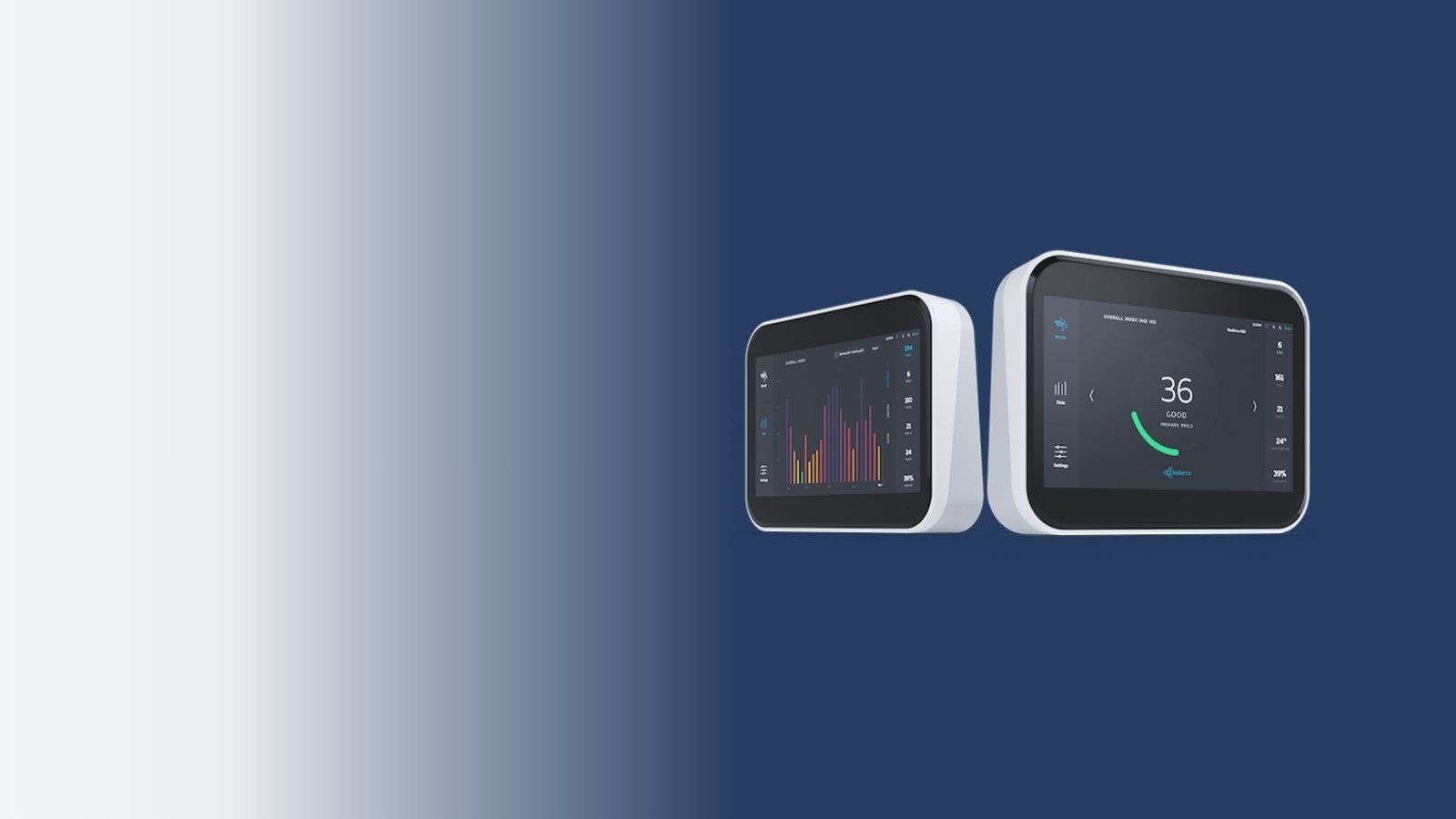
HawaQ currently publishes three indoor-monitoring brands: Kaiterra, Atmocube and Airthings. Sensor sets vary, so every proposal should name the exact model or SKU and fitted modules.
| Published offer | Confirmed measurements and point to check |
|---|---|
| Kaiterra Sensedge and Sensedge Mini | Depending on configuration: CO₂, temperature, relative humidity, PM2.5, PM10 and TVOC; other gas modules are available. Confirm the configuration. |
| Atmocube | Current SKUs can include PM1, PM2.5, PM10, CO₂, TVOC, formaldehyde, temperature, humidity, pressure, light and noise; some add a NOx index or CO and ozone. Confirm the SKU. |
| Airthings | HawaQ describes radon, PM1/PM2.5, CO₂, VOC, temperature, humidity, pressure and noise, but does not name a model. Confirm availability and its exact sensors. |
No monitor measures every possible indoor contaminant. A TVOC sensor does not identify every gas, and humidity does not prove mould is present. Inspection or targeted laboratory analysis may still be needed.
For a home, a clear display and app may be enough. For an office, hotel or school portfolio, historical data, alerts, exports, user permissions and BMS/BAS integration can be as important as the enclosure. Confirm the dashboard, subscription, gateway, retention and support included in the quotation.
HawaQ's process: measure, understand, recommend, monitor
- Measure. Define the rooms, complaint, hours and occupancy. Select parameters and locations that answer that question, then record a representative baseline.
- Understand. Compare rooms, occupied and unoccupied periods, cleaning, doors, AC schedules, outdoor conditions and recent fit-out activity.
- Recommend. Choose source control, ventilation or HVAC work, purification, dehumidification or further testing according to the measured issue.
- Monitor the result. Repeat comparable measurements after action. Success means the relevant trend improved, not merely that equipment was installed.
Which solution do I need?
| Measured issue | What it may indicate | Appropriate next step | Relevant solution |
|---|---|---|---|
| CO₂ rises with occupancy | Too little outdoor air for the number of people | Review fresh-air supply, controls, dampers and occupancy | No MedicAir or Stadler Form unit lowers CO₂ |
| PM2.5 or PM10 remains high | Outdoor ingress, dust, smoke, cooking or indoor activity | Control the source; check envelope and HVAC filters; then size room filtration | MedicAir Pro Mini, Pro or Pro Max for an appropriate room and clean-air target |
| TVOC or formaldehyde rises | Products, finishes, furniture, cleaning or another gaseous source | Identify and remove the source, ventilate and use targeted testing where required | Activated carbon can support gas and odour control; HEPA alone cannot |
| Relative humidity remains high | Moisture source, leak or AC/HVAC operating issue | Investigate the cause and HVAC, then dehumidify if needed | Stadler Form Albert, Lukas or Lukas Pro, sized for the actual room |
| Particles and humidity are both high | Two distinct conditions requiring combined action | Address sources and building operation, then treat both | Lukas Pro combines 50 L/day rated dehumidification with H11 purification; purifier coverage is smaller |
UV-C is model-specific treatment technology. MedicAir's published range combines HEPA, activated carbon and an enclosed UV-C chamber, but UV-C does not replace ventilation, particle filtration or humidity control.
When MedicAir purification fits
PRO TECHnology publishes MedicAir Pro Mini, Pro and Pro Max for the GCC. Particle findings may support purification after source and HVAC checks. Select by room volume, target clean-air rate, layout and the fan speed occupants will accept—not building type alone.
When Stadler Form dehumidification fits
For persistent humidity, Stadler Form Albert and Lukas are rated up to 20 L/day and 70 m² under manufacturer conditions. Lukas Pro is rated up to 50 L/day and 175 m² for dehumidification and adds H11 purification. Maximum ratings are not a universal sizing promise; use the UAE dehumidifier sizing guide for the room and conditions.
Different buildings need different monitoring plans
Offices
Track CO₂ in meeting rooms and occupied zones, particles near entrances and VOC changes after cleaning or fit-out.
Hotels
Separate guest rooms, lobbies, meeting areas and wet zones. One lobby sensor cannot represent the whole property.
Villas and apartments
Compare bedrooms, living spaces and wardrobes. Night-time CO₂, cooking particles and humidity with the AC running point to different actions.
Schools
Read classroom CO₂ and particles against timetables, cleaning, outdoor conditions, and door and window use.
Clinics may also use general IAQ trends for facilities decisions, but a room monitor is not an infection-control instrument and does not replace clinical ventilation, pressure or filtration requirements.
How to enquire about indoor air quality monitoring in Dubai and the UAE
Share the property type and UAE location, approximate room areas and ceiling heights, occupancy and operating hours, the main concern and when it occurs, plus any existing readings or recent fit-out or water event. If a certification, authority, lease or insurer requires a particular report, say so.
The PRO TECHnology indoor-air-quality showroom at Showroom 3, Aswar Building, Business Bay, Dubai displays monitors alongside MedicAir purification and Stadler Form dehumidifiers. Use the contact form, call +971 4 343 5501 or email sales@protech.ae to discuss a UAE project or arrange a visit.
Indoor air quality monitoring: frequently asked questions
What does an indoor air quality monitor measure?
Depending on its sensors, it can record CO₂, PM1, PM2.5, PM10, TVOC, formaldehyde, temperature, relative humidity, pressure, noise, light or radon. Check the exact model and configuration.
Can air conditioning alone ensure good indoor air quality?
No. Cooling, outdoor-air ventilation, filtration and moisture control are separate functions. A cool room may still have high CO₂, particles or humidity.
Does an air purifier reduce CO₂?
No. A standard room purifier recirculates indoor air; it does not introduce outdoor air. Occupancy-related CO₂ requires a ventilation response.
Do I need an air purifier or a dehumidifier?
Use measured conditions: particles may support filtration, while persistent high relative humidity may support dehumidification after the moisture source and HVAC are checked. Some rooms need both.
When is UV-C relevant in an air purifier?
Only when it is part of the documented model design. MedicAir publishes an enclosed UV-C chamber alongside HEPA and carbon; it does not substitute for ventilation, particle filtration or humidity control.
How can offices and hotels monitor indoor air quality?
Choose representative occupied zones and special-use rooms, record a baseline, compare trends with occupancy and operations, and repeat comparable measurements after action.
How does HawaQ recommend a solution?
HawaQ measures the relevant conditions, interprets the pattern and context, recommends action for that finding, then uses monitoring to check the result.
مراقبة جودة الهواء الداخلي في الإمارات
هواك (HawaQ) شركة تابعة لبرو تكنولوجي ومتخصصة في حلول جودة الهواء. تبدأ المنهجية بقياس الظروف وفهم النتائج ثم اختيار الإجراء المناسب ومراقبة النتيجة. ارتفاع ثاني أكسيد الكربون يشير عادةً إلى مراجعة التهوية؛ الجسيمات قد تستدعي ترشيحاً مناسباً؛ والرطوبة المرتفعة المستمرة قد تستدعي فحص المصدر واستخدام جهاز سحب رطوبة. للاستفسار: +971 4 343 5501 أو sales@protech.ae.
Sources and how we checked them
Product names and measurements were checked against HawaQ's pages and current manufacturer documentation on 2 October 2026. Where HawaQ does not publish a model or SKU, the article says so rather than inferring one.
Start with the building and the problem—not a product name
Tell HawaQ and PRO TECHnology the property type, location, approximate area and main concern. We can then discuss the monitoring configuration and a suitable next step.