
How to Choose an Air Purifier for Villas and Apartments in the UAE
Published · PRO TECHnology Air Quality Solutions
Homes here are not the homes air purifier marketing is written for. Ceilings are high, dust is constant, windows stay shut for eight months of the year and a villa is a set of separate rooms behind separate doors. This guide works through what actually decides the specification, room by room.
The two questions people ask are which purifier is best and whether one is enough for the house. Neither has a general answer, but both have a method: size from room volume, treat every closed door as a wall, and choose the speed the unit will be run at rather than the one on the box. Everything below follows from that. Where we name equipment we use the MedicAir range that PRO TECHnology distributes in the UAE, because those are the figures we can stand behind, but the arithmetic works for any brand.
- Volumenot floor area, decides everything
- 3 to 5air changes per hour, the usual home targets
- 1 per rooma closed door is a wall
- Noisethe reason a bedroom unit gets switched off
Key takeaways
- Size from room volume: length x width x ceiling height, then multiply by the air changes per hour you want. Floor area alone is useless when ceilings here run from 2.9 m to 6 m.
- A villa needs more than one unit. Air that never reaches an intake never gets cleaned, and bedroom doors are shut most of the time.
- An apartment is often one connected living volume plus separate bedrooms, which is usually a two or three unit answer, not a one or five unit answer.
- In a bedroom the deciding number is noise, not airflow. A unit that gets switched off at midnight delivers nothing for the rest of the night.
- Dust here loads the pre-filter faster than European replacement intervals assume. Clean the intake grille and budget for cartridges from day one.
- A purifier does not dehumidify, does not ventilate and does not fix a damp wall. Those are three different machines and one building repair.
The method, in one section
Required clean air (m³/h) = room volume (m³) x target air changes per hour, where room volume is length x width x ceiling height. Inverted, to test a unit against a room: air changes delivered = the unit's rated capacity divided by the room volume.
Why floor area is the wrong number here
Almost every purifier sold in the UAE is marketed with a coverage area in square metres, usually carried over from a market where ceilings are a standard 2.4 m. Local ceilings are not. A 40 m² living room with a 2.9 m ceiling holds 116 m³. The same 40 m² under a 4.5 m villa ceiling holds 180 m³, more than half as much air again, and needs more than half as much equipment again to achieve the same result. A coverage figure in square metres, with no ceiling height attached, cannot be checked and should not be trusted.
What air change target to use at home
There is no regulation covering homes, so this is a judgement rather than a compliance question. Three air changes an hour is MedicAir's own guidance for residential spaces and is a reasonable baseline for a general improvement in a low-load room. Five air changes an hour is the figure the US CDC recommends for general indoor spaces as a voluntary target, and it is the sensible one for a bedroom of someone with dust sensitivity, a room next to a busy road or building site, or a home with pets. Both are planning figures, not requirements.
A typical villa master bedroom, 5 m x 4.5 m with a 3.2 m ceiling, holds 72 m³.
At three air changes an hour it needs 216 m³/h; at five, 360 m³/h.
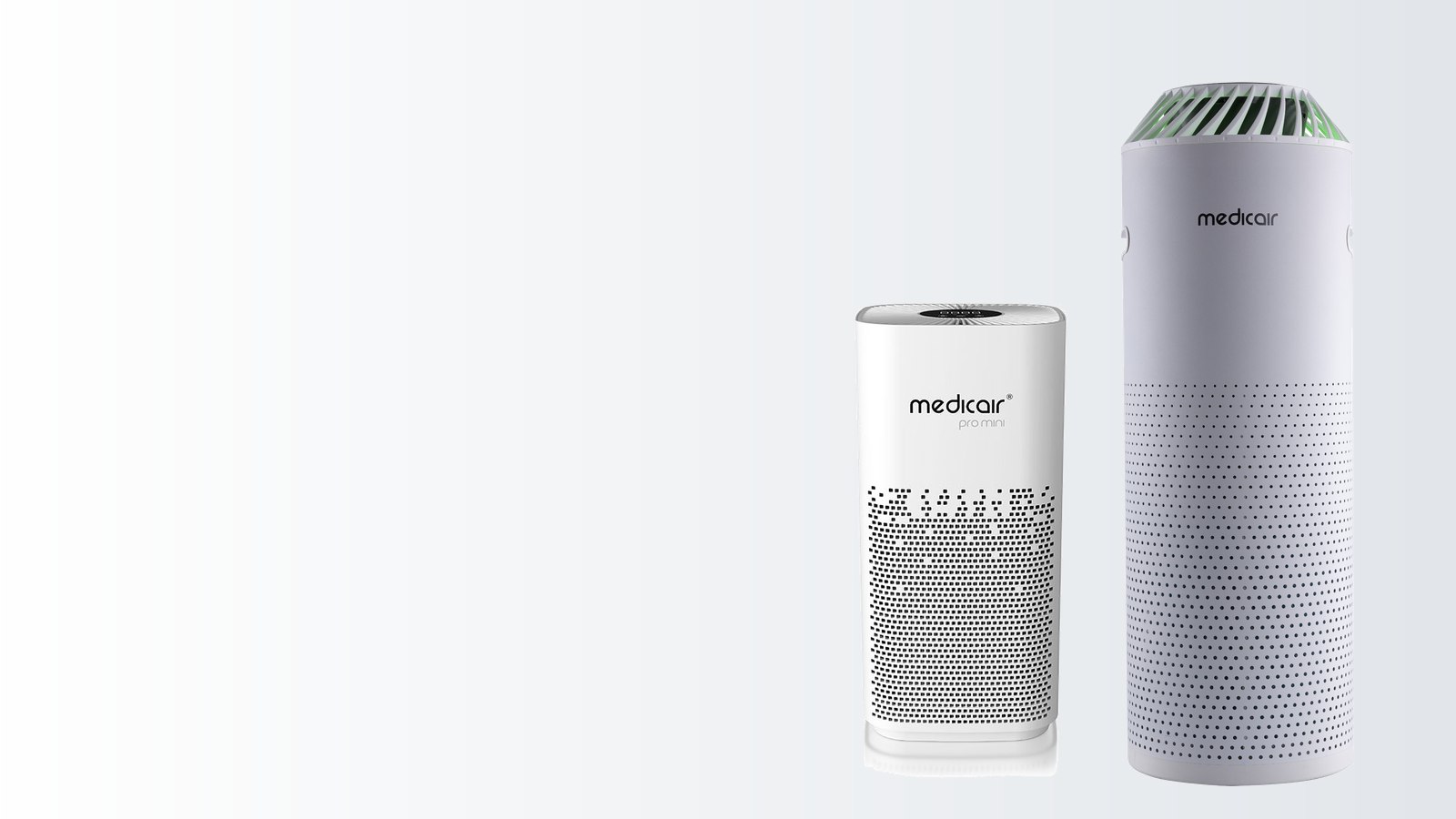
A MedicAir Pro Mini is rated at up to 400 m³/h, so it clears both targets and, more usefully, clears the three-air-change target at a low, quiet setting.
That headroom is the whole point of sizing generously. The smallest unit that technically qualifies is the unit that has to run loud.
Apartments: one connected volume, plus the bedrooms
Apartments are the easier case, because the living, dining and kitchen area is often a single connected volume with no doors between its parts. That connected volume is what you size for, not the total area on the title deed and not each notional room.
- Walk the apartment and note which spaces are genuinely open to each other with no door. That is one zone.
- Measure the zone's length, width and ceiling height and multiply. In a typical two-bedroom Dubai apartment the living and dining zone comes out between 120 and 200 m³.
- Multiply by three to five air changes an hour. A 160 m³ zone needs 480 to 800 m³/h, which is a MedicAir Pro at the lower target and a Pro plus something else at the higher one.
- Treat each bedroom separately, because its door is shut when it matters. A Pro Mini per bedroom you actually sleep in.
- Ignore rooms nobody occupies. A purifier in a spare room is a filter cartridge being consumed for nothing.
Three apartment-specific problems
- The kitchen. An open kitchen puts cooking particulate and odour straight into the living zone. The carbon stage is what addresses the smell, and a unit near, but not inside, the cooking zone will work harder and need its cartridge changed sooner. Extraction over the hob is still the first line of defence and nothing replaces it.
- The corridor and the front door. In a tower, the corridor is a pressurised shared space and the front door is where its air arrives. If a neighbour's cooking or cigarette smoke reaches your hallway, a purifier in the living room will help with what gets in, but the fix is the door seal.
- Balconies during a sandstorm. The instinct is to open up when the weather breaks. On a dusty day, keeping the apartment closed and letting the purifier work is the better move, and the unit will tell you when the reading has come back down.
Villas: why one unit is never the answer
A purifier cleans only the air that passes through it. In an apartment that limitation is mild, because much of the home is one volume. In a villa it is decisive: bedrooms, majlis, study and family rooms sit behind doors that are shut most of the day, and air does not migrate between them in any quantity worth counting. A single machine in a villa hallway is cleaning the hallway.
The pattern that works
| Space | Typical volume | Target | What that needs |
|---|---|---|---|
| Living and dining, open plan | 200 to 280 m³ | 3 air changes per hour | 600 to 840 m³/h: a Pro, or a Pro Max if the ceiling is double height |
| Majlis | 90 to 150 m³ | 3 to 5 per hour | 270 to 750 m³/h depending on the target and how heavily it is used: a Pro |
| Master bedroom | 60 to 80 m³ | 3 to 5 per hour | 180 to 400 m³/h: a Pro Mini |
| Children's bedrooms | 40 to 60 m³ | 5 per hour | 200 to 300 m³/h: a Pro Mini each |
| Double-height entrance | 150 to 300 m³ | Usually not worth treating | Nobody sits in it. Spend the money on rooms people occupy |
| Maid's room, store, spare rooms | Any | None | Leave them out unless somebody lives there |
The realistic answer for a four-bedroom villa where everyone is home is therefore four to six units, not one. The realistic answer for a family that wants one improvement is a Pro in the living space and a Pro Mini in the master bedroom, and adding the rest later.
Double-height and mezzanine spaces
Villa living rooms with a void to the first floor are the single most common sizing mistake we see. The volume is far larger than the floor plan suggests, and warm air rises into the void and takes suspended particulate with it, away from an intake at floor level. A unit sized on the ground-floor footprint will be permanently behind. Measure to the actual ceiling, use the real volume, and expect to need either the Pro Max or two units placed apart rather than one in a corner.
Villa dust is a different category
Sand and construction dust enter a villa at ground level, every time a door opens, and settle on every horizontal surface. That has three practical consequences. Pre-filters load far faster than a European replacement schedule assumes, so clean the intake grille regularly and expect the cartridge to reach the shorter end of its published life. Rooms near the entrance and the garden doors carry the heaviest load. And filtration only treats airborne dust: what has already settled on a shelf has to be wiped. Our dedicated guide to choosing an air purifier for dust in the UAE goes into pre-filter care in more detail.
Bedrooms: where noise beats airflow
A bedroom is the one room where the best-performing unit is often the wrong unit. The specification that matters is: what can this machine deliver at a volume you can sleep through?
- Published sound figures are always the quietest setting. The MedicAir Pro Mini publishes 21 dB at its lowest, and its manual gives 55 dB(A) as the maximum. A machine described as 21 dB is not a 21 dB machine at full output.
- Rated capacity is always the loudest setting. Sizing a bedroom so that the unit meets its target on speed one or two, rather than on maximum, is how you end up with a unit that actually runs all night.
- Sleep mode usually dims or extinguishes the display as well as dropping the fan. Worth checking, because a glowing air quality indicator across a dark bedroom is the other reason units get switched off.
- Place it away from the head of the bed but not against a wall or behind a curtain: intakes need more than 20 cm of clearance or the unit recirculates its own output.
- If the sleeper has dust sensitivity, size for five air changes an hour rather than three, and accept that this means a bigger unit running quietly rather than a small one running hard.
What a home air purifier will not do
This section exists because these four misunderstandings account for most of the disappointed reviews in this category.
It will not dehumidify
Filtration and humidity control are unrelated. If the complaint is condensation on the glass, a musty smell in a closed room, damp patches or clothes that never quite dry, the machine you need is a dehumidifier, not a purifier. PRO TECHnology distributes Stadler Form dehumidifiers for exactly this, and our guide to sizing a dehumidifier for a UAE villa or office covers that side.
It will not ventilate, or reduce carbon dioxide
A purifier recirculates and cleans air that is already in the room. It brings in no outdoor air. That matters most in a closed bedroom overnight, where carbon dioxide rises with two people breathing in a sealed room; no filter removes CO₂, and a unit with a CO₂ sensor reports the problem without solving it. Air conditioning is not ventilation either: it cools and recirculates. The remedy is fresh air, a trickle vent or a mechanical ventilation system.
It will not remediate mould
A HEPA filter captures airborne mould spores that pass through it, and that is worth having. It does nothing about the moisture source producing them, the growth on the wall or the spores in the carpet. If there is visible mould, the sequence is find the water, stop the water, remove the growth, control the humidity, and only then talk about filtration.
It will not make a room odour-proof
The activated carbon stage genuinely reduces airborne odours, VOCs and cooking smells, and a purifier without a meaningful carbon layer will do almost nothing for smell. But carbon adsorbs gases from the air; it cannot reach inside a sofa, a rug or a curtain that has absorbed years of cooking or smoke. And carbon has a finite capacity: once it is loaded it stops working with no visible sign, which is why the replacement interval matters more in a high-odour home.
Putting it together: a specification for a home
One-bedroom apartment
A Pro Mini in the bedroom. For the living zone, measure it: under about 130 m³ a second Pro Mini will do at three air changes an hour, above that it is a Pro.
Two or three-bedroom apartment
A Pro for the connected living and dining volume, a Pro Mini per occupied bedroom. Three units is the common answer.
Four-bedroom villa
A Pro or Pro Max for the living and dining volume, a Pro for the majlis if it is used, a Pro Mini per occupied bedroom. Four to six units.
A villa with a double-height living space
Measure to the real ceiling. Expect a Pro Max, or two units placed apart rather than one, and do not size on the floor plan.
A short checklist before you buy anything
- Measure each room you intend to treat, including ceiling height, and write down the volumes.
- Decide a target: three air changes an hour for general improvement, five where somebody is sensitive or the load is heavy.
- Multiply, and compare against candidate units' rated capacity, remembering that rating is at maximum speed.
- Check the noise range, not the single quiet number, for any room somebody sleeps or concentrates in.
- Confirm there is a real activated carbon stage if odours matter to you, and find out what a replacement cartridge costs and how quickly you can get one locally.
- Ask what happens in year two. A purifier is a consumable-driven machine, and a unit with an exhausted filter is a fan.
If you would rather not do the arithmetic, send it to us. Room dimensions, ceiling heights, which doors stay shut and who is in the house is enough for us to come back with a unit count and a placement plan, and to tell you where a purifier is not the right answer.
Air purifiers for UAE homes: frequently asked questions
How many air purifiers does a villa need?
More than one, and usually four to six for a four-bedroom villa where everyone is home. A purifier cleans only the air that reaches its intake, and a closed bedroom door is a wall. The normal pattern is a larger unit for the connected living and dining volume, one for the majlis if it is used, and a compact unit in each occupied bedroom. Rooms nobody uses are left out.
What size air purifier do I need for my apartment?
Measure the connected living, dining and kitchen volume by multiplying length, width and ceiling height, then multiply by three to five air changes an hour. A typical Dubai two-bedroom living zone of about 160 cubic metres needs 480 to 800 cubic metres per hour of clean air. Bedrooms are sized separately because their doors are closed, and a compact unit is normally enough for each.
Does ceiling height matter when choosing an air purifier?
It matters more than anything else and most coverage claims ignore it. A 40 square metre room with a 2.9 metre ceiling holds 116 cubic metres of air; the same room under a 4.5 metre villa ceiling holds 180 cubic metres. A coverage figure quoted in square metres, with no ceiling height stated, cannot be checked. Always work from volume.
Which air purifier is quietest for a bedroom?
Compare the whole published range rather than the headline figure, because every manufacturer quotes its quietest setting. The MedicAir Pro Mini publishes 21 dB at its lowest and its manual states 55 dB(A) at maximum. The practical trick is to size the room so that the unit meets its target at a low speed, which means choosing a slightly larger unit than the minimum that qualifies, not a smaller one.
Will an air purifier help with dust in a UAE villa?
Yes for airborne dust, which is what the HEPA stage captures, and it is the improvement most households notice first. Two caveats. Dust here loads the pre-filter much faster than European replacement intervals assume, so clean the intake grille regularly and budget for cartridges. And filtration treats air, not surfaces: dust that has already settled still has to be wiped.
Can an air purifier reduce humidity in my home?
No. Purification and dehumidification are different machines doing different jobs. If the problem is condensation on the glass, a musty smell, damp patches or laundry that will not dry, you need a dehumidifier. If the problem is dust, pollen, cooking smells or general air quality, you need a purifier. Some households need both, and they do not substitute for each other.
Should I run an air purifier all day or only at night?
Continuously in the rooms that matter, on an automatic mode if the unit has one. Automatic modes such as MedicAir's ReAKT raise the fan when the sensors detect a rise and drop it again afterwards, which uses far less filter life than running at a fixed high speed and means the unit responds to a real event like cooking or a dusty day. A purifier switched on for an hour in a room that has been closed all day is starting from scratch every time.
Do I need HEPA at home, or is a cheaper filter enough?
A genuine HEPA stage graded under a stated standard is what captures fine particulate, and in this region fine outdoor dust is the main thing you are trying to remove, so it is worth insisting on. Under EN 1822, H13 captures at least 99.95% and H14 at least 99.995% at the most penetrating particle size. Be wary of unattributed percentages: a figure with no standard behind it is not a specification.
Where should I put an air purifier in a room?
Somewhere the air can actually reach it: more than 20 centimetres clear of walls and furniture, not under a desk, not behind a curtain and not in a cupboard. A unit pushed into a corner recirculates its own output instead of the room's air. In a long or subdivided room, two units placed apart outperform one larger unit in a corner, because air that never reaches an intake never gets cleaned.
اختيار جهاز تنقية الهواء للفلل والشقق في الإمارات
تُحدّد السعة المطلوبة من حجم الغرفة لا من مساحتها: يُضرب الطول في العرض في ارتفاع السقف، ثم يُضرب الناتج في عدد تغييرات الهواء المستهدفة في الساعة، وهي عادة ثلاث إلى خمس في المنازل. وارتفاع السقف مهم للغاية في فلل الإمارات، إذ إن غرفة بمساحة 40 مترًا مربعًا تحتوي 116 مترًا مكعّبًا من الهواء عند سقف 2.9 متر، و180 مترًا مكعّبًا عند سقف 4.5 متر.
الفيلا تحتاج إلى أكثر من جهاز واحد، لأن الجهاز لا ينقّي إلا الهواء الذي يصل إلى مدخله، وباب الغرفة المغلق يعمل عمل الجدار. النمط المعتاد: جهاز أكبر لصالة المعيشة والمجلس، وجهاز صغير في كل غرفة نوم مستخدمة.
في غرفة النوم، مستوى الصوت أهم من معدل التدفّق، لأن الجهاز الذي يُطفأ لا ينفع. ويُنصح باختيار جهاز أكبر قليلاً مما تحتاجه الغرفة حتى يعمل على سرعة منخفضة هادئة.
وأخيرًا: جهاز التنقية لا يخفّض الرطوبة ولا يوفّر التهوية ولا يعالج مصدر العفن. للاستشارة وحساب السعة المناسبة لكل غرفة: 5501 343 4 971+ أو sales@protech.ae.
Sources and how we checked them
The arithmetic in this guide is standard air-change methodology and is set out so you can check it. Air change targets are attributed to the body that published them, and where a figure is a manufacturer's own recommendation rather than a standard or a public health position, we say so. Product figures are from the MedicAir documents supplied with the units sold in the UAE and from the manufacturer's website, read on 27 September 2026. This is procurement guidance, not medical advice.
- US CDC, ventilation in buildings: the 5 air changes per hour target, published as a voluntary recommendation
- US EPA, Guide to Air Cleaners in the Home: clean air delivery rate and why it is not the same as rated airflow
- World Health Organization: air filters do not provide ventilation and do not replace other ventilation methods
- MedicAir Pro Mini user manual, IFU_EM_REV1.1, April 2022
- MedicAir product specifications for the Pro Mini, Pro and Pro Max
Send us the rooms and we will do the arithmetic
For each room we need length, width and ceiling height, what it is used for, and whether the door is normally open or shut. Tell us if anyone in the house has dust sensitivity and whether noise at night is a concern. We will come back with how many units the home needs, which model per room and where to put them, and we will say plainly if the problem you are describing is humidity or ventilation rather than filtration. Call +971 4 343 5501 or email sales@protech.ae.