
UAE Data Protection Law (PDPL) for IT Teams: Where It Stands in 2026 and the Controls That Meet It
Published · PRO TECHnology Enterprise IT
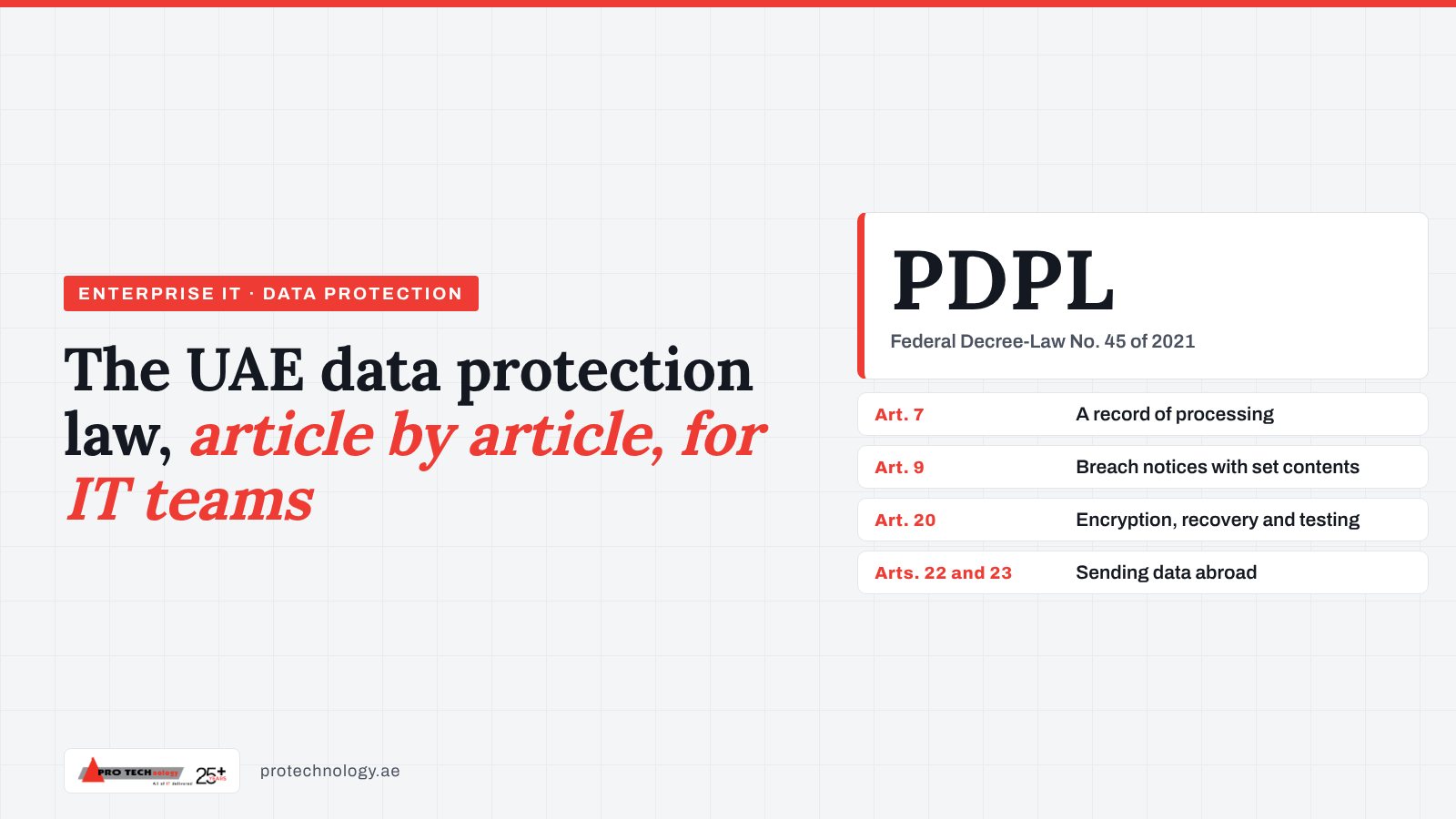
The UAE Personal Data Protection Law, Federal Decree-Law No. 45 of 2021, has been in force since 2 January 2022. Its executive regulations, which set the breach-reporting period and start the six-month window to comply, were still not on the official legislation portal on 19 November 2026. The duties that land on IT are already in the law itself: security measures including encryption, a record of processing, breach notices with set contents and rules on sending data abroad. This guide maps each one to the systems that meet it.
- The law
- Federal Decree-Law No. 45 of 2021, in force since 2 January 2022
- Executive regulations
- Not published: the official UAE Legislation portal listed none on 19 November 2026
- Regulator
- The UAE Data Office, whose functions moved into the new Artificial Intelligence and Data Authority announced on 14 June 2026
- Outside its scope
- Free zones with their own data law, such as DIFC and ADGM; government data; health and banking data covered by their own laws
Key takeaways
- The UAE PDPL is in force, but the executive regulations that start the six-month compliance window in Article 29, and set details such as the breach-reporting period, have not been published.
- Work out which regime applies before planning controls: the mainland and most free zones follow the PDPL, DIFC and ADGM have their own data protection laws, and health data follows Federal Law No. 2 of 2019, which keeps it in the UAE unless the health authority allows otherwise.
- Article 20 lists the security measures: encryption and pseudonymisation, systems that stay confidential and reliable, timely recovery of data after a failure, and regular testing of those measures.
- A breach notice under Article 9 must describe the nature, causes and approximate scale of the breach, its likely effects and the fixes, so the inventory, logs and remote-wipe records have to exist before the incident.
- The controls the law points to are worth having whichever way the regulations land: an inventory, encryption, removable media control, patching, tested backups, secure erasure and knowing where vendors process data.
Where the UAE PDPL stands in November 2026
The Personal Data Protection Law was issued as Federal Decree-Law No. 45 of 2021 and came into force on 2 January 2022 (Article 31). Article 28 asked for executive regulations within six months. Article 29 then gives controllers and processors no more than six months from the issue of those regulations to bring their processing into line, a period the Cabinet may extend by a similar period (UAE Legislation).
Those regulations had still not been issued on 19 November 2026. The law's page on the official UAE Legislation portal showed no update since 20 September 2021, and its list of related legislation held no executive regulation. Al Tamimi & Company also wrote in September 2026 that the regulations had not yet been issued (Al Tamimi). Several web pages state a regulation number or a 2026 issue date. Before you plan around one, check that it is listed on the official portal.
The regulator has also changed. On 14 June 2026 the UAE Cabinet announced an Artificial Intelligence and Data Authority, chaired by Omar Sultan Al Olama. It brings together the functions of the Office of Artificial Intelligence, Digital Economy and Remote Work Applications, the Digital Government Sector at the TDRA and the UAE Data Office, the body the PDPL names to receive breach notices (UAE Cabinet; Gulf News).
Fines are a separate question. The decree-law does not set amounts itself: Article 26 leaves the list of violations and the administrative penalties to a Cabinet decision. Treat any fine figure quoted for a mainland PDPL breach with care unless it names that decision.
Our reading. The detail that is missing is mostly about timing and procedure. What the law asks IT to build, secure processing, a record of it, a breach process and control over transfers, is already in the text. Building those controls now means the six months, once they start, go on checking rather than building.
Which data protection law applies to your organisation?
Under Article 2 the PDPL covers the processing of personal data of people who live or do business in the UAE, by controllers and processors established in the UAE, and by those outside the UAE who process the data of people inside it. It excludes government data and government entities, data held by security and judicial authorities, processing by individuals for personal purposes, health and banking data that have their own laws, and companies in free zones that have their own data protection legislation (UAE Legislation; Clyde & Co).
| Where the data sits | Main rule | What it means for IT |
|---|---|---|
| Mainland companies, and free zones without their own data law | The PDPL, Federal Decree-Law No. 45 of 2021 | This guide applies |
| Dubai International Financial Centre (DIFC) | DIFC Data Protection Law, DIFC Law No. 5 of 2020 | A separate law; follow the DIFC rules for DIFC entities |
| Abu Dhabi Global Market (ADGM) | ADGM Data Protection Regulations 2021 | A separate regime; follow the ADGM rules for ADGM entities |
| Health data from health services in the UAE | Federal Law No. 2 of 2019 on ICT in health fields | Stored and processed inside the UAE; Article 13 allows it outside only where the health authority, in coordination with the Ministry, issues a resolution |
| Banking and credit data | The laws and regulations that already govern it | Sector rules come first; check with your compliance team |
| Government data and government entities | Outside the PDPL | Outside this guide; government rules apply |
A group with a mainland company and a DIFC branch, or a clinic group that also sells products online, may have datasets under different regimes. Map each system to the regime that governs its data, and ask your legal adviser to confirm the map. This page is general guidance, not legal advice.
What the PDPL asks of IT, article by article
Most of the law is about lawful grounds, consent and individuals' rights, which sit with your data protection officer or legal team. The articles below are the ones that turn into systems, settings and evidence that IT owns.
| Article | What it requires | IT controls that answer it |
|---|---|---|
| Article 5: processing rules | Process for a specific and clear purpose, limit it to what is necessary, keep data accurate and secure, and do not keep it once the purpose is spent unless it is anonymised | Retention settings in mail, file shares and backups; deletion and secure erasure at end of life |
| Article 7: controller duties | Security measures including pseudonymisation; default settings that limit processing to its purpose; a record of processing that lists the data categories, the people with access, the processing times, limits and scope, transfers abroad and the security measures | Role-based access groups; a device, software and data-store inventory; a written security baseline |
| Article 8: processor duties | Follow the controller's instructions, protect the data, erase it when the processing period ends or once it is handed back to the controller, and keep a record of processing | Contracts, data-location answers and exit plans for cloud, hosting and support vendors |
| Article 9: breach notice | Notify the regulator on becoming aware of a breach that would prejudice the privacy, confidentiality and security of data, within the period the executive regulations set, describing its nature, form, causes and approximate number of records, the DPO's details, the likely effects and the corrective measures; tell the people affected where their privacy is prejudiced; processors tell the controller as soon as they know | Central logs, an accurate device inventory, remote lock and wipe with an audit trail, and an incident playbook |
| Article 10: data protection officer | A DPO where processing is high risk because of new technology or volume, involves systematic and comprehensive assessment of sensitive data, including profiling and automated processing, or covers large volumes of sensitive data | IT gives the DPO system maps, access lists and evidence |
| Articles 13 to 18: individuals' rights | Information, portability, correction or erasure, restriction, and objection, including to automated processing | Knowing which systems hold each person's data, so it can be found, exported, corrected or deleted |
| Article 20: security of processing | Encryption and pseudonymisation; measures for the continuous confidentiality, safety, accuracy and flexibility of systems; timely retrieval of and access to data after any actual or technical failure; testing and evaluation of the measures | Disk and media encryption, device management, patching, tested backups and restores |
| Article 21: impact assessment | An assessment before processing that is high risk because of modern technology, including automated processing and profiling with legal effects, and large volumes of sensitive data | Review new platforms, such as AI tools, HR systems and camera analytics, before rollout |
| Articles 22 and 23: transfers abroad | Allowed, in cases approved by the Data Office, to countries with data protection legislation and a judicial or regulatory authority, or under a UAE agreement; otherwise on listed grounds such as a contract binding the recipient to the law's measures or the person's explicit consent | Know where each SaaS service, backup and vendor support team processes data |
Summarised from the official English translation on the UAE Legislation portal, read on 19 November 2026. The Arabic text prevails.
The controls, one by one
Know where personal data lives
The record of processing in Article 7, every rights request and every breach notice start from the same question: which systems and devices hold the data? A device management platform reports each computer's hardware, installed software, encryption status and last check-in, which gives you the device half of that record. See how to track company devices and installed software and FileWave unified endpoint management.
Encrypt laptops, phones and removable media
Article 20 names encryption first. In practice that means full-disk encryption on every company laptop and desktop, enforced through device management so you can prove it, passcodes and encryption on managed phones, and hardware-encrypted drives for any data that has to travel on removable media. Our guides compare self-encrypting drives and BitLocker, cover USB data loss prevention and explain which FIPS certification a sector rule may ask for.
Be ready to lock or wipe a lost device
A lost or stolen laptop is a breach question until you can show the data was protected. With the device enrolled in management you can lock, locate or erase it, and the record of that action is part of the evidence the Article 9 notice draws on. Our lost or stolen device guide sets out the steps for each platform.
Patch, and keep the reports
Article 20 asks for systems that stay confidential, safe and accurate, which depends on current software. Patch operating systems and applications on a schedule, and keep the compliance reports, because an auditor or a regulator will ask what was installed and when. See patch management for Windows, Mac, iPhone and iPad.
Back up, and test the restore
Article 20 asks for timely retrieval of and access to data after a failure, and for testing of the measures. A backup nobody has restored is an assumption, not a control. Keep at least one copy that ransomware cannot reach, test restores on a schedule and write down how long they take. See data backup and disaster recovery for UAE businesses.
Erase data properly at end of life
Article 5 says data should not be kept once its purpose is spent, and Article 8 expects processors to erase it when the processing period ends. Drives leaving the building, for resale, repair or recycling, need verified erasure or destruction with a record per drive. See secure data erasure before a drive leaves the building.
Know where your vendors process data
SaaS platforms, cloud backups and remote vendor support can all move personal data abroad, which Articles 22 and 23 control. Ask each vendor where data, backups and logs are stored and from which countries its support staff connect, and keep the answers with the contract. Our article on what an on-premises system still sends out shows the questions in detail.
Breach response: what the notice must contain
Article 9 sets the contents of the notice to the regulator: the nature, form and causes of the breach, the approximate number of records, the data protection officer's details, the likely effects, the corrective measures taken or proposed, and supporting documents. The period for sending it was left to the executive regulations, so the law gives no fixed number of hours. Plan to have the facts in hours, not days. Saudi Arabia has its own law and its own deadline; see our Saudi PDPL and NCA ECC guide.
- Contain. Lock or wipe affected devices, disable compromised accounts and preserve the logs before anything is rebuilt.
- Scope. List the systems involved, the categories of personal data they held and an approximate number of records.
- Cause. Record how the breach happened and when it was found.
- Effects and fixes. Write down the likely effect on the people concerned and what has been done or is planned.
- Notify. Your data protection officer or legal adviser decides on the notice to the regulator and to the people affected; IT supplies the evidence.
- Keep the file. Store the timeline, logs and decisions together, so the record can be produced later.
Hypothetical example. A sales manager's laptop is stolen from a car in Dubai. It is enrolled in device management, its drive is encrypted and the management console shows a remote lock sent within the hour. The data protection officer can state what was lost, which customer records the laptop could reach, that the data was encrypted and what was done, which is the substance Article 9 asks for. Without the inventory and the encryption record, the same notice would rest on guesses.
A 90-day plan for IT
This is a practical order of work, not a legal deadline. It assumes a data protection officer or legal adviser owns the legal side.
- Days 1 to 30: map. Inventory devices, applications and data stores; mark which hold personal or sensitive data; list every vendor that stores or can reach that data and where it does so.
- Days 31 to 60: close the gaps. Enforce disk encryption on laptops and phones, issue encrypted drives for removable media and block the rest, turn on remote lock and wipe, set patch baselines and set retention on mail, shares and backups.
- Days 61 to 90: prove it. Run a restore test, run a breach exercise against the six steps above, and help the data protection officer write the Article 7 record of processing from the inventory.
Where PRO TECHnology helps, and where it does not
We work with the makers of two of the tools behind these controls. FileWave, whose partnership with us covers sales, deployment and local support across the Middle East, handles device inventory, encryption enforcement, patching and remote lock and wipe (FileWave, July 2026). Kanguru, which lists us for the UAE, the other GCC countries and Jordan, makes hardware-encrypted drives with central management, and drive duplicators that securely erase drives (Kanguru).
We are not lawyers. Which grounds you rely on, what your privacy notices say and whether to notify the regulator are decisions for your data protection officer or legal adviser. Our part is the systems and the evidence they produce.
Sources
The decree-law and Federal Law No. 2 of 2019 were read on the UAE Legislation portal on 19 November 2026; the Arabic text prevails. The Cabinet announcement, legal commentary and manufacturer pages were checked on the same day. Laws are summarised, not quoted in full, and this page is general guidance, not legal advice. We will update it when the executive regulations are published.
- UAE Legislation: Federal Decree-Law No. 45 of 2021 Concerning the Protection of Personal Data
- UAE Legislation: Federal Law No. 2 of 2019 on the use of ICT in health fields
- UAE Cabinet: Mohammed bin Rashid approves establishing Artificial Intelligence and Data Authority (14 June 2026)
- Gulf News: UAE creates federal authority for artificial intelligence and data (14 June 2026)
- Al Tamimi & Company: UAE establishes new federal authority for AI and data (September 2026)
- DIFC: Data Protection Law, DIFC Law No. 5 of 2020
- ADGM: Data Protection Regulations 2021
- Clyde & Co: UAE issues landmark personal data protection law (November 2021)
- FileWave: PRO TECHnology and FileWave expand unified endpoint management across the Middle East (July 2026)
- Kanguru: where to buy, Europe, Middle East and Africa
Frequently asked questions
Is the UAE PDPL in force?
Yes. Federal Decree-Law No. 45 of 2021 has been in force since 2 January 2022. Its executive regulations had not been published as of 19 November 2026, and Article 29 gives organisations no more than six months from their issue to comply, a period the Cabinet may extend.
Can a company be fined under the UAE PDPL today?
The decree-law does not set fine amounts. Article 26 leaves the violations and administrative penalties to a Cabinet decision, which we did not find on the official legislation portal on 19 November 2026. Sector regulators and other laws can still apply, so ask your legal adviser about your position.
Does the UAE PDPL apply in DIFC and ADGM?
No. Free zones with their own data protection legislation are outside it. DIFC entities follow the DIFC Data Protection Law, DIFC Law No. 5 of 2020, and ADGM entities follow the ADGM Data Protection Regulations 2021.
Does the UAE PDPL require encryption?
Article 20 names encryption and pseudonymisation among the measures controllers and processors must take, alongside measures that keep systems confidential and reliable, recover data in time after a failure and test the measures. It does not prescribe a product or a certification.
Does the UAE PDPL set a number of hours for breach notification?
Not yet. Article 9 requires the controller to notify the regulator on becoming aware of a breach that would prejudice the privacy, confidentiality and security of data, within the period the executive regulations set. Until they are published there is no fixed number of hours in the law, so prepare to report as soon as the facts are known.
Can personal data be stored in a cloud service outside the UAE?
Articles 22 and 23 allow transfers, in cases approved by the Data Office, to countries with data protection legislation and a judicial or regulatory authority, or under a UAE agreement, and otherwise on listed grounds such as a contract binding the recipient to the law's measures or the person's explicit consent. Health data has a stricter rule that keeps it in the UAE unless the health authority allows otherwise.
Do we need a data protection officer under the UAE PDPL?
Article 10 requires one where processing is high risk because of new technology or volume, involves systematic and comprehensive assessment of sensitive data, or covers large volumes of sensitive data. Whether or not one is required, Article 7 still expects the controller to keep a record of processing.
Plan the technical controls with us
Tell us how many devices you run, which systems hold personal data and which regime you report under. We will propose the device management and encryption tools that close the gaps, and a pilot, from Dubai.