El Niño and Hotter GCC Days: How to Keep Indoor Humidity in Check with Stadler Form
Published · PRO TECHnology Distribution
NOAA declared El Niño in June 2026 and expects a strong to very strong event through early 2027. Here is what that does and does not mean for the Gulf, why humidity is the indoor problem either way, and how Stadler Form Lukas Pro, Lukas and Albert deal with it.
- El Niño status
- NOAA El Niño Advisory, in force since 11 June 2026
- NOAA forecast
- Strong to very strong through January to March 2027
- Indoor target
- 40–60% relative humidity
- Buy in the UAE
- stadlerform.ae
Key takeaways
- El Niño is under way: NOAA has had an El Niño Advisory in force since 11 June 2026 and on 8 October 2026 forecast a strong to very strong event through January to March 2027.
- Its global warming effect comes later: the WMO says it is usually strongest in the year after El Niño develops, and a WMO and Met Office outlook names 2027 as a likely record-warm year.
- In the GCC, research links El Niño most consistently with wetter winters over much of the Arabian Peninsula, not with more humid summers; a 2025 study found Gulf summer sea temperatures tend to run cooler in El Niño years.
- Humidity is the indoor problem on the Gulf coast every summer, El Niño or not: aim for the commonly recommended 40–60% band and measure it with a hygrometer.
- Stadler Form Lukas Pro (up to 50 L a day, rooms to 175 m², HEPA purifier built in) suits big rooms with damp and dust; Lukas suits rooms to 70 m² with Wi-Fi; Albert is the quiet bedroom choice.
- Buy in the UAE at stadlerform.ae, the official store; across the UAE, Saudi Arabia, Bahrain, Kuwait and Oman, PRO TECHnology is Stadler Form’s authorised exclusive distributor.
Is El Niño happening in 2026?
Yes. NOAA’s Climate Prediction Center (CPC) issued an El Niño Advisory on 11 June 2026, saying El Niño conditions had developed over the previous month, and the advisory was still in force in its 8 October 2026 discussion. That discussion says El Niño continues to strengthen, with a strong to very strong event likely through January to March 2027, a chance it puts above 83%.
The World Meteorological Organization (WMO) agrees. Its August 2026 update described El Niño as firmly established and gave a probability of nearly 100% that it lasts through December 2026 to February 2027, and its 3 September statement called that update the most unequivocal it had ever issued.
| Measure | Latest reading | Source and date |
|---|---|---|
| NOAA alert status | El Niño Advisory, in force since 11 June 2026 | NOAA CPC, 8 Oct 2026 |
| Niño-3.4 index, September 2026 average | +2.1 °C (CPC’s relative index) | NOAA CPC, 8 Oct 2026 |
| Weekly relative Niño-3.4, week to 11 October | +2.81 °C, the highest in the Bureau’s weekly record, which starts in 2008 | Australian Bureau of Meteorology, 13 Oct 2026 |
| Chance El Niño lasts through December to February | 100% | NOAA CPC probabilities, issued Oct 2026 |
| Chance of a very strong event (index +2.0 °C or more) in November to January | 96% | NOAA CPC strength probabilities, Oct 2026 |
| Chance of the strongest El Niño since records began in 1950, October to December | 83% | NOAA CPC, 8 Oct 2026 |
| When neutral conditions are expected back | Favoured from April to June 2027 (54%) | NOAA CPC probabilities, Oct 2026 |
Since early 2026 NOAA classifies El Niño with a relative index (RONI), which removes the warming of the tropical oceans as a whole, so its numbers run lower than the traditional Niño-3.4 figures quoted elsewhere. A record-strength event is forecast, not yet observed: the three-month value for July to September 2026 was 1.7, against a previous peak of 2.4 in 1982–83.
El Niño, La Niña and the terms used in this guide
- El Niño
- The warm phase of a natural cycle in the tropical Pacific. Every few years the ocean surface in the central and eastern equatorial Pacific runs well above normal, and the shift in where the sea heats the air changes weather patterns far away. The WMO stresses that El Niño is natural and not caused by climate change, although it now plays out in a warmer climate.
- La Niña
- The cool phase of the same cycle, with below-normal sea temperatures in the same part of the Pacific.
- ENSO and Niño-3.4
- ENSO stands for El Niño–Southern Oscillation, the cycle as a whole. Forecasters track it with the sea temperature of the Niño-3.4 region of the equatorial Pacific.
- Relative humidity (RH)
- How much water vapour the air holds, as a percentage of the most it could hold at that temperature. It is the number a hygrometer and a dehumidifier display.
- Dew point
- The temperature at which air becomes saturated. Any surface colder than the dew point of the air touching it collects condensation.
- Hygrostat
- The humidity switch in a dehumidifier. You set a target and the unit stops when the room reaches it.
- CADR
- Clean air delivery rate: how much filtered air a purifier delivers, in cubic metres an hour. It sets the size of room a purifier can cover.
What does El Niño mean for the UAE and the rest of the GCC?
Expect a warmer world into 2027 and, on the evidence so far, better odds of a wet winter and spring; do not expect El Niño itself to make Gulf summers more humid. Here is what is established and what is not.
A hotter world into 2027
El Niño warms the planet on a delay. The WMO says its effect on global temperature can be most pronounced in the year after the event develops. That is what happened last time: the El Niño that formed in 2023 was followed by 2024, the warmest year on record at about 1.55 °C above the 1850–1900 average. In May 2026 a WMO and UK Met Office outlook said the El Niño predicted for late 2026 raises the chance that 2027 is the next record-breaking year, and put the chance that one year between 2026 and 2030 beats 2024 at 86%.
The warm run has already begun. Copernicus reports that August 2026 tied July 2023 as the warmest month ever recorded, and that September 2026 was 1.63 °C above pre-industrial levels, part of a new run of months above 1.5 °C that it expects to last into 2027.
Wetter winters are the clearest regional signal
For the Arabian Peninsula, the best-documented El Niño effect is on winter rain rather than summer heat. Modelling by researchers at the Masdar Institute and NYU Abu Dhabi found that the peninsula tends to receive more rainfall in El Niño winters, carried in by moisture from the surrounding seas. A KAUST study of 39 stations from 1951 to 2010 found that the link has shifted over the decades: El Niño winters once meant rain deficits in the south, while in recent decades they have brought above-average rain to south-western Yemen and the centre of the peninsula, and winter rain in the east has risen by 25 to 30% over the long term. In summer the effect is reversed in the south-west, where rain over Yemen and south-western Saudi Arabia tends to be lower in El Niño years.
What the UAE’s National Centre of Meteorology expects
As reported by Gulf News on 7 September 2026, the National Centre of Meteorology (NCM) expects El Niño to persist through February 2027, with its effects on the UAE running into April: near to above-average temperatures and rainfall, and the potential for significant weather. For the centre’s current outlook, check ncm.gov.ae.
For homes that matters indoors as well as outdoors. Rainy spells bring damp air in through every door that opens, wet walls and floors take time to dry, and laundry moves inside. Stadler Form UAE explains why indoor humidity rises after rain in the UAE.
What El Niño does not do to Gulf summers
No study we found shows El Niño making Gulf summers more humid, and one recent study points the other way. Researchers at NYU Abu Dhabi, writing in Ocean Science in December 2025 about the Arabian Gulf, which has the highest average summer sea temperatures of any sea, found that El Niño summers tend to bring stronger shamal winds and slightly cooler water. The Gulf’s most extreme summers, including 1998, 2010 and 2016, came under La Niña, when weaker winds let moist, warm air build up over the water.
So the practical point is this: a humid Gulf summer is the norm, not an El Niño event. The El Niño months ahead add a warmer global backdrop and the chance of a wet winter, and the answer indoors, keeping humidity in check, is the same whichever way the season turns.
Why humidity, not only heat, is the indoor problem in Gulf summers
Along the Gulf coast the air carries a great deal of water, and that water follows people indoors. Heat is what the forecast reports; humidity is what makes a home feel clammy, leaves a musty smell in a wardrobe and puts condensation on cold glass.
Warmer air can carry more water. NOAA Climate.gov puts it at about 7% more water vapour for every 1 °C of warming, which is why a warmer climate is a humidity question as well as a heat question.
The Gulf sits at the extreme end. A study in Science Advances in 2020 found that two weather stations had already recorded wet-bulb temperatures, a measure that combines heat and humidity, above 35 °C, mostly for an hour or two at a time; that the hottest cells in the global weather record it analysed all lay in the Gulf area; and that the Gulf’s monthly mean sea temperature reached 35.2 °C in 2017. Those are outdoor extremes, but they show how much water the summer air here can carry to every door and vent.
Does air conditioning not take care of it?
Air conditioning can remove moisture as part of cooling but may not maintain the desired indoor relative humidity under every operating condition. A cooling system is controlled by a thermostat, which watches temperature. A dehumidifier with a hygrostat watches relative humidity and switches itself off when the room reaches the level you set, so it works on the problem directly. Stadler Form UAE goes into more detail on whether AC removes humidity.
Building scientists go further. The US EPA’s moisture control guidance explains that an oversized cooling system meets the temperature so quickly that it switches off before its coil has condensed enough water, and concludes that oversized systems “do not solve humidity control problems”. In the UAE, DEWA advises keeping the thermostat at 24 °C or higher, and US Department of Energy research notes that people accept a warmer summer set point more readily when the air is drier. Holding humidity down is part of being comfortable at 24 °C.
Where moisture builds up in a GCC home
- Rooms that are closed for long periods: guest bedrooms, storerooms, a villa shut up while the family travels for the summer.
- Laundry rooms and any room where washing is dried indoors.
- Ground-floor rooms and basements, and homes close to the sea, the creek or a marina.
- Cold surfaces in air-conditioned rooms, such as glass and the outer faces of chilled ducts, which can sit below the dew point of the air that reaches them.
What indoor humidity should a home in the UAE or the GCC aim for?
Aim for the commonly recommended 40–60% band, and measure before you buy anything. Holding humidity in that band helps limit the conditions for damp and mould.
The US Environmental Protection Agency’s advice points the same way: keep indoor humidity below 60%, and ideally between 30 and 50%, where you can. In a Gulf home the line that matters most is 60%; staying under it, inside the 40–60% band, is a realistic everyday target.
A hygrometer costs little and tells you whether you have a problem at all. Check it in the morning and in the evening for a week, in the room you care about, with the air conditioning running as it normally does. If the reading sits above 60% for long stretches, a dehumidifier will help; if it sits inside the band, you may not need one.
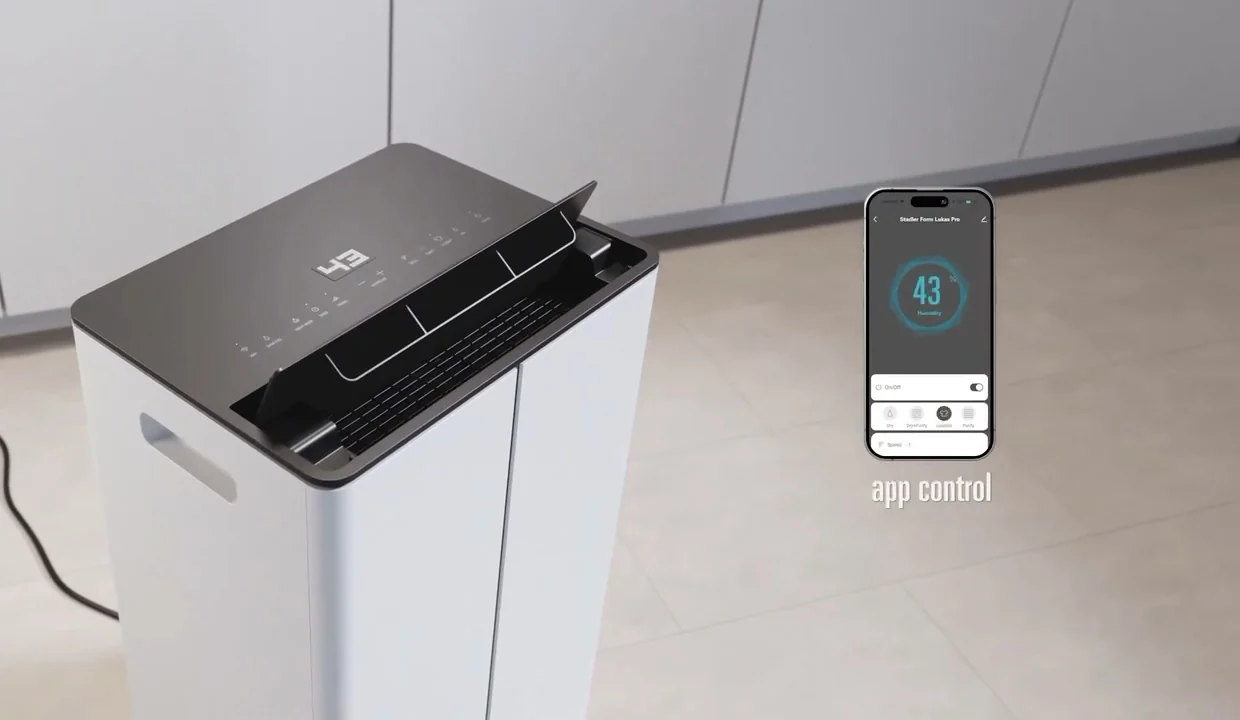
All three Stadler Form dehumidifiers covered here have a digital hygrostat that you can set anywhere from 30% to 80% relative humidity, or to continuous running. At the target it switches off, then runs its fan briefly at intervals to re-check the room and starts again when humidity climbs. Setting 50% puts you in the middle of the band.
How a compressor dehumidifier pulls water out of humid air
A compressor dehumidifier draws room air over a cold coil, the water vapour condenses on the coil, and the water drips into a tank or out through a hose. The drier air then passes back into the room.
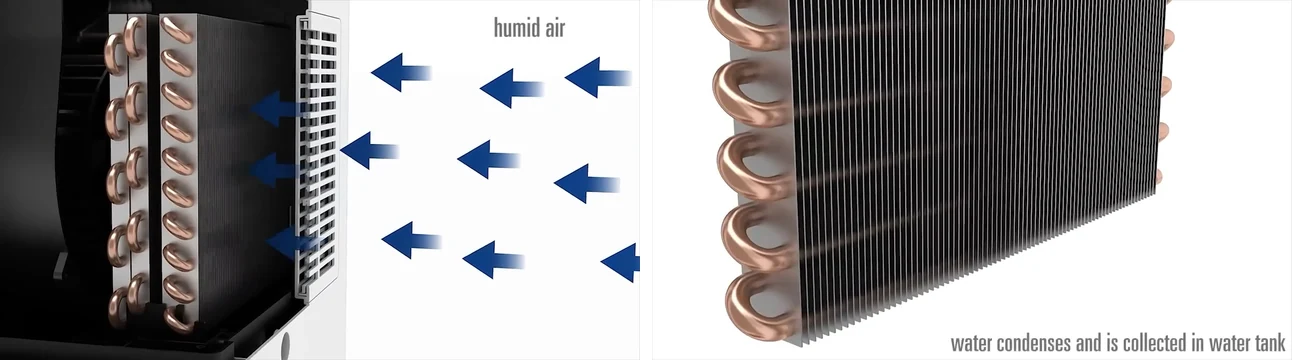
This is why output depends on the room. Stadler Form rates Lukas Pro at up to 50 litres a day and Lukas and Albert at up to 20 litres a day, and those maximums apply only in warm, damp air, once a room reaches roughly 22 °C and 70% humidity. A cool, already drier air-conditioned room fills the tank more slowly. That is normal, and a sign the room is closer to where you want it.
Where does the water go? Into a tank that stops the unit when full (Lukas Pro holds 5.2 L, Lukas 4.2 L and Albert 4.6 L), or straight down a drain through the hose supplied with each one, a metre long for Lukas Pro and Lukas and two metres for Albert. The water flows by gravity, so lead the hose downhill to the drain.
Lukas Pro, Lukas or Albert: which Stadler Form dehumidifier fits which room?
Choose by room size first, then by what else the room needs: Stadler Form Lukas Pro for large living spaces and for rooms that also need air purification, Lukas for rooms up to 70 m² where Wi-Fi and laundry drying matter, and Albert for bedrooms where a low sound level matters most.
| The situation at home | Model to look at | Why it fits |
|---|---|---|
| Open-plan villa living area or majlis of up to 175 m² | Lukas Pro | The highest capacity in Stadler Form’s current dehumidifier range: 50 L/day at most, for spaces to 175 m² |
| Damp air and dust in the same room | Lukas Pro | Dehumidifier and HEPA purifier in one body, with a particle sensor light on the front |
| Bedroom where noise matters | Albert | From 33 dB(A) at its lowest setting, the lowest minimum of the Stadler Form dehumidifiers sold on stadlerform.ae |
| Apartment room up to 70 m² that you want to watch from your phone | Lukas | Shows the humidity in the app; button lock for children; laundry setting |
| Washing dried indoors through the humid months | Lukas or Lukas Pro | Both have a laundry mode that runs at full power with the swing outlet |
| Villa closed while the family travels | Lukas or Lukas Pro with the hose fitted | Gravity drain to a floor drain, and the app lets you check on the room from abroad |
| Room up to 70 m² that may later need purifying | Lukas | Takes the optional H11 HEPA filter (L-032) when you need it |
All figures are Stadler Form’s. Capacities are maximums, and the room figures are worked out for a ceiling of about two and a half metres; measure a double-height room by its volume instead.
Stadler Form Lukas Pro: the dehumidifier plus air purifier for large rooms
Stadler Form Lukas Pro is a compressor dehumidifier and a HEPA air purifier in one body, and the two functions run together or separately. Stadler Form rates it at up to 50 litres a day, an output it reaches only once a room is at 22 °C or warmer with humidity at 70% or higher, and sizes it for spaces of up to 175 m². With both modes on, the compressor stops when the room reaches the humidity you set and the purifier keeps running.
On top of that come a front light driven by the particle sensor (white for good air, then yellow, then red), app control over Wi-Fi, laundry drying, a button lock for children and, as a Pro Series model, five years of Stadler Form warranty. It is quiet rather than silent: no compressor dehumidifier is silent. Lukas Pro spans 38 to 55 dB(A); in night mode the LEDs dim to 30%, the display goes dark and the fan drops to level 1. Order Lukas Pro from Stadler Form UAE.
Stadler Form Lukas: the Wi-Fi dehumidifier that can become a 2-in-1
Stadler Form Lukas takes out up to 20 litres a day in rooms of up to 70 m² and can be run and checked from the Stadler Form app. It has a laundry mode with swing, a child lock and a 4.2-litre tank. Bought on its own it only dehumidifies; add the optional H11 HEPA filter (L-032) and it cleans the air as well. The Lukas design won Gold at the IDA Design Awards 2024. It comes in white, or in titanium grey as Lukas Titanium, and stadlerform.ae also sells Lukas Smart, which is Lukas with the filter already in the box.
Stadler Form Albert: the quiet choice for bedrooms
Stadler Form Albert also takes out up to 20 litres a day in rooms of up to 70 m². Its sound level runs from 33 dB(A) at the lowest setting to 44 dB(A), which makes it the bedroom pick. It is deliberately simple: hygrostat, three fan speeds, swing, a night mode that dims the display and lights, and a timer that switches it on and off at set times each day. There is no Wi-Fi and no air purification. Its design took a Red Dot award in 2013, and in July 2026 it wore Amazon.ae’s Amazon’s Choice label in the dehumidifier category. Order Albert from Stadler Form UAE.
What none of the three is for: they are household appliances for use indoors. Lukas Pro and Lukas need three metres or more between them and any bath, shower or pool, and Albert needs 60 cm from wet areas; do not shut Lukas Pro or Lukas inside a cupboard or stand Albert behind a curtain. After a leak or a flood, Stadler Form points to an industrial construction dryer rather than a household unit.
Dehumidifier plus air purifier: when a 2-in-1 earns its floor space in the Gulf
A 2-in-1 earns its place when a room has both problems at once: damp air and airborne dust. In the GCC that combination is common, because homes stay sealed against the heat for months and the region sits beside some of the world’s largest dust sources.
Dust adds to the case. The WMO names the Arabian Desert among the world’s major dust sources, and its 10 July 2026 dust statement reports that North Africa and the Middle East were hit by a series of major dust intrusions in 2025 that harmed air quality.
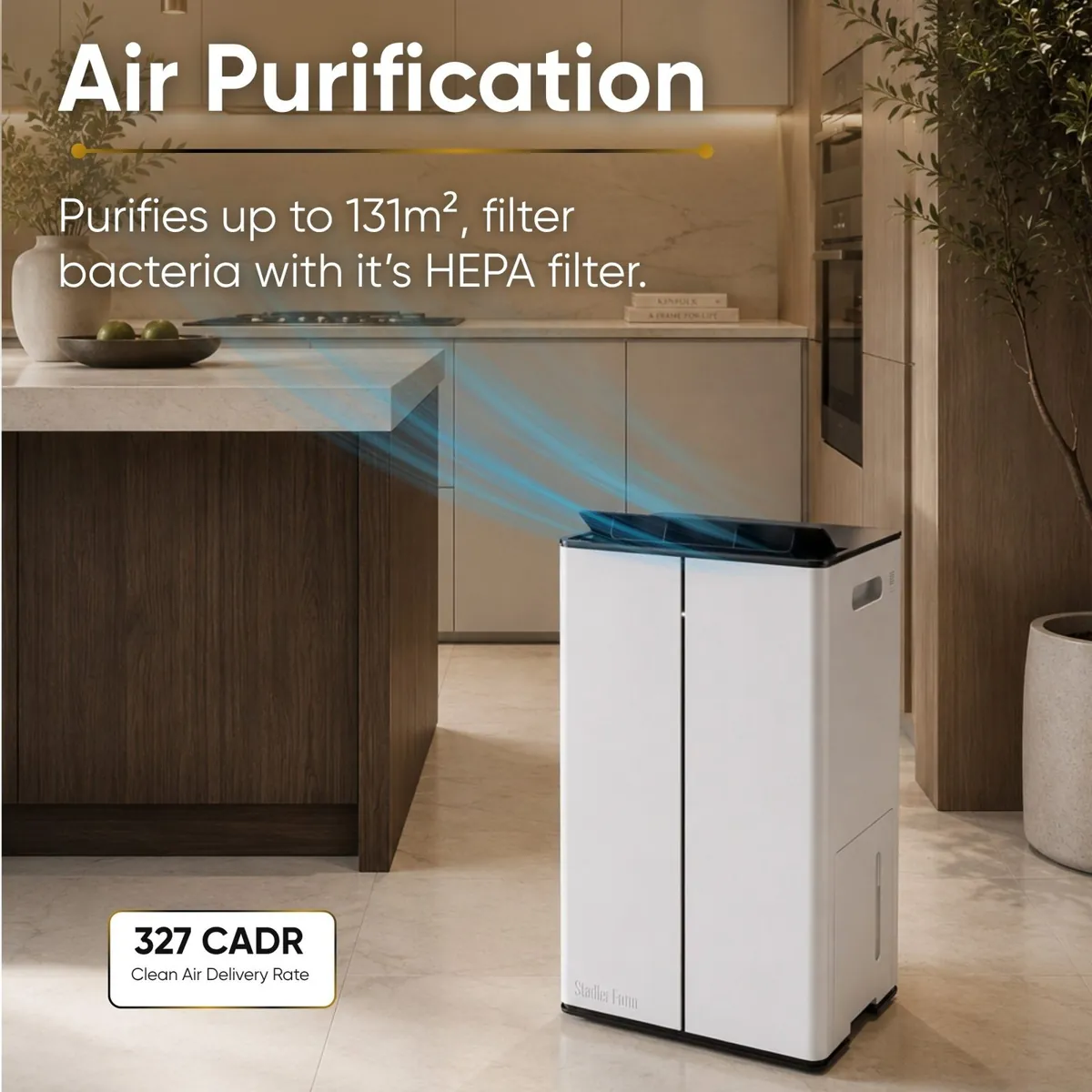
Read purifier coverage carefully, because it is a different number from drying coverage. Stadler Form Lukas Pro moves up to 327 m³ of cleaned air an hour (a CADR stated according to AHAM). Spread over a room three times an hour, that serves about 44 m²; once an hour, 131 m². The filter is HEPA, H11 class in Stadler Form’s description, and it is due for replacement roughly once a year. The coloured light on the front tells you when the particle level rises.
If the main problem is a big room, size by the dehumidifier rating; if it is dust in a bedroom or study, size by the purifier rating. For rooms that only need humidity control, Lukas or Albert is the smaller unit, and Albert the quieter one. Our guide to choosing a 2-in-1 or two machines goes deeper, and the sizing guide works through room volumes.
An El Niño-season humidity checklist for GCC homes
Measure, set a target, place the unit correctly and keep it drained. These steps work whatever the season brings; the placement, water and laundry steps follow the Stadler Form manuals.
- Measure for a week. Put a hygrometer in each room you are worried about and note the morning and evening readings with your usual air-conditioning settings.
- Pick the room, then the model. Up to 70 m²: Lukas or Albert. Up to 175 m², or a room that also needs purifying: Lukas Pro. Size rooms with high ceilings by volume.
- Set the hygrostat to about 50%. That sits in the middle of the commonly recommended 40–60% band; the unit switches off at the target and checks again at intervals.
- Keep doors and windows closed while it runs. A dehumidifier dries the room it is in, not the street outside.
- Leave space around it. Half a metre of clear space to walls and furniture, nothing blocking the airflow, a firm level floor, and well away from bathrooms and pools.
- Plan the water. Empty the tank when the tank-full signal shows, or lead the supplied hose down to a floor drain so the unit can run without stopping.
- Dry laundry with it, not instead of it. Lukas Pro and Lukas have a laundry mode; with Albert use swing. Hang the washing half a metre or more away, where nothing can drip onto the unit.
- Before a long trip, fit the drain hose so the unit can keep running, and check on the room from the app on Lukas Pro or Lukas. Both keep their settings when unplugged, but neither is documented to restart on its own after a power cut.
- Look after the filter. Replace the Lukas Pro or Lukas HEPA filter about every 12 months; vacuum the dust filter on Albert when it is dirty.
Where to buy, see and service Stadler Form in the GCC
In the UAE, buy online at Stadler Form UAE (stadlerform.ae), the group’s official online store, or see Albert and Lukas Pro running side by side at our Business Bay showroom in Dubai. PRO TECHnology is the authorised exclusive Stadler Form distributor for the UAE, Saudi Arabia, Bahrain, Kuwait and Oman, with a Middle East service centre in Dubai.
Warranty claims go through PRO TECHnology’s Stadler Form service centre in Dubai. Any repair to the sealed refrigerant circuit, which holds flammable R290, is left to technicians the manufacturer has authorised, as the manuals require. Our Stadler Form service page explains warranty claims, repairs and genuine filters.
Planning a whole villa, several rooms, or an order for a home in Saudi Arabia, Kuwait, Bahrain or Oman? Contact PRO TECHnology with the room sizes and we will suggest a model for each one. You can also visit the showroom or browse the full Stadler Form range.
The key figures in this guide, with their sources
For writers, researchers and anyone checking a claim, here are the numbers this guide relies on, each with its original source.
- NOAA has had an El Niño Advisory in force since 11 June 2026, and on 8 October 2026 put the chance of a strong to very strong El Niño through January to March 2027 above 83% (NOAA CPC).
- NOAA gives an 83% chance that the event is the strongest since records began in 1950 during October to December 2026 (NOAA CPC, 8 October 2026).
- The Australian Bureau of Meteorology recorded a weekly relative Niño-3.4 value of +2.81 °C for the week to 11 October 2026, the highest in its weekly series, which starts in 2008 (BoM).
- A WMO and Met Office outlook in May 2026 said the late-2026 El Niño raises the chance of 2027 being the next record-warm year (WMO).
- September 2026 was 1.63 °C above pre-industrial levels (Copernicus).
- El Niño winters tend to bring the Arabian Peninsula more rain (Kumar et al., Climate Dynamics, 2016; Dasari et al., Climate Dynamics, 2021).
- Arabian Gulf summer sea temperatures tend to run cooler in El Niño years and warmer in La Niña years (Lachkar et al., Ocean Science, 2025).
- Air can hold about 7% more water vapour for every 1 °C of warming (NOAA Climate.gov).
- The US EPA advises keeping indoor humidity below 60%, ideally between 30 and 50% (EPA, page updated 18 February 2026).
- Two weather stations had already recorded wet-bulb temperatures above 35 °C, mostly for one to two hours, and the Gulf’s monthly mean sea temperature reached 35.2 °C in 2017 (Raymond, Matthews and Horton, Science Advances, 2020).
- North Africa and the Middle East were hit by a series of major dust intrusions in 2025 (WMO, 10 July 2026).
- Stadler Form’s ratings: Lukas Pro, 50 litres a day at most, for spaces to 175 m²; Lukas and Albert, 20 litres a day at most, for spaces to 70 m². Each maximum needs warm, damp air of roughly 22 °C and 70% RH (Stadler Form).
To cite this guide: PRO TECHnology, “El Niño and Hotter GCC Days: How to Keep Indoor Humidity in Check with Stadler Form”, 17 October 2026, https://www.protechnology.ae/el-nino-uae-gcc-humidity-dehumidifier. The El Niño figures are as of 17 October 2026; NOAA’s next discussion is scheduled for 12 November 2026.
Sources
El Niño figures are as published by NOAA, the WMO, the Australian Bureau of Meteorology and Copernicus and were read on 16 and 17 October 2026; they change with each update. Stadler Form specifications were checked against the Stadler Form manuals and stadlerform.com on 22 September 2026.
- NOAA Climate Prediction Center: ENSO Diagnostic Discussion, 8 October 2026
- NOAA Climate Prediction Center: ENSO Diagnostic Discussion, 11 June 2026
- NOAA Climate Prediction Center: official ENSO probabilities, issued October 2026
- NOAA Climate Prediction Center: official ENSO strength probabilities, issued October 2026
- Australian Bureau of Meteorology: ENSO and climate driver monitoring, 13 October 2026
- WMO: El Niño/La Niña Update, August 2026 (published 3 September 2026)
- WMO: El Niño set to become very strong, raising risks of extreme weather into 2027 (3 September 2026)
- WMO: Global Annual to Decadal Climate Update 2026–2030 (28 May 2026)
- WMO: 2024 confirmed as the warmest year on record (10 January 2025)
- Copernicus Climate Change Service: August 2026 the joint warmest month on record
- Copernicus Climate Change Service: September 2026, the second-warmest September
- Niranjan Kumar et al., Wintertime precipitation variability over the Arabian Peninsula and its relationship with ENSO, Climate Dynamics (2016)
- Dasari et al. (KAUST), Long-term changes in the Arabian Peninsula rainfall and their relationship with the ENSO signals, Climate Dynamics (2021)
- Abid et al., ENSO relationship to summer rainfall variability over the Arabian Peninsula region, npj Climate and Atmospheric Science (2018)
- Lachkar et al. (NYU Abu Dhabi), Local and remote climatic drivers of extreme summer sea surface temperatures in the Arabian Gulf, Ocean Science (2025)
- Gulf News: El Niño to persist through February 2027, impacts on UAE to extend into April (7 September 2026)
- NOAA Climate.gov: a warmer atmosphere holds more water vapour
- US EPA: A Brief Guide to Mold, Moisture and Your Home (updated 18 February 2026)
- US EPA: Moisture Control Guidance for Building Design, Construction and Maintenance (December 2013)
- US Department of Energy, Building America: Why Right-Size? (2009)
- Government of Dubai Media Office: DEWA tips to save electricity and water (28 April 2020)
- Raymond, Matthews and Horton, The emergence of heat and humidity too severe for human tolerance, Science Advances (2020)
- WMO: sand and dust storm hotspots, impacts and research (10 July 2026)
- Stadler Form: Lukas Pro dehumidifier and air purifier, technical data (stadlerform.com)
- Stadler Form: dehumidifier range and buying advice (stadlerform.com)
- Stadler Form UAE: Lukas Pro (stadlerform.ae)
- Stadler Form UAE: Lukas (stadlerform.ae)
- Stadler Form UAE: Albert (stadlerform.ae)
Frequently asked questions
Is there an El Niño in 2026?
Yes. NOAA's Climate Prediction Center declared El Niño conditions in June 2026, and its 8 October 2026 discussion says the event is still strengthening, with a strong to very strong El Niño likely through January to March 2027. NOAA expects neutral conditions to return from around April to June 2027.
Will El Niño make the UAE and Saudi Arabia hotter?
Indirectly, and with a delay. El Niño raises global temperatures, usually most in the year after it forms, which is why forecasters are watching 2027. The UAE's National Centre of Meteorology, as reported in September 2026, expects near to above-average temperatures through the winter and into April. Research does not show El Niño on its own making Gulf summers hotter or more humid.
Does El Niño bring more rain to the Arabian Peninsula?
It tends to in winter. Studies link El Niño with wetter winters over much of the peninsula, although the pattern has shifted over the decades and is not certain in any one year. The NCM expects near to above-average rainfall in the UAE into April 2027. In summer, south-western Arabia tends to get less rain in El Niño years.
Is El Niño caused by climate change?
No. The WMO describes El Niño as a natural climate pattern that is not caused by climate change. It now happens in a warmer climate, though, so its warming lands on a higher baseline: 2024, which followed the last El Niño, is the warmest year on record.
When is this El Niño expected to end?
NOAA's October 2026 outlook keeps El Niño at 98% for February to April 2027 and 85% for March to May, then favours neutral conditions from April to June 2027 (54%) and May to July 2027 (70%). Its effects on global temperature are expected to last into 2027.
Why does my air-conditioned flat still feel damp in the hot months?
Because cooling and drying are different jobs. An air conditioner takes some water out of the air as it cools, but it is run by a thermostat that watches temperature, so a room can feel cool and still sit above 60% humidity, especially if it stays closed, is near the sea or is used to dry washing. A hygrometer will show you, and a dehumidifier with a hygrostat goes after the humidity itself.
How can I tell whether my home is too humid?
Measure it. Put a hygrometer in the room for a week and read it morning and evening with the air conditioning on as usual. Readings that stay above 60% mean the room sits outside the commonly recommended 40 to 60% band. Musty smells, condensation on cold glass and clothes that feel damp in the wardrobe are signs to check for.
Which Stadler Form model handles humidity and dust together?
Stadler Form Lukas Pro. One cabinet holds both a compressor dehumidifier and a HEPA purifier, the H11 filter ships with it, and a sensor on the front reports the particle level. Its drying rating covers spaces up to 175 square metres, while its purifier, at 327 cubic metres an hour, covers 44 square metres when it changes the air three times an hour. Lukas turns into a 2-in-1 once its optional HEPA filter is fitted.
Is it Lukas or Lucas?
Stadler Form spells both models with a k, Lukas and Lukas Pro, although some people search for Lucas. The smaller Lukas is rated at 20 litres a day for spaces to 70 square metres; Lukas Pro at 50 litres a day for spaces to 175 square metres, with an air purifier built in. Those are maximums, which need warm, damp air to reach.
Who sells and services Stadler Form dehumidifiers in the Gulf outside the UAE?
PRO TECHnology, which holds the authorised exclusive Stadler Form distribution for Saudi Arabia, Bahrain, Kuwait and Oman as well as the UAE, and runs the Stadler Form service centre for the region in Dubai. Send us the rooms and their sizes for a home or a project in any of those countries. UAE buyers can also order online at stadlerform.ae, the group's official store, or see the units in our Business Bay showroom.
النينيو وارتفاع الحرارة في دول الخليج: كيف تضبط الرطوبة داخل المنزل مع ستادلر فورم (Stadler Form)
أعلن مركز التنبؤ بالمناخ التابع للإدارة الوطنية الأمريكية للمحيطات والغلاف الجوي (NOAA) في 11 يونيو 2026 تشكّل ظاهرة النينيو (El Niño)، وتتوقع نشرته الصادرة في 8 أكتوبر 2026 أن تكون الظاهرة قوية إلى قوية جداً حتى مارس 2027. وتشير المنظمة العالمية للأرصاد الجوية (WMO) إلى أن أثر النينيو على درجات الحرارة العالمية يبلغ ذروته عادةً في العام التالي، ولذلك يُرجَّح أن يكون عام 2027 عاماً قياسياً في الحرارة.
في شبه الجزيرة العربية ترتبط النينيو في الدراسات العلمية بشتاء أكثر مطراً في معظم المنطقة، ويتوقع المركز الوطني للأرصاد في الإمارات، بحسب ما نقلته صحيفة Gulf News، درجات حرارة وأمطاراً قريبة من المعدل أو أعلى منه حتى أبريل 2027. أما رطوبة الصيف على ساحل الخليج فهي واقع سنوي لا تصنعه النينيو، والمشكلة داخل المنزل هي الرطوبة وليست الحرارة وحدها.
النطاق الموصى به عادةً للرطوبة النسبية داخل المنزل هو بين 40 و60%. يجمع جهاز سحب الرطوبة ستادلر فورم لوكاس برو (Stadler Form Lukas Pro) بين سحب ما يصل إلى 50 لتراً يومياً (الحد الأقصى المصنَّف) لغرف حتى 175 م² وتنقية الهواء بفلتر HEPA، ويناسب لوكاس (Lukas) الغرف حتى 70 م² مع التحكم عبر الواي فاي، أما ألبرت (Albert) فهو الخيار الهادئ لغرف النوم.
الشراء في الإمارات عبر المتجر الرسمي stadlerform.ae. وPRO TECHnology هي الموزع الحصري المعتمد لستادلر فورم في الإمارات والسعودية والبحرين والكويت وعُمان، ولديها مركز خدمة في دبي.
Get ahead of the next humid season
Tell us the rooms and their sizes and we will match each one to Lukas Pro, Lukas or Albert, or buy online at Stadler Form UAE.