Choosing an Air Purifier for Dust in the UAE
Published · PRO TECHnology Air Quality Solutions
Dust is the defining indoor air problem of this region, and it does not stop at the door. It arrives on the shamal, it comes off construction sites, it settles as the fine grey film every villa and office in the Emirates knows, and it keeps arriving in buildings that stay sealed and air-conditioned for most of the year. Choosing a purifier for it is not the same as choosing one for smoke or for a cold climate. This guide covers what the filter has to catch, how to size the machine honestly rather than by the headline coverage figure, and the maintenance step that decides whether it still works in year two.
Key takeaways
- Size from CADR, not from the coverage figure on the box. Stadler Form's published coverage figures work out to exactly one air change per hour at a 2.5 metre ceiling, which is a ventilation-style benchmark rather than a dust-control one.
- For dust and allergy relief a commonly recommended target is four to five air changes per hour, so plan on roughly a quarter to a fifth of the headline coverage figure.
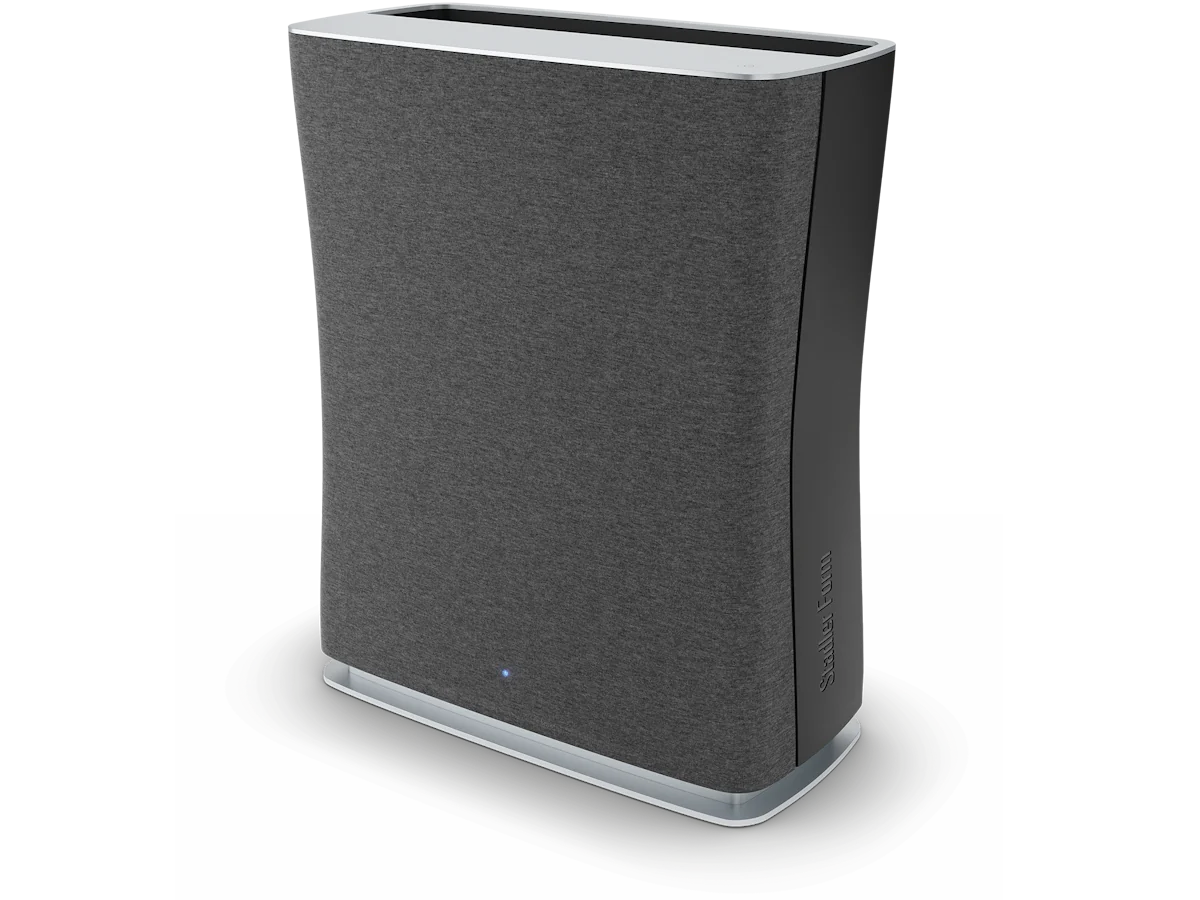
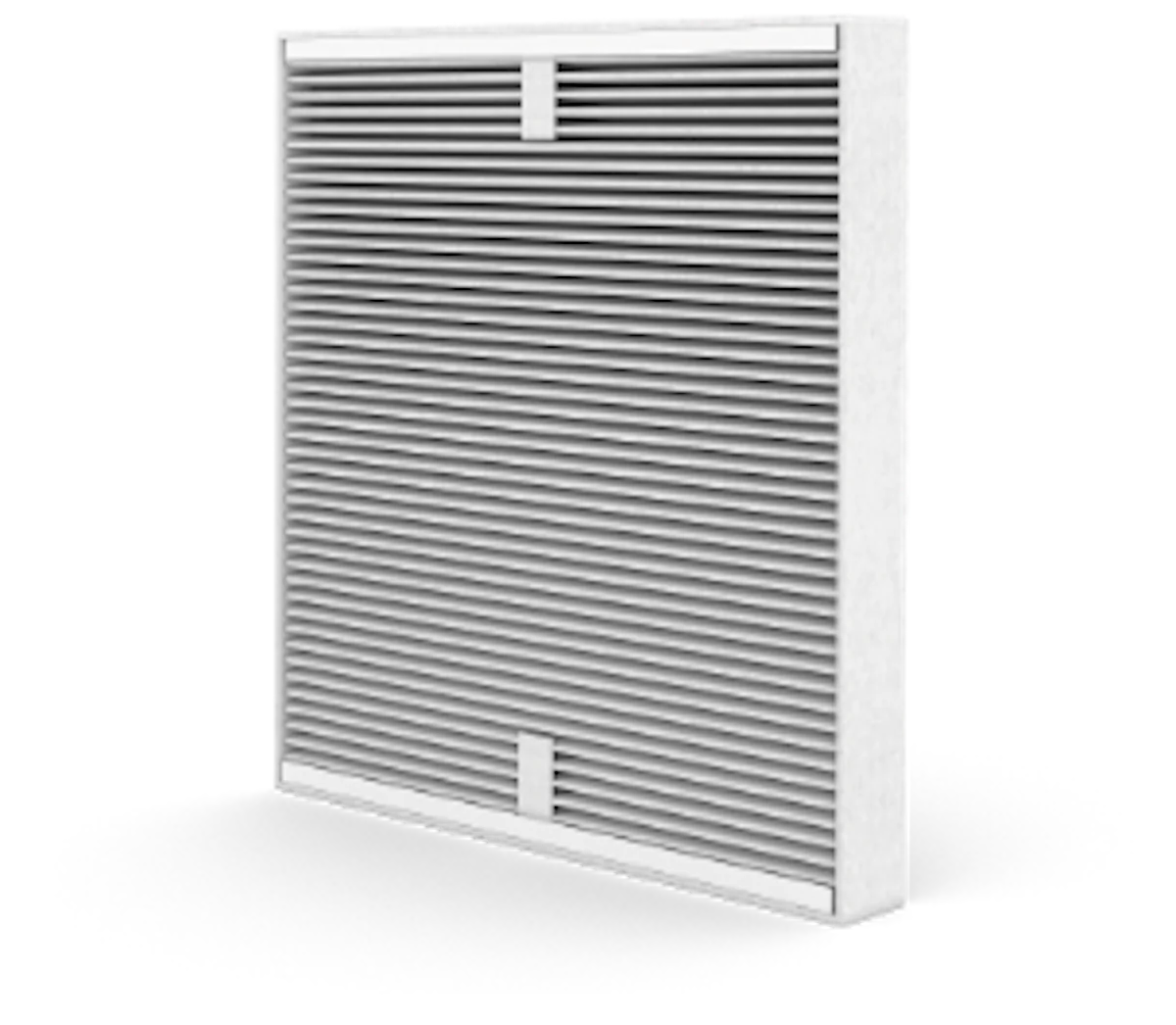
- The Roger family runs a Dual Filter combining HEPA H12 with activated carbon: the HEPA layer handles fine dust, sand, pollen and other particles, and the carbon layer handles odours and volatile organic compounds that no HEPA filter can touch.
- In a dusty climate the washable textile pre-filter is the part that decides filter life. Neglect it and the expensive HEPA layer loads early; Stadler Form specifies washing it at 30 °C.
- A purifier removes particles. It does not reduce humidity and it does not reduce CO2, so damp rooms and stuffy meeting rooms are different problems with different answers.
Why dust is the particle problem here
Gulf buildings are designed to keep heat out, which means they keep air in. For most of the year windows stay shut and the same air is cooled and recirculated rather than replaced. That is comfortable and efficient, and it has one consequence for air quality: whatever gets inside tends to stay inside and accumulate, because there is no natural flushing.
What gets inside here is overwhelmingly mineral. Regional dust and nearby construction raise indoor particulate levels even in well-sealed buildings, carried in through doors, on clothing, through gaps and through the ventilation system itself. During a shamal the outdoor load rises sharply for days at a time, and a sealed building simply flattens and delays the curve rather than stopping it.
Particulate is measured in two size bands, and the distinction matters when choosing a machine. PM10 covers coarse particles up to ten micrometres, which is where most wind-blown mineral dust and sand sits. PM2.5 covers fine particles up to 2.5 micrometres, which penetrate deeper into the lungs and stay airborne far longer. The World Health Organization's 2021 air quality guidelines set PM2.5 at 5 micrograms per cubic metre as an annual average and 15 over 24 hours, and PM10 at 15 annually and 45 over 24 hours. Those are guideline values rather than regulations, and they are useful mainly as a reference point for what a monitor is telling you.
The practical implication is that a purifier used here is fighting a continuous, coarse-and-fine mineral load rather than an occasional event. That changes which specifications matter: filtration grade and clean air delivery rate obviously, but also pre-filter design and filter replacement economics, because the machine is working every day rather than during a pollen season.
What the filter actually has to do
A purifier for this environment needs to handle three different things, and only one of them is dust.
Particles: the HEPA layer
HEPA filtration is what captures fine dust, sand, pollen, and particles carrying bacteria and viruses. Stadler Form's Roger range uses an H12-grade HEPA layer. Grades matter less than marketing suggests, but they are not meaningless: a higher grade captures a larger fraction of the most penetrating particle size, at the cost of more airflow resistance, which is why grade should be read together with clean air delivery rate rather than on its own. A very fine filter in a machine that cannot push much air through it is not an upgrade.
Gases and odours: the carbon layer
No HEPA filter removes gases. Cooking smells, paint and new-furniture off-gassing, cleaning chemicals and the volatile organic compounds that come with a recent fit-out pass straight through it. That is the job of activated carbon, and it is why the Roger models combine both in a single Dual Filter cartridge. In a newly handed-over apartment or a recently refurbished office, the carbon layer is often doing more perceptible work in the first months than the HEPA layer is.
The coarse load: the pre-filter
Ahead of both sits a textile pre-filter whose job is to catch hair, lint and the coarse fraction of dust before it reaches the expensive layers. In most climates this is a detail. Here it is the single most important maintenance item on the machine, for reasons covered further down.
Sizing: use CADR, and be honest about the target
This is where most purifier purchases go wrong, and it is worth working through properly because the arithmetic is simple and the marketing is not.
Clean air delivery rate, quoted in cubic metres per hour, is the volume of filtered air a machine actually delivers. Room volume is floor area multiplied by ceiling height. Divide one by the other and you get air changes per hour, which is the number that describes what the machine will do for you:
Air changes per hour = CADR ÷ (floor area × ceiling height)
Now compare that with the coverage figure on the box. Stadler Form publishes 92 square metres for the Roger Little at 231 m³/h, 186 square metres for the Roger at 465 m³/h, and 294 square metres for the Roger Big at 736 m³/h. Divide each CADR by its coverage and the ceiling height implied is 2.5 metres in every case, at exactly one air change per hour. The published coverage figures are internally consistent and perfectly honest; they simply describe a single air change, which is a reasonable general-purpose benchmark and a weak one for dust.
For dust and allergy relief the commonly recommended target is four to five air changes per hour. Applying that to the same machines gives a very different and much more useful set of room sizes:
| Model | CADR | Published coverage | Room size at 4–5 air changes | Noise |
|---|---|---|---|---|
| Viktor | Not published | 50 m² | Small rooms; washable particle filter, recommended for allergy sufferers | Not published |
| Roger Little | 231 m³/h | 92 m² | About 18–23 m²: bedroom, nursery, small office | 24.7–59 dB(A) |
| Roger | 465 m³/h | 186 m² | About 37–47 m²: living room, master suite, meeting room | 25.2–65 dB(A) |
| Roger Big | 736 m³/h | 294 m² | About 59–74 m²: open-plan living, showroom, larger office floor | 25.8–58 dB(A) |
Two caveats before anyone uses that table as gospel. Ceiling heights in UAE villas and apartments are frequently nearer 3 metres than 2.5, which reduces the achievable air changes for a given room, so measure rather than assume. And clean air delivery rate is measured at maximum fan speed, which is also maximum noise; a machine run permanently on its quietest setting is not delivering its rated figure. Both arguments point the same way, which is to size up rather than down.
The maintenance step that decides everything
A purifier in Dubai does not usually fail. It quietly stops being effective, and nobody notices because it is still switched on and still making the same noise.
The mechanism is the pre-filter. In a dusty environment the coarse load arrives continuously, and the textile pre-filter loads far faster than it would in a temperate climate. Once it is blinded, two things happen at once: airflow drops, so actual clean air delivery falls well below the rated figure, and the fan works harder against the resistance. If the pre-filter is not being cleaned, the coarse dust reaches the HEPA and carbon cartridge instead, and that cartridge, which should be a periodic replacement, loads prematurely and becomes a frequent one.
The fix is trivial and almost universally skipped. Stadler Form's textile pre-filter is washable at 30 °C, and on the Roger models it carries an integrated Sanitized hygiene function. Put it on a calendar. In a villa near open desert or beside an active construction site, checking it monthly is reasonable; in a sealed high-floor apartment, quarterly may be enough. Let the machine tell you: if the air quality indicator sits worse than it used to at the same fan speed, the pre-filter is usually the reason.
Plan for the main filter as a running cost rather than a surprise. Because filter life here is driven by actual dust load rather than by a calendar, the honest answer to how long a cartridge lasts is that it depends on where you live and how well the pre-filter is maintained. PRO TECHnology holds Stadler Form filters in Dubai stock precisely because this is the part that runs out, and our distributor and service page covers what is stocked and how replacements are handled.
Sensors, auto mode and noise
The Roger models carry air quality sensing with an indicator that changes colour as the air deteriorates, from blue through orange to red, and an auto mode that raises and lowers cleaning performance to match. In a dusty climate that is a genuinely useful feature rather than a gimmick, because the load is not constant: it spikes when a door opens, when the cleaner vacuums, when a shamal blows, and it is exactly then that you want the machine at full speed without having to be in the room.
Noise is the constraint that decides where a purifier can live. The Roger family spans roughly 25 to 65 dB(A) across five power levels, so the quietest setting is genuinely quiet and the fastest setting is not something to sleep beside. Every model in the range has a night mode, and the practical approach in a bedroom is to run the machine hard during the day with the door shut and let night mode maintain it. Power draw is modest at every setting, from 3 to 40 watts on the Roger Little and 4 to 100 watts on the Roger, so continuous running is not the expense people assume it is.
Placement matters more than most specifications. Give the unit clear air on its intake and outlet rather than tucking it behind a sofa, keep it in the room you actually occupy rather than a hallway, and accept that a closed door makes a small machine effective and an open-plan layout makes a large one necessary.
When a purifier is the wrong answer
Being clear about what these machines do not do saves a lot of disappointed purchases.
- Damp, musty rooms and condensation. A purifier filters particles and has no mechanism for removing water vapour. That is a dehumidifier problem. Where both issues are present, our guide to the 2-in-1 dehumidifier and air purifier explains when one machine is the smarter footprint, and our dehumidifier sizing guide covers the moisture side.
- Stuffy meeting rooms and afternoon headaches. That is usually carbon dioxide, which is a ventilation problem. No filter removes CO2; the answer is more fresh air. Our guide to indoor air quality in schools and clinics covers what to measure and in what order.
- Clinical infection control. Wards, treatment rooms and dental surgeries need medical-grade equipment with sealed UV-C treatment and clinical-duty air circulation, not a domestic purifier. See medical-grade air purification.
- Washroom odour. Treating it at the source is more effective than filtering it downstream, which is a different product category again, covered on our Air Quality Solutions page.
Buying and supporting a Stadler Form purifier in the UAE and GCC
PRO TECHnology is Stadler Form's authorised exclusive distributor for the UAE, Saudi Arabia, Bahrain, Kuwait and Oman, with a Middle East service centre in Dubai and replacement filters held in stock rather than ordered in from Europe per request. Stadler Form has been Swiss-engineering indoor climate products since 1998 and carries a two-year warranty on the Roger range.
Current models, specifications and pricing for this market are published on the brand's own regional site: the Stadler Form UAE air purifier range lists the Viktor, Roger Little, Roger and Roger Big with live availability. Buying through the authorised channel is what makes the warranty, the service centre and the filter supply real rather than theoretical, and grey-import units are the most common reason a filter cannot be sourced two years later.
For offices, villas in handover, hospitality and multi-unit specification, talk to us about sizing across a floor plan rather than room by room. Call +971 4 343 5501, email info@protech.ae, or use the contact page.
Frequently asked questions
What size air purifier do I need for a room in the UAE?
Work it out from clean air delivery rate rather than the coverage figure on the box. Divide the CADR by the room volume, which is floor area multiplied by ceiling height, to get air changes per hour. For dust and allergy relief a commonly recommended target is four to five air changes per hour. On that basis the Roger Little suits about 18 to 23 square metres, the Roger about 37 to 47, and the Roger Big about 59 to 74.
Why is the coverage figure on the box so much larger than that?
Because it describes a single air change per hour. Dividing each published CADR by its published coverage gives an implied ceiling height of 2.5 metres and exactly one air change in every case. That is a reasonable general benchmark, but one air change per hour is not enough for continuous dust control, which is why sizing to four or five changes gives a much smaller and more realistic room.
Does a HEPA filter remove dust and sand?
Yes, that is precisely what it is for. A HEPA layer captures fine dust, sand, pollen and particles carrying bacteria and viruses. What it does not do is remove gases and odours, which pass straight through, so a purifier used in a new or recently refurbished building needs an activated carbon layer as well. The Roger range combines HEPA H12 and activated carbon in one Dual Filter.
What is the difference between PM2.5 and PM10?
PM10 covers coarse particles up to ten micrometres, which is where most wind-blown mineral dust and sand sits. PM2.5 covers fine particles up to 2.5 micrometres, which penetrate deeper into the lungs and stay airborne much longer. The WHO 2021 guidelines set PM2.5 at 5 micrograms per cubic metre annually and 15 over 24 hours, and PM10 at 15 annually and 45 over 24 hours.
How often should I change the filter in a dusty climate?
There is no honest calendar answer, because life depends on the actual dust load where the machine runs. What matters far more is the washable textile pre-filter: if it is not cleaned, coarse dust reaches the main HEPA and carbon cartridge and shortens its life dramatically. Stadler Form specifies washing the pre-filter at 30 degrees Celsius. Monthly is sensible near open desert or construction, quarterly in a sealed apartment.
Can I run an air purifier during a sandstorm?
Yes, and it is exactly when it earns its place, though keep expectations realistic. Close windows and external doors, run the unit at a higher speed or leave it in auto mode so it responds to the load, and clean the pre-filter afterwards rather than waiting for the usual interval, because a single heavy dust event can load it as much as weeks of normal conditions.
Will an air purifier help with dust allergies?
Capturing airborne dust, sand and pollen is what a HEPA purifier does, and sizing it for four to five air changes per hour in the room where you sleep or work is the most effective thing you can do with one. Stadler Form specifically recommends the Viktor for allergy sufferers. It is not a medical device and it does not address dust already settled in soft furnishings, so it works alongside cleaning rather than instead of it.
Does an air purifier reduce humidity?
No. A purifier drives air through filters that trap particles and has no mechanism for removing water vapour. Damp rooms, condensation and musty smells are a dehumidifier problem. If you have both dust and humidity, either run two machines or consider a genuine 2-in-1 such as the Stadler Form Lukas Pro, which pairs a 50 litre per day dehumidifier with real HEPA purification in one chassis.
Do air purifiers reduce CO2 in a meeting room?
No. Carbon dioxide is a gas that filtration does not remove, and rising CO2 is a signal that the room is not getting enough fresh air. The answer is ventilation. Measure it before buying equipment, because a purifier bought to fix afternoon stuffiness will not fix it.
How noisy is an air purifier at night?
The Roger family runs from roughly 25 dB(A) at its quietest to around 58 to 65 dB(A) at full speed, across five power levels, and every model has a night mode. Bear in mind that the rated clean air delivery figure is measured at maximum speed, so a unit run permanently on its quietest setting delivers considerably less. Running hard during the day and using night mode overnight is the practical compromise.
Where can I buy Stadler Form air purifiers in the UAE?
PRO TECHnology is Stadler Form's authorised exclusive distributor for the UAE, Saudi Arabia, Bahrain, Kuwait and Oman, with a Dubai service centre and replacement filters held in local stock. Current models, specifications and pricing for this market are on the brand's regional site at stadlerform.ae. Buying through the authorised channel is what makes the warranty and long-term filter supply reliable.
كيف تختار جهاز تنقية هواء مناسبًا للغبار في الإمارات
الغبار هو المشكلة الأولى لجودة الهواء الداخلي في الخليج، إذ تبقى المباني مغلقة ومكيّفة معظم أيام السنة فيُعاد تدوير الهواء بدل تجديده، بينما تتسرب أتربة الشمال وأعمال البناء إلى الداخل باستمرار. عند اختيار الجهاز، لا تعتمد على مساحة التغطية المكتوبة على العلبة، بل احسب عدد مرات تغيير الهواء في الساعة: معدل توصيل الهواء النظيف CADR مقسومًا على حجم الغرفة أي المساحة مضروبة في ارتفاع السقف. أرقام التغطية المنشورة لأجهزة ستادلر فورم تعادل تغييرًا واحدًا للهواء في الساعة عند ارتفاع سقف 2.5 متر، في حين يُنصح عادة بأربع إلى خمس مرات للسيطرة على الغبار والحساسية، أي ما يقارب 18 إلى 23 مترًا مربعًا لجهاز Roger Little، و37 إلى 47 لجهاز Roger، و59 إلى 74 لجهاز Roger Big. تجمع فلاتر Dual Filter بين طبقة HEPA من فئة H12 للغبار الدقيق والرمال وحبوب اللقاح، وطبقة الكربون النشط للروائح والمركبات العضوية المتطايرة التي لا تلتقطها فلاتر HEPA. الأهم في مناخنا هو الفلتر الأولي القماشي القابل للغسل على 30 درجة مئوية، فإهماله يُقصّر عمر الفلتر الرئيسي كثيرًا. وتذكّر أن جهاز التنقية لا يخفّض الرطوبة ولا ثاني أكسيد الكربون. بروتكنولوجي هي الموزّع الحصري المعتمد لستادلر فورم في الإمارات والسعودية والبحرين والكويت وعُمان، مع مركز خدمة في دبي وفلاتر متوفرة في المخزون.
Tell us the room, not just the model
Send us the floor area and ceiling height of the rooms that matter, whether the building is newly handed over, and how close you are to open desert or an active site. We will size the units properly against air changes rather than a coverage figure, and tell you honestly where one machine is enough and where it is not. For offices, villas and hospitality we will do it across the whole floor plan.