Yacht interior humidity control: specifying Stadler Form Lukas and Lukas Pro for UAE builders and refit teams
Published · PRO TECHnology Distribution
A specification note for yacht builders, refit yards, interior designers, yacht management companies and marine procurement teams in the UAE. It sets out what Stadler Form actually publishes for Lukas and Lukas Pro, which figures decide a project and which do not, and what has to be confirmed in writing before a household appliance goes into a yacht interior package.
- Manufacturer scope
- Household appliances. Both manuals state the appliance is “only to be used in the home” and “For indoor use only”.
- Minimum room area
- 4 m² for Lukas, 7.2 m² for Lukas Pro, for installation, operation and storage.
- Clearance
- More than 50 cm from walls and large objects, airflow unobstructed.
- Drainage
- Gravity only. The hose end must sit lower than the outlet spout.
- Refrigerant
- R290, 60 g in Lukas and 127 g in Lukas Pro. Circuit work is restricted to manufacturer-authorised technicians.
- Supply
- PRO TECHnology, authorised exclusive Stadler Form distributor for the UAE, Saudi Arabia, Bahrain, Kuwait and Oman.
Key takeaways
- Lukas and Lukas Pro are household dehumidifiers. Stadler Form claims no marine certification, saltwater resistance or waterproofing, and neither is approved for use underway or as built-in marine HVAC.
- The figures that decide a project are the minimum room area (4 m² for Lukas, 7.2 m² for Lukas Pro) and the clearance rule, not litres per day.
- Rated output of 20 and 50 litres a day is only achievable from about 22 °C and 70% relative humidity, and the 70 m² and 175 m² coverage figures describe one connected room, not a vessel.
- Drainage is by gravity, so the position of a drain point constrains the layout as much as the clearance rule.
- Specify these as portable appliances in defined, supervised conditions, with suitability and warranty coverage confirmed in writing for the intended use.
Who this is for, and the decision it supports
This is written for the people who draw up the equipment schedule rather than the people who live with it: yacht builders and refit yards in the UAE, interior designers and outfitters, yacht management companies running several vessels, and marine procurement teams comparing suppliers. It supports one decision. Does a portable Stadler Form dehumidifier belong in a yacht interior package, and what has to be confirmed before it is specified?
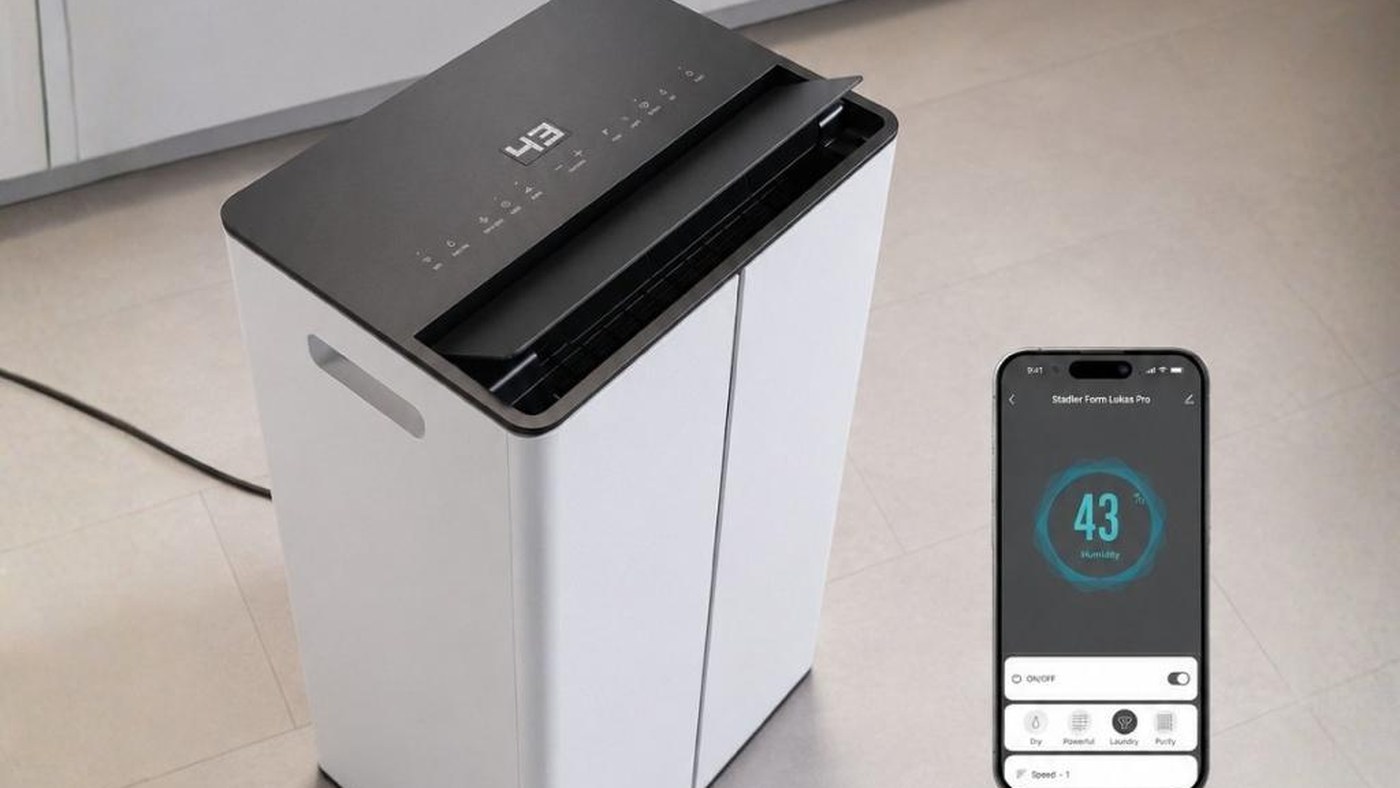
The answer starts with a limitation rather than a feature. Lukas and Lukas Pro are Swiss-designed household dehumidifiers. The operating instructions for both state that the appliance “is only to be used in the home for the purposes described in these instructions”, and both say “For indoor use only”. Neither is marine certified, saltwater resistant or waterproof, neither is approved for operation underway, and neither is a built-in marine HVAC component. That does not put them outside a yacht programme. It means specifying them as portable appliances used in defined, supervised conditions, with suitability confirmed for the project rather than inferred from a room-size figure.
PRO TECHnology is the authorised exclusive distributor of Stadler Form for the UAE, Saudi Arabia, Bahrain, Kuwait and Oman, with warranty service through our Middle East service centre in Dubai. Owners and captains looking for the practical buying and humidity-control guide rather than the specification view will find it on Stadler Form UAE.
Where humidity becomes a project problem
Three phases carry most of the interior moisture risk a yard or management company actually owns. At fit-out and handover, new joinery, adhesives, coatings and soft furnishings release moisture into a closed interior while climate systems are still being commissioned. During a refit, compartments are open, wet trades are aboard and the vessel is often unpowered or on a limited shore supply, so interior humidity is no longer controlled by anything the original designer specified. In lay-up and limited use, cabins stay closed between charters, air handling cycles down, and a warm, still interior sits at whatever the ambient condition allows.
In each case a dehumidifier is a temporary, movable measure attached to a project phase: project equipment with a warranty and a service route, not an installation with a class file.
What the interior is exposed to, stated carefully
Timber trim and veneered panels take up and give off moisture and move as they do. Upholstery, foam and bedding hold moisture and odour. Enclosed accommodation with little air exchange concentrates both. Holding a stable, moderate relative humidity reduces the conditions that favour mould growth and surface condensation. It does not prevent mould, corrosion or damage on its own: leaks, ventilation, cold surfaces, the state of the air handling and how often the vessel is opened all bear on the outcome, and no portable appliance controls any of them.
The hygrostat on both models is adjustable from 30 to 80 per cent, against the commonly recommended 40 to 60 per cent band. Set a project target against the specific vessel and its finishes rather than copying a domestic figure.
Lukas and Lukas Pro compared for project selection
Three published numbers are routinely misread in schedules. The 20 and 50 litres a day are rated maxima, and both manuals state the specified performance is only achievable from about 22 °C and from 70 per cent relative humidity. The 70 m² and 175 m² coverage figures come from Stadler Form’s product pages and describe one connected room at a domestic ceiling height, so on a vessel they are a ceiling on a single connected volume, not a rating for a deck. And Lukas Pro’s air-cleaning coverage is a separate rating again: up to 44 m² at three air changes an hour in the manual, up to 131 m² at one air change an hour on the product page, both from the same 327 m³/h CADR measured according to AHAM. Our 2-in-1 guide sets out why those two coverage numbers are not interchangeable.
| Specification | Lukas | Lukas Pro |
|---|---|---|
| Rated extraction | Up to 20 L/day | Up to 50 L/day |
| Stated coverage, dehumidifying | Up to 70 m² / 175 m³ | Up to 175 m² / 435 m³ |
| Minimum room floor area | 4 m² | 7.2 m² |
| Dimensions (W × H × D) | 358 × 572 × 254 mm | 382 × 650 × 287 mm |
| Weight | 15.8 kg | 18.0 kg |
| Water tank | 4.2 L | 5.2 L |
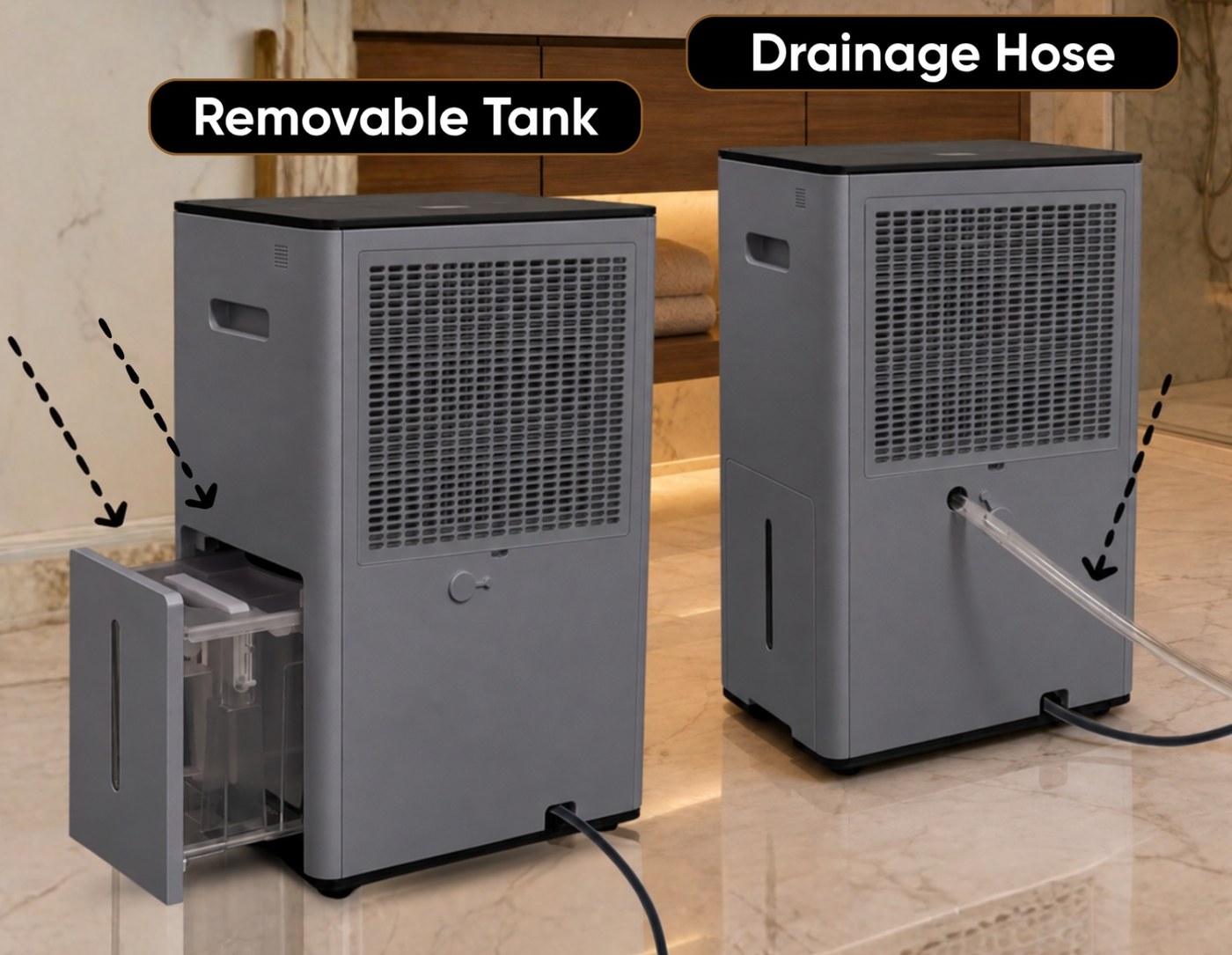
| Continuous drainage | 100 cm hose, gravity fall | 100 cm hose, gravity fall |
| Sound level | 38 – 52 dB(A) | 38 – 55 dB(A) |
| Power input / rated power | 260 W / 330 W | 545 W / 735 W |
| Supply | 220 – 240 V | 220 – 240 V, 50 Hz |
| Refrigerant | R290, 60 g | R290, 127 g |
| Maximum operating condition | 35 °C, 90% RH | 35 °C, 80% RH |
| Air purification | Optional HEPA H11 filter (L-032) | HEPA H11 included (replacement L-034) |
| Wi-Fi | Yes, 2.4 GHz | Yes, 2.4 GHz |
| UAE warranty | 2 years | 5 years, Pro Series |
Power input is measured at 26.7 °C and 60% RH; rated power at each model’s maximum operating condition, which is the figure to size a circuit against in a UAE summer. Full specifications are on the Lukas and Lukas Pro pages.
The deciding figures are usually not the extraction ratings. They are the minimum room area and the clearance rule. Lukas Pro must be installed, operated and stored in a room of at least 7.2 m², which rules it out of most single cabins; Lukas needs 4 m², which brings guest cabins into range. Both manuals also require more than 50 cm between the appliance and walls or other large objects, with airflow unobstructed. Applied on all sides, that turns a 358 × 254 mm footprint into roughly 1.7 m² of floor that must stay clear, and a 382 × 287 mm footprint into roughly 1.8 m². In a saloon that is a furniture decision. In a cabin it is often the whole answer.
What decides the specification besides capacity
Noise
Lukas runs at 38 to 52 dB(A) and Lukas Pro at 38 to 55 dB(A) across their speed ranges, with a night mode that dims the display and drops to the lowest fan level. Neither is silent, and the quoted range is a manufacturer laboratory figure, not a cabin measurement.
Drainage access
Continuous operation needs the supplied hose run to a drain lower than the outlet spout, because it drains by gravity. If the hose end is not below the spout, the manual warns water will not drain and flooding may occur. Aboard, that usually means siting the unit above a shower tray or sink.
Maintenance
The Lukas Pro HEPA filter is a consumable replaced roughly every 12 months, as is the optional Lukas filter. Tanks must be emptied if the hose is not used, and always before a move.
Local support
Both use R290, a flammable refrigerant: 60 g in Lukas, 127 g in Lukas Pro. The manuals state that work on the refrigeration system must not be carried out by local service companies and may only be done by technicians authorised by the manufacturer and trained in flammable refrigerants. For a fleet, that decides where units are serviced.
A specification checklist to send with an enquiry
Sizing on a vessel starts from a compartment schedule rather than a single floor area, which is where it departs from our villa and office sizing guide. Send these nine items and the answer can be given properly.
- Compartment schedule with floor area and volume for each space, and whether doors stay open.
- Which compartments share airflow and which are sealed.
- Expected interior temperature range during the phase in question.
- Measured relative humidity, not an assumption, and the target band for the project.
- Power supply at each position, and whether it is shore power, generator or inverter.
- A drainage point at or below the intended position, or a decision to run on the tank with a named person emptying it.
- Intended operating conditions: alongside, supervised or unsupervised, vessel powered or unpowered, and never underway.
- Any class, flag, insurer or yard requirement covering portable electrical equipment carried aboard.
- Written confirmation of suitability and warranty coverage for the intended use.
A portable appliance is not a vessel humidity system
An engineered vessel-wide strategy is part of the HVAC design: ducted, zoned, sized against heat and moisture loads, commissioned and covered by the vessel’s own approvals. A portable dehumidifier is one appliance on a floor in one compartment, moved by hand, plugged into a socket, drained by gravity and governed by its own hygrostat. It is a useful tool for fit-out, refit and lay-up, not a substitute for the system.
Two consequences follow. A unit serves the compartment it stands in and whatever is genuinely connected to it by open doors, so separate enclosed cabins need their own units or a scheduled rotation. And because these appliances must be transported upright, left upright for 24 hours before first use and at least 60 minutes after any later move, with the tank emptied first, relocating one between cabins is a planned task rather than a five-minute job.
Design, finish and interior compatibility
These units stand in a finished interior during handover and viewings, which is a fair reason to care how they look. Stadler Form has designed household climate appliances in Switzerland since 1998, and both models share the same restrained, rectilinear Matti Walker design language rather than the utilitarian look of site equipment. Lukas is an IDA Design Awards Gold winner for 2024, listed on Stadler Form’s own awards page; Stadler Form lists no model-specific award for Lukas Pro. The practical points for a designer are the plain cabinet, a display that dims, and hidden wheels and a recessed handle that keep the visible outline clean.
Stadler Form announced a Titanium special edition on 8 September 2026 covering Lukas, Sam, George, Noah and Noah Pro. Titanium is a metallic colour finish, not the construction material, and Lukas Pro is not part of the edition. Lukas Titanium is listed and shown in stock at Stadler Form UAE with the same specification as the white Lukas. Confirm the current stock position with us before writing a colour variant into a schedule.
Supply and support from PRO TECHnology
We supply genuine Stadler Form stock with local warranty across the UAE, Saudi Arabia, Bahrain, Kuwait and Oman, and service it through our Middle East service centre in Dubai. Units can be seen running at our Business Bay showroom before they are specified, and the full range sits on the Stadler Form UAE page.
Send us the compartment schedule and the checklist above. We will tell you which model fits, which spaces it cannot serve, and what we can and cannot confirm about the intended use.
Frequently asked questions
What should a yacht builder check before specifying a portable dehumidifier?
Four things the datasheet will not answer: each compartment’s floor area against the appliance’s minimum room area, whether the clearance requirement can be met in the finished layout, whether a gravity drain point sits below the intended position, and whether the manufacturer and the warranty cover the intended use in writing.
How should a refit team compare Lukas and Lukas Pro?
Not on litres per day. Lukas Pro extracts more and includes a HEPA filter, but needs a room of at least 7.2 m², weighs 18 kg and draws up to 735 W. Lukas needs 4 m², weighs 15.8 kg and draws up to 330 W. Where cabins are treated one at a time, several Lukas units usually beat one Lukas Pro.
Can one unit serve multiple enclosed cabins?
Not while they are closed. A dehumidifier treats the air it can circulate. Held open so the spaces genuinely share air, one unit can serve a connected group; otherwise each enclosed cabin needs its own unit or a planned rotation.
Are these marine-certified appliances?
No. Stadler Form claims no marine certification, saltwater resistance or waterproofing for either model, and the manuals state they are for indoor use only and only to be used in the home for the purposes described. They are not approved as built-in marine HVAC equipment and should not be specified for use underway.
What should be checked about power, drainage and placement?
Power: a 220 to 240 V supply at each position, sized for up to 330 W for Lukas or 735 W for Lukas Pro. Drainage: the hose drains by gravity, so its end must sit lower than the outlet spout. Placement: a firm, level, waterproof surface where the unit cannot tip, more than 50 cm from walls and large objects, at least 3 m from a bath, shower or pool, never inside a closet or locker, and never covered.
Does the stated room coverage apply to an entire yacht?
No. The 70 m² and 175 m² figures describe one connected room at a domestic ceiling height, published for household use. On a vessel they are an upper bound on a single connected volume. Size against the compartment schedule.
Is Lukas Titanium available for UAE projects?
It is listed and shown in stock at Stadler Form UAE, with the same specification as the white Lukas. Titanium is a metallic colour finish announced on 8 September 2026, not the construction material, and there is no Lukas Pro in the edition. Confirm current stock and lead time before it goes into a schedule.
What information should be included in a supplier enquiry?
The compartment schedule with area and volume, which spaces share air and which are sealed, the project phase with expected temperature and humidity, the power available at each position, the drainage points, whether operation will be supervised, and any yard, flag, class or insurer requirement covering portable electrical equipment aboard.
Sources
Every figure on this page comes from Stadler Form: the EU operating instructions for Lukas and Lukas Pro for safety rules, clearances, minimum room areas, refrigerant charges and the specification tables; the manufacturer product pages for Lukas, Lukas Titanium and Lukas Pro for room coverage and purification figures; the Titanium special edition media release of 8 September 2026; and the Stadler Form awards page for the IDA Design Awards Gold 2024 listing for Lukas. UAE availability and warranty terms are as published by Stadler Form UAE. No marine certification, saltwater rating or approval for use underway is claimed by the manufacturer for either model, and none is claimed here.
التحكم في رطوبة المقصورات الداخلية لليخوت: دليل المواصفات لشركات البناء وإعادة التجهيز في الإمارات
هذه صفحة مواصفات موجهة إلى شركات بناء اليخوت وورش إعادة التجهيز ومصممي المقصورات الداخلية وشركات إدارة اليخوت وفرق المشتريات البحرية في الإمارات. الحقيقة الأولى التي يجب أن تُذكر بوضوح: أجهزة ستادلر فورم لوكاس ولوكاس برو هي أجهزة منزلية، ودليل التشغيل لكل منهما ينص على أن الجهاز «مخصص للاستخدام المنزلي فقط» و«للاستخدام الداخلي فقط». لا تقدّم الشركة المصنّعة أي اعتماد بحري أو مقاومة لمياه البحر أو موافقة على التشغيل أثناء الإبحار، ولا يُعد أي منهما جزءًا من نظام تكييف بحري مدمج. لذلك يجب تحديدها كأجهزة محمولة تعمل في ظروف محددة وتحت إشراف، مع تأكيد خطي بملاءمتها للاستخدام المقصود وبتغطية الضمان.
الرقمان اللذان يحسمان اختيار المشروع ليسا سعة السحب اليومية، بل الحد الأدنى لمساحة الغرفة: 4 أمتار مربعة للوكاس و7.2 متر مربع للوكاس برو، إضافة إلى قاعدة المسافة الفاصلة، أي أكثر من 50 سم بين الجهاز والجدران أو الأجسام الكبيرة مع عدم إعاقة تدفق الهواء. عند تطبيق هذه القاعدة من كل الجهات تصبح المساحة الواجب إبقاؤها خالية نحو 1.7 متر مربع للوكاس و1.8 متر مربع للوكاس برو. كما أن سعة 20 و50 لترًا يوميًا هي قيم قصوى لا تتحقق إلا من حوالي 22 درجة مئوية و70% رطوبة نسبية، وأرقام التغطية 70 و175 مترًا مربعًا تصف غرفة واحدة متصلة لا سفينة كاملة. التصريف المستمر يعمل بالجاذبية فقط، ويجب أن تكون نهاية الخرطوم أخفض من فتحة التصريف. ويحتوي الجهازان على غاز التبريد R290 القابل للاشتعال، بواقع 60 غرامًا في لوكاس و127 غرامًا في لوكاس برو، وأعمال دائرة التبريد مقصورة على فنيين معتمدين من الشركة المصنّعة. بروتكنولوجي هي الموزّع الحصري المعتمد لستادلر فورم في الإمارات والسعودية والبحرين والكويت وعُمان، مع ضمان محلي وخدمة من مركز الشرق الأوسط في دبي.
Send us the compartment schedule
Tell us the spaces, the phase, the power and the drainage points, and we will tell you which model fits, which spaces it cannot serve, and what we can and cannot confirm about the intended use.