Does Shelfy work? What the tests show, and how to test a fridge purifier yourself
Published · PRO TECHnology Distribution & Retail
Vitesy publishes lab results for Shelfy on bacteria, odour, ethylene and shelf life. Here is what each test measured, what it cannot tell you, and how to run a fair test in your own fridge.
The short answer: in Vitesy's published lab tests, Shelfy cut airborne test bacteria by 99% in 10 minutes and kept some produce fresh for longer: courgettes stayed acceptable for 22 days instead of 10 in a 6 °C lab fridge. It treats the air inside the fridge, not the food, and it does not replace cleaning or cold storage. Results at home depend on the food, the fridge and how often the door opens, so the fair way to judge it is a side-by-side test like the one below, which follows the protocol Vitesy gives retail buyers. Shelfy reaches the UAE through PRO TECHnology in Dubai.
- Lab studies
- 6, run on the original Shelfy
- Home test
- At least 2 weeks, side by side
- Best test produce
- Apples, pears, bananas, tomatoes, kiwi
- Sizing
- 1 Shelfy per about 300 litres
Key takeaways
- Vitesy's test report covers six studies by named laboratories and universities. The figures are the manufacturer's, and all of them were measured on the original white-LED Shelfy, before the current model with blue LEDs.
- The strongest results are for airborne microbes (99% of sprayed test bacteria in 10 minutes; 95% to 97% of the moulds naturally in fridge air) and for shelf life, where the gain depends on the food: up to 12 extra days for courgettes, 4 to 8 for others.
- Odour results show a reduction, not a perfume: 80% lower volatile compounds from ripening fruit and 73% lower fish-odour compound, both after 5 hours. A fridge that still holds the source of a smell needs cleaning first.
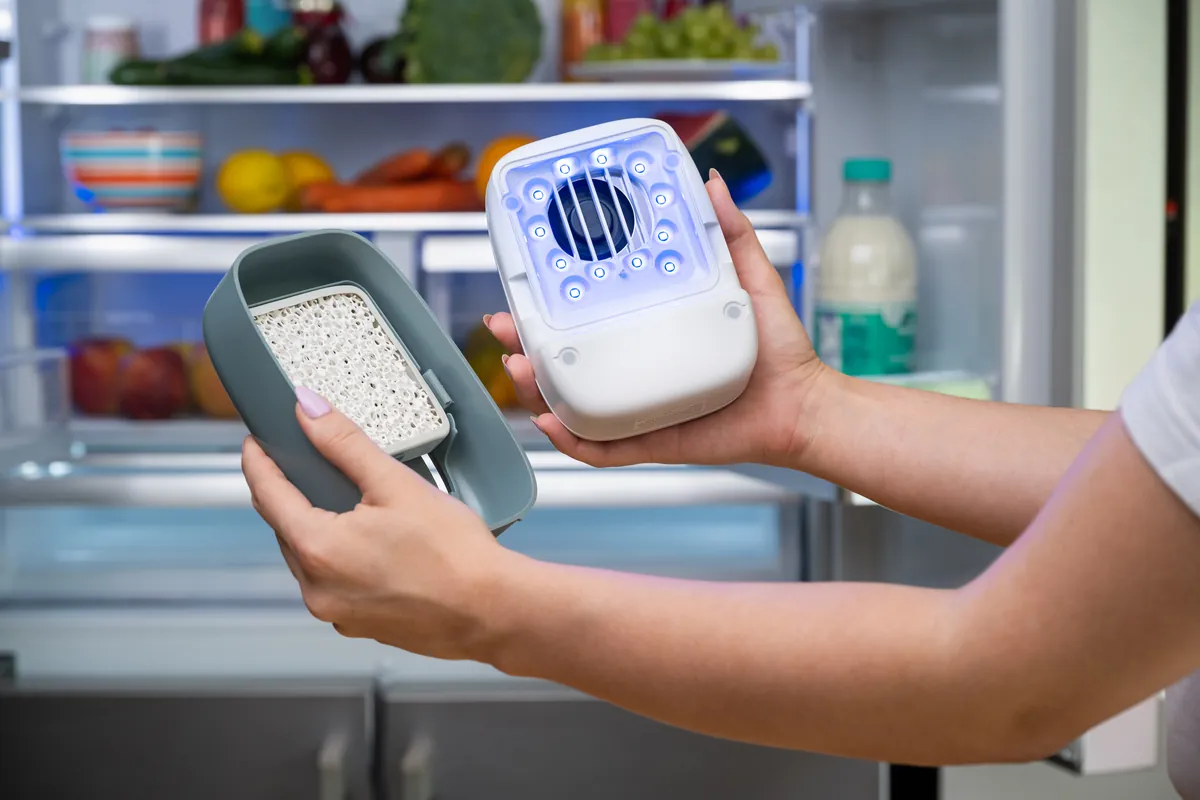
- Shelfy uses a fan and a photocatalytic ceramic filter lit by visible blue LEDs: no ozone and no UV. It works in cycles, so a quiet unit is not necessarily switched off.
- To judge it yourself: two matched fridges or set-ups, the same fruit split between them, at least two weeks, and a daily smell, texture and mould check against the control.
What Shelfy is meant to do
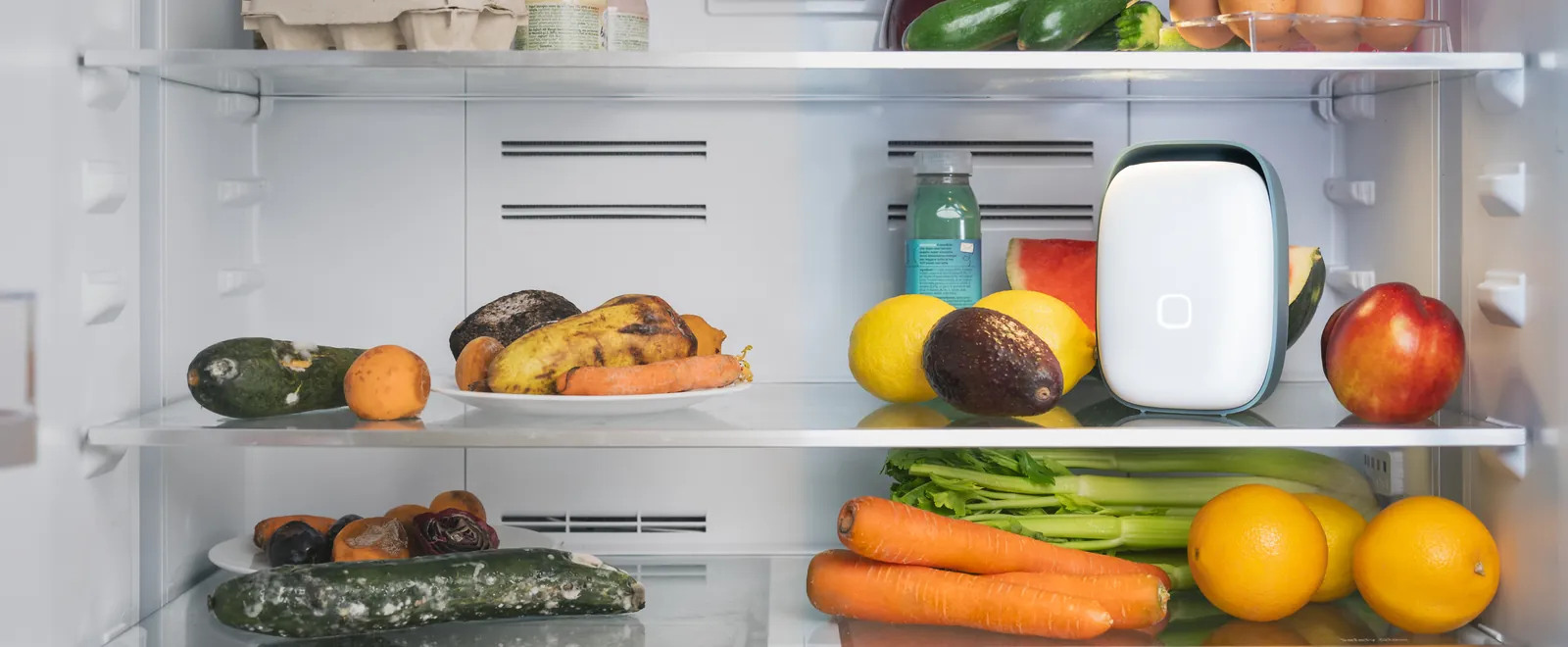
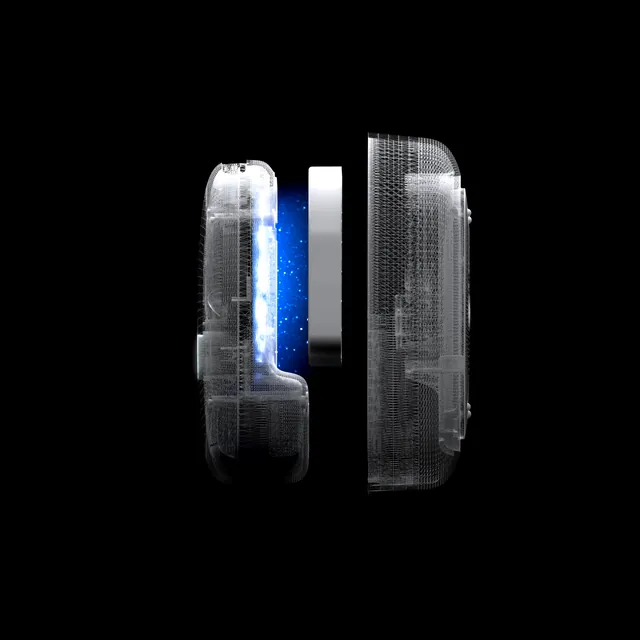
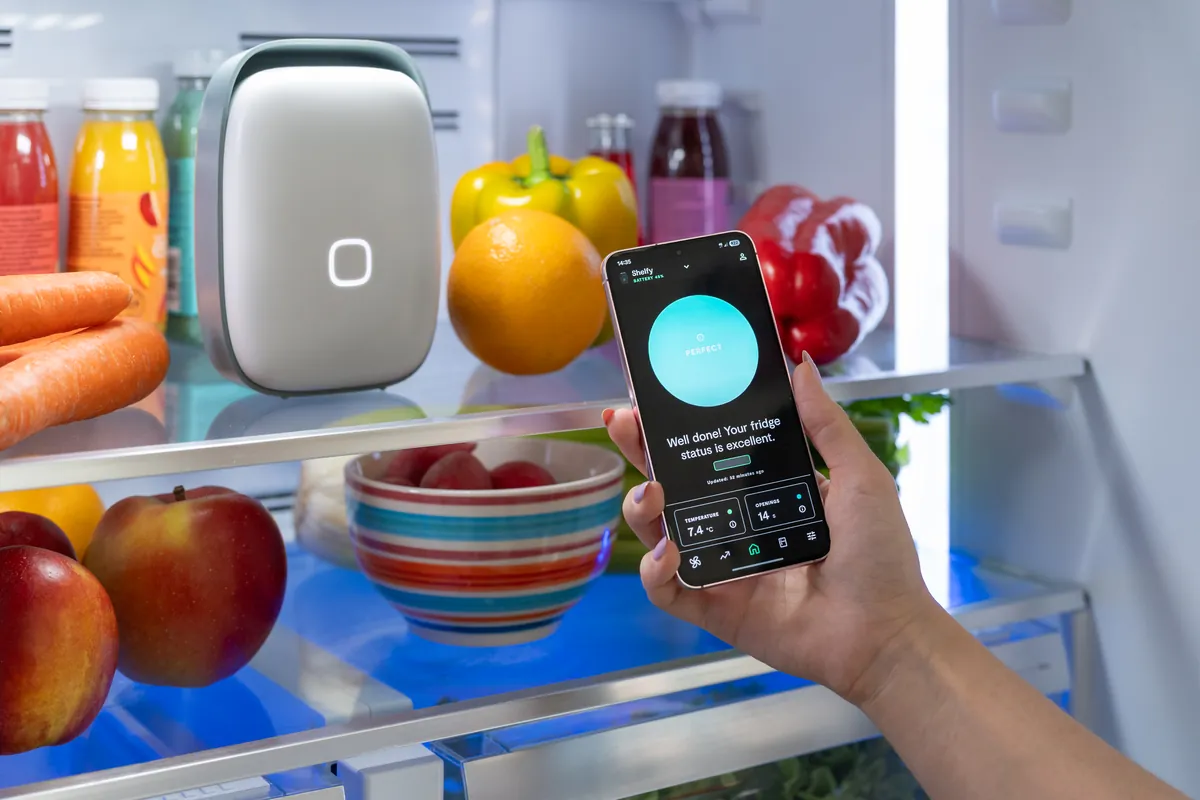
Shelfy is a battery-powered purifier the size of a small book (167 × 114 × 67 mm) that sits on a fridge shelf, in the door or in the crisper drawer. A small fan draws the fridge air through a washable ceramic filter coated with a photocatalyst. Twelve blue LEDs, visible light rather than UV, activate the coating, which breaks down bacteria, odour compounds and ethylene, the gas that makes fruit ripen. In Vitesy's words, Shelfy “acts on the air inside your refrigerator, not directly on the food.”
It has three modes: Eco for everyday use, about three weeks per charge; Crisper for the vegetable drawer, a few days less; and Performance for short bursts after a strong smell, about four to five days. Vitesy recommends one Shelfy per roughly 300 litres of fridge and two above 350 litres (placement guide). The Vitesy Hub app shows the fridge temperature, door openings, battery and filter-wash reminders; Shelfy also works from its button without the app.
What Vitesy's lab tests measured
Vitesy's Shelfy test report (Rev. 1, November 2023; the Italian Rev. 2 of June 2024 repeats the same figures) brings together six studies. Each measured one thing in one set-up, which is worth reading before reading the headline numbers.
| What was measured | Set-up | Who ran it | Result |
|---|---|---|---|
| Airborne test bacteria | Bacteria sprayed into a 180-litre fridge; compared with an identical unit without photocatalysis | Chimicambiente (lab) | 99.37% fewer in 10 minutes |
| Microbes naturally in fridge air (mostly moulds) | Two 220-litre fridges in Eco mode; plates read after 48 hours and 3 days | University of Udine | 95% and 97% fewer |
| Volatile compounds from ripening fruit | Apples and avocados in a 370-litre fridge at 4 °C | ARCO Solutions (University of Trieste spin-off) | 80% lower after 5 hours |
| Fish-odour compound (trimethylamine) | 118-litre test box | INSTM and ARCO Solutions | 73% lower after 5 hours |
| Ethylene | 210-litre test box | ACEA | 56.3% lower after 14 hours, against 5% without Shelfy |
| Shelf life of produce | Lab fridges at 6 °C with an avocado as ethylene source, July to August 2022 | CSI (IMQ Group) | Up to 12 extra days (courgettes) |
All six studies used the original Shelfy with white LEDs. Source: Vitesy, Shelfy test report; all of Vitesy's reports are on its research page.
Shelf life varies by food
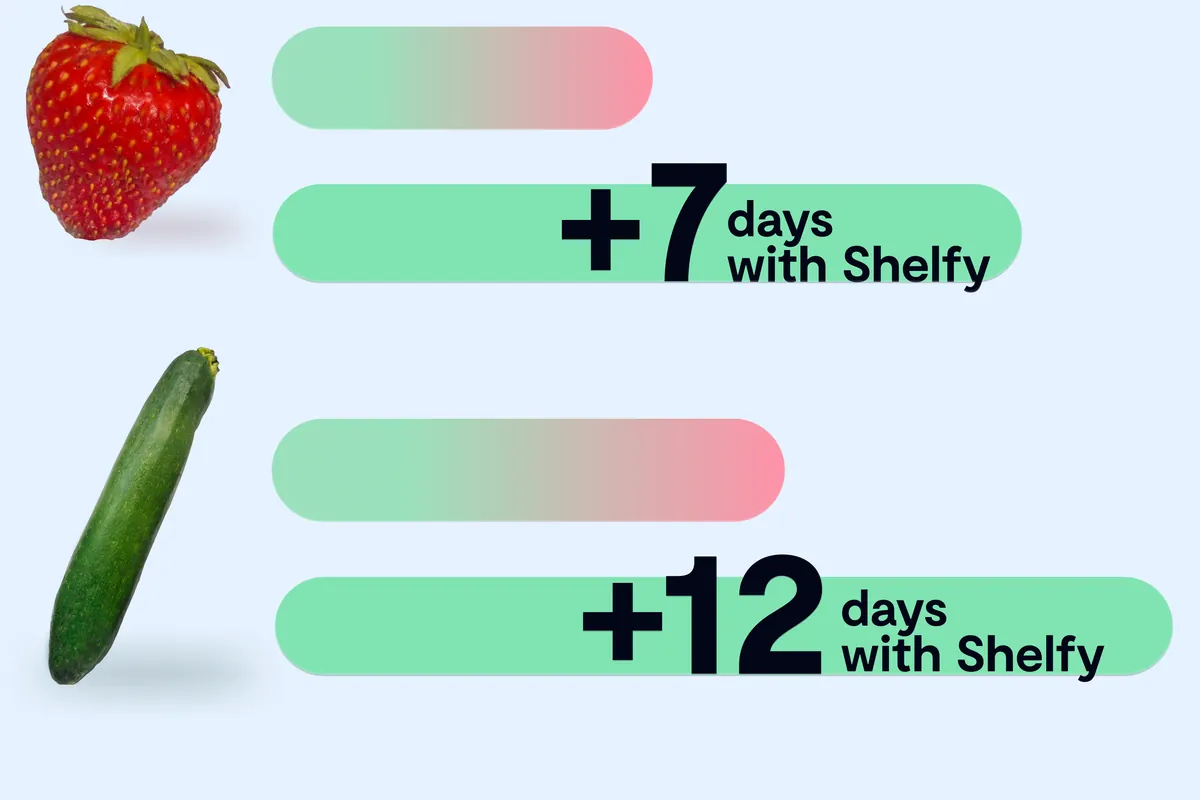
The shelf-life study counted the days until each food was no longer acceptable, without and then with Shelfy: strawberries 3 and 10 days, courgettes 10 and 22, Belgian endive 3 and 7, apricots 10 and 17, cherry tomatoes 14 and 22. So “twice as long” holds for strawberries, courgettes and endive, while apricots gained 70% and cherry tomatoes about 57%. Climacteric fruit, which keeps ripening after picking, shows the clearest effect, because Shelfy lowers the ethylene that speeds ripening.
What the tests do not tell you
- They were run on the original model. The current upgraded Shelfy uses blue LEDs instead of white ones and carries its own EU declaration of conformity (October 2025), but Vitesy has not yet published efficacy tests on it.
- They are lab conditions. Closed fridges, set temperatures and controlled contamination. Vitesy's own test guide for buyers says home tests “can't replicate the controlled conditions of our lab experiments”.
- They measure air, not food safety. Vitesy states that results “may vary significantly” and that Shelfy is not “a safeguard against foodborne illnesses or spoilage”. Cold storage and use-by dates still decide what is safe to eat.
- They report reductions, not by-products. The six studies measure what fell; the report does not include measurements of compounds formed along the way. HawaQ, the group's indoor air quality consultancy, compares photocatalysis with catalytic, ozone and absorbent methods in PCO, catalytic or ozone?
- They cannot fix a dirty fridge. Spoiled food, a full drain tray or a mouldy door seal will keep producing odour faster than any purifier removes it.
How to test Shelfy at home: a two-week side-by-side test
This follows the test guidelines Vitesy issues to retail buyers (April 2026), adapted for a home. The aim is that the only difference between the two set-ups is Shelfy.
- Prepare two matched set-ups. Ideally two identical fridges at the same temperature (4 °C or a little below for food you will eat). With one fridge, the fairest option is two test periods of the same length with the same food, without and then with Shelfy, rather than two shelves in the same fridge, which share the same air.
- Clean both fridges first, including the drain tray and door seal, so neither starts with a source of smell.
- Charge Shelfy fully and rinse its filter, then stand it upright on a shelf with food about 5 cm away so air can flow. Shelfy comes with a USB-C cable but no plug: use a 5 V adapter of at least 15 W (5 V, 3 A).
- Split identical produce between the two set-ups, undamaged and bought at the same time. Climacteric fruit such as apples, pears, bananas, peaches, kiwi, melon and tomatoes shows the clearest difference. Keep it out of sealed boxes and plastic bags, and do not overcrowd the shelves.
- Run at least one full cycle in Performance mode, as Vitesy's guide asks, and recharge as soon as the battery runs low so there are no long gaps. Shelfy works in cycles: the fan speed changes between modes and it is not always running.
- Check once a day: smell when you open the door, texture and any mould against the control, and a photograph of each set-up from the same angle. Note door openings, which the app records.
- Keep going for at least two weeks. Odour differences show within hours; shelf-life differences need days to weeks.
Vitesy's buyer guide allows dedicated test fridges at about 10 °C to speed the test up. Only do that with produce you will throw away afterwards, never with food you plan to eat.
How retailers and buyers test Shelfy and Deo before stocking them
Vitesy gives retail buyers written test protocols for both products, so a shop, online seller or hotel buyer can check the claims before committing to stock. Here is what each one asks for.
| Shelfy | Vitesy Deo | |
|---|---|---|
| Set-up | Two identical, dedicated fridges; one Shelfy per 300 litres of the above-0 °C compartment | A control space and a test space, matched for temperature, humidity, volume and odour source; at least one Deo per 0.5 m³ |
| What to load | Undamaged climacteric fruit, split equally, out of the crisper and out of sealed containers | One odour source at a time; Vitesy names fish, onion, cabbage and very ripe banana as the hardest |
| Duration | At least 2 weeks | At least 72 hours |
| Checks | Daily: odour, texture against the control, door openings in the app | Smell at 2, 5, 24, 48 and 72 hours, scored blind from 1 (no odour) to 10 (unbearable) by several people |
| Watch out for | Battery running out in Performance mode; overcrowding | Humidity above 80% or condensation, which temporarily reduces Deo's effect; dropped units |
Summary of Vitesy's test guidelines for buyers (Shelfy, April 2026; Deo, May 2026), from the distributor kit.
Vitesy is candid in the Deo guide: Deo “may significantly reduce the intensity of odors without necessarily eliminating them completely”. In its own lab test, a sealed 60-litre box, the fish-odour compound fell below the instrument's detection limit within 2 hours (Deo test report). Retailers who want trade terms can choose “Retailer or reseller” in the form on the Vitesy page or email sales@protech.ae.
Shelfy or Deo: which one to test
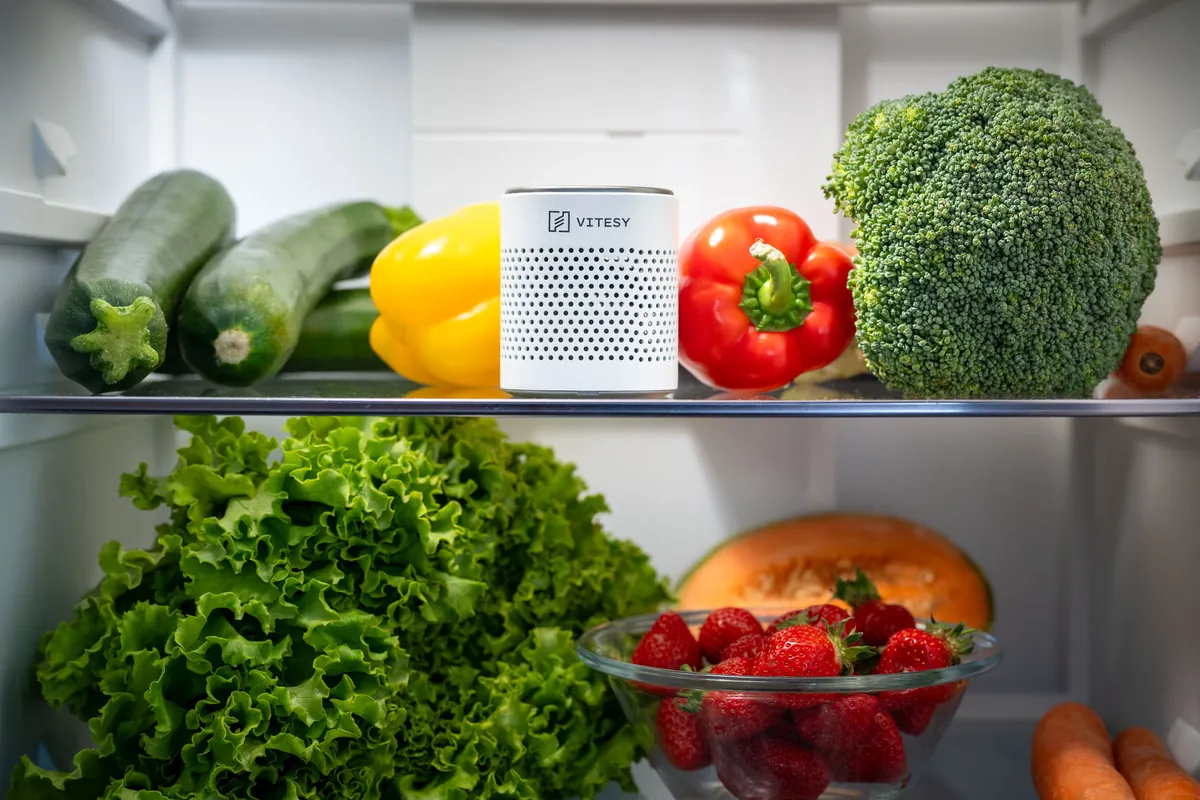
Vitesy Deo is a small passive odour eliminator: a ceramic catalytic filter in an aluminium case breaks odour molecules down into carbon dioxide and water, with no power and no refills. It does nothing for shelf life. Shelfy is the one to test if you want produce to last longer, odours reduced and the fridge's temperature and door openings logged.
Five ways to get a misleading result
- Testing in a fridge that still smells. Remove the source and clean first; see how to get rid of fridge smell.
- Using different batches of fruit in each set-up, or fruit that is already bruised.
- Sealing the food in boxes or bags, which keeps the air Shelfy treats away from it.
- Opening one fridge far more often than the other; the app's door count shows it.
- Letting the battery run flat, especially in Performance mode, and losing days of treatment.
For the storage side of freshness, which matters as much as any device, see how to keep fruit and vegetables fresh longer.
Coming soon · Shelfy and Deo by 20 November 2026
Reserve Shelfy or Deo
PRO TECHnology in Dubai expects the first Vitesy shipment by 20 November 2026. Choose a product and quantity; the Distribution team contacts you to confirm price and delivery as the stock lands. No payment is taken online.
Frequently asked questions
Does Shelfy actually work?
In Vitesy's published lab tests on the original model it cut airborne test bacteria by 99% in 10 minutes, lowered volatile compounds from ripening fruit by 80% in 5 hours and kept some produce fresh for longer, up to 12 extra days for courgettes. Results at home vary with the food, the fridge and how often it is opened, so a two-week side-by-side test is the fair way to check.
Is Shelfy safe? Does it produce ozone?
Shelfy uses a photocatalytic filter activated by visible blue LEDs, with no ozone and no UV, according to Vitesy. The upgraded model has an EU declaration of conformity covering electrical, radio and battery safety standards. The US EPA advises against ozone generators sold as air cleaners.
How long before I notice a difference with Shelfy?
Vitesy's buyer guide says to check odour after a few hours; its lab odour results were measured after 5 hours. Shelf-life differences take days to weeks, which is why Vitesy asks buyers to test for at least two weeks.
Does Shelfy make fruit and vegetables last twice as long?
For some foods. In Vitesy's lab study strawberries lasted 10 days instead of 3 and courgettes 22 instead of 10, but apricots gained 70% and cherry tomatoes about 57%. The effect is clearest for fruit that keeps ripening after picking.
How many Shelfy units does my fridge need?
Vitesy recommends one Shelfy per roughly 300 litres of fridge and two for fridges above 350 litres, for faster odour removal. The capacity is on the fridge's rating label or in its manual.
Does the Shelfy filter need replacing?
No. Vitesy says the filter does not need replacing: you rinse the filter half under the tap about once a month and let it dry. The app reminds you when it is due.
هل يعمل جهاز Shelfy؟ وكيف تختبر منقي هواء الثلاجة بنفسك؟
في اختبارات Vitesy المخبرية المنشورة، والتي أُجريت على الطراز الأصلي، خفّض Shelfy البكتيريا المرشوشة في هواء الثلاجة بنسبة 99% خلال 10 دقائق، وأطال صلاحية بعض الخضار والفواكه، فبقيت الكوسا صالحة 22 يوماً بدلاً من 10 في ثلاجة مخبرية عند 6 درجات مئوية. يعالج الجهاز الهواء داخل الثلاجة لا الطعام نفسه، ولا يغني عن التنظيف والتبريد الجيد.
لاختباره في المنزل: جهّز ثلاجتين متماثلتين أو فترتين متساويتين، ووزّع الفاكهة نفسها بينهما، واستمر أسبوعين على الأقل مع فحص يومي للرائحة والملمس والعفن مقارنة بالمجموعة الأخرى. تتوقع PRO TECHnology في دبي وصول أول شحنة من Vitesy بحلول 20 نوفمبر 2026، ويمكنك حجز Shelfy أو Deo الآن من دون دفع عبر الإنترنت.
Sources
Figures and methods come from the pages below, read on 5 November 2026, and from Vitesy's test guidelines for buyers (Shelfy, April 2026; Deo, May 2026) in the distributor kit, which are not public. Vitesy figures are the manufacturer's own test results.
- Vitesy: Shelfy test report (Rev. 1, November 2023)
- Vitesy: research and test reports
- Vitesy: Shelfy product page
- Vitesy: where to place Shelfy
- Vitesy: how long the Shelfy battery lasts
- Vitesy: how to wash the Shelfy filter
- Vitesy: Deo test report (September 2025)
- US EPA: Ozone generators that are sold as air cleaners
See the proof for yourself
Reserve Shelfy or Deo ahead of the first UAE shipment, or read more about the Vitesy range.