Choosing a Distributor in the UAE and GCC: A Guide for Technology Brands
Published · PRO TECHnology Distribution
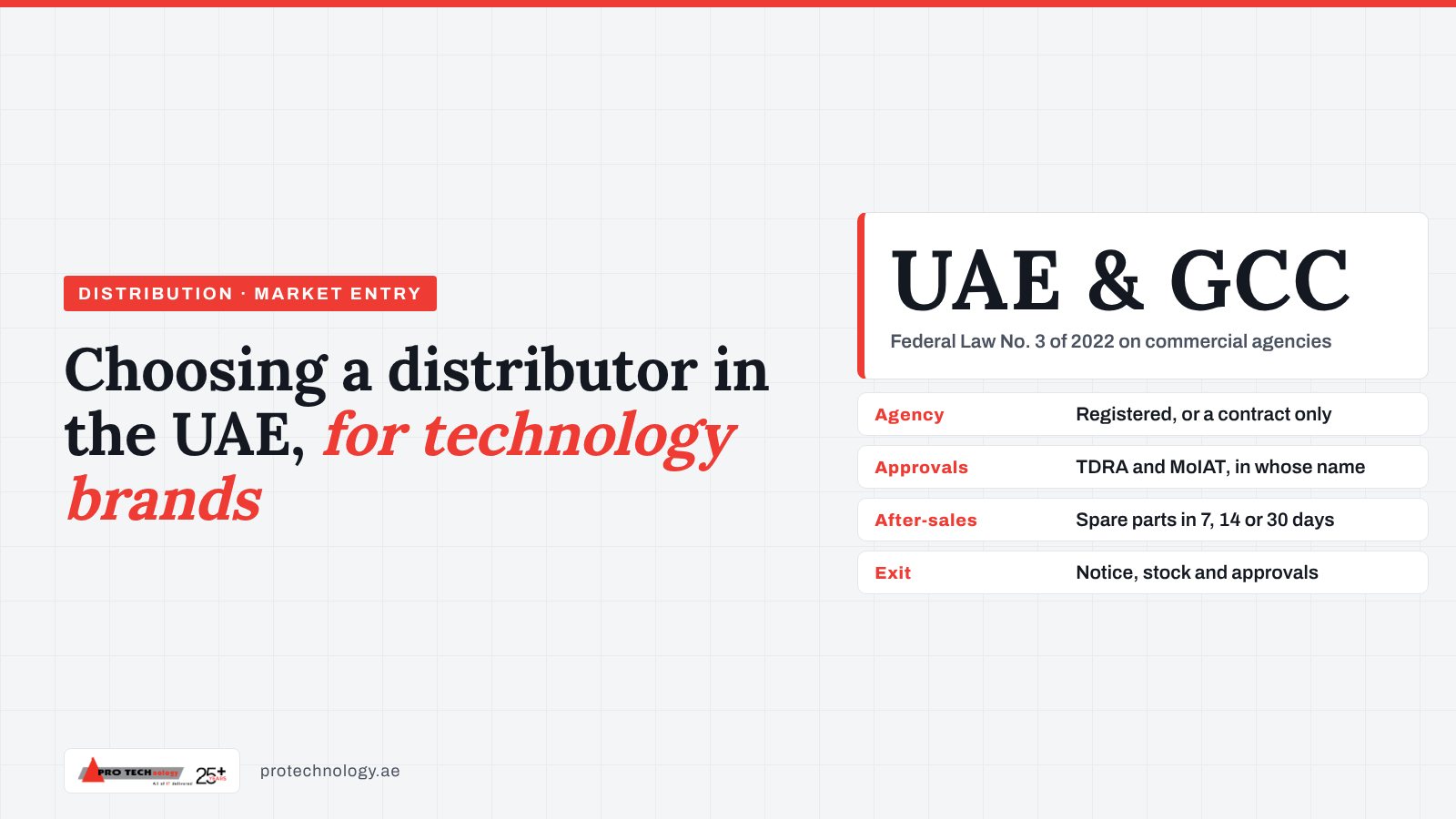
A technology brand entering the UAE needs a local partner that can import, register, sell and service its products. Settle three questions before you choose one: will the deal be a registered commercial agency or an unregistered distribution contract, who will hold the product approvals, and who will stock spare parts and run the after-sales service the regulations expect. This guide sets out what UAE law and the regulators say on each point, then lists what to ask any candidate. It is general guidance, not legal advice.
- Agency law
- Federal Law No. 3 of 2022 Regulating Commercial Agencies, in force since 15 June 2023
- Registered agents
- UAE nationals and companies wholly owned by them, with the exceptions the law lists
- Radio and telecom products
- TDRA type approval and registration before they are used, sold or distributed
- Spare parts for consumers
- Within 7, 14 or 30 days, depending on the part and the sales channel
Key takeaways
- Under Federal Law No. 3 of 2022, a commercial agency is valid only if the agent is entered in the Ministry of Economy and Tourism register under a written, notarised contract.
- Only UAE nationals and companies wholly owned by them can be registered agents, apart from the exceptions in Article 2, such as public joint-stock companies with at least 51% UAE ownership.
- Registration gives the agent a customs block on goods others bring in for trading, and it comes with duties to supply spare parts and maintenance.
- Radio and telecom equipment must be type approved and registered with TDRA before it is used, sold or distributed in the UAE; products under a UAE technical regulation need a MoIAT certificate of conformity.
- Agree in writing who holds each registration and approval, who stocks spare parts, and what happens to stock, approvals and warranty customers if the partnership ends.
Registered commercial agency or unregistered distribution contract
UAE law reads commercial agency broadly. Federal Law No. 3 of 2022 defines it as the representation of a principal by an agent under a contract of agency, distribution, sale, offer or concession, or the provision of goods or services inside the UAE for a commission or profit (Article 1). A distribution agreement can therefore fall within it.
Registration is what makes such an agency valid. Article 3 says only persons registered in the Commercial Agencies Register at the Ministry may practise the activity, and an agency not entered in the register is not valid. Article 4 adds that the agent must be appointed by the original principal under a written, notarised contract.
Who can be registered is limited. Article 2 restricts the activity to UAE nationals, public bodies and companies wholly owned by them. Public joint-stock companies set up in the UAE with at least 51% of their capital held by UAE nationals are excepted, under conditions the Cabinet sets. The Cabinet may also allow an international company to act for products it owns, where there is no agent for them in the UAE and the agency is new.
Not every distribution contract is registered. The table shows what registration changes.
| Point | Registered commercial agency | Unregistered distribution contract |
|---|---|---|
| Valid as a commercial agency under the 2022 law | Yes, with a written, notarised contract entered in the register (Articles 3 and 4) | No (Article 3) |
| Goods brought in by others for trading | Customs may not release them without the approval of the Ministry or the agent (Article 20) | No such block: Article 20 covers agencies registered with the Ministry |
| Disputes between brand and partner | Heard first by the Commercial Agencies Committee, which decides within 120 days; the parties may agree arbitration (Articles 24 and 26) | Article 24 covers registered agencies; the contract’s own dispute clause matters |
| Duties on the partner | Spare parts, tools and accessories to maintain durable goods, and the maintenance services agreed (Article 19) | What the contract says, plus the consumer protection rules that apply to any provider |
General guidance, not legal advice. The UAE legislation portal states that the Arabic text of a law prevails over its English translation. Have a UAE lawyer review any agency or distribution contract before you sign it.
What registering a commercial agency involves
The application is made to the Ministry of Economy and Tourism, which keeps the register. Its Register Commercial Agency service lists a valid trade licence and the agency, distribution or exclusive representation contract, certified by the official authorities and with a legal Arabic translation if it is drafted in another language. The contract should state both parties and their domiciles, the exclusivity, where the activity takes place, the products and services and their trade names, approval for registration, the term, and its documentation and certification. The Ministry lists a service fee of AED 7,500.
A signature made outside the UAE must be documented by a notary or the concerned authority and certified by the foreign country, the UAE embassy and the UAE Ministry of Foreign Affairs. The Ministry decides within ten working days of a complete application; no reply in that time counts as a rejection, which can be challenged in court within 60 days (Articles 13 and 14). Any later change to the agency must be filed within 60 days of the agent becoming aware of it (Article 15).
Term, notice and what happens when a partnership ends
Under Article 9, an agency contract ends when its term expires without renewal, by either party under the contract’s terms, by agreement, or by a final judgment. Where the agent must build showrooms, stores or maintenance facilities, the term is five years unless the parties agree otherwise (Article 6).
Notice is set by the law. A party ending the contract early must give at least one year’s notice or notice before half the term has run, whichever is less, unless the parties agree otherwise; the same rule applies to non-renewal (Article 10). The other party can challenge an early termination before the Commercial Agencies Committee, which has 120 days to decide, and the contract stays in force until the notice period ends or the Committee decides, whichever is later.
Unless agreed otherwise, agency-related stock, spare parts and equipment held by the outgoing agent pass to the brand or the new agent at fair value, where the conditions in Article 9 are met, and either side can claim compensation for damage in the cases Article 11 sets out. Either party may also give the Committee an expert report on dues, continuity of after-sales service, asset values and expected damage (Article 10).
Write the exit into the contract on day one: the notice period, how stock is valued and bought back, who keeps each regulatory approval, how customers under warranty are served, and how the change is announced.
Product approvals to settle before the first shipment
Radio and telecom equipment: TDRA
Radio and telecommunications terminal equipment must meet TDRA’s technical standards and be registered with TDRA before it can be used, sold or distributed in the UAE. Dealers, importers and manufacturers of that equipment should also be registered with TDRA, a registration separate from type approval, and customs release for trading needs both a registered company and an approved device (TDRA: type approval).
Agree early whose name the dealer registration and each type approval will be in, who arranges and pays for test reports, and who renews them.
Products under a UAE technical regulation: MoIAT
The Ministry of Industry and Advanced Technology issues UAE certificates of conformity for products subject to technical regulations, through its ECAS service, confirming that they meet the approved standards so they can enter and circulate in the market. Check whether each product category is regulated before you plan the launch date, and budget for the Ministry’s published service fees and any testing.
Spare parts, warranty and service: what the regulations expect
Two sets of rules shape after-sales. A registered agent must provide the spare parts, tools, materials, fittings and accessories needed to maintain durable goods, and the maintenance services agreed with the brand (Federal Law No. 3 of 2022, Article 19).
Where products reach consumers, the executive regulation of the Consumer Protection Law, Cabinet Resolution No. 66 of 2023, sets deadlines for spare parts in Article 14:
- Parts consumers ask for regularly and continuously: supplied without interruption, within seven days of the request.
- Parts without regular demand: within 14 days of the request, except for force majeure.
- Goods bought through a channel other than the local commercial agent: the agent supplies parts covered by its agency within 30 days.
- Parts the factory no longer makes: the provider explains this to the consumer and agrees an alternative part or another solution.
The same regulation asks the provider for a written mechanism for spare parts, maintenance and warranty, in Arabic, displayed at its sales outlets and published on its website, with its postal address, telephone number and email (Article 16).
For a brand, that means the UAE partner needs a parts stock planned from sales data, an Arabic service and warranty process, and factory support fast enough to meet seven-day and 14-day deadlines. Our Stadler Form service page shows how one brand’s local warranty and after-sales are set out for customers.
Questions to put to a prospective distributor
Use these questions to compare candidates, including us.
| Area | What to ask | What a useful answer shows |
|---|---|---|
| Legal structure | Will the agreement be registered as a commercial agency, and can your company hold one under Article 2? | A clear answer, the company’s ownership and its trade licence activities |
| Territory and channels | Which emirates, GCC countries and channels (retail, e-commerce, corporate, government, education) will you cover yourselves? | Named channels and accounts, and where sub-distributors would be used |
| Approvals | Who applies for TDRA type approval and dealer registration, or MoIAT certificates, and in whose name? | A plan per product, the test reports needed and who pays for renewals |
| Stock and logistics | Where will stock be held, and how is it cleared and delivered? | Warehouse location, customs process and delivery coverage |
| Spare parts and service | How will you meet the 7, 14 and 30-day spare parts deadlines, and who repairs units under warranty? | A parts stocking plan, a service location and trained technicians |
| Technical pre-sales | Who demonstrates, configures and supports the product for business buyers? | Named roles, a demonstration set-up and the training they need from you |
| Arabic content | Who produces Arabic product information, warranty terms and support pages? | Arabic material they already publish |
| Reporting | What sell-in, sell-out and stock data will you share, and how often? | A reporting template and a review schedule |
| Exit | If we part, what happens to stock, approvals, open warranties and customer support? | Terms they will put in the contract, in line with Articles 9 and 10 |
Planning for the rest of the GCC
The Ministry’s register, TDRA’s approvals and MoIAT’s certificates apply in the UAE, so a GCC launch needs the same three questions answered country by country. In Saudi Arabia, for example, the standards body SASO issues conformity certificates through its Saber platform before products enter the Saudi market (SASO: market access).
A partner that claims GCC coverage should say which countries it serves through its own companies, which through partners, and who holds each country’s approvals.
How PRO TECHnology works with technology brands
PRO TECHnology has worked with technology brands in the Middle East since 1998 (about us). Our distribution work covers importing, warehousing and fulfilment from Dubai; sales through retail partners and EVO, the group’s online store; corporate and B2B programmes; launches and exhibitions; and after-sales set brand by brand. Our Dubai service centre handles Stadler Form warranty and after-sales, and for other brands warranty follows the maker’s terms.
If you make technology products and are looking for a UAE or GCC partner, send us your range, your target channels and the approvals you already hold. In Saudi Arabia, our group’s Riyadh company PRONEXT covers printing, distribution and corporate gifting.
Sources
Laws and regulator pages were read on 24 November 2026. The UAE legislation portal states that the Arabic text of each law prevails over its English translation. This page is general guidance, not legal advice.
- UAE Legislation: Federal Law No. 3 of 2022 Regulating Commercial Agencies
- Ministry of Economy and Tourism: Register Commercial Agency
- UAE Legislation: Cabinet Resolution No. 66 of 2023, executive regulation of the Consumer Protection Law
- TDRA: Type approval and dealer registration
- MoIAT: Issue conformity certificates for regulated products (ECAS)
- SASO: Market access
Frequently asked questions
What happens if a UAE distribution agreement is not registered?
Under Article 3 of Federal Law No. 3 of 2022, a commercial agency that is not entered in the Ministry’s Commercial Agencies Register is not valid, and the protections tied to registration, such as the customs block on goods imported by others for trading in Article 20, do not apply. Whether and how to register is a question for a UAE lawyer.
Can a foreign manufacturer register itself as its UAE commercial agent?
Only in limited cases. Article 2 lets the Cabinet allow an international company to act as agent for products it owns, where there is no agent for them in the UAE and the agency is new, under conditions the Cabinet sets.
How much notice ends a registered commercial agency early?
At least one year, or notice given before half the contract term has run, whichever is less, unless the parties agree otherwise. The other party can challenge the termination before the Commercial Agencies Committee, which has 120 days to decide (Article 10).
Who needs TDRA type approval before selling wireless or telecom products?
Radio and telecommunications terminal equipment must be type approved and registered with TDRA before it is used, sold or distributed in the UAE, and dealers, importers and manufacturers of that equipment should register with TDRA as well.
How quickly must spare parts be supplied to consumers in the UAE?
Under Article 14 of Cabinet Resolution No. 66 of 2023: within seven days for parts in regular demand, within 14 days for other parts, and within 30 days when the commercial agent supplies parts for goods bought through another channel.
Can one distributor cover the whole UAE?
Yes. Article 7 of Federal Law No. 3 of 2022 lets a brand appoint one agent for the whole country, or one agent per emirate or group of emirates, with distribution exclusive to that agent in its territory. The agent may use distributors in the emirates it covers.
Looking for a UAE or GCC distribution partner?
Send us your product range, target markets and the approvals you already hold, and our distribution team will reply.